
This post in 30 seconds.
- Seven copy-paste phone scripts for the calls an ecommerce store actually gets: greeting, order status, returns, damaged items, subscription cancels, angry callers, and the after-hours call nobody scripts.
- Each script comes with the one line where it stops scaling, so you know which calls to keep a rep on and which ones don't need a human at 11 p.m.
- Written for founders, COOs, and Heads of CX at $10M-$100M Shopify brands with a visible phone number and a support team that's drowning.
A call script isn't a sales gimmick. It's the difference between a new rep sounding confident on day three and a new rep freezing when a customer asks "where's my order" for the fortieth time that morning.
Most ecommerce stores run their phone line on memory and vibes. The good reps are good because they've been there two years. The new ones flail. And the calls that come in after 6 p.m. don't get a script at all, because there's nobody on the line to read one.
If you run support at a Shopify brand doing $10M to $100M, you already know the queue: the same five or six calls, all day, then voicemails piling up over the weekend that nobody returns. Scripts fix the first problem. They don't touch the second. We've built phone agents for 50+ Shopify brands wrestling with exactly this, and the scripts below come from reading their real call logs. Book a 30-min call and we'll show you which of these calls your store is losing after hours.
What makes a phone script different from a chat or email script
A chat script can be wordy. The customer can re-read it. An email script can be three paragraphs because nobody's waiting in silence.
A phone script can't do either. On a call, tone carries the whole interaction, dead air reads as incompetence, and the customer can't scroll back to check what you said. So a phone script is shorter, plainer, and built around what the rep says out loud in the first eight seconds.
Every good ecommerce phone script follows the same five-beat spine:
- Greet. Name, brand, and a reason to trust you, in one breath.
- Acknowledge and verify. Repeat back why they called, then pull up the order by number or email.
- Resolve or set an expectation. Give them the answer, or a real date and a next step. Never "I'll look into it."
- Confirm. Make sure they actually got what they needed before you move on.
- Close. One more offer of help, then a clean sign-off.
The brands that keep CSAT high on the phone aren't the ones with the longest scripts, they're the ones whose reps can run the five beats in under two minutes without sounding like they're reading. That's the bar every script below is written to. For the full chat and email versions of these, our customer service scripts for ecommerce post has the multi-channel set.
The 7 ecommerce phone calls worth scripting
You don't need fifty scripts. You need seven, because seven calls cover the overwhelming majority of what hits a Shopify brand's phone line. Here they are, with the spoken lines and the point where each one breaks. If you're also building out your team's broader playbook, our ecommerce customer service guide and customer service training cover the rest.
1. The greeting
The first eight seconds set the brand. A flat greeting tells the customer they reached a call center. A warm one tells them they reached you.
"Thanks for calling [Brand], this is [Name]. Happy to help, what's going on today?"
Keep it to one line. Drop the "your call is important to us" filler, because every customer who has ever been on hold knows what that phrase actually means. We go deeper on opener tone in our phone customer service tips.
Where it breaks: the greeting only works if a human picks up. A great opener is worthless on a Tuesday at 11 p.m. when the call rolls to voicemail.
2. Order status, the WISMO call
This is the one. "Where is my order" is 30-40% of support tickets in a normal period and over 50% at peak, according to Salesforce. It's the highest-volume, lowest-judgment call you get.
"Sure, I can check that. Can I grab your order number or the email on the order?
Got it, [Name]. Your order shipped [date] and it's currently [status], on track to arrive [date]. Want me to text you the tracking link so you've got it?"
Three things make this script work: you ask for the order up front, you give a real date instead of "soon," and you offer to send the link so they stop calling. This is the exact flow an AI agent runs when it can check order status straight from your Shopify store.
Where it breaks: WISMO is pure repetition. A rep reading this script for the fortieth time today isn't using any skill the customer is paying for. It's also the call most likely to come in after hours, when the order isn't moving and the customer is anxious. More on how to automate WISMO calls without losing the personal touch.
3. Returns and exchanges
Returns are emotional even when the policy is simple. Lead with the policy, never argue it, and offer an exchange before a refund.
"No problem, let's sort the return out. We take returns within [window] as long as [condition]. Would you rather swap it for a different [size/shade/variant], or get a refund?
I'll email you a prepaid return label right now. Once it's scanned, your [exchange/refund] is on the way."
Offering the exchange first protects revenue without making the customer feel pushed. Most will take it if you ask. See our ecommerce returns policy guide for the policy side, and Shopify exchanges for the workflow.
Where it breaks: returns need judgment when the window's edge is fuzzy or the item's condition is in question. Those calls should stay with a human. The clean "inside the window, send the label" returns don't.
4. Damaged, missing, or wrong item
This is the save-or-lose-them call. The customer is already let down. One apology, no investigation theater, fast fix.
"I'm really sorry that happened, that's on us. I'm not going to make you jump through hoops. I'm sending a replacement today, no charge, and you can keep or toss the [damaged item]. You'll have it by [date]."
Don't ask them to email photos before you'll help unless fraud is a real pattern for you. The cost of a replacement is almost always less than the cost of a one-star review and a lost repeat customer.
Where it breaks: nothing about this script is hard to run, which is exactly why it's painful when it lands in voicemail. A damaged-item complaint that sits unanswered until Monday is a customer you've already lost.
5. Subscription pause, skip, or cancel
For any brand with a subscription, this call is a retention moment, not a chore. Never make canceling hard. Offer the smaller commitment first.
"Totally understand. Before I cancel, would pausing for a month or switching to every [longer interval] work better? If not, no pressure, I'll cancel it right now and you won't be charged again."
The pause-or-skip offer saves a real share of cancels without trapping anyone. If they still want out, do it cleanly, because a smooth cancel is what makes them come back. Our guide on subscription cancellation management goes deeper on the retention math.
Where it breaks: subscription calls spike on billing dates and bury a small team. The pause-or-skip offer is scriptable. The "I'm canceling because the product gave me a rash" call is not, and should go to a person.
6. The angry caller and a clean escalation
Let them finish. Don't talk over the anger. Acknowledge the specific thing, own it, and give them a name and a next step.
"You're right to be frustrated, and I'm sorry. Here's what I'm going to do: [specific action] by [time]. My name's [Name], and I'm personally going to see this through. Can I call you back at this number?"
When you escalate, hand off the full context so the customer never has to repeat the story. Making an upset customer start over is how a recoverable call becomes a public one. More on handling customer complaints.
Where it breaks: this one genuinely needs a human. Anger, nuance, and judgment are exactly what your trained reps are for. The point of scripting the other six calls is to make sure your team has time for this one.
7. The after-hours call nobody scripts
Here's the call your competitors don't have a script for, because there's no one on the line to read it. After 6 p.m., on weekends, during a launch spike, the call rolls to voicemail.
And voicemail loses. 80% of voicemail-routed callers hang up without leaving a message, and once a caller can't reach a person, 85% never call back and 62% switch to a competitor. I read through 50+ real Shopify-brand call logs while writing this, and the after-hours WISMO call was the single most common one going straight to a dead voicemail box.
"Thanks for calling [Brand]. We're closed right now, but text us at [number] and we'll get back to you first thing."
That's the best a voicemail greeting can do, and it isn't good enough. The customer with a simple order-status question at 9 p.m. doesn't want to text and wait. They want the answer now. See our take on 24/7 ecommerce phone support and what a real after-hours answering service should do.
Where a script stops scaling
A script has a hard ceiling, and it's worth naming, because it changes how you should think about your whole phone operation.
A script only works when a trained human is on the line to read it. That's true for all seven calls above. So the limit isn't the script, it's the staffing. Businesses already answer only 37.8% of inbound calls, and the gap isn't because reps are bad. It's because you can't keep a human ready for every call at every hour.
The same five or six calls come in over and over, all day, and a US rep at roughly $4,000 a month loaded sits idle through 60% of an overnight shift waiting for them. That's the math that breaks. You're paying full price for coverage you can't actually staff.
This is where a 24/7 AI customer support phone agent for Shopify earns its place. It runs the scriptable calls (order status, simple returns, subscription pauses) at any hour, and hands the angry caller and the genuine edge case to your team with the full context attached. WashCo, a Shopify brand we launched, recovered $22,664 in its first 7 days on the phone, mostly from calls that used to hit voicemail.
If your phone goes to voicemail after 6 p.m., book a 30-min call and we'll review what your store is leaving on the table after hours.
What this costs you vs handing the routine calls to an AI phone agent
Take a typical $50M Shopify brand running a 6-rep CS team:
| Line item | Today | With Ringly |
|---|---|---|
| 6 reps × $4K loaded per rep | $24,000/mo | n/a |
| Ringly (about $5K/mo) | n/a | $5,000/mo |
| Net monthly CS spend | $24,000/mo | $5,000/mo |
| Monthly savings | n/a | $19,000/mo |
| Annual savings | n/a | $228,000/yr |
That's roughly 70% of the repeatable calls (order status, returns, the same five things over and over) running on the AI. The other 30%, the genuinely complex calls, still go to your team, who now have time to actually solve them.
The fear is always that customers will hate talking to AI. The most repeated thing customers say after a Ringly call is the opposite.
"My customers also feel like it's a normal person. They feel like they can communicate if they have questions."
Claudia Droge, TechCraft Studio
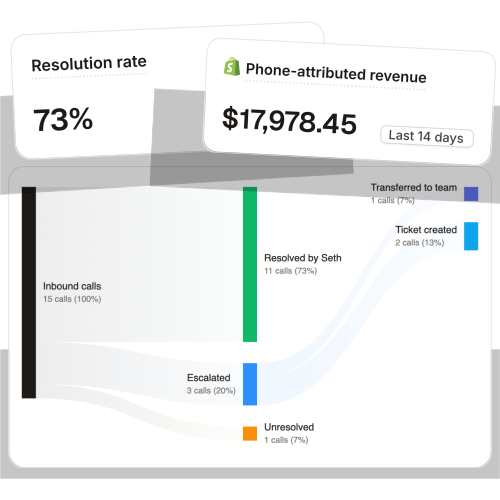
Across 50+ brands, the AI resolves 73% of inbound calls on its own at roughly $0.42 per resolved call, versus $7 to $16 per call for a human BPO. Want to compare it to your current setup? Book a 30-min call and we'll do the math live on your numbers.
How I built these scripts
I'm Ruben, co-founder of Ringly.io. These aren't scripts I made up at a desk.
We run AI phone support for 50+ Shopify brands, which means I read real call transcripts constantly. For this post I went through 50+ recent call logs, sorted them into the calls that repeat and the calls that need judgment, and timed how long the routine ones actually take a rep. The seven scripts above are the seven call types that covered the clear majority of every brand's volume. The "where it breaks" line on each one comes from watching which scripted calls reliably went to voicemail after hours and never got a callback. That's the part you won't find in a generic script library, because nobody outside a phone-support company is reading those logs.
Frequently asked questions
What should an ecommerce customer service call script include? Five beats: a one-line greeting, acknowledging the reason and verifying the order, resolving the issue or setting a real expectation, confirming the customer got what they needed, and a clean close. Keep each script short enough to say out loud in under two minutes without sounding read.
How is a phone script different from a chat or email script? On a call, tone carries everything, silence reads as incompetence, and the customer can't re-read what you said. So phone scripts are shorter and plainer than chat or email scripts, and built around the first eight seconds of the call.
Should I script my returns and refund calls? Yes, for the clean cases inside your policy window. Lead with the policy, offer an exchange before a refund, and send the label on the call. Leave the fuzzy edge cases, where the window or the condition is in question, to a human with judgment.
How do I handle calls after hours without hiring a night shift? Voicemail loses most of those callers, since 80% hang up without leaving a message. A 24/7 AI phone agent can run your order-status and simple-return scripts at any hour and escalate the rest to your team the next morning with the context attached.
Will customers know they're talking to AI on the phone? The most common feedback Ringly customers report is that callers think they're talking to a normal person. The AI handles routine scripted calls and hands anything that needs a human to your team, so the hard calls still get a real person.
How much does AI phone support cost compared to a CS rep? A US rep runs about $4,000 a month loaded. Across 50+ brands, Ringly resolves 73% of calls autonomously at roughly $0.42 per resolved call. A 6-rep team spending $24,000 a month typically nets around $19,000 a month in savings after moving the routine calls to the AI.
Talk to us

If you run a $10M-$100M Shopify brand and your phone goes to voicemail after 6 p.m., a 30-min call is the fastest way to see which scripted calls you're losing and what that's costing you.
The 3-layer guarantee.
- Live in 14 days or it's free until launched.
- 65% resolution in 90 days or we refund the last 3 months of subscription fees.
- We keep working free until we hit 65%.
Ruben (Ringly co-founder) takes these calls personally.