
This post in 30 seconds.
- Nine concrete customer service automation examples a Shopify brand can actually run, with what each one does and where it breaks.
- The biggest lever isn't chat. It's the phone: 37.8% of inbound calls go unanswered, and 62% of those callers go buy from someone else.
- Built for founders, COOs, and Heads of CX at $10M-$100M Shopify brands with a visible phone number and a paid helpdesk.
Most articles on this topic show you the same six things: a chatbot, an email auto-responder, a help center, a sentiment score. All useful. All chat-and-ticket. Almost none of them mention the one channel where automation is still rare and a missed contact costs the most.
The phone. Businesses answer only 37.8% of their inbound calls, according to a 411 Locals study of 85 businesses, and 62% of people who hit a missed call go to a competitor instead, per missed-call research rounded up by getAira. If you run support at a $10M-$100M Shopify brand, that's not a metric. That's the customer you paid $40 to acquire, calling at 7 p.m., getting voicemail, and reordering from a brand that picked up.
So this list is examples-led and phone-first. Not because chat automation is bad, but because the phone is the gap nobody else is closing. I'll show you nine examples, the outcome each one produces, and the honest part most posts skip: where automation stops working and a human has to take over.
If after-hours calls and the same five questions all day are eating your CS team, book a 30-min call and we'll talk through what your store is leaving on the table after hours.
How I picked these examples
I'm Ruben, co-founder of Ringly.io. We run AI phone support for 50+ Shopify brands, so I get to see what automation actually closes versus what it just deflects into a worse experience.
For this list, I read 30 days of real call transcripts across those brands and counted which calls automation resolved end to end, which it handled but escalated, and which it never should have touched. The examples below are the ones that showed up over and over and resolved cleanly.
- Volume first. I sorted every call type by how often it appeared. The top five questions are the same in almost every store.
- End-to-end, not half. An example only made the list if automation could finish the job, not just collect a name and promise a callback.
- The break point. For each one, I noted where it stopped working and a rep had to step in. That's the section most guides leave out, and it's the one that keeps you out of trouble.
I don't get paid to recommend anyone else's tool here. I only sell Ringly, and it shows up below against the same bar as everything else.
What counts as a customer service automation example
A real automation example is a routine task a customer used to wait on a human for, now handled start to finish without one. The rule of thumb across the brands we work with: roughly 70% of inbound contacts are repeatable, and the other 30% genuinely need a person. Automate the 70%, protect the 30%, and your CS team stops drowning in the same questions over and over.
The 70% is the same five things almost everywhere: where's my order, can I return this, can I change my subscription, does this product do X, and how do I reach a human. Everything below is a worked example of automating one of those.
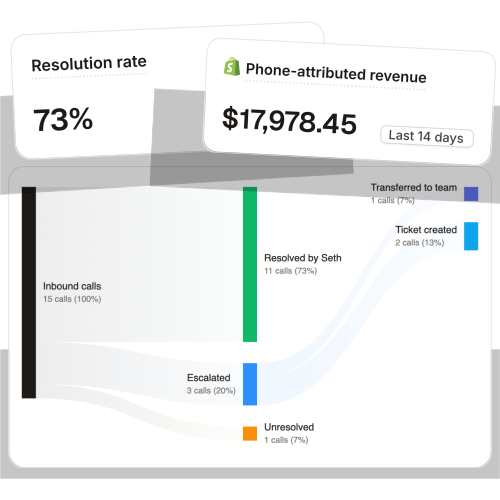
Across our 50+ brands the AI resolves 73% of inbound calls on its own, at roughly $0.42 per resolved call versus the $7 to $16 a human BPO charges. That's the shape every example below is chasing.
9 customer service automation examples
These run the gamut from the obvious (order status) to the ones most brands never automate (after-hours phone, subscription changes on a live call). The further down the list you go, the bigger the gap between "everyone does this" and "almost nobody does this on the phone."
1. Answering "where's my order" calls automatically
WISMO is the single most common support question in ecommerce. Gorgias data puts it at about 18% of support volume for the average Shopify brand, as cited in ShippyPro's 2026 WISMO guide, and Gladly reports it can hit 50-80% during peak.
The automated version: a customer calls, the AI pulls their order from Shopify by phone number or order number, reads back the tracking status, and texts them the link. No rep, no hold, no "let me check on that." It works the same at 2 p.m. and 2 a.m.
WashCo, a Shopify brand we launched, recovered $22,664 in attributed revenue in its first 7 days on the phone once those calls stopped going to voicemail. If you want to see the mechanics, our order-status feature and the breakdown in our WISMO calls guide both walk through it.
2. After-hours phone coverage
Your team logs off at 6 p.m. Your customers don't. The launch-night spike, the weekend reorder, the 11 p.m. "did my order even go through" call: all of it currently goes to a voicemail nobody returns until Monday.
Automating after-hours coverage means the phone is answered every hour, in 40 languages, with the same order lookups and returns the daytime AI handles. BioLongevity Labs, a supplement brand on Ringly, resolves 79% of its calls this way without a human picking up. More detail in our 24/7 phone support guide.
3. Returns and exchanges started on the call
Most returns automation stops at "here's a link to the portal." The stronger version finishes the job on the call: the AI verifies the order, checks it against your return policy, files the return, and texts the prepaid label before the customer hangs up.
This is the difference between deflecting a call and resolving it. The customer never has to repeat themselves to a rep later, and the return shows up in your helpdesk already tagged.
4. Subscription pause, skip, and swap on the phone
For supplement and consumables brands, this is the call that buries the team. "Skip next month," "switch me to the 90-day," "pause until I'm back from travel." It's repetitive, it's high-volume, and it's the easiest churn to prevent if someone actually picks up.
Automating it means the AI handles the change live against your subscription app, confirms by text, and only escalates if the customer is trying to cancel outright (where a human save attempt earns its cost). If you sell on a subscription model, this one alone usually pays for the whole system. Our supplement brands page covers the pattern.
5. Product and sizing questions from the knowledge base
"Will this work for sensitive skin." "What's the difference between the two strengths." "Does this fit a large breed." These pull straight from your existing docs, so the AI answers them from your knowledge base the same way a trained rep would, without the training.
TechCraft Studio handles 88% of its calls without a human this way. And the part operators worry about (sounding robotic) tends not to be the problem in practice:
"My customers also feel like it's a normal person. They feel like they can communicate if they have questions."
Claudia Droge, TechCraft Studio
6. Proactive shipping-update texts
The best WISMO call is the one that never happens. Trigger an automated text the moment a tracking status changes (shipped, out for delivery, delayed) and a chunk of your inbound just disappears.
This is the one automation example that pays you back twice: fewer calls AND a customer who feels looked after. Our SMS-to-caller feature wires this into the phone flow.
7. Smart ticket routing and clean escalation
Automation isn't only about resolving calls. It's also about getting the right calls to the right human fast. Incoming contacts get auto-tagged by topic and priority, and the ones that need a person escalate cleanly into the helpdesk you already run.
The AI sits in front of your stack, not on top of it. Calls that need a human transfer to Gorgias, Zendesk, Richpanel, or Reamaze with the full call context attached, so your rep isn't starting cold. See how the smart transfer works.
8. Abandoned-cart rescue follow-up
A customer fills a cart, hesitates, leaves. An automated outbound follow-up (a text, or for higher-value carts a call) brings a slice of them back, and answers the actual objection that stopped them instead of just nagging.
It's the rare support automation that's also a revenue line, which is why we treat it as a cart-recovery feature, not a marketing afterthought.
9. Call analysis and auto-tagging
Every call transcribed, categorized, and surfaced in a dashboard so you can see the patterns: which products generate the most questions, when your volume actually spikes, which calls keep escalating and why.
Gear Rider ran 1,595 sales calls in 90 days with no phone rep, and the value wasn't only the calls handled. It was finally seeing, in one place, what customers were actually asking. Our call analysis feature turns that into something your team reads on Monday.
What this costs you today vs what it costs with automation
Take a typical $50M Shopify brand running a 6-rep CS team:
| Line item | Today | With Ringly |
|---|---|---|
| 6 reps × $4K loaded per rep | $24,000/mo | n/a |
| Ringly Enterprise (~$5K/mo) | n/a | $5,000/mo |
| Net monthly CS spend | $24,000/mo | $5,000/mo |
| Monthly savings | n/a | $19,000/mo |
| Annual savings | n/a | $228,000/yr |
That's roughly 70% of repeatable calls (order status, returns, product questions, the same five things over and over) routed to the AI. The other 30%, the genuinely complex calls, still go to your CS team, who now have time to actually solve them.
The point isn't to shrink the team. It's to stop paying reps to read tracking numbers off a screen and let them do the work that keeps customers. You can run the self-serve numbers on the pricing page or book a 30-min call and we'll do the math against your real volume.
Where automation breaks (and what stays human)
Here's the part most automation guides won't tell you: some calls should never be automated, and a tool that tries reads as cold and costs you the relationship.
- Grief and illness calls. Pet and health brands get these. A customer whose dog just died, or who's scared about a side effect, needs a person. We hard-code these to escalate immediately, no automation attempt.
- Genuinely novel complaints. The first time something goes wrong in a new way, a human should hear it. Automation is for the patterns, not the exceptions.
- Anything that needs judgment. A goodwill credit, a policy exception, a high-value customer who's clearly about to walk. These are calls where discretion is the product.
The brands that get the most out of automation are the ones that draw this line on purpose, not the ones that try to automate everything. Automate the 70% that's repeatable, and give your reps the time and headroom to be genuinely good at the 30% that isn't. More on the balance in our ecommerce customer service guide.
The easiest example to start with
If you only automate one thing, automate the "where's my order" phone call.
It's the highest-volume call, the most repeatable, and the one customers are most frustrated to wait on. Start there, measure the drop in voicemails and the calls handled after hours, then expand into returns and subscription changes once you trust it.
Choose phone automation first if: your number is visible on your site, you're missing calls after 6 p.m. or on weekends, and your team keeps reading the same tracking numbers off a screen. That's the profile where it pays back fastest. Our phone support overview and the Shopify phone agent page cover the setup.
Frequently asked questions
What is customer service automation? It's handling routine support tasks (order status, returns, product questions, subscription changes) start to finish without a human, so your team only touches the calls that genuinely need them. The goal is to automate the roughly 70% of contacts that are repeatable.
What are the most common examples? Answering "where's my order" calls, after-hours phone coverage, automated returns and exchanges, subscription changes, product questions from a knowledge base, proactive shipping texts, and clean escalation to your helpdesk. The phone versions of these are the ones most brands haven't automated yet.
Can you automate phone support, not just chat? Yes, and it's the biggest opportunity. Most automation tools focus on chat and email, which leaves the phone (where 62% of missed-call customers switch to a competitor) wide open. An AI phone agent answers calls 24/7, looks up orders in Shopify, and escalates to a human when needed.
Does automation replace my CS team? No. It takes the repeatable 70% off their plate so they can spend their time on the 30% that needs judgment, empathy, or a save attempt. Grief calls, novel complaints, and policy exceptions stay human by design.
How much does it cost and what's the ROI? A 6-rep team running $24,000/mo can shift most repeatable calls to automation at roughly $5,000/mo, netting about $19,000/mo in savings. Across our brands the AI resolves calls at about $0.42 each versus $7 to $16 for a human BPO.
What's the easiest example to start with? The "where's my order" phone call. It's the highest-volume, most repeatable contact, so you see the impact fastest, then you expand into returns and subscriptions once you trust it.
Does it work with my existing helpdesk? Yes. The AI sits in front of Gorgias, Zendesk, Richpanel, or Reamaze and escalates the calls that need a human with the full call context attached. You keep your current number, helpdesk, and workflows.
Where does automation break? On calls that need real human judgment: grief and illness, genuinely new problems, and anything requiring discretion like a goodwill credit. The brands that win draw that line on purpose instead of trying to automate everything.
Talk to us

If you run a $10M-$100M Shopify brand and you're missing calls after hours, a 30-min call is the fastest way to see exactly which of these examples would move your numbers, and what they'd be worth.
The 3-layer guarantee.
- Live in 14 days or it's free until launched.
- 65% resolution in 90 days or we refund the last 3 months of subscription fees.
- We keep working free until we hit 65%.
Ruben (Ringly co-founder) takes these calls personally.