

This post in 30 seconds.
- A self-service return portal stops the inbox flood. It does almost nothing for the phone, and as you scale, the phone is where returns get expensive.
- The right order to automate: portal and status notifications first, rule-based approvals next, then the return calls a portal never catches.
- Built for founders, COOs, and Heads of CX at $10M-$100M Shopify brands whose manual returns process started breaking somewhere around rep #4.
Most growing brands automate returns in the wrong order. They install a portal, watch the support inbox calm down, and assume the problem is solved. Then the phone keeps ringing, and nobody can say why.
The reason is simple. A portal handles the customers who are happy to click through a returns flow online. It does nothing for the ones who call to ask whether something is even returnable, where their refund went, or why the portal rejected their request. At a small store those calls are a trickle. At $30M they are a line item.
If you run customer experience at a Shopify brand doing $10M-$100M, you already know the version of this where your CS team is drowning in calls every time you run a promo or a product comes back in a bad batch. We've launched AI phone support for 50+ Shopify brands hitting exactly that wall. Book a 30-min call and we'll map where your return calls are actually going.
The moment manual returns stop working
Returns are not a small problem you can outrun. The average ecommerce return rate sat around 19-20% in 2026, roughly two to three times the in-store rate, according to eMarketer's US returns data. In apparel it runs 20-30%. So for every five orders you ship, one is coming back, and the customer behind it usually has a question.
A manual returns process survives at low volume. It looks like this: a customer emails or calls, a rep checks the order in Shopify, confirms the policy, generates a label by hand, and processes the refund once the item lands. Fine at 200 orders a month. A slow disaster at 5,000.
The breaking point isn't a date, it's a payroll line: returns start eating a measurable chunk of your CS team's day, and you can feel it before you can prove it. Manual return handling costs retailers somewhere between $10 and $65 per return, and only about 48% of returned items get resold at full price, per MakeMyReceipt's 2026 returns report. Every hour a rep spends on a routine return is an hour not spent on the call that actually saves a customer.
A few signs tell you the manual loop is already past its limit:
- Returns are now a named slice of your ticket volume. When your lead CSR can tell you "returns are basically a third of our week," you're past manual.
- Your refund SLA is slipping. The "where's my refund" calls are climbing because the answer takes too long to find.
- The seasonal spike breaks you every time. Post-holiday returns hit, and you're scrambling for coverage you didn't budget for.
- You're hearing the same questions over and over. Is this returnable, how do I start a return, where's my label. Same five questions, all day.
That last one is the tell. When the same handful of return questions repeat across every channel, you don't have a complexity problem. You have a volume problem, and volume problems are what automation is for.
Why returns get more expensive, not less, as you grow
There's a trap in returns that catches almost every brand crossing $10M. The cost per return doesn't fall as you scale. It often rises, because the work that used to be one rep glancing at one order turns into a queue, and a queue needs coordination, escalation, and someone watching the SLA.
Return rates also climb with category mix as you expand. The category data bears it out: apparel and footwear run 18-30%, while supplements sit around 7%, per Richpanel's 2026 benchmarks. Add a clothing line to a brand that started in accessories and your return volume can double overnight while your team stays the same size. The brands that handle this well don't just hire ahead of it. They take the routine work off humans before the volume arrives, which is the whole point of automating early.
There's a revenue angle too. Returns aren't only a cost, they're a retention moment. A bad return experience pushes 71% of consumers away from re-purchasing, while an easy one makes 92% likely to come back, per Route's 2026 data. A returns process that's slow or hard to reach doesn't just cost you labor. It costs you the next order. Our guide on how to reduce product returns gets into the upstream fixes, and ecommerce customer retention covers why the post-purchase moment matters so much.
Here's how the three layers of a returns operation actually compare once you're at scale:
| Layer | What it handles | What it misses | Cost pattern |
|---|---|---|---|
| Manual (email + reps) | Everything, slowly | Nothing, but it doesn't scale | Linear with volume |
| Self-service portal | Online self-serve returns, labels, status | Anyone who calls instead of clicking | Flat monthly + per-return |
| AI phone support | The return calls: status, eligibility, policy | Genuinely complex cases (escalate) | Flat monthly, no per-rep |
Most brands stop at the middle row and wonder why the phone still rings.
What to automate first, and what to leave for later
You don't automate returns all at once. You sequence it so each step buys back the most time for the least setup. Start where the relief is biggest.
1. Self-service return portal. This is the first move and the obvious one. Instead of emailing your team, the customer picks the item, selects a reason, and gets a label or QR code on the spot. It stops the inbox flood, which is real: brands that ship easy returns keep customers, with 92% saying they'd buy again from a retailer when the return process is easy, according to Route's 2026 consumer data. If you're picking a tool here, our rundown of the best returns management software for ecommerce walks the options, and the Shopify returns app landscape is a good starting map.
2. Automated status notifications. The second-biggest source of return tickets is "where's my refund." Push automatic updates at each stage, return received, inspected, refunded, and you cut the reverse-WISMO chatter hard. Brands using automated return-status notifications reduce those queries by 40-60%, per Outvio's WISMO breakdown. This is the cheapest win after the portal.
3. Rule-based approvals. Once the portal is live, encode your policy so the system auto-approves clean returns and flags the rest. First-time buyer versus VIP, final-sale SKUs, return windows. Define the rule once, let it run. This is where you stop reviewing every request by hand.
4. Exchange-first flows and label generation. Push exchanges and store credit ahead of refunds to keep the revenue, and automate label creation so reps stop generating them one at a time. Our guide to Shopify exchanges covers the mechanics, and the Shopify refunds workflow rounds it out.
The order matters because each step removes a different bottleneck, and skipping ahead leaves the early ones in place. Portal first kills the inbox. Notifications kill the "where's my refund" follow-ups. Rules kill the manual review. Do them out of order and you'll automate the small stuff while the big stuff still lands on a human.
There's a fifth step almost nobody plans for, and it's the one that keeps the phone ringing after everything above is live. Want to see where your return calls are actually landing? Book a 30-min call and we'll pull the pattern from your last week.
The returns calls a portal never catches
Every returns-automation guide stops at the portal. The problem is that a portal only serves the customers who choose to self-serve online. A meaningful slice of your return-related contact still comes by phone, and that slice gets bigger, not smaller, as you move upmarket.
Think about who calls instead of clicking. The older, high-AOV customer who wants to talk to a person. The buyer who isn't sure the item qualifies and won't risk starting a return that gets rejected. The one whose refund is three days late and who is now annoyed. None of those people open the portal. They dial your number.
And phone is where the cost concentrates. "Where's my order" and its returns cousin "where's my refund" already account for up to 50% of inbound calls to ecommerce support, according to Salesforce, and they spike to 70-80% at peak. When those calls hit voicemail, you lose them: 80% of voicemail-routed callers hang up without leaving a message, per Eden's data, and 85% of people who can't reach a person never call back, with 62% switching to a competitor, per PCN's 2026 study. A returns portal does not save a single one of those calls. We dig into the call side of this in our breakdown of WISMO calls and the strategies to reduce WISMO calls that actually move the number.
This is the layer that doesn't show up in any returns-software comparison, and it's the one that decides whether your CS payroll keeps climbing. A returned item that triggers a phone call your team can't answer isn't just a logistics event. It's a missed call, and missed calls at a growing brand turn into lost reorders. WashCo, a Shopify brand we launched, recovered $22,664 in attributed revenue in its first 7 days on the phone, most of it from calls that would otherwise have gone to voicemail.
The frustrating part is that almost none of these calls are hard. They're routine, they're high-volume, and they're exactly the kind of work that shouldn't need a person. But a returns portal can't pick up a phone, so they stay on your team's plate by default. The brands that actually get their return calls under control treat the phone as a channel to automate, not a queue to staff. That's the shift, and it's the one nobody writing about returns software ever mentions.
How I looked at the returns-call problem
I'm Ruben, co-founder of Ringly. We run AI phone support for 50+ Shopify brands, so I get to see the call side of returns that the portal vendors never look at.
To write this, I pulled a week of return-related calls across active Ringly brands and sorted them by what the customer actually wanted:
- Eligibility checks. "Can I return this, is it past the window, is it final sale." The customer hasn't opened the portal because they don't want to start something that gets rejected.
- Refund status. "I sent it back, where's my money." The classic reverse-WISMO call, by voice.
- Policy edge cases. Gift returns, partial returns, damaged-on-arrival. The portal kicks these out, so they call.
- Start-a-return-for-me. Older or less technical customers who would rather talk it through than click.
The pattern was consistent: a large share of these calls never touch the self-service portal at all. They're not complex, they're just on a channel the portal can't reach. That's the gap. A portal automates the clicks. Something has to automate the calls, or your team keeps answering them one at a time.
What a fully automated returns operation looks like at a $30M brand, once all the layers are in place:
- The portal absorbs the self-serve returns, which is the bulk of your volume, with labels and status baked in.
- Automated notifications handle the refund-status follow-ups, so "where's my refund" stops generating tickets.
- The phone line answers itself for routine return calls, checking eligibility and starting returns without a rep.
- Your team only sees the genuinely hard cases, the angry escalation, the fraud flag, the weird policy exception that needs judgment.
Every brand that gets here stops thinking about returns as a headcount problem. It becomes a systems problem, and systems don't quit at month seven.
How Ringly handles return calls, and where it fits your stack
Ringly.io is AI phone support for Shopify brands. It's not a returns portal and it doesn't replace one. It sits on your phone line and handles the return calls a portal can't, so your team stops being the catch-all for every routine return question.
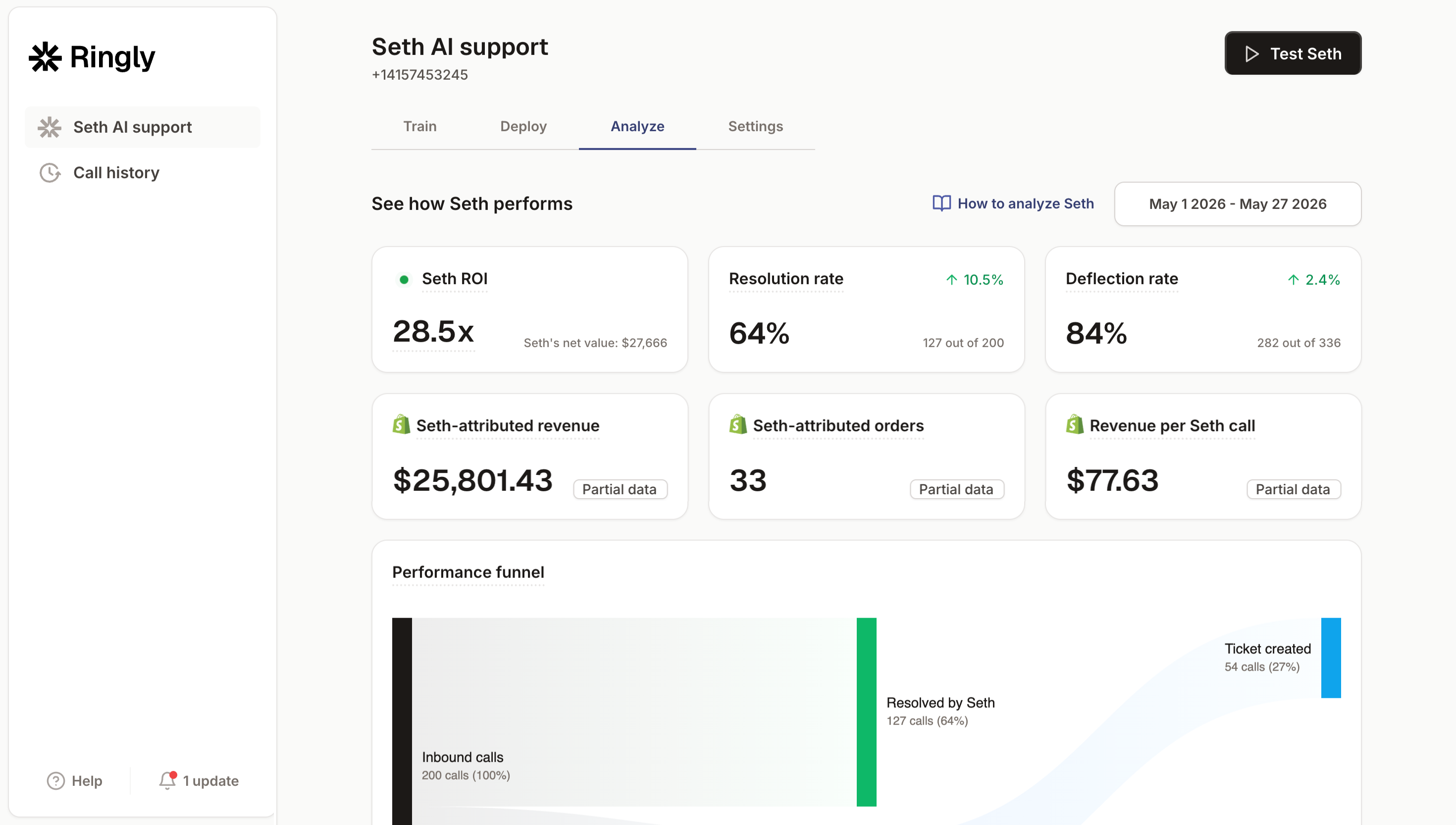
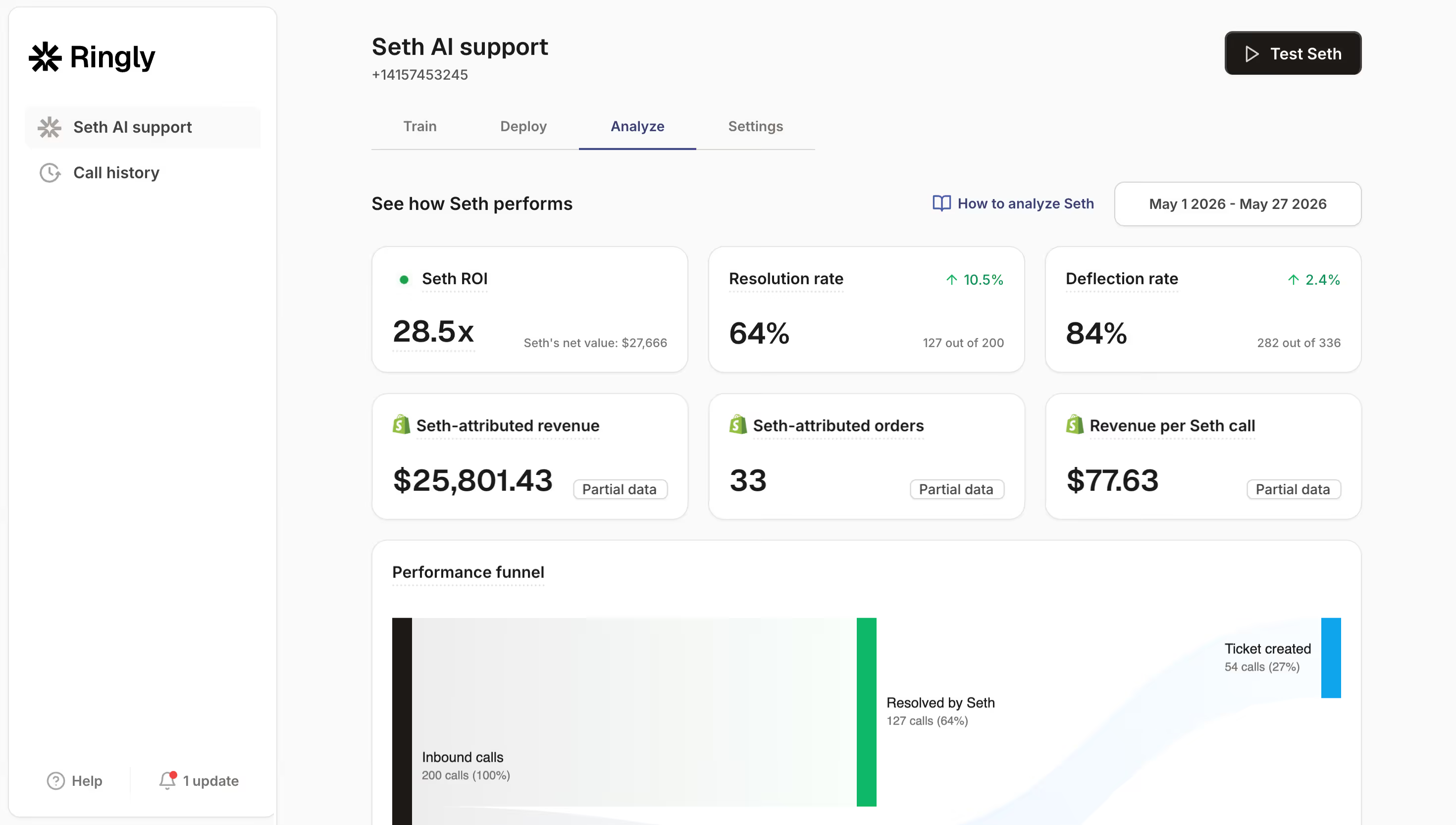
On a return call, the AI finds the order in your Shopify store, checks the item against your return policy, tells the customer whether it qualifies, starts the return or exchange, and answers "where's my refund" by reading the real status. The genuinely hard calls, the angry escalation or the weird edge case, get handed off cleanly to your team or your helpdesk. Across 50+ brands the AI resolves 73% of calls autonomously at roughly $0.42 per resolved call. It keeps your current phone number, your Shopify order-status data, and whatever helpdesk you already run.
"My customers also feel like it's a normal person. They feel like they can communicate if they have questions."
Claudia Droge, TechCraft Studio
Where it fits
Pair it with your returns portal, not against it. The portal handles customers who self-serve. Ringly handles the ones who call. Your team handles the 30% that genuinely need a human. Calls that need escalation route cleanly to Gorgias, Richpanel, or whatever you run, and if you're weighing those, our Gorgias alternatives breakdown and the Gorgias vs Richpanel comparison are worth a read. You can see the full AI phone agent for Shopify setup, and the broader ecommerce phone support and 24/7 ecommerce phone support context if you want the wider picture.
Pricing
Grow is $349/mo (1,000 minutes), Pro is $799/mo (2,500 minutes), and Enterprise is custom, set on a call. There's a 65% resolution guarantee: if the AI resolves under 65% of your calls in 90 days, we refund the last 3 months. Full numbers are on the pricing page.
What automated returns actually save you
Here's the part that makes the case to your CFO. The portal saves clicks. Automating the call layer saves headcount, and headcount is where the real money sits.
Take a typical $50M Shopify brand running a 6-rep CS team:
| Line item | Today | With Ringly |
|---|---|---|
| 6 reps x $4K loaded per rep | $24,000/mo | n/a |
| Ringly (~$5K/mo) | n/a | $5,000/mo |
| Net monthly CS spend | $24,000/mo | $5,000/mo |
| Monthly savings | n/a | $19,000/mo |
| Annual savings | n/a | $228,000/yr |
That's roughly 70% of repeatable calls, return status, eligibility, the same five questions over and over, routed to the AI. The other 30%, the genuinely complex calls, still go to your CS team, who now have time to actually solve them.
The hiring math reinforces it. Replacing one CS rep costs around $14,113 and the industry turns over 31.2% of its support staff a year, per Insignia's research. Every routine return call you take off your team's plate is one less reason to hire rep #7 just to keep up with the seasonal spike. If you want to model your own numbers, our ecommerce customer service cost breakdown and the ecommerce return statistics for 2026 give you the benchmarks.
Want to compare this to your current setup? Book a 30-min call and we'll do the math live on your numbers.
Frequently asked questions
When should a growing ecommerce brand automate returns? The trigger is volume, not revenue. Once returns are a named slice of your ticket load and your refund SLA is slipping, you've outgrown manual. For most Shopify brands that's somewhere between rep #3 and rep #6.
What should I automate first in the returns process? The self-service return portal. It stops the inbox flood faster than anything else. Automated refund-status notifications are the next cheapest win, since they cut "where's my refund" queries by 40-60%.
Does a return portal eliminate return-related support calls? No. A portal only serves customers who self-serve online. Eligibility questions, refund-status calls, and policy edge cases still come by phone, and that share grows as your AOV and customer age go up. The portal handles clicks, not calls.
How much do returns cost to process? Manual returns run roughly $10 to $65 each, and only about 48% of returned items resell at full price. The labor cost on the phone calls those returns generate is on top of that, and it's the part most brands never measure.
Can AI handle return requests over the phone? Yes. Ringly's AI finds the order in Shopify, checks return eligibility against your policy, starts the return or exchange, and answers refund-status questions, escalating the hard cases to your team. It resolves 73% of calls autonomously across 50+ brands.
What's the difference between a returns portal and AI phone support for returns? A returns portal is the self-service web flow where customers click through a return. AI phone support is the voice layer that handles the customers who call instead. They're complements: portal for the clicks, AI for the calls, your team for the genuinely complex 30%. See our DTC returns best practices guide for the full workflow.
Talk to us

If you run a $10M-$100M Shopify brand and your returns are quietly driving up your call volume, a 30-min call is the fastest way to see exactly which return calls are costing you and what it would take to route them to an AI instead.
The 3-layer guarantee.
- Live in 14 days or it's free until launched.
- 65% resolution in 90 days or we refund the last 3 months of subscription fees.
- We keep working free until we hit 65%.
Ruben (Ringly co-founder) takes these calls personally.