
This post in 30 seconds.
- Cosmetics support has four jobs, and a phone line that goes quiet after 6 p.m. quietly kills the fourth.
- We pulled call logs from the 50+ Shopify CS operations we run phone for: 70-80% of cosmetics calls are the same four questions.
- Built for founders, COOs, and Heads of CX at $10M-$100M Shopify cosmetics brands running a paid helpdesk and a visible phone number.
A Monday at a $40M cosmetics brand looks the same most weeks. The helpdesk is stacked with weekend tickets, half of them asking where an order is. Five voicemails from Saturday nobody has called back. A creator posted a Reel Friday night and now there's a foundation shade selling out, with the questions to match.
Customer service at a cosmetics brand is its own animal. Your customers are buying something they put on their face, so the questions are more personal than "did it ship." If you run customer experience at a Shopify cosmetics brand doing $10M-$100M, you already know the launch-week queue and the after-hours calls that roll to voicemail. This is the operator's-eye view of what good looks like across every channel, and where the routine work is quietly eating your team. Book a 30-min call and we'll show you what your missed calls are costing.
What great cosmetics customer service actually looks like
Strip away the slogans and cosmetics support has four jobs. Pre-purchase consults, where someone wants to know if a shade or formula is right for them. Order and shipping questions. Returns and exchanges. And the quiet one: keeping your best customers buying again.
Great cosmetics CS makes the personal questions feel personal and the repetitive ones disappear. That second half is where most teams drown, because the repetitive calls never stop and they crowd out the consults that actually drive a sale.
Personalization isn't optional in this category. Roughly 75% of beauty shoppers expect a personalized experience from the brands they buy. A shopper who calls asking which serum fits an oily-skin routine is a sale waiting to close, if someone picks up. A shopper who can't reach anyone just closes the tab.
There's a structural reason the personal touch matters more in cosmetics than in most categories. The product is tied to the customer's body and routine, so a returned serum or a wrong shade isn't a neutral logistics event, it's a small disappointment with the brand attached to it. That's why the brands with the strongest cosmetics and skincare CX tend to win on retention, not just first sale. The flip side is that every dropped call and slow reply gets weighted heavier too.
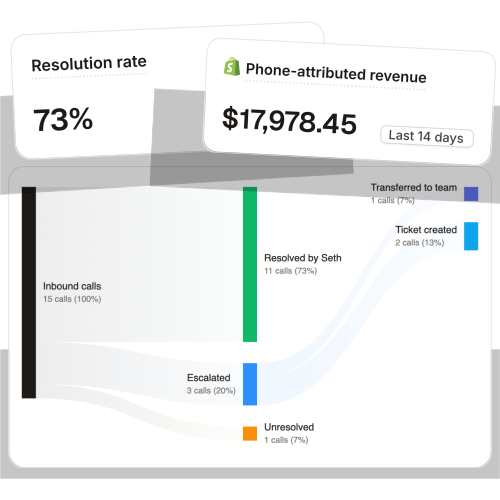
The brands that get this right (think the Glossier, Tatcha, Drunk Elephant tier) treat support as part of the product, not a cost center bolted on after checkout. It's the same discipline behind any good ecommerce customer service operation, just with higher stakes per interaction. TechCraft Studio, a brand on Ringly, handles 88% of its calls without a human and routes the rest to people who finally have time to handle them well.
The questions your team answers over and over
Here's the part that surprises operators when they actually read their own call logs. Across the 50+ Shopify CS operations we run phone for, 70-80% of cosmetics calls are the same four questions: where's my order, which shade, what's in it, and can I return it.
- Shade and match. Undertone, finish, "is this the same as the one I had two years ago." The single most cosmetics-specific call type.
- Ingredient and allergen. "Is there fragrance in this." "Is it safe while pregnant." These need accurate, on-brand answers, not a guess.
- Where's my order. WISMO runs 30-40% of tickets, 50%+ at peak. Same in cosmetics as everywhere else.
- Returns and exchanges. Beauty carries higher return friction than most categories, partly because opened product can't be restocked for hygiene reasons.
The consults are the calls you want your humans on. The other three are the same questions over and over, and they're the reason your team is burnt out by Thursday. When 70% of the volume is repeatable, hiring faster just buys you more people doing repetitive work. The move is to get the routine calls off your reps so they can do the work that moves revenue.
Worth saying plainly: the split lands at 70/30 not because the consults are rare, but because a brand at $40M generates a lot of order-status and shade-basics volume, and that volume scales with revenue while the genuinely subjective consults stay roughly flat. So the bigger you get, the worse the ratio gets, and the more of your payroll goes to answering "where's my order" for the hundredth time that week.
The channels cosmetics customers use, and the response times to hold
Cosmetics customers reach you everywhere: email, live chat, social DMs, and the phone. The mistake is treating them all the same. Each channel has its own expectation, and missing it costs you differently.
Here are the response-time targets the better Shopify CS teams hold, channel by channel:
| Channel | Target response | What slips if you miss it |
|---|---|---|
| Phone | 80% of calls answered in 20 seconds | The caller hangs up and buys elsewhere |
| Live chat | 12 to 30 seconds | Cart gets abandoned mid-question |
| Under 4 hours | Trust erodes; sub-1h replies hold 71% retention vs 48% at 24h | |
| Social DMs | Around 15 minutes | A public complaint compounds before you see it |
Phone is the channel most cosmetics brands quietly let fail. Email and chat get staffed because they queue politely. The phone doesn't queue. Businesses answer only 37.8% of inbound calls, and 85% of callers who can't reach a person never call back, with 62% switching to a competitor.
So the after-hours phone line that goes to voicemail isn't a coverage gap. It's a revenue leak you can't see, because the missed call never shows up in your helpdesk. Most operators don't know what they're losing until they pull the call log. If your number rings out after 6 p.m., that's the first thing worth measuring. You can dig into the 24/7 phone coverage math separately, but the short version is that the calls roll over, the voicemails pile up, and 80% of voicemail-routed callers hang up without leaving a message.
The other channel mistake is treating order-status volume as inevitable. A big share of WISMO contacts come from customers who'd happily self-serve if the answer were one tap away, which is why proactive tracking and tight order-status workflows take pressure off every channel at once. Fix the WISMO leak and the phone, chat, and email queues all get shorter on the same day. For brands on Shopify Plus, the Plus customer service patterns at higher volume make this even more pronounced.
Peak season and launch spikes
Cosmetics doesn't run on a steady call volume. It runs flat, then violent. A creator post, a product drop, or Black Friday, and the queue triples overnight.
The numbers back this up. BFCM support volume spikes 80% or more for most ecommerce stores, and some see 2-4x. Health and beauty made up 16% of Shopify's BFCM sales in 2025, so cosmetics feels the peak harder than most. An influencer-driven launch can push 5-10x call volume in 48 hours with no warning. Then January arrives and the holiday returns hit, spiking 30-50% above baseline.
This is the staffing trap. You can't hire eight seasonal reps for a launch you can't predict, train them in time, and then pay them through the nine quiet months. So most brands understaff the spike, eat the bad CSAT, and hope it passes.
And the returns wave is its own season. Makeup carries a 12-15% return rate because the sensory mismatch (wrong shade, wrong undertone, texture that didn't land) can't be designed away, and virtual try-on only trims it by 10-25%. So the spike isn't one event, it's a sales surge followed weeks later by a returns surge, and both land on the same team. Planning for one and forgetting the other is how January quietly becomes the worst month of the year for your reps.
"My customers also feel like it's a normal person. They feel like they can communicate if they have questions."
— Claudia Droge, TechCraft Studio
The spike is exactly where the routine calls hurt most, because at 5x volume the WISMO and shade-basics calls bury the consults that could turn a launch into repeat customers. Getting the routine load handled before the spike is what separates a launch that scales from one that face-plants in public.
What this costs, and where AI fits
Run the math on a steady-state team and the launch model gets expensive fast.
Beauty brands staff for the peak and pay the load year-round. A typical $50M cosmetics brand staffs eight reps to survive launch month:
| Line item | Today | With an AI phone layer |
|---|---|---|
| 8 reps × $4K loaded | $32,000/mo | — |
| AI phone support (~$8K/mo) | — | $8,000/mo |
| True annual CS spend | $384,000/yr | — |
| Net monthly savings | — | ~$24,000/mo |
That's a team idle nine months of twelve. Cutting the team isn't the goal. The goal is to stop paying eight people to wait for the next drop while the routine calls still go unanswered after hours.
This is where an AI phone agent earns its place, and it's worth being precise about what it does and doesn't do. Ringly.io is AI phone support for Shopify brands. It answers inbound calls 24/7, finds orders in your Shopify store, handles the shade-basics and ingredient questions from your knowledge base, processes returns, and escalates the calls that need a human to your existing helpdesk. It resolves up to 90% of calls on its own for $1.99 a call after the first 50, versus $7-$16 for a human BPO.
Two things beauty operators always ask. First, the brand-voice worry. The single most repeated thing customers say after a call is "you don't sound like AI," which matters more in cosmetics than anywhere else. Second, the female-voice question (Nancy at Shop Priceless put it bluntly: "we're a female ecommerce brand"). The voice is configurable, so it matches your brand rather than fighting it. The complex consults still go to your team. The AI handles the routine cosmetics calls so your people can sell.
Real numbers from WashCo, a Shopify brand we launched recently:
- $22,664 in attributed revenue, first 7 days post-launch
- 271 calls handled
- 85% deflection rate
- 66% resolution rate
- $0.91 per call vs $2.70 per human-handled call
Source: Ringly dashboard, verified live data.
The call makes sense if:
- You're a Shopify (or Shopify Plus) cosmetics brand doing $10M-$100M
- You run a paid helpdesk (Gorgias, Zendesk, Gladly, Re:amaze, or Intercom)
- You have a visible phone number on your store
- Your CS team is 3-12 people
What happens on the call.
- We pull your last seven days of missed calls live, on the call. No homework for you.
- We show you the recovered revenue at the resolution rates we see for cosmetics brands.
- You decide if it's worth a deeper conversation. No deck, no follow-up sequence.
If your phone line goes quiet after the team logs off, book a 30-min call and we'll do the math live on your store.
The metrics that tell you it's working
You can't fix what you don't measure, and most cosmetics teams measure the wrong things. Ticket count tells you how busy you are, not how well you're doing.
The numbers worth watching:
- First-contact resolution. The share of contacts solved without a second touch. The single best predictor of CSAT in cosmetics CS.
- After-hours answer rate. What percentage of calls outside business hours actually get answered. For most brands the honest number is close to zero.
- Repeatable-call share. How much of your volume is the same four questions. If it's 70%+, you're overpaying for routine work.
- Cost per contact. Loaded human cost per resolved contact, by channel. Phone is usually the most expensive and the least measured.
If your after-hours answer rate is near zero and your repeatable-call share is north of 70%, the math almost always favors moving the routine calls to an AI layer. Track these four for a month and the decision makes itself. The fuller list of CS KPIs for ecommerce goes deeper, but these are the four that matter for cosmetics. And because beauty lives or dies on repeat purchase, watch how they move alongside ecommerce customer retention: support quality and retention rise and fall together.
Frequently asked questions
What channels do cosmetics customers use most? Email, live chat, social DMs, and phone, in roughly that order of volume. Phone is lower volume but higher stakes, because the calls are pre-purchase consults and time-sensitive order issues that don't wait politely in a queue.
What response times should a cosmetics brand target? Hold 80% of calls answered within 20 seconds, live chat in 12 to 30 seconds, email under 4 hours, and social DMs around 15 minutes. Sub-one-hour email replies hold 71% retention versus 48% at 24 hours, so speed compounds.
How do you handle shade and match questions at scale? Put your shade logic, undertone guidance, and finish descriptions into a knowledge base your team and any AI layer both pull from. The basic match questions get answered consistently, and the genuinely subjective consults escalate to a human.
How do you staff for a launch or BFCM spike? You don't, at least not with seasonal humans alone. Launches can drive 5-10x call volume in 48 hours, so the workable model is to get the routine 70% handled automatically and keep your team free for the consults and escalations that scale with the spike.
Should a cosmetics brand have a phone line? Yes, if your AOV and customer profile support it. A visible phone number converts pre-purchase consults and rescues order problems, but only if someone actually answers. An unanswered line is worse than no line, since 85% of callers who can't reach a person never call back.
Can AI handle cosmetics customer service calls? For the routine 70-80% (order status, basic shade and ingredient questions, returns), yes. Ringly's AI phone agent resolves up to 90% of calls on its own and escalates the subjective consults to your team. The voice is configurable to match your brand.
What metrics matter most for cosmetics customer service? First-contact resolution, after-hours answer rate, repeatable-call share, and cost per contact by channel. Together they tell you whether you're solving problems or just absorbing volume.
Talk to us

If you run a $10M-$100M cosmetics brand and your phone line goes quiet after the team logs off, a 30-min call is the fastest way to see what that's costing you. We'll pull your missed calls and run the recovered-revenue math live on your store.
Our 3 promises.
- Live in under 1 hour. Setup and test calls are free.
- 30-day money back on the $99 plan fee.
- 65% resolution guarantee: if Seth resolves under 65% of your support calls in a month, that month comes back as credit (after 90 days on Pay per call).
Ruben (Ringly co-founder) takes these calls personally.