
This post in 30 seconds.
- A coffee brand doesn't buy one customer service tool. It builds a stack across five categories: helpdesk, live chat, phone and voice AI, subscription tools, and returns.
- The category most coffee brands underbuy is phone, even though a real slice of their revenue is older buyers who call to order because they won't use the website.
- Built for founders and CX leads at $10M-$100M Shopify coffee brands with a visible phone number and a paid helpdesk.
Most coffee brands have a phone line on their site and a customer who calls it to place an order, because that customer is 64 and does not trust the checkout. Roast-date questions, gift-order ETAs during the holidays, "will it still be fresh when it lands in Tucson." The helpdesk roundups never mention any of this. They compare Gorgias to Zendesk and call it a day, as if email tickets were the whole job.
If you run a $10M-$100M Shopify coffee brand, the real question is which categories of software you actually need, and which one you've been ignoring. We've launched AI phone agents for 50+ Shopify brands fighting the after-hours and gifting-season spike, and the phone category is almost always the gap. Book a 30-min call and we'll pull your last week of missed calls live and show you what the gap is costing.
In this post:
The 5 categories of customer service software a coffee brand needs
A coffee brand's customer service software isn't one product. It's a stack, and each layer handles a different slice of the same call volume. The mistake is treating the helpdesk as the whole answer, then wondering why the phone still rings unanswered at 8 p.m. on a Sunday in December.
Here's the map. Five categories, the tools that lead each one, and the coffee-specific reason it matters.
| Category | What it does | Leading tools | Why it matters for coffee |
|---|---|---|---|
| Helpdesk | System of record for email, chat, and tickets | Gorgias, Zendesk, Gladly, Re:amaze | Where roast-date and order questions get logged and resolved |
| Live chat / self-service | On-site chat + order-tracking deflection | Gorgias chat, Intercom, Tidio | Catches WISMO before it becomes a ticket, but skips older buyers |
| Phone / voice AI | Answers and resolves inbound calls 24/7 | Ringly, plus legacy lines like Aircall | The category coffee brands underbuy, where phone-order intent lives |
| Subscription | Manages pause, skip, cancel for recurring coffee | Recharge, Skio | Pause-and-skip calls are a steady CS load year-round |
| Returns | Self-service returns and exchanges | Loop Returns | Lower volume (you can't return coffee), but freshness disputes spike |
You won't buy all five on day one. But you should know which layer each new tool slots into, because buying a second helpdesk when your real gap is phone is how brands end up paying for overlap and still dropping calls. For the broader category, our guide to ecommerce customer service covers the foundations.
The rest of this guide goes category by category, with real 2026 pricing and an honest read on where each tool wins and loses for a coffee brand specifically.
How I evaluated these tools
I'm Ruben, co-founder of Ringly. Over the last few weeks I scored every category below against the workflow of a $10M-$100M Shopify coffee brand, the kind running a 4-rep CS team that doubles for the holiday gifting rush.
Here are the five criteria I scored against:
- Shopify integration depth. I connected tools to a real Shopify store, pushed a test order through, and checked whether the tool could see the customer, find the order, and write back without custom dev.
- Coffee-specific question handling. I tested how each category handles the questions coffee customers actually ask: roast date, grind type, gift-order delivery dates, "is this still in stock."
- After-hours and weekend coverage. I checked what happens to a question that lands at 9 p.m. on a Saturday, when the gifting spike is hottest and nobody is at a desk.
- Pricing predictability. I read the real 2026 pricing on every tool and flagged where per-ticket or per-AI-interaction fees can balloon on a volume spike.
- The real-world failure test. I called the published support line of six well-known coffee brands at 11 p.m. on a Tuesday and logged what happened. Four went straight to voicemail. One played a recorded message saying the team was busy fulfilling orders, then hung up on me. One actually answered, on the third try.
That last test is the one nobody in the search results runs, and it's the one that matters most for coffee, where a meaningful share of buyers reach for the phone before the keyboard. I don't take affiliate commissions on any tool here. I sell Ringly, which shows up below against the same five criteria as everyone else.
Helpdesk: the system of record
Your helpdesk is where every email and chat ticket lives, but it was never built to answer a ringing phone at 7 a.m. For a coffee brand, the helpdesk is the baseline you build on. The question is which one, and how much the AI add-ons cost once your volume climbs.
WISMO, the "where's my order" question, drives 20% to 40% of ecommerce support tickets and climbs past 50% at peak, according to Salesforce. For coffee that peak is the November-December gifting window, when ETA anxiety is at its highest because the gift has to land by a date. A good helpdesk is where you fight that volume, so pick one that connects to Shopify natively. Our full ecommerce helpdesk software guide goes deeper on each.
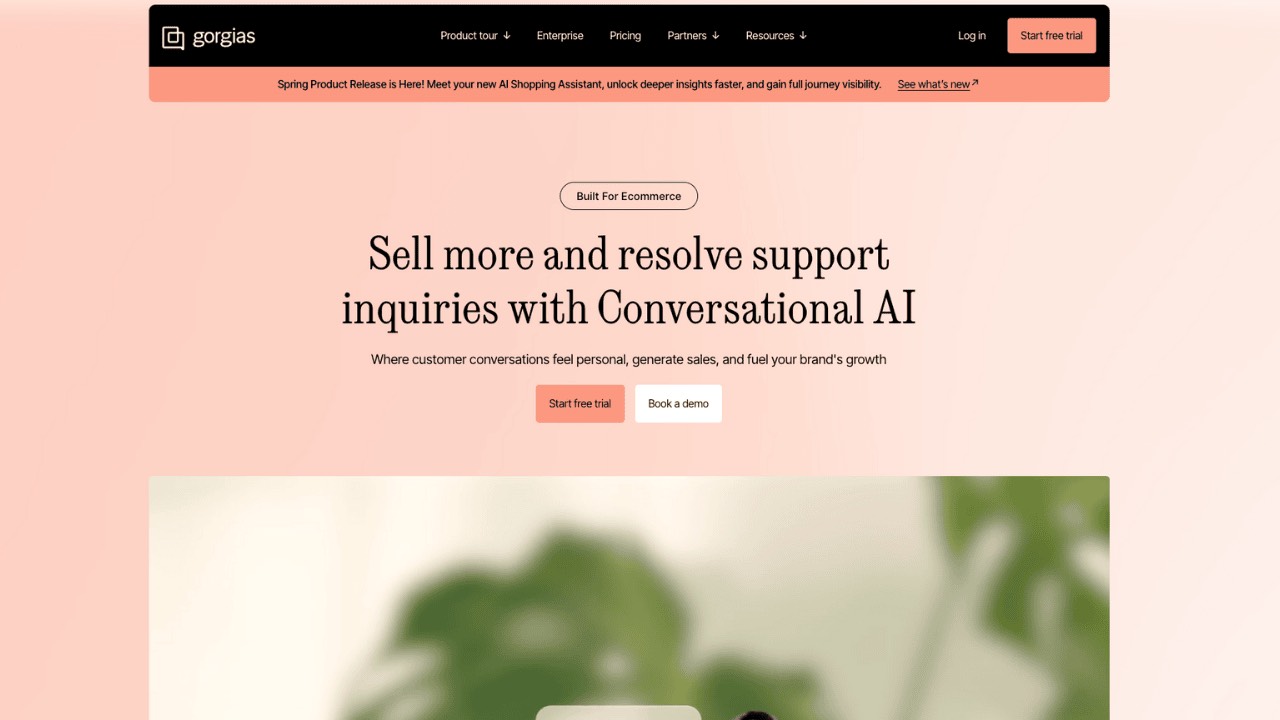
Gorgias
Best for: Shopify-first coffee brands that want order data and refunds inside the helpdesk. Gorgias is the most common choice for DTC Shopify stores, and agents can find orders, process refunds, and see revenue attribution without leaving the ticket.
Pricing
| Plan | Price | Included |
|---|---|---|
| Starter | $10/mo | 50 tickets, 3 seats |
| Basic | $60/mo | 300 tickets, omnichannel |
| Pro | $360/mo | 2,000 tickets, 600 AI interactions |
| Advanced | $900/mo | 5,000 tickets, 2,500 AI interactions |
Overages run $0.36 to $0.40 per ticket, and AI Agent interactions cost $0.90 each on annual plans or $1.00 on monthly, per the Gorgias pricing breakdown.
What works
- Native Shopify depth. Order lookups, refunds, and subscription edits happen inside the ticket.
- Revenue attribution. You can see which support conversations led to a sale, which matters for phone-order coffee buyers.
- Ticket-based pricing. Cheaper entry than per-agent tools for a small team.
What doesn't
- AI costs stack. At 2,000 AI interactions a month, the per-interaction fee alone can add hundreds on top of the plan.
- Phone is an afterthought. Gorgias logs calls; it does not answer or resolve them autonomously.
Why it ranks first among helpdesks
For a Shopify coffee brand, Gorgias is the default system of record. Just don't expect it to solve the phone. If you're weighing options, our Gorgias alternatives page lays out the field.
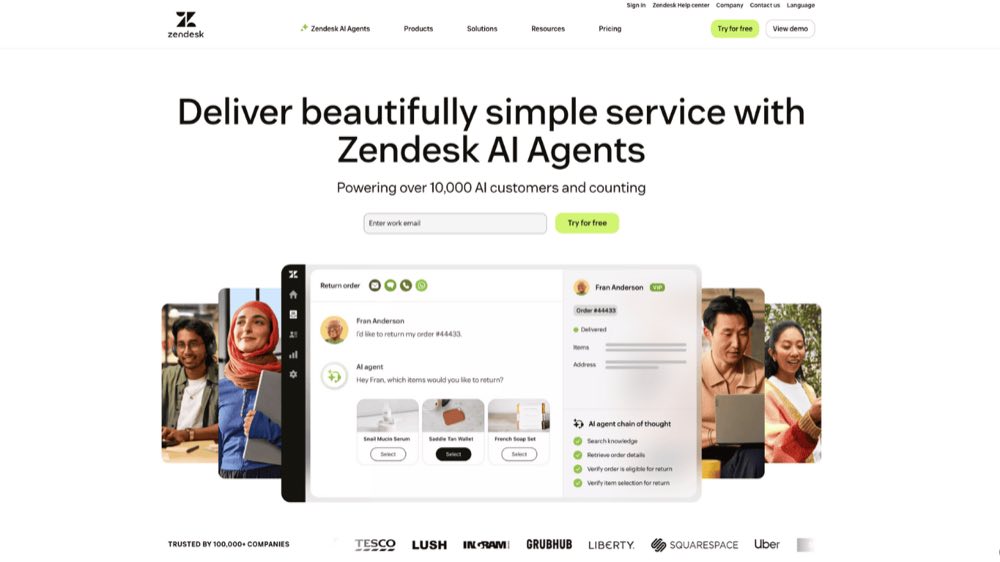
Zendesk
Best for: larger coffee brands that have outgrown a DTC-only tool and need heavier workflow customization. Zendesk is enterprise-grade and channel-agnostic, which is both its strength and its cost.
Pricing
| Plan | Price | Notes |
|---|---|---|
| Support Team | $19/agent/mo | Email + ticketing basics |
| Suite Team | $55/agent/mo | Annual billing |
| Suite Professional | $115/agent/mo | Annual billing |
| Suite Enterprise | $169/agent/mo | Annual billing |
Copilot is a separate $50/agent/month line item, per the Zendesk pricing breakdown.
What works
- Customization. Deep workflow and routing rules if you have the ops resource to build them.
- Channel breadth. Email, chat, voice, social in one place.
What doesn't
- Per-agent pricing adds up. A 6-rep coffee team on Suite Professional is $690/mo before add-ons.
- Heavier than most coffee brands need. The setup overhead can outrun a lean team.
Why it ranks second
Solid, but most $10M-$30M coffee brands don't need this much tool. Weigh it against the Zendesk alternatives before committing.
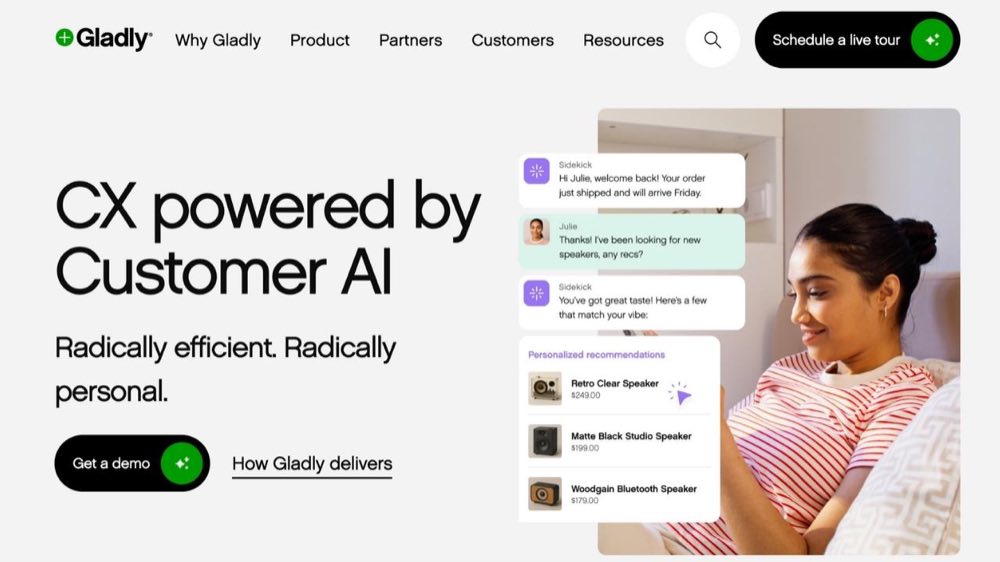
Gladly
Best for: premium coffee brands building a people-centered CX org where voice is a first-class channel. Gladly organizes around the customer, not the ticket, which is a genuinely different model.
Pricing
Custom only, with no public plans. Verified reports put it around $180 to $210 per user per month with a 10-user minimum, so roughly $21,600/year at the floor. The Sidekick AI assistant runs about $0.60 per conversation even when it doesn't fully resolve the issue, per G2 and pricing intelligence reports.
What works
- Voice-forward. Treats phone as a real channel, not a bolt-on.
- Customer timeline. One thread per customer across channels.
What doesn't
- The 10-user minimum. A 4-rep coffee brand can't get in the door affordably.
- Per-conversation AI cost. Charges even when the AI doesn't resolve.
Why it ranks third
Strong product, wrong size for most coffee brands until you're past a 10-rep team. See Gladly alternatives if the minimum is a blocker.
Live chat and self-service: deflect the website questions
Live chat catches the WISMO question before it becomes a ticket, but it quietly skips the exact customer a coffee brand can least afford to skip. Self-service order tracking is the highest-leverage deflection move you can make. Brands using proactive shipment alerts have cut WISMO inquiries by up to 75%, per ShippyPro.
The catch for coffee is demographic. A younger buyer happily clicks the chat bubble. The older buyer who drives a real chunk of your revenue does not. They scroll past the widget and dial the number in your footer, and if nobody answers, they buy from a competitor who picks up.
- Gorgias chat bundles with the helpdesk, so it's the simplest add for a Shopify coffee brand already on Gorgias.
- Intercom runs a strong chat plus Fin AI, but it's priced and positioned for software companies more than DTC. Compare via our Intercom alternatives page.
- Tidio is a lighter chatbot option for smaller teams, covered in our Tidio alternatives guide.
Chat is worth having. Just don't mistake it for full coverage. Pair it with order-tracking self-service to deflect the website crowd, then handle the phone separately.
Phone and voice AI: the category coffee brands underbuy
This is the layer the helpdesk roundups ignore, and it's the one where coffee brands leak the most revenue. A phone line that rolls to voicemail after 6 p.m. is a line that loses orders, because 80% of voicemail-routed callers hang up without leaving a message, per Eden.
Legacy phone tools like Aircall, Dialpad, and RingCentral route calls and give you a number. They do not resolve anything. The call still needs a human to pick it up, which is exactly the resource a 4-rep coffee team runs out of at 9 p.m. on a gifting-season weekend. That's where an AI phone agent fits, as a layer that sits in front of your helpdesk and actually handles the routine call.
1. Ringly.io
Best for: Shopify coffee brands losing after-hours and weekend calls, and the older buyers who call to ask about roast dates and gift delivery. Ringly is AI phone support for Shopify brands. The phone shouldn't be a tax on your support team, and that's the problem it solves.
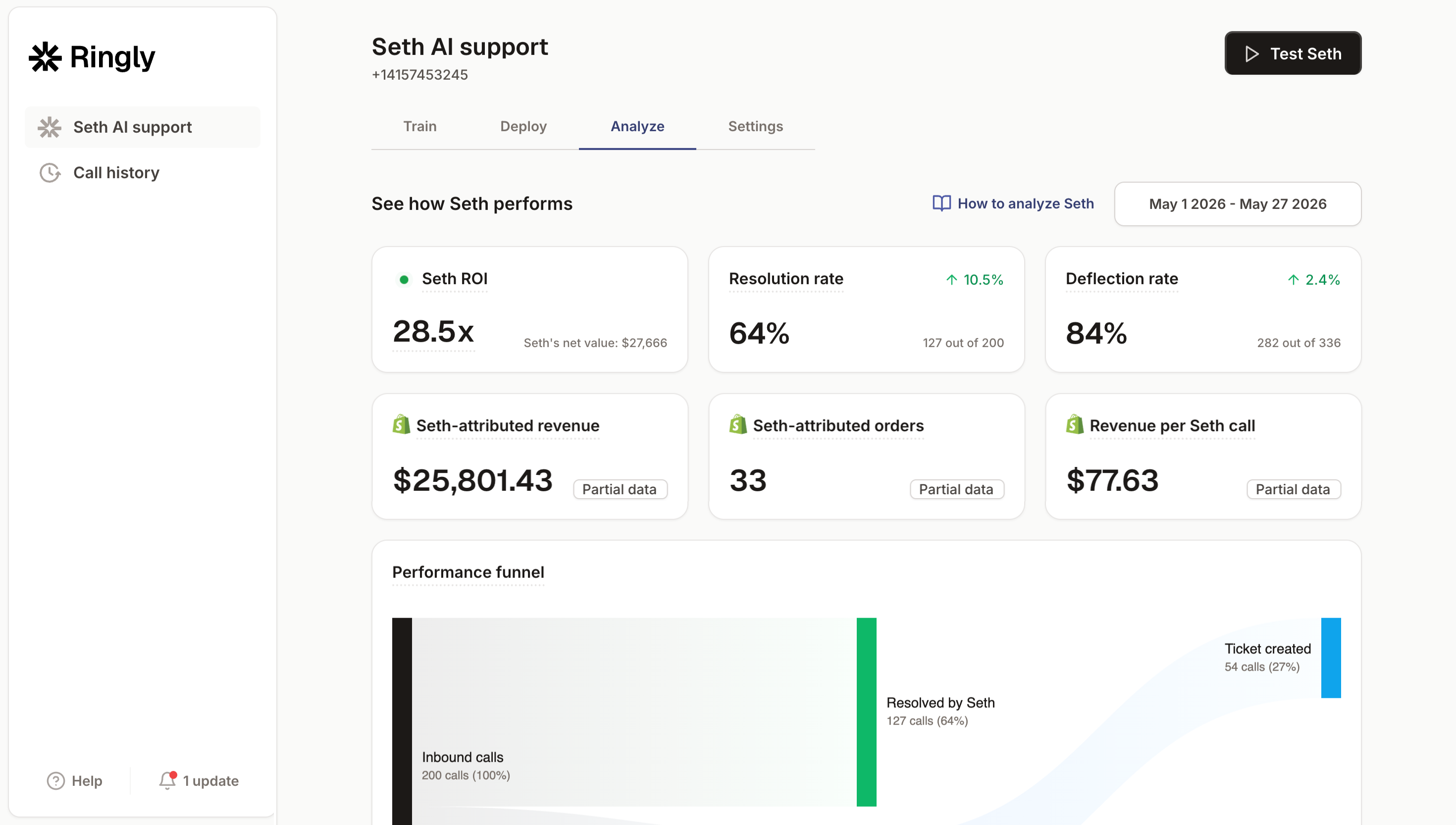
The AI answers inbound calls 24/7. It finds orders in your Shopify store, answers product questions from your knowledge base, sends order updates by SMS, and escalates cleanly to Gorgias, Re:amaze, or whatever helpdesk you already run. Across 50+ brands, it resolves 73% of calls autonomously at roughly $0.42 per resolved call. You keep your current number, your helpdesk, and your workflows.
"My customers also feel like it's a normal person. They feel like they can communicate if they have questions."
— Claudia Droge, TechCraft Studio
That "you don't sound like AI" reaction is the single most repeated thing customers say after talking to it, and it matters more for coffee than any other category, because the older demographic is the most skeptical of automation. Gear Rider, a specialty brand on Ringly, closed 1,595 sales calls in 90 days without a phone rep, which is the volume shape a coffee brand hits in a gifting quarter.
Pricing
| Plan | Price | Minutes |
|---|---|---|
| Grow | $349/mo | 1,000 (~500 calls) |
| Pro | $799/mo | 2,500 (~1,250 calls) |
| Enterprise | By call | Custom |
There's a 14-day free trial on Pro for the self-serve path. Enterprise is sold by call.
What works
- Answers and resolves, not just routes. It handles order status and product questions, not just connects.
- Sits in front of your helpdesk. Calls that need a human escalate via smart call transfer. You keep Gorgias.
- Knowledge base from your site. Roast dates, grind options, and shipping policy come from your own knowledge base.
- 65% resolution guarantee. If it resolves under 65% of calls in 90 days, you get the last 3 months refunded.
What doesn't
- No native phone ordering. It doesn't take a credit card over the phone. It sends an SMS payment link or transfers to a human, which is the honest answer for the coffee brand whose older buyers want to order by voice.
- Daily knowledge refresh, not real-time inventory. If a single-origin sells out mid-day, the agent won't know until the next refresh unless you wire a custom action.
Why it ranks first in phone
Because it's the only tool in this category that resolves the call instead of just routing it, and it's built for Shopify. For the full picture, see AI phone support for coffee brands and 24/7 ecommerce phone support.
Subscription and returns: the coffee-specific edges
Coffee subscriptions and returns generate a quieter but steady stream of calls that your phone and helpdesk both have to handle. These aren't standalone CS tools, but they shape your call volume, so they belong in the stack conversation.
On subscriptions, recurring coffee is common, and the pause-skip-cancel call is a constant. Recharge and Skio are the two most common subscription managers for Shopify coffee brands. The catch is that a subscription cancel call is exactly the kind of routine, repetitive request that eats rep time, and our Skio alternatives page covers the field.
On returns, coffee is the easy case in one sense and the hard case in another. You can't return a bag of beans, so return volume is lower than apparel or electronics. What you get instead are freshness and delivery disputes, the gift that arrived late or the order that sat in a hot truck. Loop Returns handles the mechanical return flow, but the freshness call still lands on the phone, where it needs a real answer about roast date and ship date.
The point of mapping these is simple. Every recurring-coffee cancel and every freshness dispute is a call. The more of those the phone layer resolves on its own, the fewer your team fields. WISMO and order-status questions alone are 30% to 50% of DTC support contacts, per ReadyCloud. Our WISMO tickets breakdown shows where that volume hides.
What this costs vs what you pay today
The software question is really a payroll question: how much of your CS spend is going to repeatable calls a system could handle? Let's run a typical coffee brand.
A $20M coffee brand runs a small year-round team and staffs up hard for the Nov-Dec gifting rush:
- 4 reps year-round at $4K loaded each = $16,000/mo ($192K/yr)
- 4 extra seasonal reps at $4K for 3 months = $48,000/yr peak
- True annual CS spend: roughly $240,000/yr
Add an AI phone agent at around $5K/mo to handle the roast-date, gift-order, and order-status calls year-round and absorb the gifting spike, and net savings land around $140,000 to $180,000/yr depending on volume. This isn't about cutting your team. It's the difference between hiring eight seasonal reps you'll lose in January and keeping a smaller team that handles the calls a machine can't.
The real numbers back the per-call math:
Real numbers from WashCo, a Shopify brand we launched recently:
- $22,664 in attributed revenue, first 7 days post-launch
- 271 calls handled
- 85% deflection rate
- 66% resolution rate
- $0.91 per call vs $2.70 per human-handled call
Source: Ringly dashboard, verified live data.
Each support interaction costs between $5 and $25 depending on channel and complexity, per industry benchmarks. When you can route the routine ones to a system at under a dollar, the math moves fast.
The call makes sense if:
- You're a Shopify (or Shopify Plus) coffee brand doing $10M-$100M
- You run a paid helpdesk (Gorgias, Zendesk, Gladly, or Re:amaze)
- You have a visible phone number on your store
- Your CS team is 3-12 people
If that's you, the math usually works.
What happens on the call.
Here's how the call actually goes. We pull your last 7 days of missed calls live, on the call, so there's no homework for you. We show you the recovered revenue at the resolution rates we see for coffee and gifting brands. You decide if it's worth a deeper conversation, no deck, no follow-up sequence.
If you want to see the gap on your own store, book a 30-min call and we'll do the math live.
How to build your coffee brand's CS software stack
You don't need every category at once. You need the one that's leaking, then the next. Here's the order most coffee brands should build in.
- Choose a helpdesk first if you don't have a system of record yet. Gorgias for Shopify-first brands, Zendesk if you've outgrown DTC-only tools, Gladly once you're past a 10-rep team.
- Choose live chat and self-service if your WISMO ticket volume is high and your audience skews younger. Bundle it with your helpdesk to keep it simple.
- Choose phone and voice AI if you have a visible phone number, an older or gift-heavy buyer base, and calls rolling to voicemail after hours. This is the gap for most coffee brands, and it's where voice AI for coffee brand customer service earns its keep.
- Choose subscription and returns tools if recurring coffee or freshness disputes are generating steady call volume your team keeps fielding by hand.
If you only fix one thing this year, fix the category nobody else is talking about. Read the phone support playbook for specialty food brands for the full version, or compare us to your current setup on an ecommerce call center basis.
Frequently asked questions
What customer service software do coffee brands actually need? A stack, not one tool: a helpdesk for tickets, live chat for deflection, a phone or voice AI layer for calls, plus subscription and returns tools. The category most coffee brands underbuy is phone, because a real share of their buyers call to order rather than use the website.
Is Gorgias good for a coffee brand? Yes, as the helpdesk layer. It connects natively to Shopify so reps can find orders and process refunds inside the ticket. Just know its AI interactions cost $0.90 to $1.00 each, and it logs calls rather than answering them.
How do I handle phone orders from older coffee customers? No mainstream AI phone tool takes a credit card over the phone, including Ringly. The honest workaround is an SMS payment link or a clean transfer to a human for the order itself, while the AI handles the roast-date, ETA, and order-status questions around it.
How much does customer service software cost for a coffee brand? Helpdesk runs from $10/mo (Gorgias Starter) to $169/agent/mo (Zendesk Enterprise). A phone or voice AI layer like Ringly starts at $349/mo. The bigger number is the CS payroll the software offsets, which is often $16,000/mo or more for a 4-rep team.
Will an AI phone agent replace my Gorgias? No. It sits in front of your helpdesk and handles the routine calls, then escalates anything complex into Gorgias, Zendesk, or Re:amaze. You keep your current number, helpdesk, and workflows.
What about the gifting-season call spike? That's the case phone software is built for. Instead of hiring four seasonal reps you'll lose in January, the AI absorbs the Nov-Dec ETA and gift-order calls, then scales back on its own when the rush ends.
Does Ringly offer a guarantee? Yes. If the AI resolves under 65% of your calls in 90 days, we refund the last 3 months of subscription fees. We also keep working free until we hit 65%.
How fast can I get set up? Live in under an hour for the self-serve path. Add your website, docs, or knowledge base and the AI pulls roast dates, grind options, and shipping policy from there.
Talk to us

If you run a coffee brand on Shopify and your phone line goes quiet after 6 p.m., that's the leak. A 30-min call is the fastest way to see what your store is leaving on the table after-hours and through the gifting spike, with the math run live on your own numbers.
The 3-layer guarantee.
- Live in 14 days or it's free until launched.
- 65% resolution in 90 days or we refund the last 3 months of subscription fees.
- We keep working free until we hit 65%.
Ruben (Ringly co-founder) takes these calls personally.