

This post in 30 seconds.
- Coffee customer service has a shape almost nobody writes about: the same five questions all day, an older crowd that calls instead of typing, and perishable, gift-timed orders where a slow reply turns into a refund.
- We pulled the patterns from running phone support for 50+ Shopify brands, including a specialty brand that handled 1,595 sales calls in 90 days with no phone rep.
- Built for founders and CX leads at $10M-$100M Shopify coffee brands with a visible phone number and a paid helpdesk.
Run a coffee brand long enough and the support inbox starts to rhyme. Where's my order. Can I get this ground. When was it roasted. Skip my next bag. Then a phone that rings at 7 p.m. and rolls to a voicemail nobody returns.
It's a specific kind of pain. Your customers skew older than most DTC, they're emotionally attached to the product, and half your year rides on a Q4 gifting window where one late box becomes a one-star review. According to the Edelman Trust Barometer, 88% of consumers say trust is critical when picking a brand, and 85% put customer service right behind it. For coffee, where people buy the same bag every month, that trust is the whole business.
This is the operator's guide to running that support well, from a founder or Head of CX at a $10M-$100M Shopify coffee brand who's tired of the phone backlog. We've launched AI phone agents for 50+ Shopify brands trying to fix exactly this. Book a 30-min call and we'll show you what your after-hours calls are actually worth.
Why coffee customer service is its own animal
Most ecommerce CS advice treats every store the same. Coffee isn't every store. Three things stack on top of normal support pain: the product is perishable, the buyer skews older and calls instead of types, and a big chunk of revenue runs through a gift window with a hard delivery date.
Perishable means time pressure. A bag that ships late or arrives stale isn't a slow ticket, it's a refund and a lost subscriber. Roast date matters to your customers, so "when was this roasted" and "will it still be fresh" aren't trivia, they're buying decisions.
The demographic matters too. A lot of ecommerce customer service playbooks assume everyone wants chat. Coffee buyers, especially the loyal 50-plus crowd, pick up the phone. They call in the evening and on weekends, and when they hit voicemail they hang up and don't call back. Research from CX studies puts it bluntly: 97% of shoppers have abandoned a purchase because it was inconvenient.
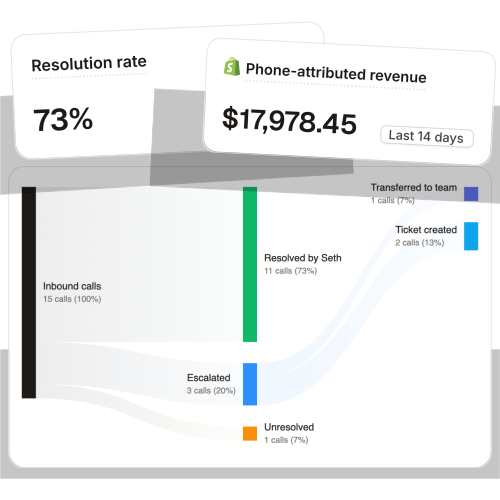
You can see the shape of it in the call data. Gear Rider, a specialty brand, handled 1,595 sales calls in 90 days without a single phone rep on staff. Volume like that doesn't come from people who love filling out contact forms. It comes from customers who'd rather talk.
The questions your customers actually ask
Here's the part that saves you the most money once you see it. Across the 50+ Shopify brands we run phone support for, roughly 70% of a coffee brand's inbound is the same handful of questions, over and over. Map them once and most of your volume becomes routable instead of reactive.
The recurring set, ranked by how often we see them:
- Where's my order. WISMO ("where is my order") runs 30-40% of ecommerce tickets in a normal week and climbs past 50% at peak, per Salesforce data on WISMO. For coffee it's worse around gifting, because the question becomes "will it arrive by the 24th."
- Grind and roast changes. "Send it ground for a drip machine." "Can I switch to the dark roast." Easy to answer, constant, and the Trade Coffee pattern shows a confusing grind setting on the site quietly generates a wave of these.
- Freshness and roast date. "When was this roasted." "Is it still good." A real buying signal, not a complaint.
- Subscription changes. Skip the next bag (which is not the same as pause), change cadence, swap beans. Getting "skip" wrong is a top driver of cancel requests.
- Damaged, wrong, or stale product. Needs a fast, no-questions replacement. Make the customer fight for it and you lose the LTV.
- Phone orders. Older buyers who won't place online and just want to talk to someone.
- Corporate and bulk gifting. Spikes in Q4, higher value, more anxious about delivery dates.
The same five questions, all day, every day, are exactly the work your team shouldn't be spending its hours on. Sort your tickets by reason for one week and you'll have your own version of this list. That list is your automation map.
The channels a coffee brand needs (and how to route them)
You don't need every channel. You need the few your customers actually use, wired so the routine stuff resolves fast and the hard stuff reaches a human.
| Channel | Best for | Target first response |
|---|---|---|
| Email / helpdesk | Detailed issues, photos of damaged bags, order edits | Under 4 hours, under 1 hour ideally |
| Live chat | Pre-purchase grind/roast questions, quick WISMO | Under 2 minutes during staffed hours |
| Phone | Older buyers, phone orders, urgent gift-delivery worry | Pick up, every time |
| SMS | Order updates, payment links, shipping confirmations | Automated, instant |
| Self-serve tracking | WISMO before it becomes a ticket | Instant |
A solid order-tracking page deflects WISMO before it lands, and a paid helpdesk like Gorgias or its alternatives handles email and chat well. The channel that breaks for coffee brands is the phone.
Look at the published hours of real coffee brands and the gap jumps out. Mon-Fri 8:30 to 4:30. Mon-Fri 6 to 6. Mon-Fri 9 to 5. Then nothing. Your phone is staffed during the exact hours your older customers are at work, and silent during the evenings and weekends when they actually call. When a caller can't reach a person, 85% never call back and 62% switch to a competitor, per PCN's missed-call study. And 80% of the ones you push to voicemail hang up without leaving a message. The after-hours line isn't a small leak. It's revenue walking out the door quietly.
Set SLAs you can actually hit
An SLA you miss every day is worse than no SLA, because it trains your team to ignore the targets. Set ones that match your channels and your staffing.
Reasonable targets for a mid-size coffee brand:
- Email: first response under 4 hours, resolution under 24. Speed compounds. One study found sub-1-hour first responses keep 71% of customers versus 48% for replies that take a full day.
- Chat: under 2 minutes during staffed hours, or turn it off when you can't staff it. A chat widget nobody answers is a trust killer.
- Phone: answered, not parked. Black Rifle Coffee learned this the hard way when its line told callers it was busy fulfilling orders and then disconnected them. That's the worst outcome of all.
- Replacements: same-day yes on damaged, wrong, or stale product. No photos-and-forms gauntlet on a $20 bag.
Then write a second, looser SLA for peak season and tell customers about it. A banner that says "we're running on holiday volume, replies may take up to 48 hours" sets expectations instead of breaking promises. If you want a deeper framework, our guide to ecommerce customer service SLAs walks through the math.
Surviving the Q4 gifting spike
Coffee is a gifting business in November and December, and the support load moves with it. Ticket volume across ecommerce jumps 200-300% between Thanksgiving and Christmas, agents in 2025 handled about 22% more sessions per week, and 77% of retailers hit labor shortages right when they needed people most (see Shopify's holiday customer service guidance and the broader ecommerce customer service playbook).
The trap is hiring for the peak and paying for it all year. A coffee brand that staffs for December is overstaffed for the other ten months and still underwater on the 24th. Here's the honest cost of the seasonal-rep path.
What this costs a $20M coffee brand
Specialty food and coffee brands run a small team year-round and a much bigger one for the Nov-Dec gifting rush:
- 4 reps × $4K loaded year-round = $16,000/mo ($192K/yr)
- 4 extra seasonal reps × $4K × 3 months = $48,000/yr peak
- True annual CS spend: roughly $240,000/yr
The work those reps do in November is mostly the same WISMO, gift-ETA, and grind questions they answer in June, just more of it. Route the routine 70% to an AI phone agent at roughly $3K-$5K/mo and it absorbs the gifting spike without the hiring scramble. Net savings land around $140K-$180K/yr depending on volume. Start that work by September, not November, the way every holiday-ready support team does.
If you're a $10M+ coffee brand staring down another Q4, book a 30-min call and we'll run your numbers live.
Where AI fits: the routine 70%, not the whole job
AI is one layer of this, not the answer to all of it. The right way to think about it: let the AI take the repeatable calls so your people can handle the ones that actually need a human.
Ringly.io is AI phone support for Shopify brands. Instead of hiring and training a phone team, the AI handles inbound calls 24/7: order status, returns, product questions, abandoned cart rescue. Across 50+ brands, it resolves 73% of calls autonomously at roughly $0.42 per resolved call, and calls that need a person escalate cleanly to Gorgias, Re:amaze, or whatever helpdesk you already run.
The thing coffee operators ask first is whether their older customers will accept it. Fair question. The answer is voice quality, and it's the single most repeated compliment we hear across every brand.
"My customers also feel like it's a normal person. They feel like they can communicate if they have questions."
— Claudia Droge, TechCraft Studio
For the older buyer who calls to place an order, the AI doesn't fake taking a credit card over the phone. It transfers to a human or sends an SMS payment link. The routine stuff (WISMO, grind, roast date, skip-my-bag) it just handles. The line is open at 9 p.m. on a Sunday, which is exactly when that customer calls.
What still goes to your team:
- Taste disputes and quality complaints that need judgment ("this batch tastes off")
- A gift that arrived late or damaged during the holidays, where the customer is upset and wants a human
- Anything emotional where the relationship matters more than the answer
That's the escalation rule, hard-coded. Set it once and the AI knows what to handle and what to hand off.
The call makes sense if:
- You're a Shopify (or Shopify Plus) coffee brand doing $10M-$100M
- You run a paid helpdesk (Gorgias, Zendesk, Gladly, Re:amaze, or Intercom)
- You have a visible phone number on your store
- Your CS team is 3-12 people
If that's you, the math usually works out in your favor.
What happens on the call.
- We pull your last 7 days of missed calls live, on the call. No homework for you.
- We show you the recovered revenue at the resolution rates we see for coffee and specialty food.
- You decide if it's worth going further. No deck, no follow-up sequence.
Want to compare this to what your team handles today? Book a 30-min call and we'll do the math on your store.
WashCo, a Shopify brand we launched recently, generated $22,664 in attributed revenue in the first 7 days post-launch, with 271 calls handled, 85% deflection, 66% resolution, and $0.91 per call versus $2.70 for a human-handled one. Different vertical, same mechanism: the routine calls get answered, and answered calls turn into orders. If you want the deeper version, here's our take on voice AI for customer service and how it keeps customers coming back.
Frequently asked questions
What are the most common customer service questions for a coffee brand? Order status (WISMO), grind and roast changes, freshness and roast-date questions, subscription changes like skip-or-pause, and replacement requests for damaged or stale product. Across the brands we work with, these few make up around 70% of inbound. The rest are taste and quality issues that need a human.
How should a coffee brand handle after-hours calls? Most coffee brands staff the phone 9-to-5 and lose the evening and weekend calls, which is when their older customers actually dial. Either extend coverage or put an AI phone agent on the line so the routine calls get answered around the clock. The cost of doing nothing is high: 85% of callers who can't reach you never call back.
What customer service channels does a DTC coffee brand need? Email or a paid helpdesk for detailed issues, live chat for quick pre-purchase questions, a self-serve order-tracking page to deflect WISMO, SMS for updates and payment links, and phone for the older buyers and gift-delivery worries. You don't need all of them maxed out, you need the ones your customers use answered reliably.
How do you handle the Q4 gifting support spike? Start prep by September, write a separate peak-season SLA and tell customers about it with a site banner, and route the routine 70% of contacts to automation so your team can focus on upset gift recipients. Hiring four seasonal reps to answer the same WISMO questions is the expensive path. Volume jumps 200-300% over the holidays, so plan for it early.
Can AI handle coffee brand customer service? Yes, for the routine majority. An AI phone agent for gourmet food brands handles order status, grind and roast questions, freshness, and subscription changes, then transfers or sends an SMS payment link for phone orders. Taste disputes and emotional gift issues still go to your team.
What SLA should a coffee brand set for support response times? Aim for email first response under 4 hours, chat under 2 minutes when staffed, same-day yes on replacements, and a phone that gets answered rather than parked. Sub-1-hour first responses retain about 71% of customers versus 48% at a full day, so speed pays for itself.
How do you handle subscription skip versus pause requests? Treat them as different actions. "Skip my next bag" means one shipment off, not a permanent hold, and conflating the two is a top driver of cancel requests. Make both one-click in the customer portal and the calls about it mostly disappear. Our coffee subscription customer service guide goes deeper.
Talk to us

If you run a $10M-$100M Shopify coffee brand and the after-hours line goes quiet, a 30-min call is the fastest way to see what the routine calls are costing you. We'll pull your recent missed calls and run the recovered-revenue math live.
The 3-layer guarantee.
- Live in 14 days or it's free until launched.
- 65% resolution in 90 days or we refund the last 3 months of subscription fees.
- We keep working free until we hit 65%.
Ruben (Ringly co-founder) takes these calls personally.