
This post in 30 seconds.
- Returns hit roughly one in five online orders in 2026, and most of them were decided before checkout. A chatbot can catch the wrong buy at three moments: pre-purchase, the point of doubt, and post-purchase.
- The moment chat keeps missing is the phone call. The high-value, "I'd rather just call" shopper doesn't type into a widget, and that call is usually a return about to happen.
- Built for founders and CX leads at $10M-$100M Shopify brands running a paid helpdesk and a visible phone line.
Returns are now about 20.8% of online orders heading into 2026, up from 11% in 2020, according to DTC benchmark data from Eightx. Online stores get returned at more than double the rate of physical retail, where the number sits around 8.7%. And roughly 45% of those returns trace back to size, fit, or color, per the root-cause data Baymard and Narvar track. So when someone asks whether a chatbot can reduce returns, the real question is narrower: where in the buying journey does a return get born, and can a conversation catch it before it does.
That is the lens this guide uses. Most articles on this keyword stop at fit quizzes and size predictors on the product page. Useful, but it's a third of the story. If you're the founder or Head of CX at a $10M-$100M Shopify brand, you already know the routine: a wave of "where's my order" questions, the same product questions over and over, and a return rate that quietly eats margin every month. The brands we run AI phone support for see the same pattern, and a real chunk of it is preventable. Book a 30-min call and we'll look at where your returns are actually getting decided.
Here's the part most playbooks skip. A return is rarely an accident at the warehouse. It's a decision the customer made earlier, usually while they were uncertain about something a quick answer would have settled. Find those moments and you find your return rate. Want to see your own numbers on a call?
Where returns actually get born (the three moments a chatbot can touch)
A return looks like one event: a box comes back. But it's really the end of a chain that started much earlier. Map the chain and you can see exactly where a conversation could have changed the outcome.
There are three moments where a chatbot, typed or spoken, can step in.
- Pre-purchase. The customer is about to buy the wrong thing. Wrong size, wrong shade, wrong product for their use case. About 45% of returns trace to size, fit, or color mismatch, per Baymard and Narvar data. Another 14% come from a product that didn't match the description.
- The point of doubt. The customer is hesitant. They'll either guess, abandon, or buy and "see how it goes." Bracketing, buying multiple sizes to return the extras, is now practiced by 63% of consumers. A guess at checkout is a return waiting in the next paragraph of the story.
- Post-purchase. The order arrived and something's off, or they panicked before it even shipped. This is where a return either happens or gets turned into an exchange. Narvar finds up to 60% of returns can be converted to an exchange or store credit when the experience supports it.
Most teams pour their entire returns budget into the first moment and ignore the other two, which is where the margin actually leaks. Fit tech and size quizzes are real, but they only touch shoppers who engage with them. The point-of-doubt caller and the post-purchase exchange both happen in a live conversation, and that's the part the typical chatbot stack never reaches.
Each return also carries a real cost. Processing a single return runs $10 to $65 once you count return shipping, labor, inspection, and restocking, and fewer than half of returned items resell at full price. So you pay twice: the processing overhead and the margin haircut on the item's second life. For a fuller breakdown of the numbers, our ecommerce return statistics for 2026 post has the category benchmarks.
One more thing the chain view makes obvious. A return doesn't just cost you the box coming back. It also generates a support contact, and often two or three. The customer who's unsure pre-purchase contacts you, the customer whose order is late contacts you, and the customer initiating the return contacts you again. So every return reason is also a CS volume driver, which is why the brands that get serious about returns almost always end up looking at their phone and chat queues at the same time. The two problems share a root: a question that didn't get answered at the right moment. Our ecommerce customer service overview gets into how those queues interact.
How I looked at this
I'm Ruben, co-founder of Ringly. We run AI phone support for Shopify brands, which means I see what actually drives contacts, and a surprising share of them are returns in disguise.
For this guide, I went through 30 days of real call transcripts across the brands we run and sorted them by what the customer actually wanted. Here's what I scored against:
- Was this a return about to happen? I tagged every pre-purchase "is this right for me?" call, since each one is either a right buy or a return depending on the answer.
- Was this a post-purchase save? I counted the "I want to return this" and "where's my order" calls, then noted how many could have become an exchange instead of a refund.
- Could chat have caught it? For each call, I asked whether the same customer would have typed the question into a chat widget. Most would not. They called because they wanted a person.
- What did the resolution cost? I pulled the real per-call cost from the dashboard and compared it to the cost of the return it prevented or diverted.
I'm not neutral. I sell Ringly, and Ringly shows up later in this post for the same reasons everything else does. But the transcript read is the part nobody outside a platform like ours can do, and it changed how I think about returns: a lot of them are sitting in your phone queue right now, waiting for someone to pick up.
Moment 1: pre-purchase, where the chatbot stops the wrong buy
This is the moment the rest of the internet writes about, so let's be quick and accurate about it.
A pre-purchase chatbot reduces returns by answering the question that would otherwise be a guess. What size am I? Will this shade match? Is this the right formula for my skin, my dog, my machine? A 2024 peer-reviewed study across 120,000 shoppers and six European retailers found AI size predictors cut size-related returns by 22% on average. Better pre-purchase guidance more broadly tends to land in the 15-20% range, per the return-reduction research envive compiled.
The catch is in the fine print of that 22% study: it only held for shoppers who completed all the inputs. The chatbot helps the people who engage it. Everyone else buys on a guess.
It also isn't a fashion-only play, even though the SERP makes it look that way.
- Supplements. "Will this interact with what I'm already taking, and is the 3-month or the monthly right for me?" Get that wrong and you get a cancellation plus a return.
- Beauty. Shade and skin-type match. The wrong foundation is an instant return and a one-star review.
- Pet. Breed and weight fit on harnesses, beds, and food portions. Pet parents return fast when something doesn't fit the animal.
- Specialty food and coffee. Roast level, grind, dietary fit, and gift timing. A perishable that "wasn't what I expected" is a refund you can't restock.
A good pre-purchase chatbot, the kind we cover in our guide to AI chatbots for ecommerce websites, trained on your real size charts and your actual return reasons, gives specific advice instead of a generic table. That's the difference between deflecting a return and just answering a FAQ. If you want the broader version of this, our post on AI shopping assistants walks through the pre-purchase guidance patterns.
The mechanism is worth being precise about, because "chatbot reduces returns" gets thrown around loosely. It works in two ways. First, it sets expectations: when the customer hears that a coffee is a dark roast or that a supplement is a 90-day regimen, the product they receive matches the picture in their head, and the "didn't match expectations" return never forms. Second, it routes them to the right SKU: instead of guessing between two sizes and bracketing both, they buy the one the assistant pointed them to. Expectation match plus correct routing is most of the 45% size-fit-color bucket, which is why pre-purchase guidance is the highest-volume lever even if it isn't the highest-margin one.
Moment 2: the point of doubt, where chat hits its ceiling
Now the part the playbooks miss.
Pre-purchase chat works on the shopper who's already leaning in and willing to type. But a big slice of your highest-intent buyers don't behave that way. They're older, the order is expensive, and when they're unsure they do the thing your widget can't capture: they pick up the phone.
If that call goes to a missed-call queue or to voicemail, one of two things happens. They abandon, which is a lost sale, or they buy on a guess, which is a return three days from now. Either way you lost the moment a conversation would have saved.
This is the structural limit of chat-only tools. A typed assistant like Tidio or Intercom only ever helps the customer who chooses to type. The 22% number from that size-predictor study lives entirely inside that group. The non-typers, who skew toward your higher-AOV demographic, get nothing.
The phone call is the highest-intent, lowest-friction moment a customer gives you, and most brands answer it with a voicemail box. That's the return getting born in real time.
A voice chatbot, an AI phone agent, closes that gap. It answers the fit question, confirms the right product, and lets the customer buy with confidence, on a channel they actually chose. And the most common thing customers say after one of these calls is not a complaint about talking to a robot.
"My customers also feel like it's a normal person. They feel like they can communicate if they have questions."
Claudia Droge, TechCraft Studio
TechCraft Studio handles 88% of its calls without a human, and the customers don't notice the seam. That's the bar voice has to clear to work as a returns lever, and it's clearable now in a way it wasn't two years ago. We go deeper on the voice side in our AI voice agents for ecommerce guide.
Moment 3: post-purchase, turn the return into an exchange
The third moment is the one with the fastest payback, because the customer is already contacting you. They've decided something's wrong. The only question is whether you lose the sale or keep it.
A live conversation does what a returns portal can't: it asks why. Wrong size? Offer the right one as an exchange with free return shipping. Didn't match expectations? Surface the product that actually fits the use case. Just impatient because the package is late? That's a WISMO call, not a real return, and answering it calmly stops a panic refund before the box even ships back.
The numbers here are strong. Narvar finds up to 60% of returns can be converted into an exchange or store credit, and 92% of customers will buy again after an easy return experience. An exchange keeps the revenue and the customer. A refund keeps neither.
- Catch the panic return. A chunk of "I want to refund" contacts are really "I don't know where my order is." Resolve the WISMO and the return evaporates. Our returns management post covers the operational side.
- Offer the swap first. A chatbot that can pull the order and propose a Shopify exchange in the same conversation converts far more than a static returns form.
- Make it effortless. The easier the return, the more likely the repurchase. Friction kills the relationship, not the refund. See our DTC returns best practices for the full checklist.
The return-to-exchange conversion is the single highest-margin move a post-purchase chatbot makes, and it only works when the customer can actually have a conversation. A form can't talk someone out of a refund. A person can, and so can an AI that sounds like one.
There's a timing point worth naming too. Post-purchase doubt has a short fuse. A customer who gets their tracking question answered within minutes calms down. The same customer who waits a day for an email reply has already started the return, told a friend, maybe left a review. The brands we run see this constantly: the after-hours and weekend calls are exactly when post-purchase anxiety peaks, and they're exactly when a human team is offline. An always-on conversation, on whatever channel the customer reaches for, is what turns that fuse into a save instead of a loss.
What this is worth: the cost-of-returns and CS math
Let's put numbers on it, because returns are a margin problem and margin problems get budget.
Each return costs $10 to $65 to process, and fewer than half resell at full price. Now layer the support cost on top: every one of those return-related calls is also a CS contact, and your team is fielding the same questions over and over. That's two costs stacked on one event.
Take a typical $50M Shopify brand running a 6-rep CS team:
| Line item | Today | With Ringly |
|---|---|---|
| 6 reps x $4K loaded per rep | $24,000/mo | n/a |
| Ringly (~$5K/mo) | n/a | $5,000/mo |
| Net monthly CS spend | $24,000/mo | $5,000/mo |
| Monthly savings | n/a | $19,000/mo |
| Annual savings | n/a | $228,000/yr |
That's roughly 70% of the repeatable calls, order status, fit questions, exchange requests, the same five things over and over, handled autonomously. The other 30% still go to your team, who now have time to actually save the hard ones. And the returns the AI prevents or diverts are pure margin on top of the payroll math.
WashCo, a Shopify brand we launched, recovered $22,664 in attributed revenue in its first 7 days on the phone, much of it from calls that would otherwise have ended in a voicemail box and a guess. That's the revenue side of the same coin: every saved call is either a return prevented or a sale kept. For the deeper cost breakdown, our how to reduce product returns guide runs the merchandising levers alongside the support ones.
If you want to run this against your real call volume and return rate, book a 30-min call and we'll do the math live.
How Ringly reduces returns on the phone
Ringly.io is AI phone support for Shopify brands. It's the voice layer that catches the returns chat can't reach, both the pre-purchase fit call and the post-purchase exchange.
The AI answers inbound calls 24/7. It finds the order in your Shopify store, answers product and fit questions from your knowledge base, checks order status to defuse the WISMO-panic return, and offers an exchange before a refund. Calls that need a human escalate cleanly to Gorgias, Richpanel, Reamaze, or whatever helpdesk you already run. You keep your number, your stack, and your workflows. We sit in front of them.
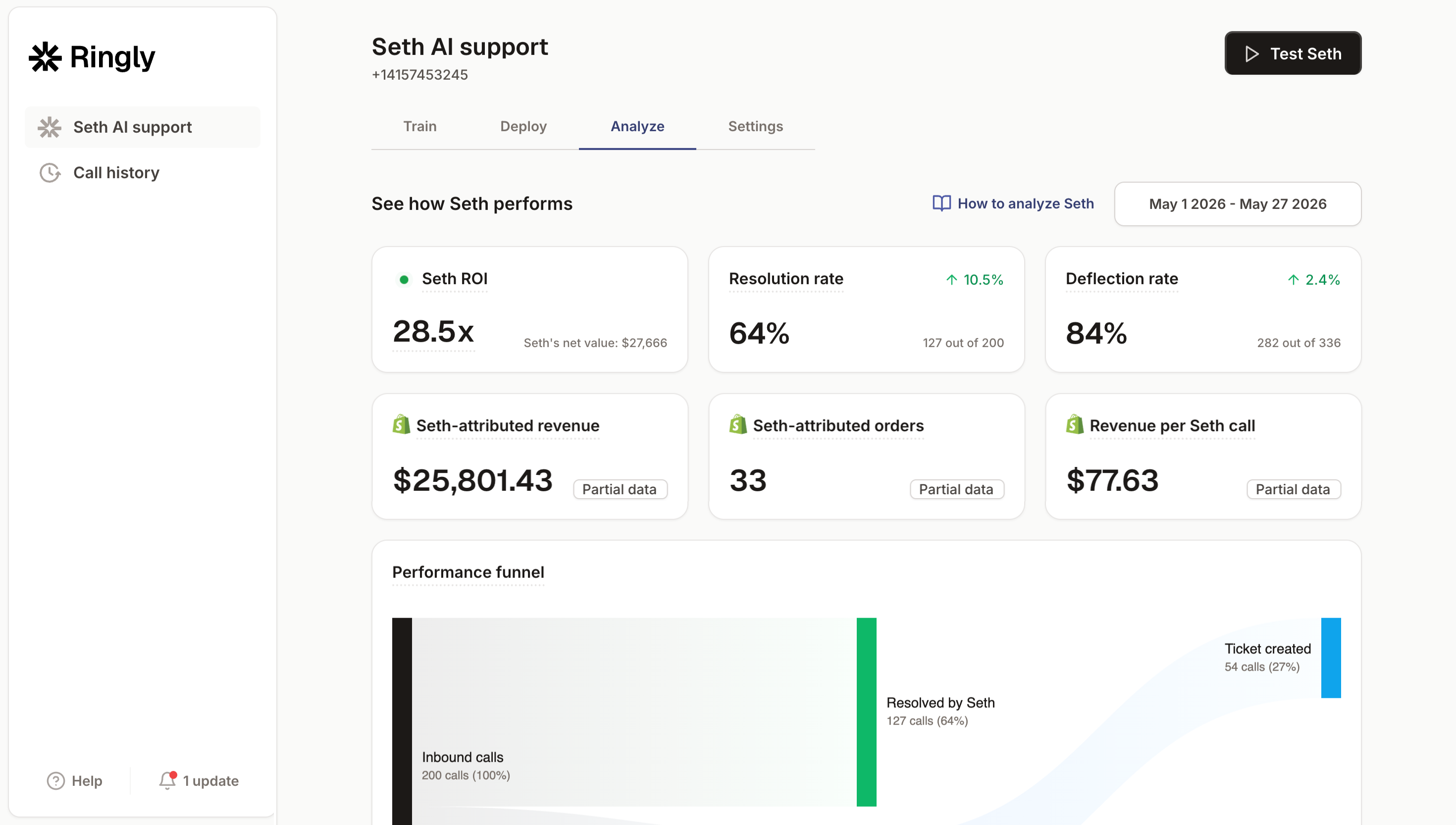
Seth resolves up to 90% of calls autonomously for $1.99 a call after the first 50, versus $7 to $16 per call at a human BPO. BioLongevity Labs, a supplement brand on Ringly, hits 79% resolution. Gear Rider closed 1,595 sales calls in 90 days without a phone rep, the kind of volume that would otherwise mean four seasonal hires or a wall of voicemails.
Pricing: $99 a month for the first 50 conversations, then $1.99 each. Live in under an hour. We back it with a 65% resolution guarantee: if Seth resolves under 65% of your calls in a month, that month comes back as credit (after 90 days on Pay per call). If you're weighing this against your current setup, our ecommerce returns best practices guide lines up the prevention levers, and you can see the tiers on the pricing page.
How to put a chatbot to work on your returns (5 steps)
You don't need to boil the ocean. Start with the moments that leak the most margin.
- Map your top three return reasons. Pull last quarter's returns and sort by reason. Size, fit, description mismatch, WISMO panic. You can't prevent what you haven't counted.
- Put the answer in the conversation, not just on the page. A product-page size chart helps the reader. A chatbot that answers "will this fit me?" in the customer's own words helps the buyer. Do both.
- Add the phone channel for the non-typers. This is the step most brands skip. The highest-intent shoppers call. If that call isn't answered, the chatbot strategy has a hole exactly where your best customers are.
- Wire the post-purchase exchange offer. Make "exchange" the default first response to a return request, in the conversation, with the order already pulled up. That's how you hit the 60% conversion Narvar measures.
- Measure return rate by reason, monthly. Watch the size/fit number after you add fit guidance. Watch the refund-to-exchange ratio after you add the post-purchase conversation. If a lever isn't moving its number, change it.
Want a second set of eyes on your return reasons before you build anything? Book a 30-min call and we'll map it with you.
Frequently asked questions
Can a chatbot actually reduce my return rate, or is that a vendor claim? The effect is real but bounded. A 2024 peer-reviewed study found AI size predictors cut size-related returns by 22%, and broader pre-purchase guidance lands around 15-20%. The catch is it only works for shoppers who engage the tool, which is why the phone channel matters for the customers who won't type.
What's the difference between a chat chatbot and a voice chatbot for returns? A chat chatbot answers typed questions on your site and helps the shoppers who engage the widget. A voice chatbot, or AI phone agent, answers the inbound call, which is where your higher-AOV and older-demographic customers go when they're unsure. The call is the moment chat can't reach.
Where do most ecommerce returns actually come from? About 45% trace to size, fit, or color mismatch, 16% to damage, and 14% to a product not matching its description. Most of those were decided before checkout, while the customer was uncertain about something a quick answer would have settled.
Does answering returns by phone really save money? Yes, on two lines at once. A return costs $10 to $65 to process and fewer than half resell at full price, and the same call is a CS contact you're paying a rep to handle. Ringly resolves up to 90% of calls autonomously for $1.99 a call after the first 50, versus $7 to $16 at a human BPO.
Will customers be annoyed talking to AI on the phone? That's the most common worry and the least common outcome in practice. The single most repeated thing customers say after a call is "you don't sound like AI." TechCraft Studio handles 88% of its calls without a human and the customers don't notice the seam.
Can a chatbot turn a return into an exchange? That's its highest-margin move. Narvar finds up to 60% of returns can be converted to an exchange or store credit, and a conversation that pulls the order and offers the swap first converts far better than a static returns form.
Do I have to replace my helpdesk to add a voice chatbot? No. Ringly sits in front of your existing stack and escalates cleanly to Gorgias, Richpanel, Reamaze, or whatever you already run. You keep your number, your helpdesk, and your workflows.
Talk to us

If you run a $10M-$100M Shopify brand and your return rate is eating margin, a 30-min call is the fastest way to see how much of it is sitting in your phone queue right now. If your phone rings during a return decision and nobody picks up, that's a refund you could have kept as an exchange.
Our 3 promises.
- Live in under 1 hour. Setup and test calls are free.
- 30-day money back on the $99 plan fee.
- 65% resolution guarantee: if Seth resolves under 65% of your support calls in a month, that month comes back as credit (after 90 days on Pay per call).
Ruben (Ringly co-founder) takes these calls personally.