
The short version.
- The gap: almost every Black Friday strategy guide is built around the demand side. The support load that demand creates, especially on the phone, is the half nobody writes down.
- The number: Shopify merchants hit $5.1 million in sales per minute at Black Friday peak last year. Support volume climbs 60-80% across the season, and the phone is where it lands hardest.
- Built for: founders, COOs, and Heads of CX at $10M-$100M Shopify brands running a visible phone line and a 3-12 rep support team.
You spent months on the offers. The email flows are queued, the inventory is forecast, the landing pages are built, the ad budget is loaded. Your whole Black Friday strategy is engineered to do one thing: create a wave of demand.
Here's the part that doesn't make it into the planning doc. Every dollar of that demand creates a support event somewhere downstream. A promo code that won't apply. A shipping cutoff question. An order that says "delivered" but isn't, the classic where's my order call. And a lot of those events end with a customer picking up the phone, on a Saturday night, while your line rings out to voicemail.
If you run customer experience or operations at a $10M-$100M Shopify brand, you already know the front half of this cold. This piece is about the back half, the one the strategy guides skip. Most $30M+ brands run a five-to-twelve rep support team and a phone line that goes quiet after 6 p.m., right when the after-hours wave starts. Book a 30-min call and we'll show you what your store is leaving on the table on the calls you miss during your biggest week.
The demand side is only half the strategy
The numbers that anchor every Black Friday plan are demand numbers. Shopify merchants did $14.6 billion globally over the 2025 Black Friday Cyber Monday weekend, up 27% year over year, peaking at $5.1 million in sales per minute just after noon on Black Friday. Across the full season, Adobe clocked $257.8 billion in US online spend, a record, with 56.4% of it coming from a phone in someone's hand.
Those are the numbers you plan around. They are also, read another way, a forecast of the support load coming at you. A Black Friday strategy that plans the demand but not the support load behind it is half a strategy. You can engineer a 3x traffic spike with a good offer and a tight email calendar. The questions, the order problems, and the calls scale right alongside it, and most plans treat that as someone else's problem until the week it lands.
The brands that come out of the weekend with their reputation intact are the ones that treated support capacity as a line in the strategy, not a fire to put out on Friday morning. The rest spend December apologizing.
It helps to think of it as two budgets. There's the demand budget: ad spend, discount margin, the cost of the offer. Everyone tracks that one to the dollar. Then there's the implicit support budget, the cost of answering everyone your demand budget brought to the door. That second budget rarely gets written down, so it gets paid in the worst possible currency: missed calls, one-star reviews, and a support team that quits in January. Naming it ahead of time is most of the work.
What the surge does to your support queue
Holiday support volume doesn't nudge up. It jumps 60-80% across the season, and some stores see two to four times their normal ticket load during peak week. Shopify's own holiday data has pegged the support-ticket spike at roughly 79% in the first week of December alone.
The pressure isn't just volume, it's speed. During the holidays, 71% of shoppers expect a response within five minutes, and 32% say they'll shop elsewhere after a single bad experience. On your highest-revenue week, the margin for a slow or missed reply is basically zero.
It's also worth being honest about what the volume is made of. Most of the spike isn't angry customers or hard problems. It's the same handful of questions, asked by a flood of new buyers who've never shopped with you before: did my order go through, when will it ship, does this code stack, can I still get it by the 24th. WISMO alone runs 30-40% of tickets in normal periods and tips over 50% at peak. That's the good news hiding in the bad news. A queue made mostly of repeatable questions is a queue most of which doesn't actually need a person.
Here's why the phone breaks before anything else. Chat and email can queue. A ticket can sit for twenty minutes and the customer is annoyed but still there. A phone call can't queue the same way, because the customer is standing in line in real time. A holiday caller gives you about two minutes before hanging up, and roughly two-thirds won't wait longer than that. When your traffic triples, your phone hold time doesn't degrade gracefully, it falls off a cliff.
I called a dozen Shopify brands' support lines the Saturday after Black Friday last year, after 8 p.m. local time. Most went straight to voicemail. A couple rang for two minutes and then dropped. One actually picked up, and it was the only brand on the list I'd have felt comfortable spending money with that night. That's the difference the phone makes during the surge, and it's the part the strategy guides never measure.
The reasons people call during this window are predictable, which is exactly why they hurt to miss. They're checking whether a promo code applies before they commit. They're asking if an item is really in stock. They're trying to confirm a shipping cutoff so a gift arrives in time. None of those are complaints. They're buying signals, and the customer is one unanswered call away from taking that signal to a competitor whose line picked up.
The after-hours leak nobody budgets for
Black Friday is a global, around-the-clock event. Your phone line probably isn't. The deals go live at midnight, customers shop on their own schedule, and a real chunk of your calls arrive at 9 p.m., on a weekend, when nobody is staffed to pick up. This is the case for after-hours phone coverage that most brands only think about once the calls are already lost.
That gap is expensive in a way that never shows up cleanly on a report. 85% of callers who can't reach a person never call back, and 62% switch to a competitor. Voicemail doesn't save you either: 80% of callers routed to voicemail hang up without leaving a message. So the after-hours call isn't a deferred sale you'll catch tomorrow. It's a sale that just walked to whoever picked up.
This is the silent leak running underneath your biggest revenue week. You spent real money driving that person to call. WashCo, a Shopify brand we launched, recovered $22,664 in its first 7 days on the phone, much of it on exactly these calls, the ones a quiet line would have lost. The most expensive call you take during Black Friday is the one you don't take at all.
And the leak compounds, because the after-hours caller you miss isn't just a lost sale, it's often a lost customer. A first-time Black Friday buyer who couldn't reach you on day one has no loyalty to spend, so they form their whole opinion of your brand on whether you picked up. Brands answer only about 37.8% of inbound calls on average across the year. Hold that number against a weekend where your call volume has tripled and you can see how much revenue is quietly rolling to voicemail while the dashboard still looks green.
Hire seasonal reps, or cover the surge another way
Every year, sometime in August or September, this decision lands on someone's desk: do we hire seasonal support reps for the spike, or not? It's a genuinely hard call, and neither obvious answer is good. (We've written a full breakdown of peak-season staffing if you want to go deeper on the trade-off.)
Staff to the peak and you're paying a team that sits idle the other ten months, and idle the other sixteen hours of every day. Staff to your average and you melt down the week it matters most. And seasonal hiring carries its own tax. New reps take six to eight months to get fully productive, which means a December temp is never at full speed during December. Turnover is brutal, and replacing one customer service rep runs about $14,113 once you count recruiting, training, and lost productivity.
Run the math on the steady-state team first, because that's the number the seasonal decision sits on top of.
| Line item | Today | With AI phone coverage |
|---|---|---|
| 6 reps at $4K loaded per rep | $24,000/mo | n/a |
| AI phone agent (Enterprise, illustrative) | n/a | ~$5,000/mo |
| Net monthly CS spend | $24,000/mo | $5,000/mo |
| Monthly savings | n/a | $19,000/mo |
| Annual savings | n/a | $228,000/yr |
The seasonal version of that math is simpler. Instead of hiring four to eight temps you'll train in November and lay off in February, then re-hire and re-train next year, you add coverage that scales with the call volume and doesn't need rebuilding every season. And the timing rarely cooperates with hiring anyway. The window where you'd want a temp rep at full speed is the exact window they're still ramping, so the spike hits while your new hires are still learning your return policy. Roughly 70% of your calls during the surge are repeatable anyway: order status, shipping cutoffs, promo terms, returns, the same five questions over and over. Those don't need a human. Your reps need to be on the genuinely hard calls, not reciting your shipping deadline for the fortieth time before lunch. This is the same call-volume spike that follows any big launch, just compressed into one weekend.
If you want to see what that swap looks like against your actual call volume, book a 30-min call and we'll do the math live on your numbers.
The phone-coverage playbook for the surge
So where does an AI phone agent actually fit a Black Friday strategy? Not as a wall in front of your customers. As the layer that catches the routine and the after-hours volume so your team can stay on the calls that need a person.
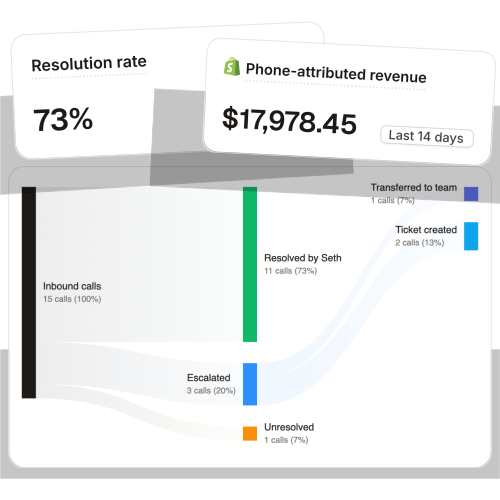
Ringly.io is AI phone support for Shopify brands. The AI answers inbound calls 24/7, finds orders in your Shopify store, processes returns and exchanges, and answers product questions straight from your knowledge base. Across 50+ brands it resolves 73% of calls autonomously at roughly $0.42 per resolved call, and the calls that need a human escalate cleanly to Gorgias or whatever helpdesk you already run. It's live in under an hour, and it's backed by a 65% resolution guarantee.
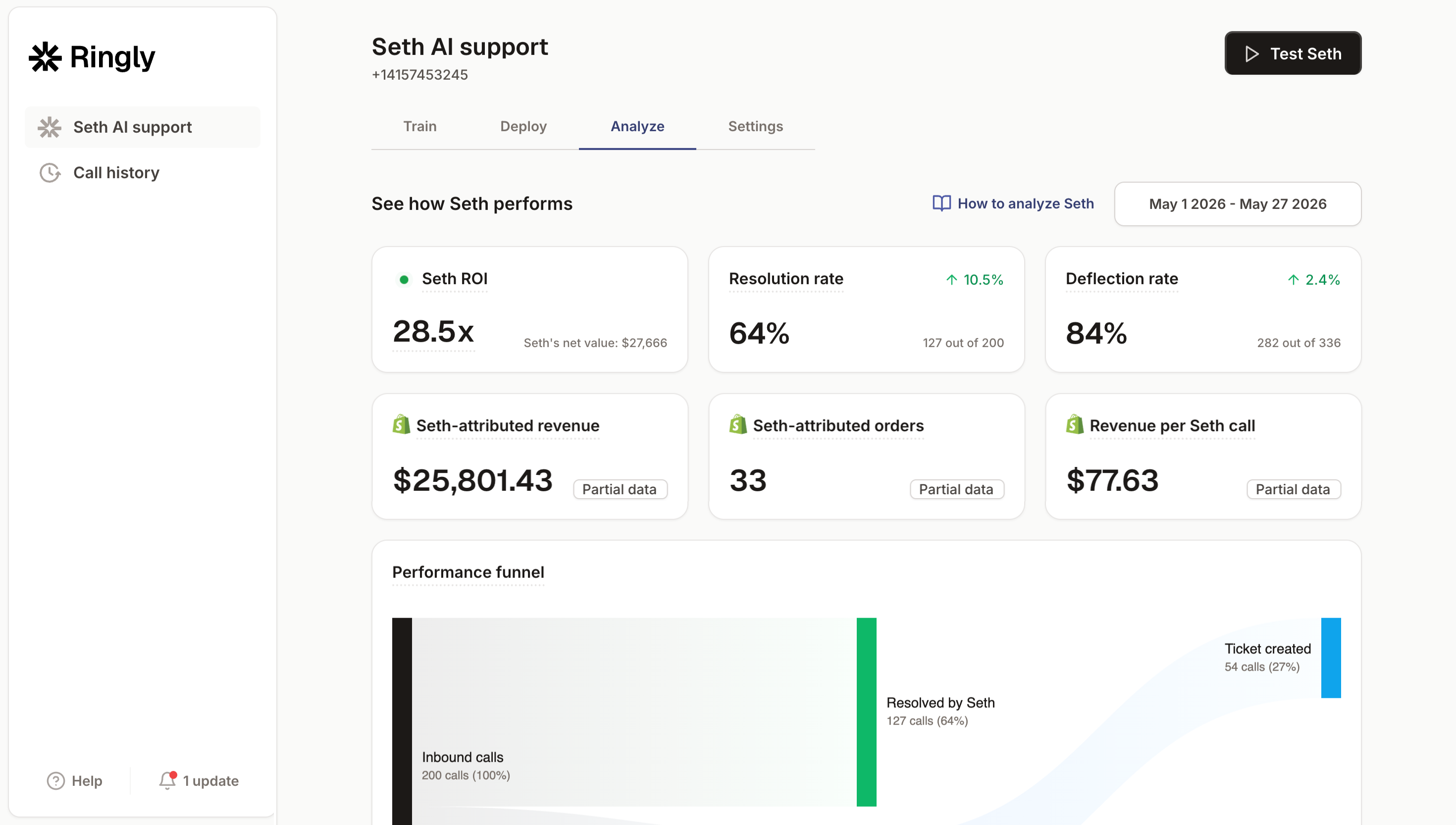
A few moves that make it actually work for the season:
- Front-load your knowledge base with the Black Friday answers. Promo terms, exclusions, shipping cutoffs, stock realities, the return window. The AI is only as good as what you give it, so write the BF-specific facts in before the weekend, not during it.
- Route after-hours and overflow to the AI first. The 11 p.m. caller gets a real answer instead of voicemail, and your daytime queue doesn't start Monday with a backlog of missed calls. This is how brands keep 24/7 phone support live without a night shift.
- Keep your reps on the hard calls. Escalation rules send the genuinely complex situations (a damaged high-value order, an upset customer, anything outside the playbook) straight to your team with the context attached.
- Set clear escalation triggers. Decide in advance what always goes to a human: an order over a certain value, anyone who sounds upset, anything touching a payment dispute. The AI handles the volume, your rules protect the calls that carry the most risk.
- Test it before the surge, not during it. Voice quality is the thing operators worry about most, and it's worth hearing for yourself on a real call before you trust it with your biggest week.
That last point matters because the fear is real. The single most repeated thing customers say after talking to our AI agent is that it doesn't sound like AI.
"My customers also feel like it's a normal person. They feel like they can communicate if they have questions."
Claudia Droge, TechCraft Studio
TechCraft handles 88% of its calls without a human. The point of phone coverage during Black Friday isn't to remove the human, it's to make sure a human is free for the calls that actually need one.
The season doesn't end when the sale ends
The mistake in most holiday plans is treating Black Friday as a weekend. The support load treats it as a quarter. The orders you take in late November turn into "where's my order" calls through December, and then return volumes spike 25-45% in the week after Christmas as the gifts that didn't fit come back. Handling that wave well is its own discipline, and it leans on the same ecommerce customer service fundamentals as the rest of the year.
So your phone-coverage plan has to cover December and January, not just the four-day weekend. WISMO calls, return questions, "where's my refund," exchange requests. Those keep coming long after the deals are gone, and they're the calls most likely to decide whether a first-time Black Friday buyer becomes a repeat customer or a one-and-done. A strategy that wins the weekend and loses January didn't win.
If you want the upstream version of this, our guide to prepping your phone queue for the holiday rush and the breakdown of Black Friday customer service both go deeper on the operational side.
Frequently asked questions
What should a Black Friday strategy actually include? Most plans cover the demand side well: offers, email and SMS, paid traffic, inventory, site speed. The half that gets skipped is support capacity, especially on the phone. A complete strategy plans for the support load the demand creates, not just the demand. See our Shopify BFCM statistics for the full picture.
How much does customer support volume increase during Black Friday? It climbs 60-80% across the season, and some stores see two to four times their normal ticket load during peak week. Shopify's holiday data has put the support-ticket spike near 79% in the first week of December alone. The phone takes the hardest hit because it's the only real-time channel.
Why is the phone the channel that breaks first during BFCM? Chat and email can queue, but a phone call can't, because the customer is on the line right now. A holiday caller waits about two minutes before hanging up, and most won't wait longer. When traffic triples, hold times don't degrade slowly, they collapse, and missed calls turn into competitor sales.
Should I hire seasonal support reps for Black Friday? You can, but it's an expensive hedge: new reps take 6-8 months to ramp, turnover is high, and replacing one rep runs around $14,113. Many brands instead route the routine and after-hours calls to an AI phone agent that scales with volume and keeps human reps on the hard calls. See our take on scaling support without hiring.
Can an AI phone agent handle the call spike without sounding like a robot? Yes on both counts. It scales with volume instead of headcount, so a 3x spike doesn't break it, and the most common thing customers say after a call is that it doesn't sound like AI. Hear it on a real call before the season so you trust it with peak week.
When should I set up phone coverage before Black Friday? The staffing decision usually lands in August or September, so that's the window to decide. Setup is fast, you can be live in under an hour, but you want time to load your knowledge base with the Black Friday specifics and test it before the weekend.
Does AI phone support work with my existing helpdesk? Yes. Calls that need a human escalate cleanly to Gorgias, Richpanel, Re:amaze, or whatever you already run, with the context attached. You keep your current phone number, your helpdesk, and your workflows, and add a layer that handles the routine and after-hours calls.
Talk to us

If you run a $10M-$100M Shopify brand and Black Friday is your single biggest revenue week, the phone is the channel most likely to break under the load you're about to create. A 30-min call is the fastest way to see what your store is leaving on the table on the calls you miss, after-hours and at peak.
The 3-layer guarantee.
- Live in 14 days or it's free until launched.
- 65% resolution in 90 days or we refund the last 3 months of subscription fees.
- We keep working free until we hit 65%.
Ruben (Ringly co-founder) takes these calls personally.