
This post in 30 seconds.
- Eight AI chatbot platforms worth shortlisting for a Shopify brand, scored on Shopify data depth, real resolution, and pricing that doesn't balloon at volume.
- Every one of them works the chat and text channel. None of them touch the phone line, and 76% of consumers still pick up the phone first.
- Built for founders, COOs, and Heads of CX at $10M-$100M Shopify brands running a paid helpdesk with a visible phone number.
Picture a normal Monday inside a growing Shopify brand. The chat widget is humming, your helpdesk is auto-replying to the easy tickets, and the dashboard says deflection is up. Then someone checks the phone line and finds nine voicemails from the weekend, four of them the same "where's my order" question, one from a customer who tried three times.
That second screen is the one almost no "ai chatbot platform" roundup talks about. The chat tools have gotten genuinely good. The phone, for most $10M-$100M Shopify brands, still rolls to voicemail after 6 p.m. This guide ranks the eight platforms worth a shortlist, with real pricing and real ratings, and it's honest about the one channel they all leave open. If you're rethinking your whole ecommerce customer service setup, start with the channel coverage, not the tool list.
Most of these tools solve text. If your store still has a visible phone number and your customers actually use it (older buyers especially), the routine calls and the missed calls are a separate problem the chat widget was never built for. If that sounds like your store, book a 30-min call and we'll show you what your phone line is doing after hours.
The 8 AI chatbot platforms at a glance
Here's the shortlist before the deep dives. Pricing is the entry point for the AI features, not the floor plan, since most of these climb with volume.
| Platform | Best for | Channel | Starting price | Verdict |
|---|---|---|---|---|
| Ringly.io | The phone line | Voice / phone | $349/mo | The layer the others skip |
| Tidio (Lyro) | SMB Shopify chat | Chat / web | ~$24-$49/mo | Best small-store starter |
| Gorgias AI Agent | Brands already in Gorgias | Chat / email | ~$360/mo + per-resolution | Deep Shopify, watch the bill |
| Intercom Fin | High-volume support teams | Chat / email | $0.99/resolution | Strong, gets pricey at scale |
| eesel AI | AI on your existing helpdesk | Chat / email | ~$0.40/task | Good if you keep your stack |
| Re:amaze | Multi-channel on a budget | Chat / email / social | $29/user/mo | Broad, lighter AI |
| Chatbase | A fast website FAQ bot | Chat / web | ~$40/mo | Quick to build, not ecommerce-native |
| Botpress | Custom builds with engineers | Chat / multi | Free + AI spend | Most flexible, most work |
A pattern jumps out of that table. Every row except the first is a chat or text product. That isn't a knock on them. It's the whole reason this list reads differently than the others.
How I tested these 8 AI chatbot platforms
I'm Ruben, co-founder of Ringly.io. Over the last few weeks I ran every platform on this list against the workflow of a real Shopify brand doing eight figures, not a feature checklist.
Here's what I scored against:
- Shopify data depth. I connected each tool to a real Shopify store, pushed a test order through, and watched whether it could actually find that order, read the fulfillment status, and answer a return question, or whether it just pulled a canned FAQ.
- Real resolution, not deflection. I asked each one the questions our customers actually ask: where's my order, can I change my size, where's my refund. Then I scored whether it resolved the question or just closed the conversation.
- Pricing that holds at volume. I modeled each pricing page at 500 and 2,000 conversations a month, because the headline number and the real bill are rarely the same thing.
- Clean human handoff. I tried to escape each bot the way a frustrated customer does, and timed how fast it got me to a person with the conversation history intact.
- The phone line. This is the one nobody else runs. I called the published support number for each brand using these tools and listened to what happened on the channel none of the chat platforms touch.
I only sell Ringly, and it's on this list judged against the same five criteria as everyone else. Where a tool is best in its lane, I say so, including when that lane isn't ours.
The 8 best AI chatbot platforms for Shopify brands
1. Ringly.io
Best for: the phone line every other platform on this list leaves on voicemail. Ringly.io is AI phone support for Shopify brands.
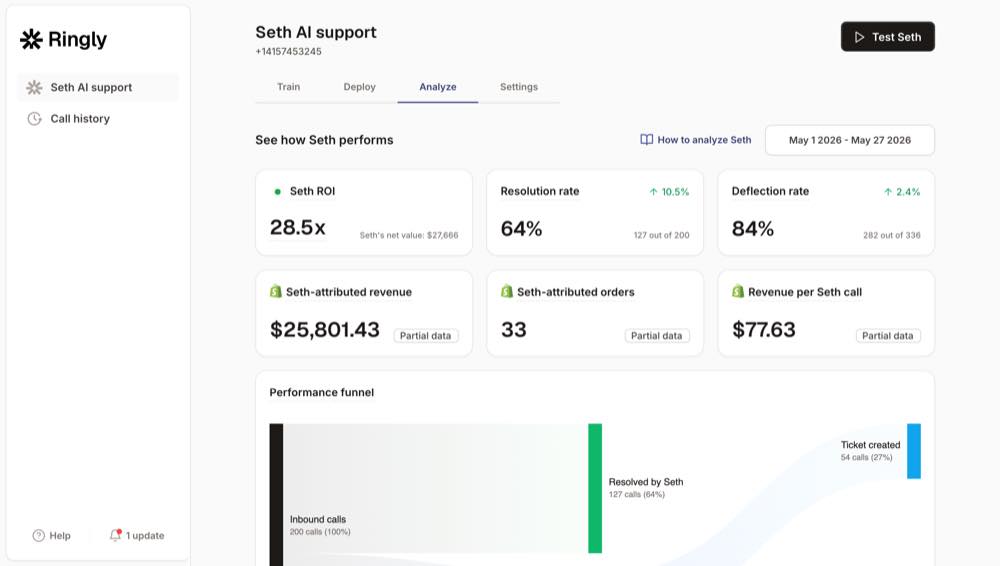
Ringly answers your inbound calls 24/7 in 40 languages. It finds orders in your Shopify store, processes returns and exchanges, answers product questions from your knowledge base, and rescues abandoned carts with an outbound follow-up. Calls that need a person escalate cleanly to Gorgias, Richpanel, Re:amaze, or whatever helpdesk you already run, so you keep your stack and just stop dropping calls.
The phone is where the older, higher-intent, revenue-bearing calls land, and it's the one channel a chat widget was never built to cover.
Pricing
| Plan | Price | Included |
|---|---|---|
| Grow | $349/mo | 1,000 minutes (~500 calls), $0.29/min overage |
| Pro | $799/mo | 2,500 minutes (~1,250 calls), $0.19/min overage |
| Enterprise | By call | Custom volume for $10M-$100M brands |
14-day free trial on Pro. Across 50+ active brands, the AI resolves 73% of calls on its own at roughly $0.42 per resolved call, versus $7 to $16 per call for human BPO.
What works
- Native Shopify order lookup. It reads live order data and handles WISMO, returns, and product questions without a human touching the call.
- You keep your helpdesk. It sits in front of Gorgias or Re:amaze and escalates the hard calls, it doesn't replace them.
- Live in under an hour. Add your site and docs and the agent is ready. No phone team to hire or train.
- It doesn't sound like a bot. The most repeated thing customers say after a call is "you don't sound like AI."
- 65% resolution guarantee. If the AI resolves under 65% of your calls in 90 days, we refund the last 3 months.
What doesn't
- It's a phone agent, not a chat widget. If all you need is a website chat bubble, this isn't that. Pair it with one of the chat tools below.
- No phone-order checkout yet. It can send an SMS payment link, but it won't take a card over the phone.
- Subscription changes are a custom action, not a default, and inventory refreshes daily rather than in real time.
Why it ranks first
Because it owns the channel none of the others do. For a Shopify brand with a visible phone number, the calls are where the expensive, repeat, revenue-attached questions live, and this is the only tool on the list built to answer them.
2. Tidio (Lyro)
Best for: small to mid-sized Shopify stores that want live chat plus an AI FAQ layer in one place. If you're shopping the broader category, our Tidio alternatives page goes deeper.
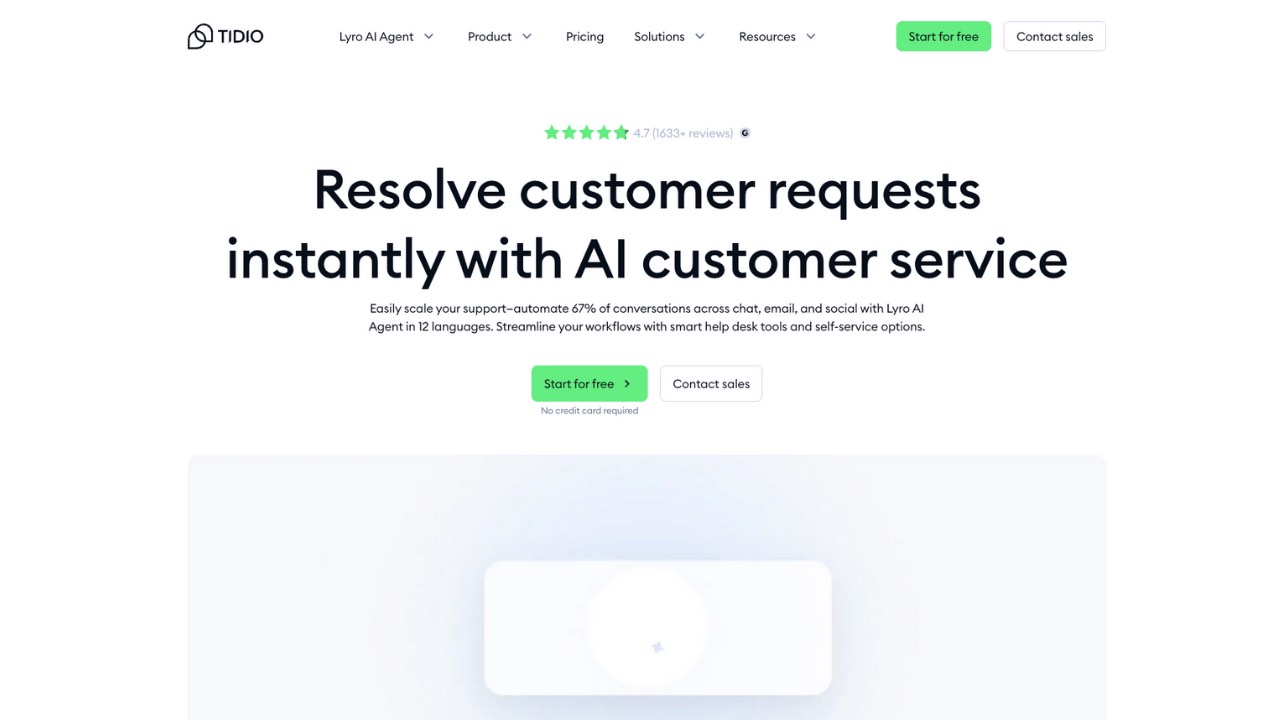
Tidio is one of the most widely used chat platforms for Shopify and WooCommerce stores. Its AI agent, Lyro, runs on Anthropic's models and handles common customer questions on the web widget.
Pricing
Lyro is priced by AI conversations, with paid tiers landing roughly in the $24 to $49+/mo range and a free starter plan to test it. Tidio rates 4.7/5 on G2 across 1,800+ reviews and 4.7/5 on the Shopify App Store across 1,100+ reviews, with ease of use the most-praised attribute.
What works
- Easy to stand up. You can have a working chat bot on the store the same afternoon.
- Lyro is genuinely capable. Tidio claims a 67% resolution rate and backs it with a 50% money-back guarantee.
- Strong Shopify fit for stores that mostly need the web widget covered.
What doesn't
- Conversation-based AI pricing climbs as your volume grows.
- It's chat only. Lyro answers the widget, not the phone.
Why it ranks second
It's the cleanest starting point for a smaller Shopify store. The ceiling is the channel: it's a strong chat tool, and only a chat tool.
3. Gorgias AI Agent
Best for: brands that already run their support out of Gorgias and want AI on their existing tickets. For a wider look, see our Gorgias alternatives breakdown.
Gorgias is the most-installed Shopify helpdesk, and its AI Agent handles order tracking, returns, refunds, subscriptions, and discount codes inside the inbox you already use. The Shopify integration is the deepest on this list.
Pricing
The helpdesk starts around $360/mo, and AI Agent resolutions run $1.00 each on monthly billing ($0.90 annual). The catch: each AI resolution also counts as a billable ticket, so you pay the ticket fee and the AI fee on the same conversation. One review documented a $360 plan turning into a $960 bill at 2,000 tickets with AI on.
What works
- Deepest native Shopify actions of any helpdesk AI here.
- One unified inbox for chat, email, and social.
What doesn't
- Double billing. Ticket fee plus AI fee on the same conversation adds up fast.
- Automation runs below the marketing claim. Gorgias markets up to 60%; its own case studies show 26-56% realistic, and G2 performance data puts response accuracy near 59%.
- The AI Agent is Shopify-only, and it handles tickets, not your phone.
Why it ranks third
It's the strongest pick if you already live in Gorgias, with the honest asterisk that the bill is unpredictable and the phone is a separate problem.
4. Intercom Fin
Best for: higher-volume support teams already on Intercom. If you're weighing it, our Intercom alternatives page has the comparison.
Fin is Intercom's AI agent, resolving support conversations across chat and email. It's one of the more capable reasoning agents in the category, and the pricing is refreshingly simple to read, at least on the surface.
Pricing
Fin charges $0.99 per resolution, one outcome per conversation. Seats and channels are billed on top. G2 reviewers cite 50-80% deflection but flag that the per-resolution model gets unpredictable and expensive at scale, with one noting costs can "add up rapidly."
What works
- Strong reasoning on complex, multi-step questions.
- Transparent per-resolution unit that's easy to model at low volume.
What doesn't
- Cost balloons at volume. $0.99 per resolution is fine at 500 conversations and painful at 10,000.
- Not Shopify-first, and it's chat and email, not phone.
Why it ranks fourth
A genuinely good agent for teams already standardized on Intercom. For a Shopify-native brand watching cost per resolution, the math gets harder as you grow.
5. eesel AI
Best for: teams that want to add AI on top of their existing helpdesk without ripping anything out.
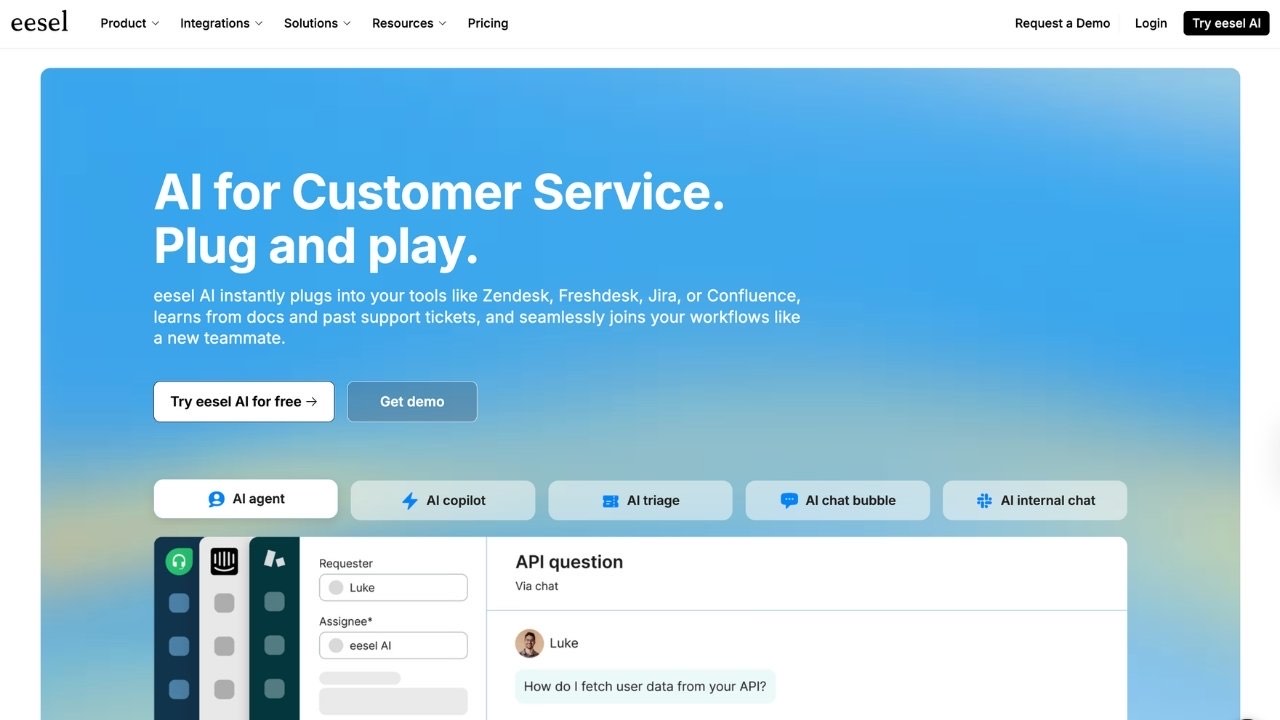
eesel sits on top of your current stack and trains on your past tickets and docs, then lets you simulate performance before you go live. It's a smart approach if your helpdesk is fine and the gap is just the AI layer.
Pricing
eesel runs around $0.40 per task on its regular tier, with tiered options from free up to higher per-task rates and an enterprise tier referenced near $1,000/mo. Pricing is per task, which keeps the unit clear.
What works
- Connects to historical tickets and docs, so it learns your actual support patterns.
- Simulation before launch lets you forecast resolution instead of guessing.
What doesn't
- Smaller, newer presence than Tidio or Gorgias.
- Chat and text channel only, same ceiling as the rest.
Why it ranks fifth
A clever layer if you're keeping your helpdesk and just want AI on top. It's still solving the text channel.
6. Re:amaze
Best for: brands that want a lot of channels bundled cheaply per seat.
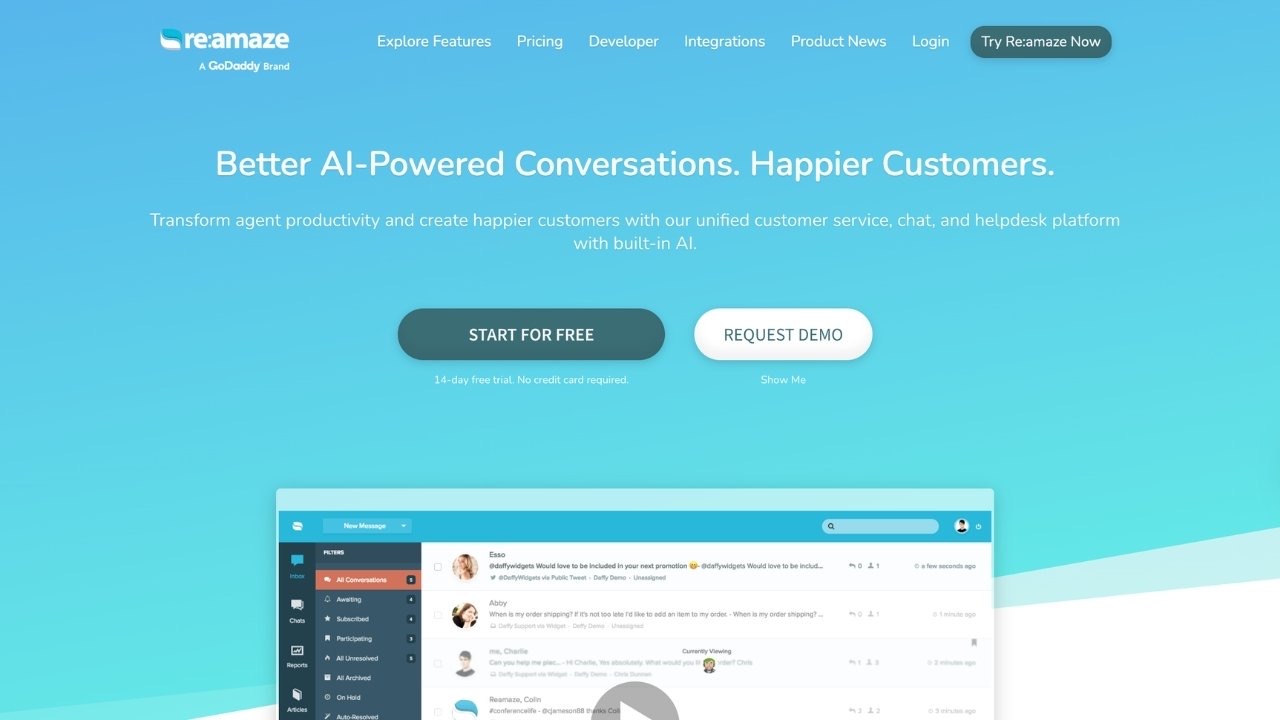
Re:amaze, owned by GoDaddy, bundles live chat, email, social, SMS, VoIP, and video into one helpdesk with an AI Agent included. The breadth is the selling point.
Pricing
Plans run $29/user/mo (Basic), $49/agent/mo (Pro), and $69/agent/mo (Plus), with a flat $59/mo Starter plan for unlimited team members capped at 500 conversations. A 14-day trial comes with every account.
What works
- Channel breadth in one tool at a low per-seat entry.
- Simple and affordable for small teams covering a lot of surfaces.
What doesn't
- The AI is lighter and less ecommerce-deep than Gorgias or Tidio.
- Its phone is VoIP-and-ticket style, not an autonomous agent that answers and resolves on its own.
Why it ranks sixth
Good value if you want many channels covered cheaply. The AI and the voice handling are both shallower than the specialists.
7. Chatbase
Best for: standing up a website FAQ bot quickly. Our Chatbase alternatives page covers the ecommerce angle.
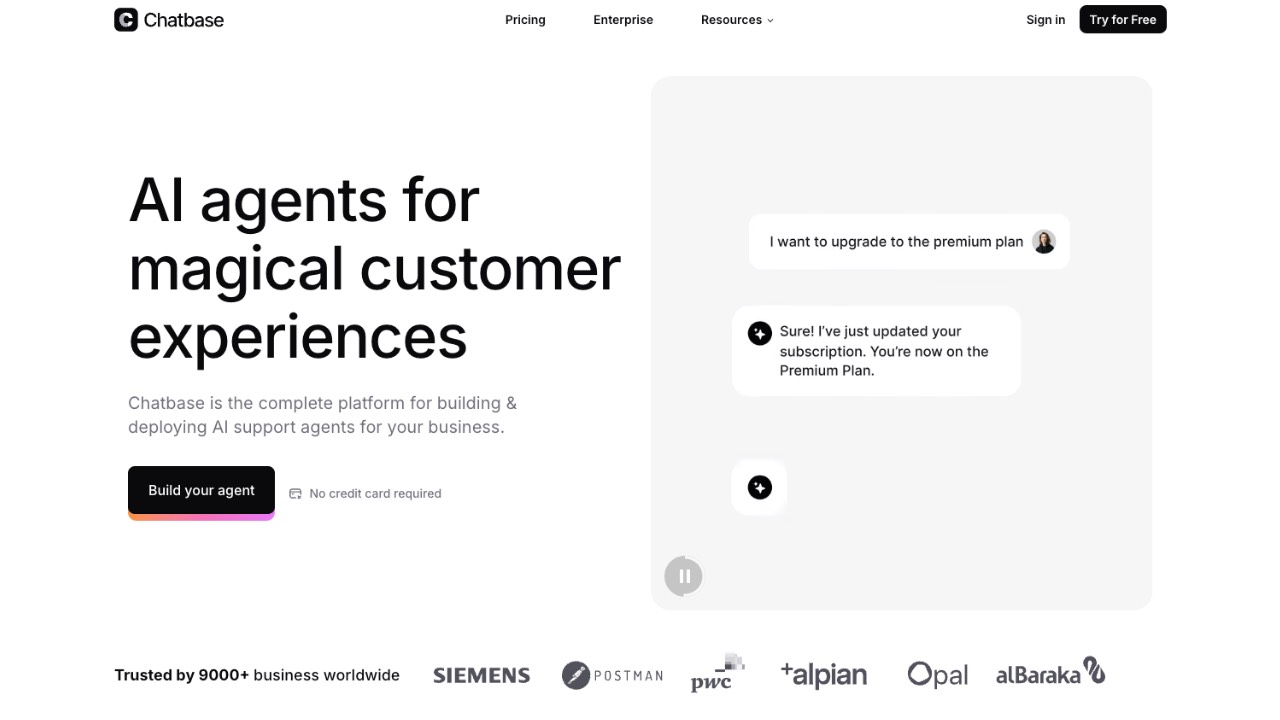
Chatbase trains a chatbot on your content fast, which is great for a general site FAQ. It's used well beyond ecommerce, which is also the limitation for a Shopify brand.
Pricing
Plans run Free, Hobby ($40/mo), Standard ($120/mo), and Pro (~$400/mo), built on a credit system where heavier models burn more credits. Add-ons like white-label and extra credits can push the bill up unpredictably.
What works
- Cheap and quick to train on your docs and URLs.
- Simple for a basic site assistant.
What doesn't
- Not ecommerce-native. It's weaker on live order data and return edge cases than the Shopify-first tools.
- The credit model is hard to forecast, and it's chat only.
Why it ranks seventh
Fine for a quick FAQ widget. For a real Shopify support workflow, the ecommerce-native tools handle the edge cases it misses.
8. Botpress
Best for: teams with engineering resources building a fully custom agent.
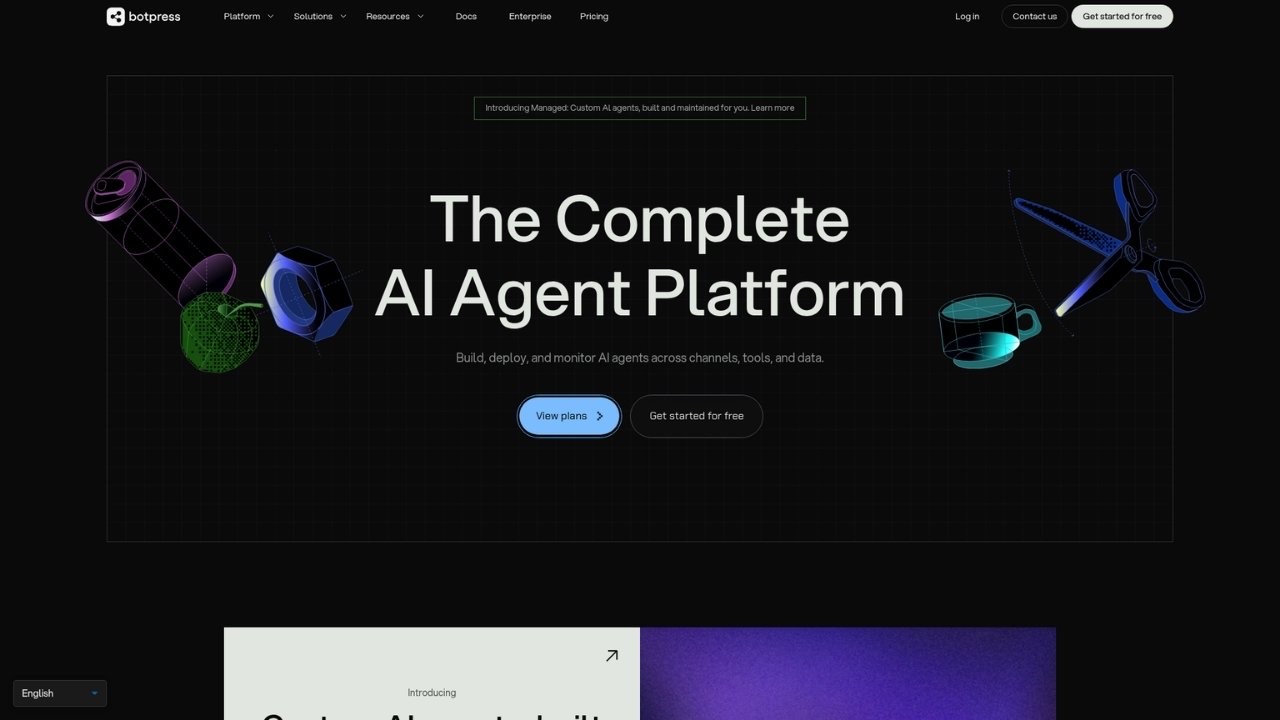
Botpress is a developer-first platform for building bespoke AI agents with deep control. If you have engineers and a specific design in mind, the flexibility is real.
Pricing
Botpress offers a pay-as-you-go start plus AI spend, a Plus plan at $89/mo + AI spend, and a Managed tier at $1,495/mo + AI spend that includes hands-on development. You pay a base plan plus usage.
What works
- Maximum customization and multi-channel control.
- Owns the full build if you want something off the shelf can't do.
What doesn't
- It needs a technical lift. This isn't turnkey for a CX lead.
- Longer time to value, and AI-spend billing on top of the base plan.
Why it ranks eighth
The most powerful and the most work. Most Shopify CX teams want something live this week, not a build project.
The channel every chatbot platform leaves uncovered
Look back at the at-a-glance table. Seven of the eight are chat or text. That's the category. And it's a category built around a single assumption: that your customers will type.
A lot of them won't. Roughly 76% of consumers still prefer the phone, and 43% pick it as their first support channel versus 17% for chat, per the channel-preference data we walk through in our chatbot vs phone support breakdown. The skew gets sharper with age: 61% of Gen X and Boomers prefer a human agent, and phone wins on satisfaction at 91% CSAT against 80% for chatbots.
A chat platform can deflect a typed FAQ all day and still miss the customer who picks up the phone because the question is urgent or the order is expensive.
The chatbot frustration data backs this up. About 75% of consumers report being left frustrated by AI customer service, per consumer-AI reporting from CNBC, and 67% abandon the interaction when they get stuck in a chatbot loop (ServiceTarget). Roughly one in five who tried AI for support said they saw no benefit at all. Customers have learned to type "agent" and "human" over and over to escape the bot, and some brands hide the handoff on purpose.
"My customers also feel like it's a normal person. They feel like they can communicate if they have questions."
Claudia Droge, TechCraft Studio
So the chat tools above are doing real work on the text channel. The mistake is assuming text is the whole job. For a Shopify brand with a visible phone number, the WISMO calls, the after-hours questions, and the higher-AOV "I want to talk to someone before I buy" calls all land on a line your chatbot platform never sees. That's the gap Ringly's phone support was built to close.
How to choose the right AI chatbot platform
Here's the simple version, by use case.
- Choose Tidio if you're a smaller Shopify store and you want chat plus an AI FAQ layer live this afternoon.
- Choose Gorgias AI Agent if your team already lives in Gorgias and you accept the per-resolution billing math.
- Choose Intercom Fin if you're a larger team already on Intercom and your volume isn't so high that $0.99 per resolution breaks the budget.
- Choose eesel AI if your helpdesk is fine and you only want to bolt AI on top of it.
- Choose Re:amaze if you want many channels bundled cheaply and you're okay with a lighter AI.
- Choose Chatbase if you just need a quick website FAQ bot and ecommerce edge cases aren't the priority.
- Choose Botpress if you have engineers and a custom build in mind.
Then, whichever chat tool you pick, layer phone on top. The chatbot covers the typing customer. Ringly covers the one who calls. They're not competing for the same job.
What a chatbot platform actually costs you vs the phone team
Most of the cost conversation in this category is about per-message or per-resolution pricing. For a $10M-$100M Shopify brand, the real number is your support payroll, and that's where the phone math actually moves.
Take a typical $50M Shopify brand running a 6-rep customer service team:
| Line item | Today | With Ringly |
|---|---|---|
| 6 reps × $4K loaded per rep | $24,000/mo | n/a |
| Ringly Enterprise (~$5K/mo) | n/a | $5,000/mo |
| Net monthly CS spend | $24,000/mo | $5,000/mo |
| Monthly savings | n/a | $19,000/mo |
| Annual savings | n/a | $228,000/yr |
That's roughly 70% of the repeatable calls (order status, returns, the same five questions over and over) routed to the AI. The other 30%, the genuinely complex calls, still go to your team, who now have the time to actually solve them. WashCo, a Shopify brand we launched, recovered $22,664 in its first 7 days on the phone. None of that revenue came through a chat widget.
The chat tools have their own ROI on the text channel, and a good one is worth paying for. The point is they don't touch this line item, because they don't touch the phone. If you want to see what your own phone line is costing after hours, book a 30-min call and we'll do the math live against your call volume.
For the broader playbook on this, our guide on how to scale customer service without hiring walks through the full approach, and the pricing page has the self-serve plans.
Frequently asked questions
What is an AI chatbot platform? An AI chatbot platform is software that uses a large language model to answer customer questions automatically, usually on a website chat widget or over email. For ecommerce, the good ones also read your store data so they can handle order status and returns, not just static FAQs. The category is almost entirely text-based, which is why the phone channel needs a separate tool.
What's the best AI chatbot platform for a Shopify store? For the web chat widget, Tidio and Gorgias AI Agent are the strongest Shopify-native picks, depending on whether you want a standalone tool or AI on your existing Gorgias inbox. For the phone line, Ringly is the one built for Shopify calls. Most brands end up running one of each.
Do AI chatbot platforms handle phone calls? Almost none of them do. The platforms in this category are built for chat and email, so when a customer calls, it still goes to a rep or to voicemail. Ringly is the phone layer, and it sits alongside whatever chat platform you already run.
How much does an AI chatbot platform cost? It ranges widely. Chat tools start around $24-$40/mo (Tidio, Chatbase), per-resolution models like Intercom Fin charge $0.99 per resolution, and Gorgias adds AI fees on top of its helpdesk plan. Watch the volume math, since several of these bill per conversation and the bill climbs as you grow.
Will customers know they're talking to an AI? With a good agent, often not, which is the point. The most common thing Ringly customers report hearing is "you don't sound like AI." The bigger risk is the opposite: a poorly tuned chatbot that loops a customer and won't hand off, which 67% of people will abandon.
Can an AI chatbot platform read my live Shopify order data? The Shopify-native ones can. Gorgias, Tidio on its higher tiers, and Ringly read live order and fulfillment data so they can answer real WISMO and return questions. Generic builders like Chatbase are weaker here because they're trained on documents, not connected to your store.
We tried a chatbot and it just deflected instead of resolving. What's different about phone? Deflection and resolution are not the same thing, and a lot of chat deployments quietly optimize for the first. Phone is a different problem because the caller is usually mid-task and won't accept a link as an answer, so the agent has to actually resolve. That's the bar Ringly is built and guaranteed against, with a 65% resolution guarantee or we refund the last 3 months.
Does Ringly replace my chat platform? No, and it's not meant to. Ringly handles the phone channel and escalates to whatever helpdesk you already run, so you keep Gorgias, Re:amaze, or Tidio for chat and add phone on top.
Talk to us

If you run a $10M-$100M Shopify brand and your phone goes to voicemail after 6 p.m., a 30-min call is the fastest way to see what that's costing you. Bring your call volume and we'll do the math against your actual numbers, not a generic example.
The 3-layer guarantee.
- Live in 14 days or it's free until launched.
- 65% resolution in 90 days or we refund the last 3 months of subscription fees.
- We keep working free until we hit 65%.
Ruben (Ringly co-founder) takes these calls personally.