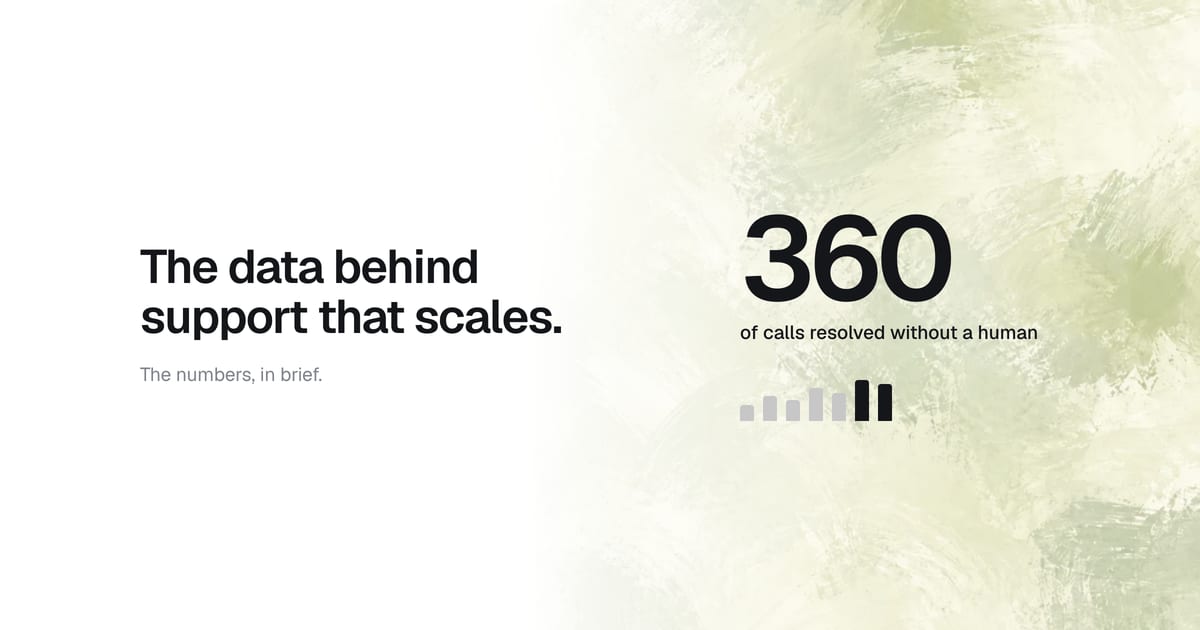


About one in five online orders comes back. Across DTC the return rate sits around 14%, and the overall ecommerce number is closer to 20-24% once you factor apparel and footwear, two to three times the in-store rate. Every one of those returns costs between $10 and $65 to process once you add shipping, labor, inspection, and restocking.
Good returns software shrinks that cost. It moves customers off email and onto a self-service portal, turns refunds into exchanges, and prints the label automatically. The seven tools below all do a version of that well.
But there's a part of the returns flow none of them touch: the phone. A returns portal answers the customer who already found it. It does nothing for the person who calls and says "how do I send this back" or "where's my refund, you got the package a week ago." Those calls still land on your team. So this guide does two things: it ranks the best returns management software for e-commerce, and at the end it covers where the phone calls those returns generate actually go.
This post in 30 seconds.
- The seven best returns management software tools for e-commerce, ranked with real 2026 pricing, what each does well, and where each falls down.
- Loop is the exchange-first pick for mid-market Shopify; Return Prime and ReturnGO are the value plays; Narvar and Happy Returns are enterprise.
- Built for founders, COOs, and Heads of CX at $10M-$100M Shopify brands who want the portal handled and the phone handled too.
Most $10M-$100M Shopify brands already run a paid helpdesk and a returns portal, yet the support team still fields the same questions over and over: how do I return this, did you get my package, where's my refund. We build AI phone support for Shopify brands, and returns/refund questions are one of the most common call types we see. If your team is fielding return calls all day, book a 30-min call and we'll show you how much of that phone volume an AI agent can take off them.
In this post:
The 7 tools at a glance
Here's the short version before the deep dives. Pricing is the real 2026 number, not the marketing headline.
| Tool | Starting price | Best for | Exchange-first | Free plan |
|---|---|---|---|---|
| Loop Returns | $155/mo (annual) | Mid-market Shopify exchanges | Yes | Checkout+ tier |
| AfterShip Returns | ~$11/mo | Returns plus order tracking | Partial | Limited |
| ReturnGO | $23/mo | Small to mid Shopify, AI insights | Yes | ReturnGuard |
| Return Prime | $19.99/mo | Value, scaling brands | Yes | Up to 5/mo |
| Narvar | Custom ($50K+/yr) | Enterprise post-purchase | Partial | No |
| Happy Returns | Custom (~$5K-$25K/yr) | High-volume, in-person drop-off | Partial | No |
| ClickPost | Free (then $0.35/return) | Full post-purchase + returns | Yes | 25 returns/mo |
One row is missing from every returns-software comparison you'll read: the phone. None of these tools answer the call when a customer dials your number to ask about a return. We'll come back to that after the six tools, because it's the gap that actually costs you the saved sale.
How I tested these returns tools
I'm Ruben, co-founder of Ringly. Over the last few weeks I set up a real Shopify store and ran the same return workflow through each tool in this list, scoring against five things.
- Shopify integration depth. I connected each tool to the store, pushed a test order through, started a return from the customer side, and watched whether it could read the order, offer an exchange, and write the refund back without me touching the Shopify admin.
- Exchange and store-credit retention. I checked whether the tool actively saves the sale (variant swap, Shop Now, bonus store credit) or just processes a refund and lets the revenue walk.
- Pricing model and total cost. I looked past the headline monthly price at the real bill: transaction fees on exchanges, annual lock-in, return-label cost, and paid support add-ons.
- Automation depth. I built return-reason rules, auto-approve thresholds, and auto-label generation to see how much runs without a human.
- The phone test. I called each vendor's own support line at 11 p.m. on a Tuesday to see who picks up, and I checked whether the tool answers a customer's return CALL at all. None of them do, which is the whole reason the last two sections exist.
That last point is the information you won't find in other roundups. We also pulled the recurring call types across 200,000+ real Ringly support calls, and returns and refund questions are one of the top inbound call types after "where's my order." A portal handles the customer who clicks. It does nothing for the one who calls.
The 7 best returns management software tools
1. Loop Returns
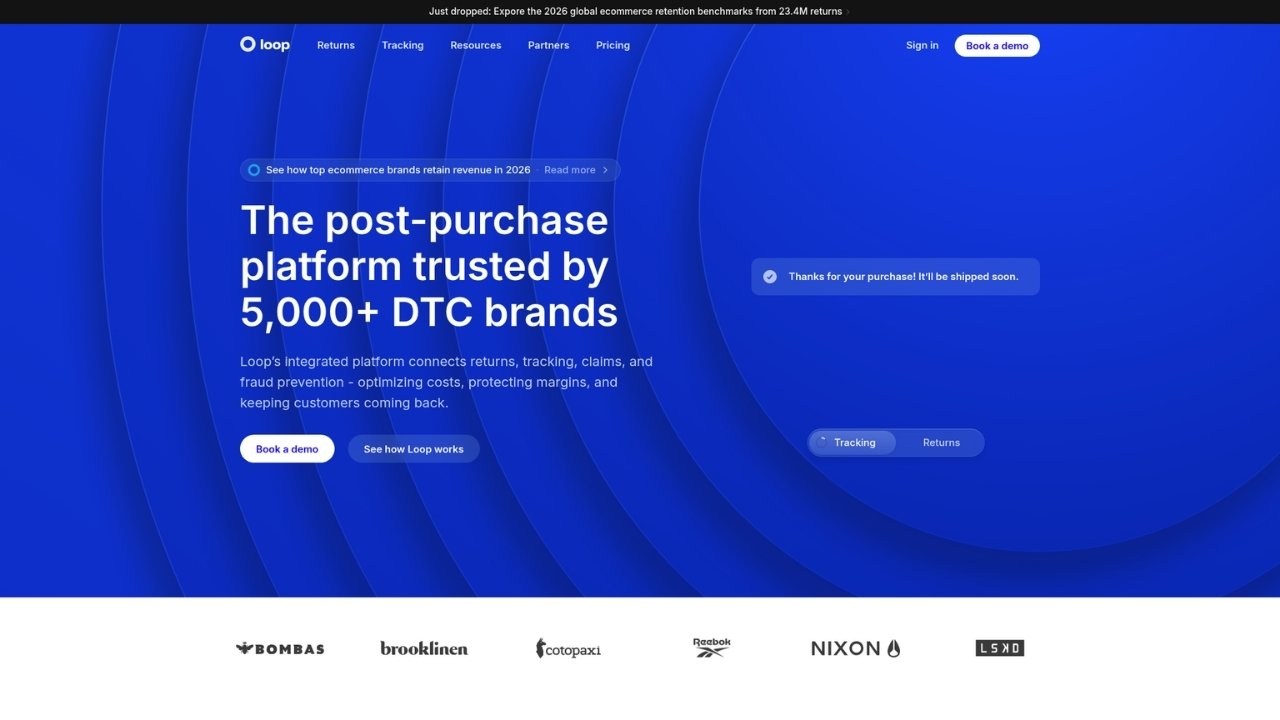
Best for: mid-market Shopify brands that want every return to become an exchange. Loop is the category leader for exchange-first returns, built natively on Shopify, and it's the tool most $20M+ DTC brands end up on.
Loop's whole pitch is turning refunds into retained revenue. Shop Now lets a customer browse your full catalog mid-return and swap a refund for a new purchase, instant exchanges ship the replacement before the original comes back, and bonus credit nudges store credit over cash refunds. It's a deep, polished product, and the workflow builder is genuinely strong.
Pricing
| Plan | Price | Notes |
|---|---|---|
| Checkout+ | Free | US and Canada domestic labels, Return Bars, package protection |
| Essential | $155/mo | Annual commitment, workflows, carrier rate shopping |
| Advanced | $340/mo | Annual commitment, Shop Now, instant exchanges, fraud prevention |
What works
- Exchange-first by design. Shop Now and instant exchanges are the best in the category for keeping the sale instead of refunding it.
- Shopify-native. Reads orders, writes refunds, and handles variants without custom dev work.
- Serious workflow control. Return-reason routing, carrier rate shopping, and fraud rules that hold up at volume.
What doesn't
- It's expensive. $155/mo and $340/mo both require an annual commitment, so there's no month-to-month escape hatch.
- Transaction fees stack. Exchanges process through Stripe at 2.9% plus $0.30, on top of the subscription.
- Overkill for smaller brands. Under roughly $5M in revenue you're paying for depth you won't use.
Why it ranks first
If you're a mid-market Shopify brand and exchanges matter more than raw price, Loop is the best returns management software for e-commerce in this list. Just go in knowing the real cost is the subscription plus transaction fees plus the annual lock-in. If the price gives you pause, our Loop Returns alternatives breakdown walks through cheaper options that do most of the same job.
2. AfterShip Returns
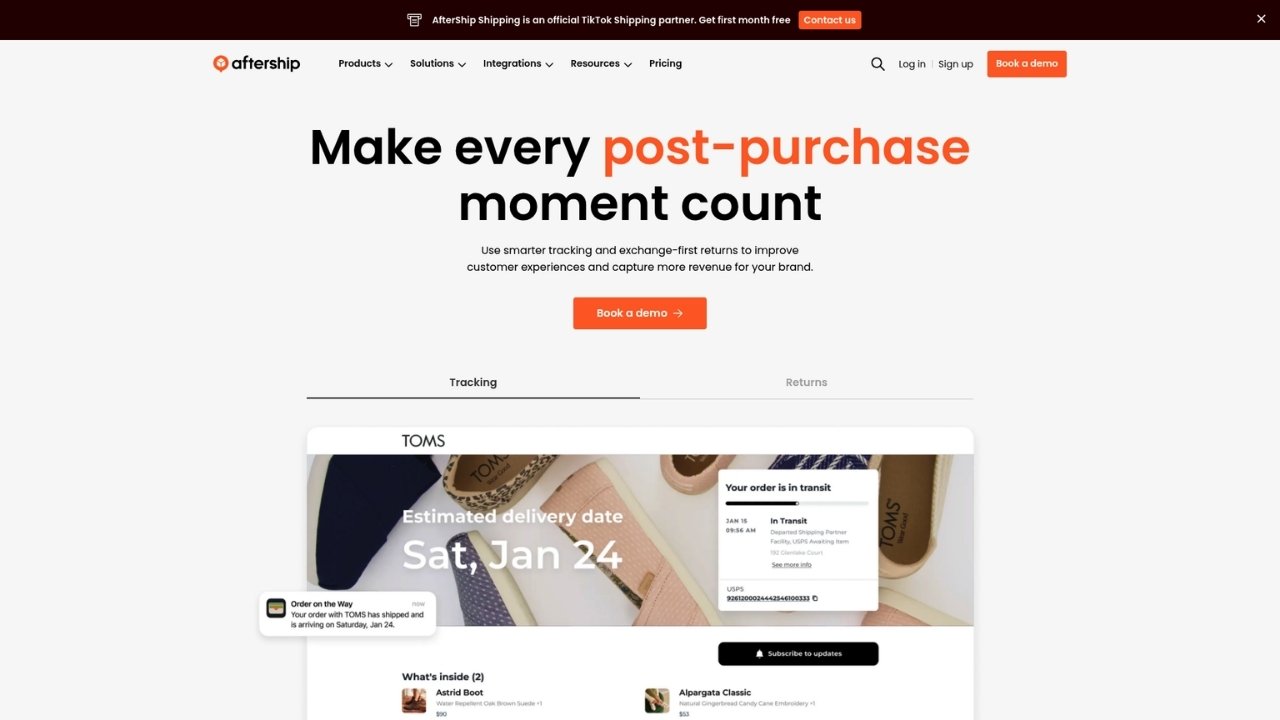
Best for: brands that want returns and order tracking from one vendor. AfterShip is best known for shipment tracking, and its returns product sits inside that broader post-purchase suite.
You get a branded returns page, automatic label generation, email notifications, store credit, and returns analytics that break down reasons and metrics. The pull is consolidation: if you already run AfterShip Tracking to cut WISMO tickets, adding Returns keeps everything under one login and one bill.
Pricing
| Plan | Price | Notes |
|---|---|---|
| Essentials | from ~$11/mo | Branded returns page, analytics |
| Pro / Premium | tiered | Automation, store credit, anti-fraud workflows |
| Enterprise | custom | ERP and carrier integrations, returns API, SSO |
What works
- Low entry price. Starting around $11/mo, it's one of the cheapest ways to get a branded returns flow live.
- One vendor for tracking and returns. If you already use AfterShip for shipment tracking, the returns add-on is a clean fit.
- Solid analytics. Return-reason data is genuinely useful for fixing the products driving returns.
What doesn't
- Support costs extra. Priced support add-ons run 20% to 30% of your subscription fee, with $200 to $400/mo minimums.
- Returns is the secondary product. Tracking is the flagship, so the returns features can lag dedicated tools like Loop or ReturnGO.
- Exchange flow is thinner. It does store credit and refunds well, but the exchange experience isn't as strong as the exchange-first specialists.
Why it ranks second
AfterShip is the value pick if you want tracking and returns from one place, especially if you're already cutting WISMO tickets with its tracking product. Just budget for the support add-on if you need fast help.
3. ReturnGO
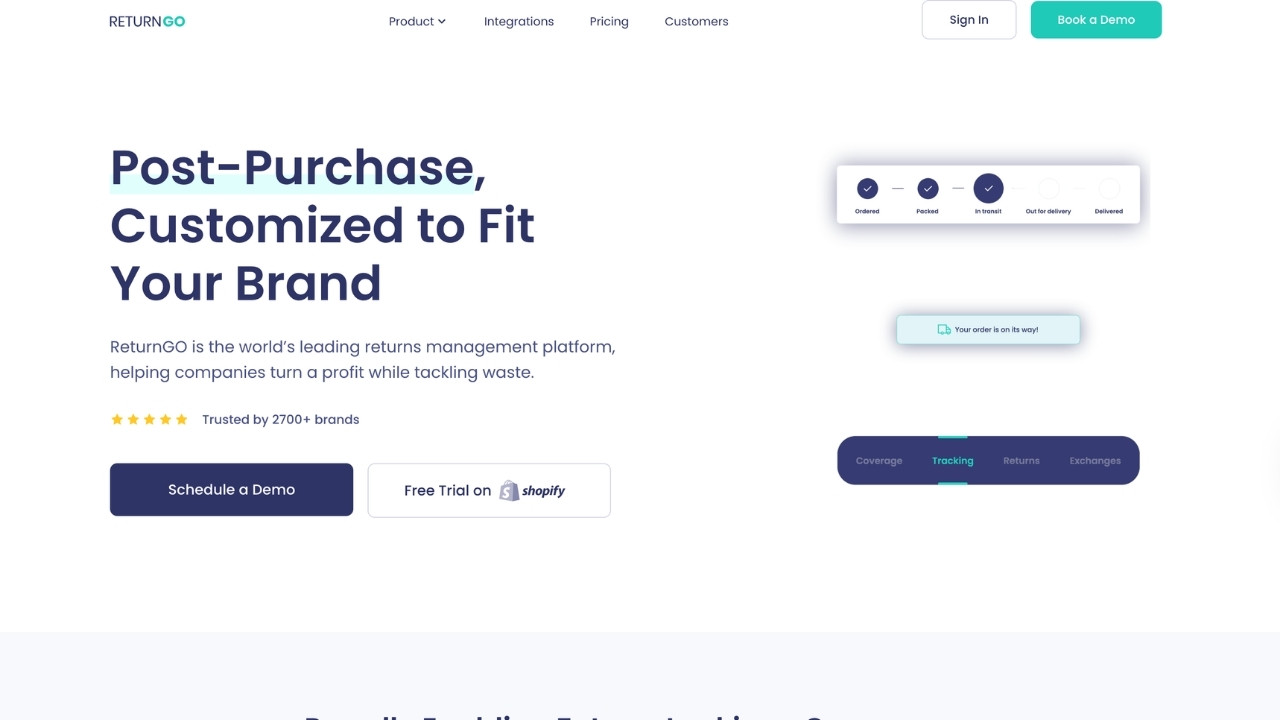
Best for: small to mid-size Shopify brands that want exchange-first returns with AI insights, without Loop's price tag. ReturnGO holds a 4.9-star rating across 350-plus Shopify reviews, and support is the thing reviewers mention most.
The portal does product and variant exchanges, gift returns, store credit, and flexible return reasons with image and video upload. Automation rules cover auto-exchange, auto-refund, auto-approve, and auto-credit, and there are AI insights on top to flag what's driving your returns. It's a strong middle ground between the cheap tools and the enterprise platforms.
Pricing
| Plan | Price | Returns/mo |
|---|---|---|
| ReturnGuard | Free | Limited |
| Starter | $23/mo | 20 |
| Premium | $147/mo | 110 |
| Higher tier | ~$297/mo | More volume |
What works
- Exchange-first at a fair price. Variant exchanges and store credit at $23/mo undercut Loop hard.
- Strong support reputation. The 4.9-star rating is mostly reviewers praising the onboarding and help.
- AI returns insights. Surfaces the products and reasons driving your return rate so you can fix the source.
What doesn't
- Volume-capped tiers. Plans are priced by returns per month, so a high-return apparel brand climbs tiers fast.
- Brand polish is good, not Loop-level. The customer-facing portal is solid but not quite as refined as Loop's.
- Reporting is lighter at the low tiers. The deeper analytics live higher up the pricing ladder.
Why it ranks third
ReturnGO is the best returns management software for a growing Shopify brand that wants exchanges and store credit without enterprise pricing. Watch the per-return caps if your volume is high. For more options in this lane, our Shopify returns app roundup compares the field.
4. Return Prime
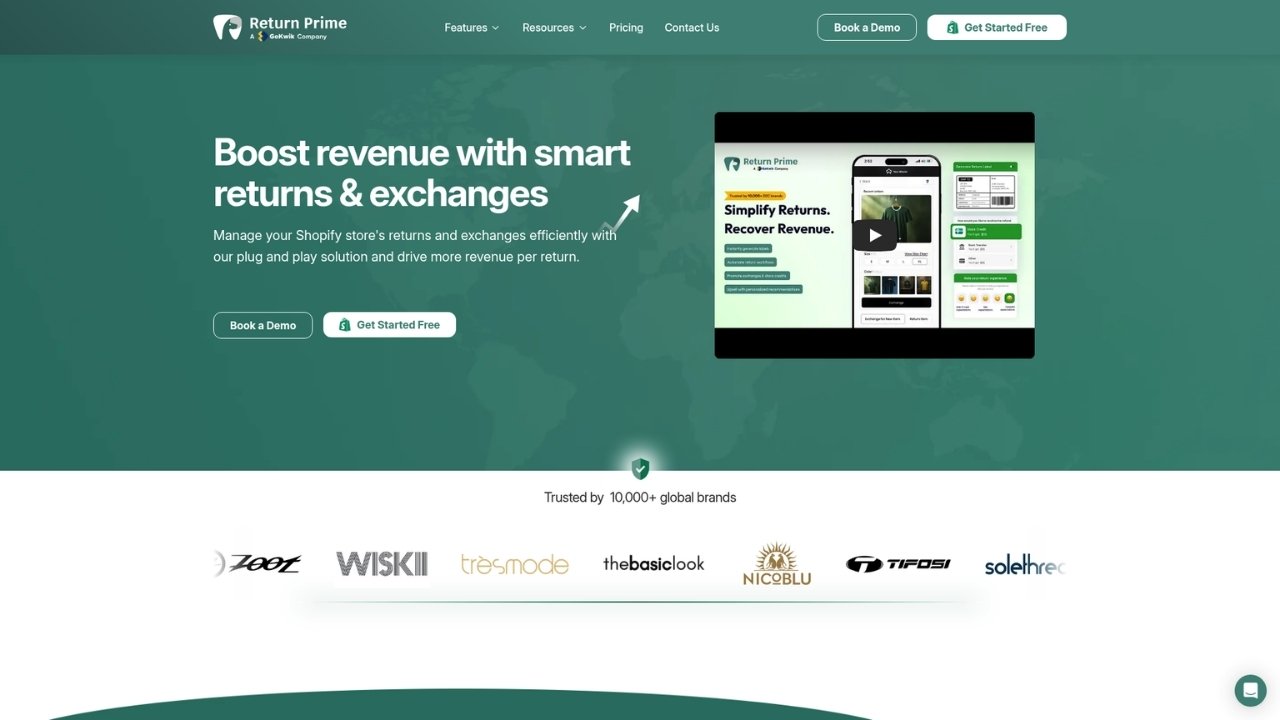
Best for: value-conscious and scaling brands that want a real returns portal without a real returns budget. Return Prime is the cheapest credible option here, with a free plan and paid tiers that top out below most competitors' starting price.
The free plan covers up to 5 returns a month, which is enough to test the flow on a small store. Paid plans add exchanges, store credit, automation, and the "turn refunds into revenue" exchange push. There's also a startup program offering up to 90% off paid plans, which makes it the obvious starting point for early-stage brands.
Pricing
| Plan | Price | Notes |
|---|---|---|
| Free | $0 | Up to 5 returns/mo |
| Grow | $19.99/mo | Core returns and exchanges |
| Grow Boost | $49.99/mo | More automation |
| Scale | $149.99/mo | Higher volume |
What works
- Genuinely cheap. A free plan plus a $19.99 entry tier makes it the lowest-cost real returns tool in this list.
- Exchange and store-credit support. It does the revenue-retention basics that matter most.
- Startup discount. Up to 90% off for early-stage brands is a real saving.
What doesn't
- Thinner at scale. The deeper workflow and fraud controls of Loop or ReturnGO aren't here.
- Free plan is a teaser. Five returns a month is a trial, not a plan, for anyone past their first month.
- Fewer enterprise integrations. If you need ERP or carrier-level integrations, look higher up this list.
Why it ranks fourth
Return Prime is the value pick. If you're a DTC brand early in your returns journey or watching every line of the P&L, start here and graduate up if you outgrow it.
5. Narvar
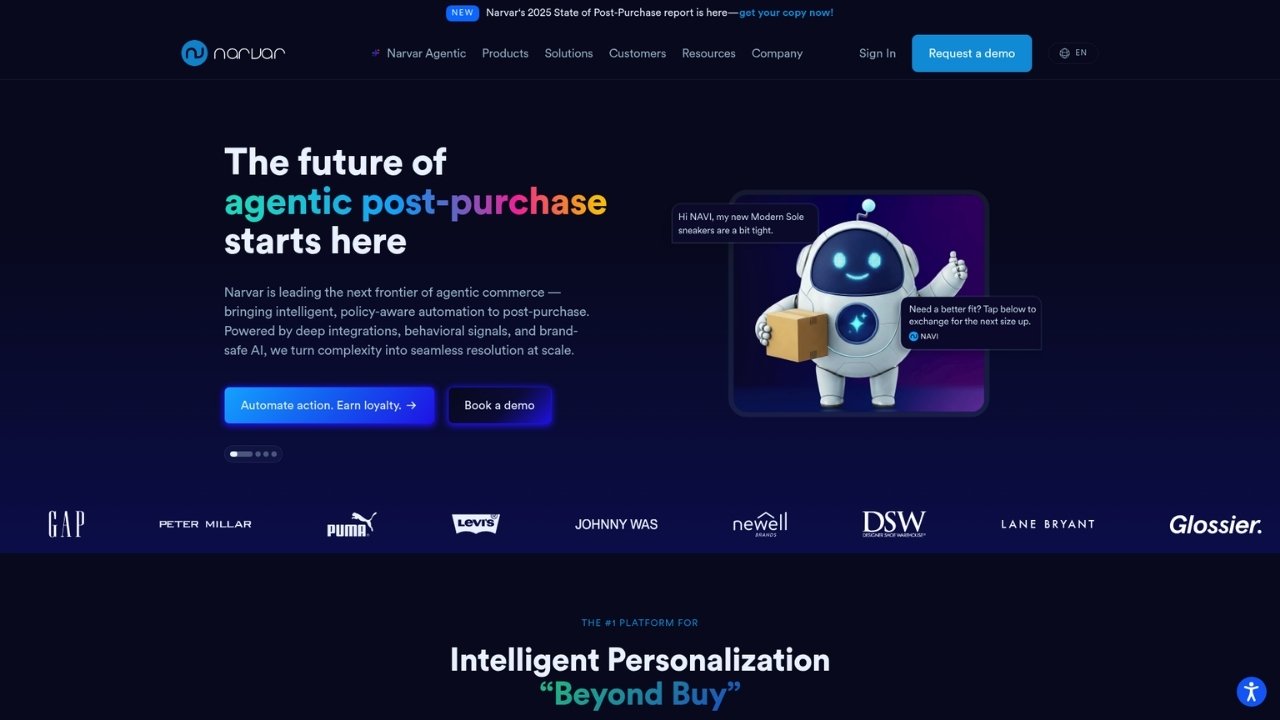
Best for: enterprise brands that want post-purchase communication and returns as one platform. Narvar is a communication-led post-purchase player, strong on branded tracking and customer messaging, with returns as one module of a bigger bundle.
Where Loop and ReturnGO lead with returns logistics, Narvar leads with the customer experience around the order: branded tracking pages, proactive notifications, and post-purchase visibility, with returns layered in. It's built for large retailers, and the pricing reflects that.
Pricing
Narvar is custom-quoted and enterprise-only. The full module bundle typically lands in the $50,000 to $150,000 per year range, with setup adding to that. There's no self-serve plan and no published price.
What works
- Post-purchase under one roof. Tracking, notifications, and returns in a single platform reduce vendor sprawl.
- Enterprise-grade. Built to handle the volume and customization a large retailer needs.
- Communication-first. The branded tracking and proactive messaging are genuinely strong.
What doesn't
- Enterprise pricing only. Five and six-figure annual contracts put it out of reach for most $10M-$30M brands.
- Returns is one module, not the focus. The dedicated returns specialists go deeper on exchange logistics.
- Heavier implementation. Expect a real onboarding project, not a one-hour install.
Why it ranks fifth
Narvar earns its spot for large brands that want post-purchase communication and returns together. For most mid-market Shopify brands it's more platform and more budget than the returns problem needs.
6. Happy Returns
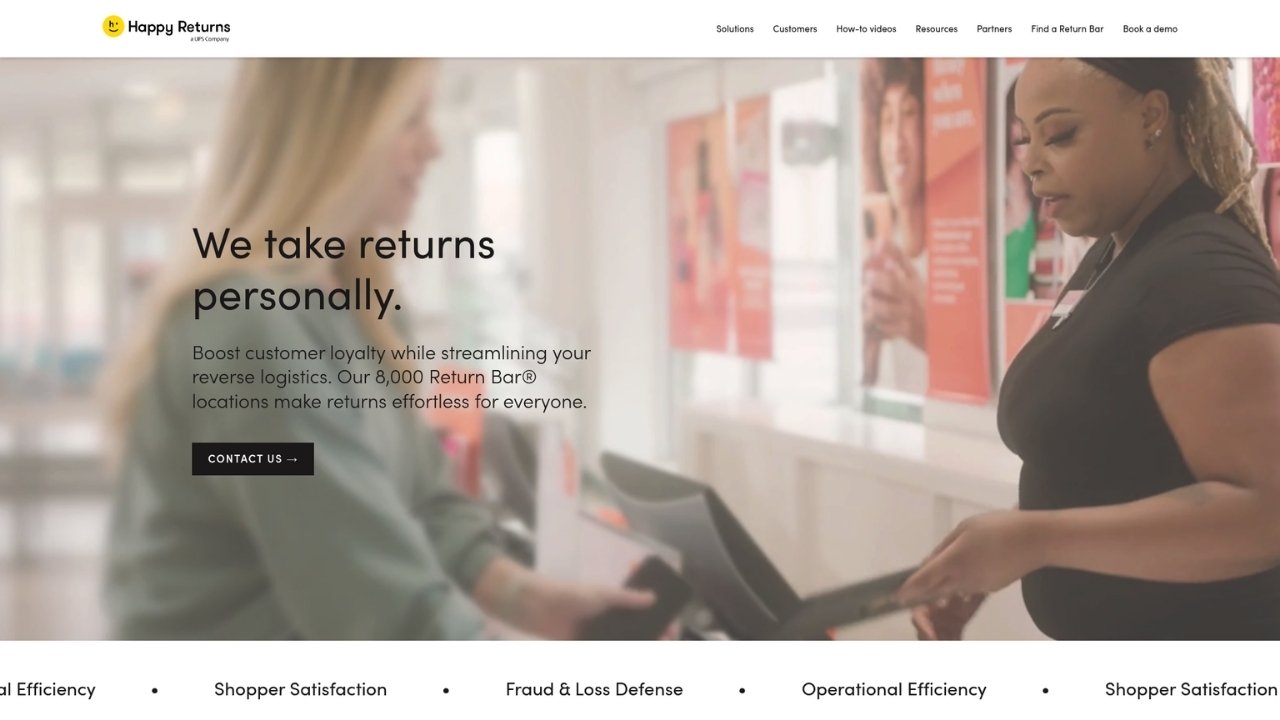
Best for: high-volume brands whose customers want box-free, label-free returns in person. Happy Returns, owned by PayPal, is the one tool here built around physical logistics rather than software alone.
Its differentiator is the network of 8,000-plus Return Bar drop-off locations where customers return items with no box and no label, then Happy Returns aggregates and ships them back to you. For a high-return apparel brand, the in-person experience and the reverse-logistics savings can be worth it.
Pricing
Happy Returns uses custom, volume-based pricing rather than a published monthly rate. Cost typically scales with return volume and the mix of physical drop-off versus ship-back, landing roughly in the $5,000 to $25,000 per year range depending on volume.
What works
- Box-free, label-free drop-off. The Return Bar network is a real convenience win for customers.
- Reverse-logistics savings. Aggregating returns can cut your shipping cost per return at high volume.
- PayPal backing. Enterprise stability and a large physical footprint.
What doesn't
- Custom pricing only. No transparent rate, and it scales with volume, so model it carefully.
- Built for scale. The economics work for high return volume, not for a brand processing a few hundred returns a month.
- Software depth is secondary. The drop-off network is the product; the portal features trail the software-first tools.
Why it ranks sixth
Happy Returns is the pick when physical drop-off is the experience your customers actually want and your volume justifies the spend. For most Shopify brands a software-first tool higher in this list is the better fit.
7. ClickPost
Best for: brands that want returns, exchanges, and the full post-purchase experience in one AI-driven platform, with returns built to retain revenue.
ClickPost treats returns as a revenue problem, not just reverse logistics. Returns, exchanges, branded tracking, and returns protection sit in one dashboard across 600+ carriers including FedEx, UPS, USPS, and DHL. Where Loop and ReturnGO lead on returns logistics and Narvar on communication, ClickPost does both, which earned it G2 Leader in Returns Management for Spring 2026 (4.8/5, 135 reviews, top "Easiest to Use"). US brands include Walmart, Jackery, and Puma.
Pricing
Tiered and self-serve. Free to install, the first 25 returns per month are free, then $0.35 per extra return. Enterprise runs roughly $700/month for up to 2,000 requests, adding AI tracking pages, unlimited carriers, 24/7 support, and a dedicated account manager. Higher volumes are custom-quoted, no setup fee. Returns Protection is a separate per-shopper checkout fee priced by SKU risk and zip-code patterns, and brands keep 100% of fees.
What works
- Returns as revenue. Exchange-first flows retain the sale, not just the refund.
- Full post-purchase in one platform. Tracking, notifications, and returns under one roof reduces vendor sprawl.
- Transparent pricing. Free entry tier with per-return pricing, no six-figure lock-in.
- AI-priced protection. Returns Protection prices risk in realtime by SKU and zip code, and brands keep 100% of fees.
What doesn't
- More than a bare returns portal. If you only want a simple returns page and nothing else, ClickPost gives you more platform than you need.
- US brand awareness is still catching up. Strong in APAC and growing in the US, but the native Shopify incumbents have more name recognition here.
- Top-end plans are quote-based. Enterprise pricing requires a conversation, like most tools at this scale.
Why it ranks seventh
ClickPost handles returns deeply and wraps them in the full post-purchase experience, priced from free to enterprise. For brands that want returns to protect margin, not just move boxes backward, it covers the most ground in one system.
Where returns software stops: the phone
Every tool above handles the customer who finds your returns portal and clicks through it. Here's what none of them handle: the customer who picks up the phone instead.
A returns portal answers the customer who already found it. The phone is where the ones who didn't go, and that call still lands on your team. Return and refund questions show up as 30-40% of support tickets, and over 50% at peak, right alongside "where's my order." A chunk of those come in by phone: how do I return this, did you get my package, my prepaid label never arrived, can I swap this for a larger size. The portal doesn't ring. Your reps do.
That's the gap Ringly.io fills. Ringly is AI phone support for Shopify brands. It doesn't replace your returns software, it answers the calls your returns software generates. The AI picks up 24/7, finds the order in Shopify, walks the customer through starting a return or exchange, checks refund status, and escalates the genuinely complex calls to your team through Gorgias, Richpanel, or whatever helpdesk you already run.
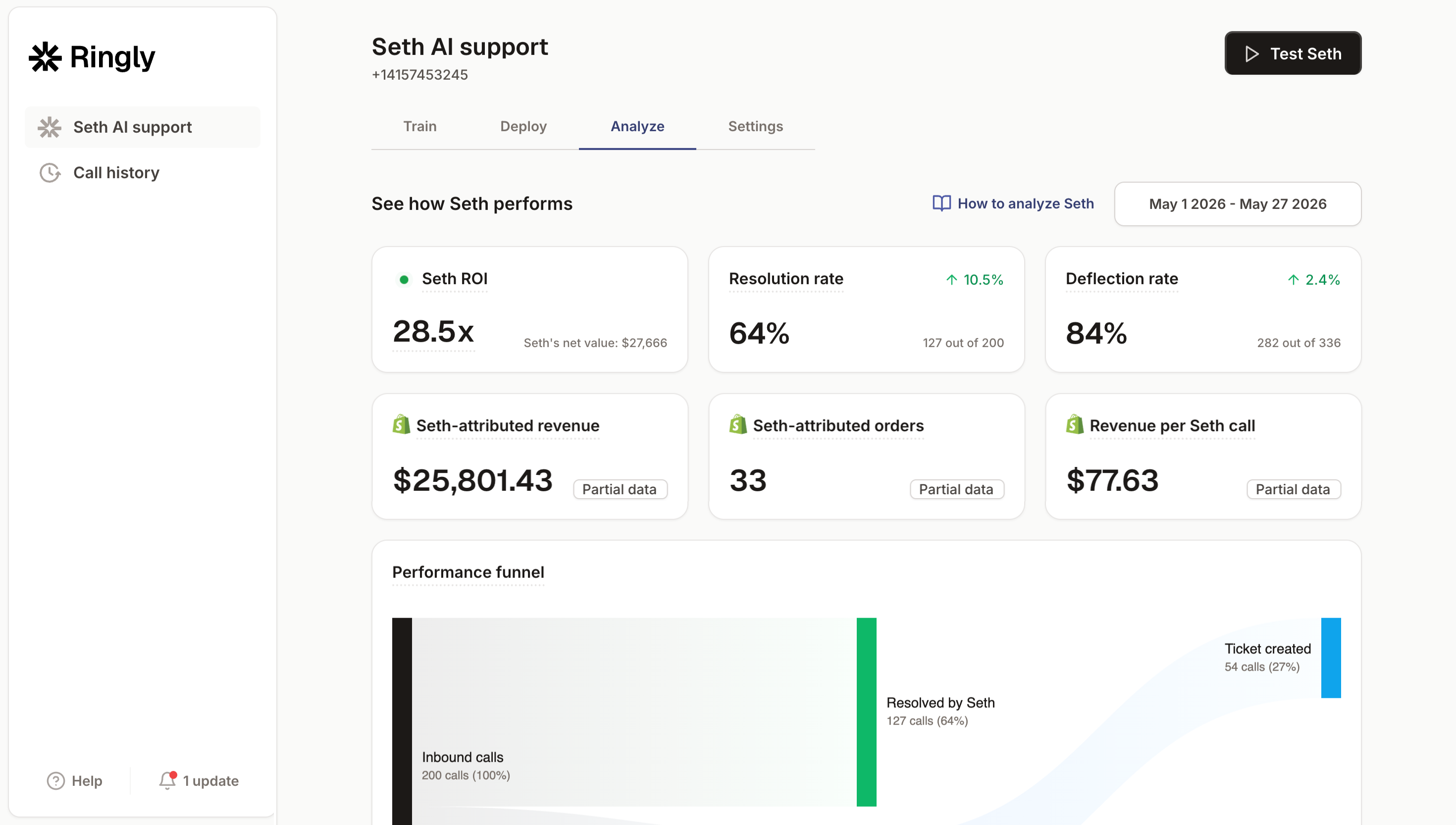
Seth resolves up to 90% of inbound calls on its own. The point isn't to deflect customers, it's to keep the phone answered so the return-call doesn't become a lost customer. 60% of callers hang up within 60 seconds on hold, and a customer who can't reach you to ask about a return often just disputes the charge instead.
"My customers also feel like it's a normal person. They feel like they can communicate if they have questions."
Claudia Droge, TechCraft Studio
There's a revenue side too. When the AI handles a return call and offers an exchange or store credit on the line, the return-call becomes a saved sale instead of a refund. TechCraft Studio handles 88% of calls without a human, and WashCo, a Shopify brand we launched, recovered $22,664 in its first 7 days on the phone. The returns portal saves the sale at the click. The phone agent saves it on the call.
What returns calls cost you today vs with an AI phone agent
Returns software is a line item you can predict. The phone team handling return calls is a bigger one. Here's the shape of it for a typical $50M Shopify brand running a 6-rep CS team.
| Line item | Today | With Ringly |
|---|---|---|
| 6 reps × $4K loaded per rep | $24,000/mo | n/a |
| Ringly Enterprise (~$5K/mo) | n/a | $5,000/mo |
| Net monthly CS spend | $24,000/mo | $5,000/mo |
| Monthly savings | n/a | $19,000/mo |
| Annual savings | n/a | $228,000/yr |
That's roughly 70% of repeatable calls, the order-status, returns, and product questions that come in over and over, routed to the AI. The other 30%, the genuinely complex ones, still go to your CS team, who now have time to actually solve them. Book a 30-min call and we'll do this math against your real call volume.
How to choose returns software for your store
The seven tools split cleanly by stage and need.
- Choose Loop Returns if: you're a mid-market Shopify brand, exchanges matter more than price, and you want the deepest exchange-first workflow in the category.
- Choose AfterShip Returns if: you want returns and order tracking from one vendor and you're already cutting WISMO tickets with its tracking product.
- Choose ReturnGO if: you want exchange-first returns with AI insights and strong support at a mid-market price.
- Choose Return Prime if: you're early-stage or value-conscious and want a real returns portal starting under $20/mo.
- Choose Narvar if: you're an enterprise brand that wants post-purchase communication and returns on one platform.
- Choose Happy Returns if: your customers want in-person, box-free drop-off and your return volume justifies custom pricing.
- Choose ClickPost if: you want returns and the full post-purchase experience (tracking, notifications, protection) in one platform with transparent per-return pricing starting free.
Whichever you pick, pair it with a plan for the phone. The software handles the self-service return. An AI phone agent handles the customer who calls instead of clicking, so both ends of the return are covered. If you want fewer returns in the first place, our guides on reducing product returns and returns best practices cover the policy side, and our ecommerce returns statistics page has the benchmarks.
If you're weighing your options against your current setup, book a 30-min call and we'll compare it to your stack live.
Frequently asked questions
What is the best returns management software for e-commerce?
For mid-market Shopify brands, Loop Returns is the strongest exchange-first option, while ReturnGO and Return Prime win on value. Narvar and Happy Returns fit enterprise and high-volume needs. The best pick depends on your return volume, budget, and whether exchanges or drop-off logistics matter most.
How much does returns management software cost?
Entry tools start around $11 to $24 a month (AfterShip, ReturnGO, Return Prime), mid-market exchange-first tools like Loop run $155 to $340/mo on annual plans, and enterprise platforms like Narvar are custom-quoted in the $50,000-plus per year range. Watch for transaction fees on exchanges and paid support add-ons that aren't in the headline price.
Does returns software handle phone calls about returns?
No. Returns software runs a self-service portal for customers who go online. It does not answer the phone. Return and refund calls still land on your support team unless you add a separate phone solution like Ringly, which is AI phone support that handles those calls 24/7.
What is the difference between Loop Returns and ReturnGO?
Both are exchange-first Shopify returns tools. Loop is deeper and more polished for mid-market and enterprise brands but starts at $155/mo on an annual commitment. ReturnGO starts at $23/mo with volume-capped tiers and a strong support reputation, making it the better value for growing brands.
Can returns software reduce my refund rate?
Yes, indirectly. Exchange-first tools nudge customers toward variant swaps, instant exchanges, and store credit instead of cash refunds, which keeps the revenue. They don't reduce the number of returns, but they change the outcome of each one from a refund to a retained sale.
Do I need returns software if I'm on Shopify?
Shopify has basic native returns, but dedicated software adds branded portals, automated labels, exchange flows, store credit, and automation rules that the native tools lack. For any brand processing more than a handful of returns a month, dedicated Shopify returns software pays for itself in saved time and retained revenue.
Which returns tool is cheapest?
Return Prime is the lowest-cost credible option, with a free plan for up to 5 returns a month and a paid Grow tier at $19.99/mo. AfterShip Returns is also cheap to start at around $11/mo, though its support add-ons can raise the real bill.
How does Ringly fit with my returns software?
Ringly sits alongside your returns software, not on top of it. The returns tool runs the online portal; Ringly answers the phone calls about returns, refunds, and exchanges, finds the order in Shopify, and escalates the complex calls to your existing helpdesk. The two cover both ends of the return.
Talk to us

If you run a $10M-$100M Shopify brand and your team is fielding return and refund calls all day, a 30-min call is the fastest way to see how much of that phone volume an AI agent can take off them.
Our 3 promises.
- Live in under 1 hour. Setup and test calls are free.
- 30-day money back on the $99 plan fee.
- 65% resolution guarantee: if Seth resolves under 65% of your support calls in a month, that month comes back as credit (after 90 days on Pay per call).
Ruben (Ringly co-founder) takes these calls personally.