
Returns automation deflects the easy returns. It doesn't stop the phone.
- The full automated workflow is 7 steps, from portal initiation to restock, and most of it is solved software.
- There are 6 places that workflow hands a customer back to a human, and the biggest one is the "where's my refund" call your portal never sees.
- Built for founders, COOs, and Heads of CX at $10M-$100M Shopify brands running a paid helpdesk and a phone line.
US shoppers returned around $890 billion in merchandise in 2024, and the NRF expects close to $850 billion again in 2025. For online stores the return rate runs higher, near 19.3% of sales. If you run a Shopify brand at any kind of scale, returns aren't an edge case. They're a department.
So most brands bought a returns portal. Loop, ReturnGO, AfterShip, one of them. And the portal works. It deflects the easy returns, generates the labels, issues the refunds. Then the calls keep coming anyway, and the team stays buried, and nobody can quite explain why.
This is the part the returns guides skip. Automated returns processing isn't one system. It's a workflow with handoff points, and the handoffs are where your CS team still loses its day. If you're the founder, COO, or Head of CX at a $10M-$100M Shopify brand, the playbook below maps the whole flow and then shows you the six places it breaks. If you'd rather just see what your own returns calls look like, book a 30-min call and we'll pull the last week of them with you.
What "automated returns processing" actually means
Returns automation is the set of software steps that move a return from "I want to send this back" to "it's restocked and the refund is done" without a person touching each one. Done well, it turns a task that ate twenty minutes of staff time into a two-minute one.
That number is real. A manual return takes about 20.4 minutes of cumulative staff time and drops to under 2 minutes when automated, and the labor cost per return falls from roughly $12.50 to $1.80. The whole case for automating returns is that you stop paying a rep to do data entry that a rule engine does for free.
Here's the full workflow, start to finish:
- Return initiation. The customer self-serves on a branded portal, looks up the order by number and email, and picks the items plus a reason.
- Policy enforcement. A rule engine checks the return window, final-sale flags, and item-condition rules, and decides eligibility automatically.
- RMA generation. A return merchandise authorization gets issued, either auto-approved or routed to a person for the cases that need eyes.
- Label and routing. A prepaid shipping label is generated and the return is routed to the right warehouse or 3PL.
- Disposition on receipt. The item is scanned in, and its condition is marked: resale-ready, damaged, or dirty.
- Refund or exchange. The refund hits the original payment method or converts to store credit, or an exchange order is created.
- Restock and analytics. Inventory updates and the return reason gets logged so you can see what's actually coming back.
Steps two through seven are mostly solved. Good portals handle them, and you should let them. If you're still scaling into this, our guide to automated returns for growing ecommerce retailers walks the build order. The honest target is 65-75% of returns running on full autopilot, which is what Narvar's operational data points to as realistic, not the 100% the vendor demos imply.
The piece most teams underweight is policy enforcement, step two. That rule engine is only as good as the policy you feed it, and a vague policy means more cases get kicked to a human. If your window rules, final-sale flags, and exchange logic aren't written down cleanly, automation can't enforce what you never decided. Tightening the policy is the cheapest way to move your autopilot rate from 65% toward 75% before you spend a dollar on new software. The interesting question is the other quarter, the returns that will always need a person no matter how clean your rules are.
The returns stack: portal, helpdesk, and the layer everyone forgets
Most brands think of returns as one tool. It's actually three layers, and the gap between them is where the phone backlog lives.
The first layer is the returns portal. Loop, ReturnGO, AfterShip, Return Prime, ReturnLogic. We broke down the main options in our guide to Shopify returns apps, so this isn't a re-review. The portal owns the self-service flow: initiation, labels, and the actual refund and exchange mechanics.
The second layer is the helpdesk. Gorgias, Zendesk, Gladly, Re:amaze. This is where anything the portal can't finish gets escalated. Tickets, macros, the agent who actually talks to the upset customer. It's the same infrastructure that runs the rest of your ecommerce customer service.
The third layer is the phone. And for most brands this layer has no automation at all. Your portal deflects three out of four returns, but the fourth one picks up the phone, and there's nothing on the other end except a rep or a voicemail box. The portal vendor doesn't sell a phone product. The helpdesk vendor treats phone as an afterthought. So the calls land on whoever's free, and they're the same calls, over and over.
That third layer is the whole point of this post. Once you see returns as a three-layer stack instead of one portal, the question stops being "which returns app" and becomes "what catches the returns the app sends to a human."
The reason the gap stays invisible is that each vendor reports on its own layer. Your portal dashboard shows a healthy share of returns self-served and you feel good. Your helpdesk shows tickets handled. Neither one shows the customer who called, sat in a queue, hit voicemail, and went to write a one-star review instead. The miss doesn't show up in any tool's reporting, so it never makes the weekly numbers. The first time most operators see it is when they actually listen to a week of their own calls and realize how many are returns the portal already "handled."
Where automation breaks: the 6 handoff points
Every automated returns flow has the same break points. These are the moments the rule engine punts and a person has to step in, and most of them ring a phone.
We run AI phone support for 50+ Shopify brands, which means I read a lot of returns calls. Across all of them, the single most common returns call is "where's my refund," and it's the one no portal ever catches, because it happens after the return is already in the system. The customer did everything right. They just want their money and they want to hear a human say it's coming.
Here are the six:
- WISMR, the "where's my refund" call. The customer shipped the item back, heard nothing for a week, checked their bank, saw nothing, and called. 85% of shoppers expect a refund within a week and most brands take 9-10 days. That gap is a call.
- Policy edge cases. Out-of-window, gift returns, damaged-on-arrival, final-sale disputes. The rule engine is built to say no cleanly, so it kicks these to a human who can say yes.
- The non-portal caller. Plenty of customers, especially older ones, won't touch a portal. They call to "start a return" because that's how they've always done it.
- Exchange by phone. The caller wants a different size or color and wants to place the exchange right there on the line, not click through a flow.
- Fraud flags. Around 9% of returns are fraudulent, and the flagged ones need a human decision before anything moves.
- Refund-method disputes. "I want it back on my card, not store credit." A routing exception the portal won't resolve on its own.
Look at that list. Five of the six are conversations, and most happen by voice. Your returns automation can be flawless and you'll still field every one of these, because they live in the 25% the portal was never going to touch.
"My customers also feel like it's a normal person. They feel like they can communicate if they have questions."
Claudia Droge, TechCraft Studio
The phone leak nobody automates
The WISMR call is WISMO's twin. Same shape, different moment. With WISMO calls the customer wants to know where the order is. With WISMR they want to know where the refund is. Both are simple lookups, both are emotional, and both eat a rep's afternoon when they pile up.
The fix isn't another portal. It's a layer that answers the phone, does the lookup, and resolves the call the same way the portal resolves the web flow. The mechanics are nearly identical to the web flow, which is why this is automatable at all: a returns call is a lookup plus a status read plus, sometimes, an action. The only thing missing was something on the line that could do those three things without a rep.
Ringly.io is AI phone support for Shopify brands. Your team wasn't hired to read order numbers off the phone fifty times a day. Instead of adding a rep every time return volume spikes, the AI takes the routine returns calls so your team can focus on the cases that actually need a person. It's one way brands scale support without hiring into every volume spike.
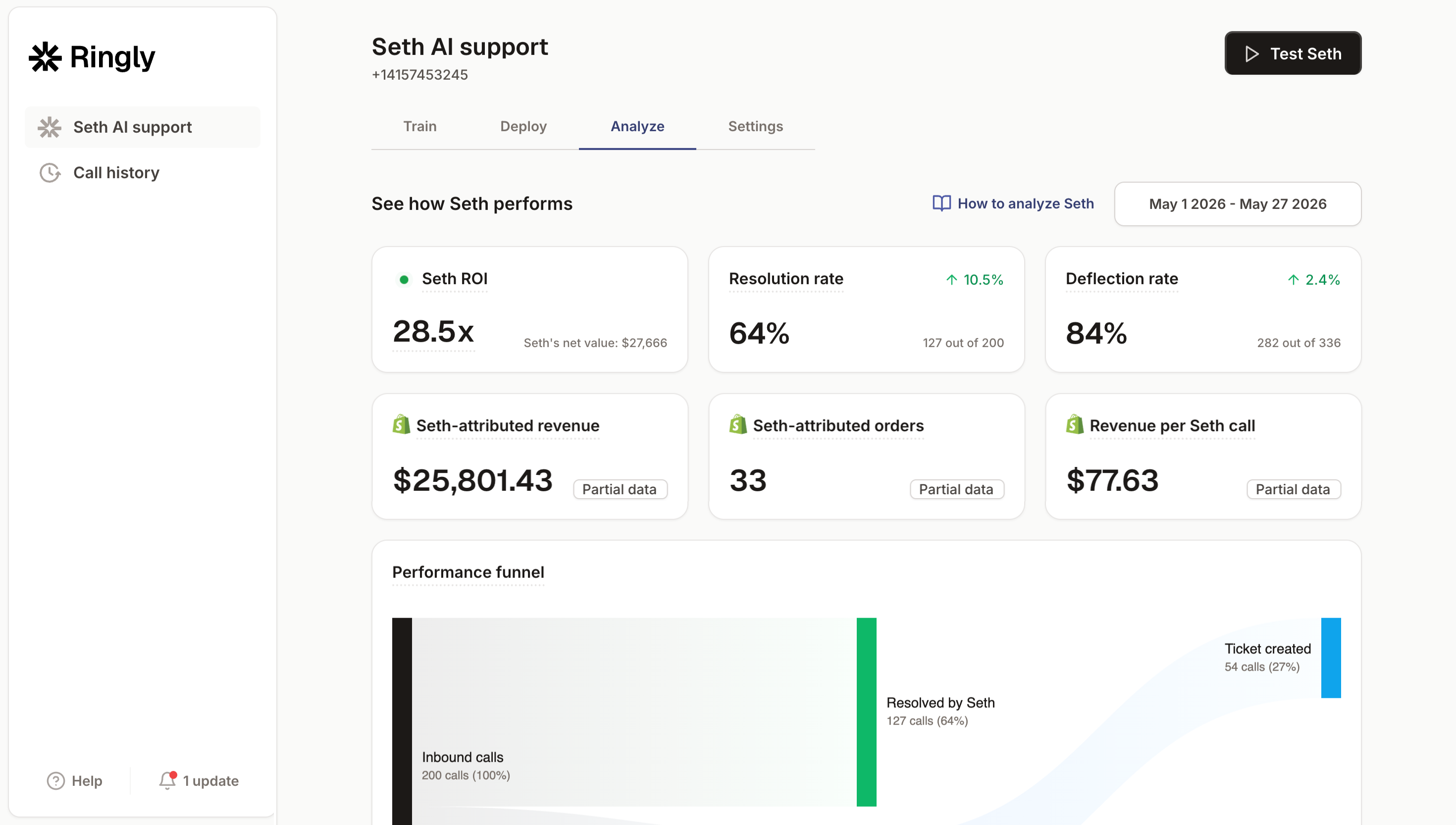
Here's what it does on a returns call. It answers 24/7, finds the order in your Shopify store via the order-status lookup, tells the caller exactly where their return and refund stand, starts a return or an exchange, and answers product questions from your knowledge base. The cases that need a human, the fraud flags and the policy disputes, escalate cleanly to Gorgias, Richpanel, Re:amaze, or whatever helpdesk you already run. Across 50+ brands the AI resolves 73% of calls on its own, at roughly $0.42 per resolved call. It doesn't replace your returns portal or your helpdesk. It sits in front of them and catches the calls they were never built to take.
WashCo, a Shopify brand we launched, recovered $22,664 in its first 7 days on the phone. Not from returns alone, but from being reachable, which is the same muscle. When someone can get a person fast, they buy the exchange instead of asking for the refund. 65% of customers say the speed and ease of a refund affects where they shop next, and the call is where that speed gets proven or lost. That reachable-around-the-clock posture is the whole idea behind 24/7 ecommerce phone support.
What this costs you, and what it saves
The math on the labor side is the easy part. The math on the phone side is the part most brands never run.
Take a typical $50M Shopify brand running a 6-rep CS team:
| Line item | Today | With Ringly |
|---|---|---|
| 6 reps x $4K loaded per rep | $24,000/mo | n/a |
| Ringly (~$5K/mo at this volume) | n/a | $5,000/mo |
| Net monthly CS spend | $24,000/mo | $5,000/mo |
| Monthly savings | n/a | $19,000/mo |
| Annual savings | n/a | $228,000/yr |
That's roughly 70% of repeatable calls, the WISMR lookups and the return-status questions and the same five things over and over, routed to the AI. The other 30%, the genuinely hard calls, still go to your team, who now have time to handle them well. Plans start at $349/mo and the full breakdown is on the pricing page.
Stack that on top of the portal savings, where each automated return drops from about $12.50 to $1.80 in labor, and the two layers compound. The portal kills the manual data entry. The phone layer kills the manual call. If you want to see your own numbers, book a 30-min call and we'll do the math live against your actual call volume.
Frequently asked questions
What is automated returns processing? It's the software workflow that takes a return from initiation to refund and restock without a person touching each step. A customer self-serves on a portal, a rule engine checks eligibility, an RMA and label are generated, the item is scanned and dispositioned on receipt, and the refund or exchange is issued automatically.
How do you automate ecommerce returns? You connect a returns portal to your store, encode your return policy as rules the system can enforce, and let it handle initiation, labels, approvals, and refunds. The realistic target is 65-75% of returns running with no human involvement, with the rest routed to a person.
What part of returns can't be automated? The conversations. Where's-my-refund calls, policy edge cases, fraud flags, exchange-by-phone requests, and refund-method disputes all hand off to a human. These are roughly the 25% of returns a self-service portal is not built to resolve.
Does returns automation replace my helpdesk? No. The portal owns the self-service flow, the helpdesk owns escalations and tickets, and the phone is a third layer most brands leave unautomated. An AI phone agent sits in front of your helpdesk, not on top of it, and escalates the hard cases cleanly.
How much does manual return processing cost? Around $12.50 per return in labor when handled manually, dropping to about $1.80 when automated, per industry operations data. A brand processing 1,000 returns a month is looking at real labor savings just on the data-entry side, before you count the call volume.
What is WISMR and why does it matter? WISMR stands for "where is my return," or in practice "where is my refund." It's the most common returns call because customers ship items back and then hear nothing while they wait 9-10 days for the money. It matters because a portal status page exists and customers still call anyway.
Can an AI phone agent process a return on a call? Yes. It can find the order in Shopify, confirm return or refund status, start a return or an exchange, and answer policy questions from your knowledge base. Cases that need a human, like fraud or out-of-policy disputes, escalate to your helpdesk.
Talk to us

If you run a $10M-$100M Shopify brand and your returns automation is solid but the phone still buries your team, a 30-min call is the fastest way to see exactly which returns calls you're leaking and what it would take to catch them.
The 3-layer guarantee.
- Live in 14 days or it's free until launched.
- 65% resolution in 90 days or we refund the last 3 months of subscription fees.
- We keep working free until we hit 65%.
Ruben (Ringly co-founder) takes these calls personally.