

This post in 30 seconds.
- Honest filter: you need this if the founder is still on the phone after-hours. You don't if you're under 10 calls/mo.
- ROI math at 100 calls a month: $0.42 per resolved AI call vs $1,500 to $3,000 for a part-time hire who covers 9-5 weekdays only.
- This is the smaller end of brands we work with: $1M to $10M ARR, 0 to 1 dedicated CS people, founder still on the line.
It's Saturday at 8:14pm. You're the founder of a $3M Shopify brand. Your phone buzzes. It's a customer asking where her order is.
You answer it. Because you don't have anyone else.
This is the most common pattern at small ecommerce brands. Revenue says you're real. Headcount says you're not. The phone became unanswerable about a year ago, but nobody had time to fix it.
Most "automated phone support" articles are written for 200-seat call centers. This one isn't. This is the smaller end of brands we work with: somewhere between $1M and $10M in revenue, 0 or 1 dedicated CS person, trying to figure out whether AI phone support is something you actually need at your size or whether it's overkill for 50 calls a month.
The short answer: yes, if your founder is still answering calls after hours. Probably not, if you get under 10 calls a month total. If you're somewhere in between and want a faster read, book a 30-min call and we'll look at your last 7 days of missed calls live.
Why phone still matters when you're small
A lot of small ecommerce brands have quietly removed their phone number from the site. The thinking goes: we can't staff it, so let's just not invite the calls. Hide the number, point everything to email.
This is the most expensive cost-saving move you can make.
Phone callers are not the same buyers as your web visitors. They're higher-intent, higher-AOV, and they tend to buy. According to Salesforce's State of the Connected Customer, 65% of customers still prefer phone for urgent issues. Phone callers spend roughly 28% more on average than web-only buyers, per industry data summarized by Invesp. And the bias toward phone for high-trust moments (pre-purchase questions on a $200+ order, problems with a delivery, anything emotional) hasn't moved much in five years.
Now layer in the small-brand specific pattern. Your AOV is probably $80-$300. Your abandoned cart recovery email goes out and converts at maybe 8-12%. The same cart, called back within 30 minutes by a real voice, converts at 20-35%. The math on a $300 AOV cart is simple. You miss 10 callback opportunities a week and you've left $2,000+ on the table every month.
The phone isn't a cost center for a small ecommerce brand. It's a conversion channel. The problem is that nobody at a 10-person company has time to staff it.
That's the gap automated phone support is built for. Not replacing your team. Catching the calls your team can't.
The "do I even need this at my size" question
Here's the honest filter most articles skip.
You need automated phone support if any of these are true:
- You're a founder or ops lead still personally answering customer calls during evenings or weekends
- You have a phone number on your site that goes to voicemail more than 30% of the time
- You're losing 10+ after-hours calls a month (check your phone log)
- You've hired and lost a part-time CS person at least once
- You sell products with $100+ AOV where buyers want to talk before purchase
You don't need this yet if:
- You're getting fewer than 10 calls a month total
- Your CS team is fully staffed 24/7 (rare at this size, but happens)
- You're pre-revenue or pre-launch
- You've genuinely tested removing the phone number and your reviews / conversion didn't drop
There's a fast test if you're not sure. Forward your phone line to a voicemail with a callback promise for one week. Track how many people leave a message, then how many you actually call back inside 4 hours, then how many of those convert vs the ones you don't call back fast enough. If the gap is meaningful, you have a problem worth solving.
The other concern small brands raise: "will an AI sound like a robot and tank my brand?" This was a real concern in 2023. It's mostly outdated in 2026. Modern voice AI agents have sub-400ms response latency, real prosody, and proper interruption handling. Most callers don't notice it's AI for the first 30 seconds of a routine call. Across 50+ active brands using Ringly.io, the AI resolves 73% of inbound calls without escalation, and the calls that escalate go cleanly to a human.
The brand-quality fear is mostly a 2023 reflex. Listen to a demo before deciding.
What automated phone support actually is in 2026
Quick definition, because the term is overloaded.
Automated phone support for a small ecommerce brand isn't an IVR ("press 1 for orders, press 2 for returns"). It isn't a voicemail bot that takes a message. And it isn't a generic AI receptionist that can only say "Brand X is closed, please leave a message."
It's a voice AI agent that:
- Picks up the call in under 2 rings, 24/7, in 40 languages
- Knows your Shopify store: can look up an order by phone number, email, or order ID
- Knows your policies: pulls from your knowledge base or help center to answer return windows, shipping timelines, product questions
- Resolves the call end-to-end when possible (~70%+ of routine calls), or hands off to your team with full context when not
- Triggers actions: processes a return, updates a shipping address, sends a discount code, books a callback
Compare that to what existed in 2023: stilted voice, 3-second pauses, couldn't handle interruption, couldn't actually do anything except take a message. The technology jumped a generation in 2024-2025. If your last impression of automated phone was a clunky IVR, the modern version is unrecognizable.
What automated phone support is NOT good at, and shouldn't try to be:
- Sales calls to new prospects (cold outreach is a different product)
- Custom B2B/wholesale inquiries (escalate these)
- Anything where the caller is angry or distressed (escalate, with context)
- Anything that takes more than 2 conversational turns to resolve cleanly (escalate)
The job of the AI is to handle the boring 70-80% of routine calls so your small team isn't drowning. The 20-30% that needs a human still gets a human, just faster and with better context.
ROI math at small-brand call volumes
This is the section most articles get wrong, because they assume call center economics. At small ecommerce scale, the math is different.
Here's a real comparison for a brand getting ~100 inbound calls a month (typical for a $2-5M DTC brand):
| Option | Monthly cost | What you actually get |
|---|---|---|
| Founder takes calls personally | $0 (plus founder burnout) | ~30% of calls answered, slow response, no after-hours |
| Voicemail only | $0 | 0% live answered, ~10% callback success rate |
| Generic AI receptionist | $50-$150 | Live answering, message-taking only, no Shopify context |
| Live answering service (Smith.ai, Ruby) | $200-$500 | Human answering, no Shopify integration, escalates to you |
| Part-time CS hire (20 hrs/week) | $1,500-$3,000 + benefits | Real handling 9-5 weekdays only, nothing after-hours, no weekends |
| Full-time CS hire | $3,500-$5,500 loaded | 9-5 coverage, after-hours gap, training overhead, turnover risk |
| Ringly.io Grow plan | $349 | 24/7 Shopify-native AI, 73% resolution, escalates to your team |
The part-time hire math breaks for two reasons. First, 20 hours of coverage means 148 hours uncovered per week. Most of your phone volume is in those uncovered hours. Second, part-time CS hires churn fast. Industry average tenure for part-time ecommerce CS is under 8 months. You'll re-hire and re-train twice a year.
The generic answering service math breaks because they don't know your store. They take messages. Your team still has to call back. You've spent $300/mo to slightly extend your voicemail.
The traditional BPO math (full call center outsourcing) doesn't even apply at this scale. BPOs start at $1,000-$2,000/mo minimums for a fractional seat. Cost per call lands around $7-$16 according to industry benchmarks reported by Deloitte's Global Outsourcing Survey. At 100 calls a month, that's $700-$1,600 monthly, and you still don't get 24/7 or Shopify-native context.
The AI math breaks even fast. At $0.42 per resolved call vs $7-$16 for human BPO, the break-even hits around 30 calls a month. Below that, AI is overkill (just take the calls yourself). Above that, AI is the cheapest option that actually resolves the call instead of routing it.
WashCo generated $22,664 in attributed revenue in the first 7 days post-launch, with 271 calls handled, 85% deflection, and $0.91 per call vs $2.70 for human-handled. That's a single-store proof at small-brand scale.
For a brand at 100-400 calls a month, the Grow plan at $349/mo gives you about 1,000 minutes (enough for 400-500 calls). You're paying roughly the cost of 4 hours of part-time CS labor and getting full 24/7 coverage that closes most calls without you touching them.
The call makes sense if:
- You're a Shopify brand doing $1M to $10M
- You have 0 or 1 dedicated CS people
- You have a visible phone number on your store (or want one back)
- The founder is still answering calls after-hours
What happens on the call.
- We pull your last 7 days of missed calls live, on the call. No homework for you.
- We show you the recovered revenue at typical resolution rates for small brands.
- You decide if it's worth a deeper conversation. No deck, no follow-up sequence.
Book a 30-min call and we'll have your recovered-revenue math in 30 minutes.
The small-brand setup that actually works
If you decide to add automated phone support, here's the setup pattern that works at small-brand scale. None of this requires a dev or a project manager.
Keep your phone number visible on the site. Hiding it costs you high-intent buyers. Modern AI means you can keep it visible without staffing it.
Hand the AI the same docs your team uses. Your shipping policy page. Your return policy. Your FAQ. Your product care sheets. If it's in your knowledge base or help center, the AI should pull from it. No separate "AI training" project required.
Connect your Shopify store. This is the part that separates real automated phone support from generic AI receptionists. The AI should be able to look up orders, see fulfillment status, and answer "where is my order" without forwarding to a human. WISMO calls alone are 30-50% of volume for most ecommerce brands. WISMO automation is the single biggest deflection win at small scale.
Pick 3-5 escalation triggers. Common ones:
- Caller is angry or frustrated (sentiment detection)
- Order value over a threshold (e.g., $500+)
- Wholesale or B2B inquiry
- Caller explicitly asks for a human
- AI hasn't resolved the issue in 2 conversational turns
Name one person as the escalation owner. When the AI escalates, where does it go? At a small brand, this is usually the founder or the one CS person. Don't route to a shared inbox. Route to one phone or one Slack channel. Things that go to "support@" at a small brand die.
Review the call recordings weekly. Block 15 minutes every Friday. Listen to 5 random calls. Note any that the AI got wrong or that should have escalated. Fix the knowledge base entry. This is how you go from 60% resolution in week 1 to 75%+ in month 2.
What the AI handles vs what your team handles
A useful mental model: split your inbound calls into three buckets.
Bucket 1: AI handles fully (target 70-80% of calls)
- Order status (WISMO): the largest single bucket, usually 30-50% of inbound
- Return and exchange requests: pull the order, check the return window, generate a label, send via SMS
- Product questions: pulled from your knowledge base or product pages
- Hours, location, policy questions: anything in your help center
- Abandoned cart callbacks: outbound, triggered by Shopify abandoned checkout webhook
Bucket 2: AI handles partially, escalates with context (15-20%)
- Modifications to in-flight orders ("change my shipping address")
- Cancellation requests where the order has already shipped
- Sizing or fit questions outside the size chart
- Discount or refund requests outside policy
Bucket 3: always escalate to a human (5-10%)
- Angry or distressed callers (the AI should detect tone)
- Custom orders, wholesale inquiries, B2B questions
- Press, partnership, or business inquiries
- Anything legal, medical, or sensitive
- Caller explicitly asks for a person
The right tool will let you configure these triggers without code. When the AI escalates, it should pass a clean summary to the human (caller name, order context, what they wanted, what the AI already tried). The human picks up at the next step, not from scratch.
This split is the whole point. Your founder shouldn't be on WISMO calls at 8pm. Your founder should be on the 3-5% of calls a week that actually need their judgment. Everything else should resolve without them.
Ringly.io for small ecommerce brands
Ringly.io is AI phone support for Shopify brands. The phone shouldn't be a tax on your support team. Instead of growing headcount every time call volume goes up, the AI takes the routine inbound calls so your small team can focus on the work that actually moves revenue.
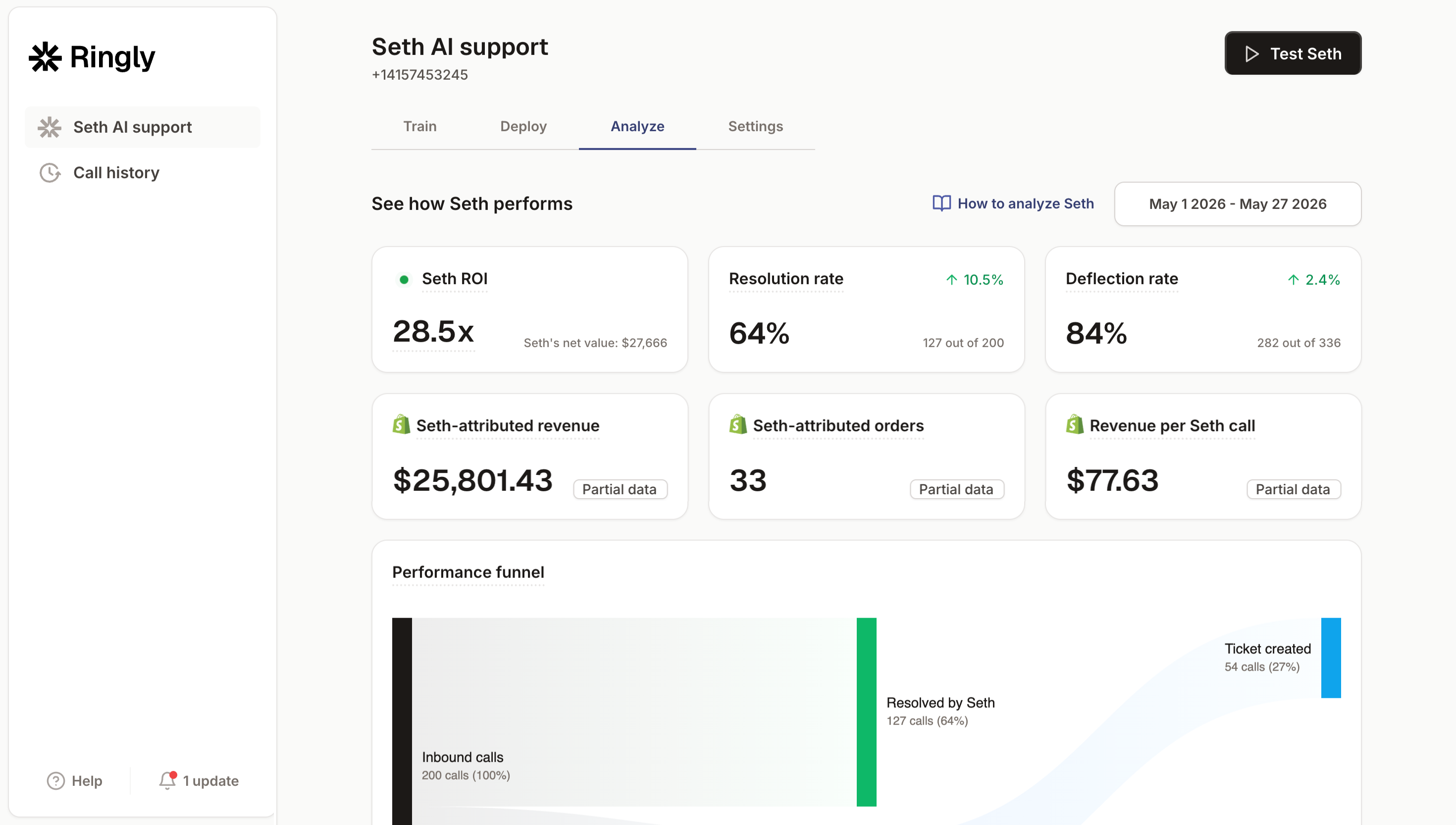
The AI answers inbound calls 24/7 in 40 languages. It finds orders in your Shopify store, processes returns and exchanges, answers product questions from your knowledge base, and rescues abandoned carts via outbound follow-up. Across 50+ active brands, the AI resolves 73% of calls autonomously at roughly $0.42 per resolved call. Calls that need a human escalate cleanly to Gorgias, Richpanel, Reamaze, or whatever helpdesk you already run.
For a small ecommerce brand specifically, the Grow plan at $349/mo gives you 1,000 minutes per month (roughly 400-500 calls), which covers most $1-5M brands with room to grow. Live in under an hour. No code, no project, no dev work.
"My customers also feel like it's a normal person. They feel like they can communicate if they have questions."
Claudia Droge, TechCraft Studio
What works for small brands specifically:
- No-team-required setup: you point it at your Shopify store and knowledge base. The AI is ready.
- Right-sized pricing: Grow at $349/mo is roughly the cost of 4 hours of part-time CS labor for full 24/7 AI coverage.
- Resolution guarantee: if the AI resolves under 65% of your calls in 90 days, you get the last 3 months of subscription back.
- Helpdesk-aware escalation: routes the 25-30% of calls that need a human into whatever helpdesk you already use, with full context.
- Outbound abandoned cart calls: the play most small brands skip because they don't have the staff. The AI makes the call.
The honest limitations:
- Not built for B2B or wholesale-heavy operations (DTC focus)
- Not designed for outbound cold sales calls (this is support, not prospecting)
- If you have under 30 calls a month, the cost per call doesn't make sense yet
FAQ
Do I need automated phone support if I only get 30-50 calls per month?
Probably yes, if those calls are coming in after-hours or going to voicemail. The math breaks even around 30 calls a month if you'd otherwise be paying yourself, a VA, or a part-time hire to take them. Below that volume, just answer them yourself.
Will an AI voice agent sound robotic and hurt my brand?
Not in 2026. Modern voice AI has sub-400ms latency, real prosody, and interruption handling that most callers don't recognize as AI in the first 30 seconds. Listen to a demo on your own store before deciding. The 2023 robotic experience is two generations of tech ago.
How is this different from a generic AI receptionist?
Generic AI receptionists answer the phone and take messages. They don't connect to your Shopify store, can't look up orders, and don't actually resolve calls. An ecommerce-specific AI agent (like Ringly.io) is built to handle WISMO, returns, and order modifications end-to-end, escalating only what's truly complex.
What does it cost vs hiring a part-time CS person?
A 20-hour-per-week part-time CS hire runs $1,500-$3,000/mo loaded, covers maybe 9-5 weekdays, and has turnover risk. Ringly's Grow plan is $349/mo for 24/7 coverage with 73% autonomous resolution. The AI is cheaper and covers more hours, but a human still wins on emotional nuance and complex cases (which is why you keep one for escalations).
Can the AI actually find orders in my Shopify store?
Yes. Once connected to Shopify, the AI can look up orders by order number, email, phone, or customer name, see fulfillment status and tracking, and tell the caller exactly where their package is. WISMO ("where is my order") calls are 30-50% of typical ecommerce inbound. WISMO call automation is the single biggest deflection win at small-brand scale.
What happens when the AI can't handle a call?
It escalates to a human with a clean summary of what the caller wanted and what was tried. You configure where escalations go (one person's mobile, a helpdesk, or a callback request). The handoff is in seconds, with full context, not "let me transfer you and you'll explain the whole thing again."
Talk to us
The real question for a small ecommerce brand isn't "can I afford automated phone support." At $349/mo it costs less than a single part-time CS shift per week.
The real question is whether you can afford to keep leaving phone callers in voicemail at $1-10M revenue. Every missed call is a customer who probably had a high-AOV question, a buying decision in progress, or a problem with an order they were about to leave a 1-star review about.
If your founder is still answering the phone at 8pm on a Saturday, that's a sign you've outgrown the "we'll just take the calls ourselves" stage. A 30-min call is the fastest way to see what changes when AI takes the boring 70-80%.
The 3-layer guarantee.
- Live in 14 days or it's free until launched.
- 65% resolution in 90 days or we refund the last 3 months of subscription fees.
- We keep working free until we hit 65%.
Ruben (Ringly co-founder) takes these calls personally.