

Atera has become a popular choice for MSPs and IT teams looking for an all-in-one RMM and PSA solution.
But the per-technician pricing model doesn't work for everyone, especially as you scale.
Add-on costs for AI features and paywalled advanced reporting have many teams exploring other options.
Whether you need per-device pricing, better mobile management, or a free tier to get started, this guide covers six Atera alternatives worth considering in 2026.
Editor’s note: Want to hear some sample AI support calls made for your Shopify store?
- Just paste your store URL
- Hear sample calls for your store (no email required)
- Listen to demo calls for my store
What is Atera and why look for alternatives?
Atera combines remote monitoring and management (RMM) with professional services automation (PSA) in a single cloud platform. It handles patch management, remote access, ticketing, and billing. For many MSPs, it works well enough.
But common complaints drive users to look elsewhere:
- Per-technician pricing gets expensive as you add staff
- Add-on costs for AI Copilot (€95/technician/month) and network discovery
- Paywalled features like advanced reporting and custom asset types
- Performance issues reported by growing teams with large endpoint counts
- Support responsiveness can be slow during critical issues
If any of these sound familiar, the alternatives below might be a better fit.
How we evaluated these Atera alternatives
We looked at platforms that solve the specific problems Atera users report. Here's what mattered most:
- Pricing transparency clear costs without surprise add-ons
- RMM capabilities monitoring, patching, remote access quality
- PSA features ticketing, invoicing, time tracking
- Scalability how pricing and performance hold up as you grow
- Integration ecosystem connects with your existing tools
- Support quality responsiveness and helpfulness
Let's look at the top alternatives.
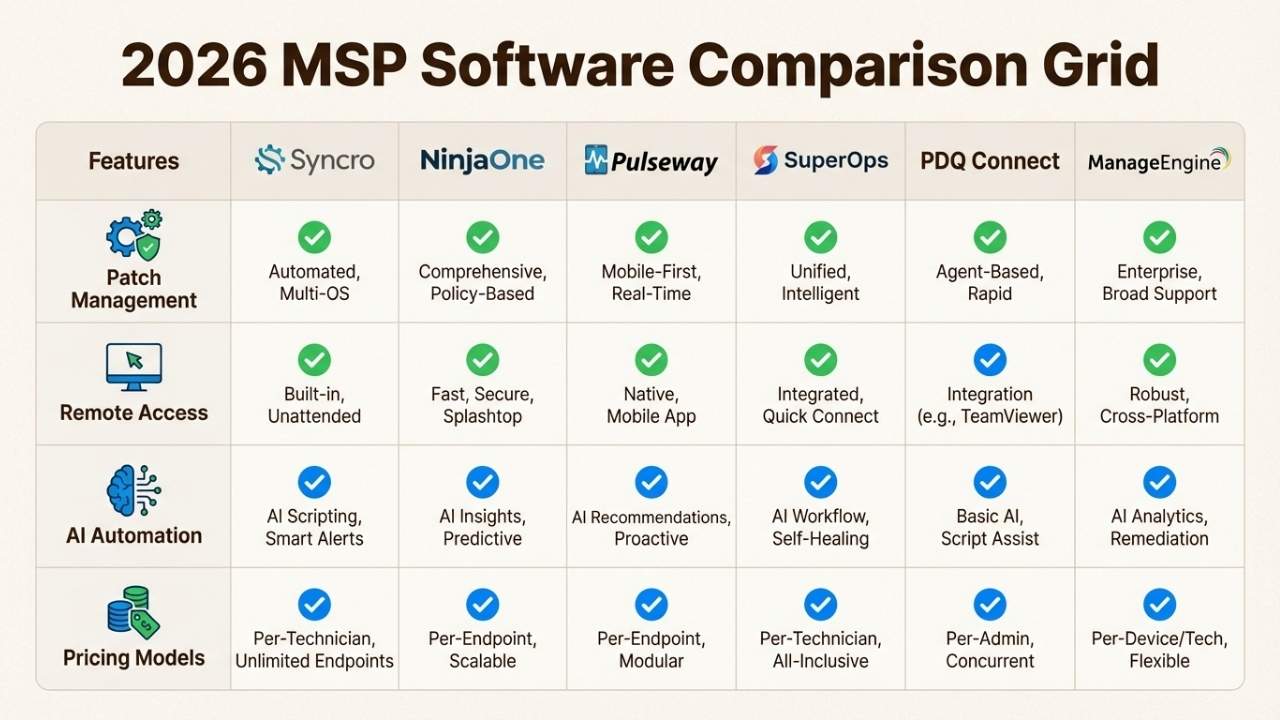
Top 6 Atera alternatives compared
1. Syncro

Syncro is an all-in-one RMM and PSA platform built specifically for growing MSPs. It combines endpoint management, ticketing, invoicing, and automation in one interface.
Key features:
- Unlimited endpoints per technician
- Built-in remote access via Splashtop
- 50+ integrations including QuickBooks, Pax8, and IT Glue
- Microsoft 365 management with Entra ID sync
- Automated billing and recurring invoices
- PowerShell, VBS, and BAT scripting with shared library
Pricing:
| Plan | Monthly Price | Annual Price | Key Features |
|---|---|---|---|
| Core | $139/tech | $129/tech | RMM + PSA, unlimited endpoints, 50+ integrations |
| Team | $189/tech | $179/tech | Everything in Core + Network Discovery, AI ticket resolution |
Free trial: 14 days, no credit card required, includes Team plan features
Best for: Growth-minded MSPs wanting unified platform without per-device fees. The unlimited endpoint model means your costs stay predictable as you scale.
Pros:
- No per-device fees
- No long-term contracts
- Strong Microsoft 365 integration
Cons:
- Per-technician pricing still applies
- Network Discovery limited to Team plan
2. NinjaOne

NinjaOne is a unified IT operations platform that goes beyond traditional RMM. It includes endpoint management, mobile device management, backup, and autonomous patching powered by AI.
Key features:
- Endpoint management for Windows, macOS, and Linux
- Mobile Device Management for Android and Apple devices
- Autonomous Patch Management with AI-powered intelligence
- Device, server, and SaaS backup (Microsoft 365, Google Workspace)
- Fast single-click remote control
- Service Desk with ticketing and documentation
Pricing:
| Endpoints | Price per device/month |
|---|---|
| 50 or fewer | $3.75 |
| 10,000+ | As low as $1.50 |
Free trial: 14 days
Best for: Enterprise IT teams and MSPs needing comprehensive endpoint management with backup and MDM included. The per-device pricing works well if you have fewer technicians managing many endpoints.
Pros:
- Includes backup and MDM
- FedRAMP Moderate and SOC 2 certified
- Fast deployment (most users operational in under 1 week)
Cons:
- Pricing not fully transparent (contact sales for exact quotes)
- Can get expensive at scale
3. Pulseway

Pulseway is a mobile-first RMM solution that lets you monitor and manage IT infrastructure from your smartphone. It's been around for over 15 years with 13,000+ customers.
Key features:
- Real-time monitoring with customizable alerts
- Full-featured mobile apps for iOS and Android
- Automated patch management for OS and third-party apps
- Secure remote control capabilities
- Mobile Device Management via Apple Services integration
- Ransomware detection with automated isolation
- Endpoint protection via Bitdefender and Webroot integration
Pricing:
| Billing Term | Starting Price (20 endpoints) |
|---|---|
| Monthly | $44/month |
| Annual | Discounted rates |
| 3-Year | Save up to 39% |
Note: One-time Advanced Onboarding fee of €149 required
Free trial: Available
Best for: MSPs and IT teams that need to manage infrastructure on-the-go. The mobile experience is genuinely best-in-class.
Pros:
- Excellent mobile management
- Real-time alerts
- Flexible contract terms
Cons:
- Onboarding fee required
- Pricing can be complex with add-ons
4. SuperOps
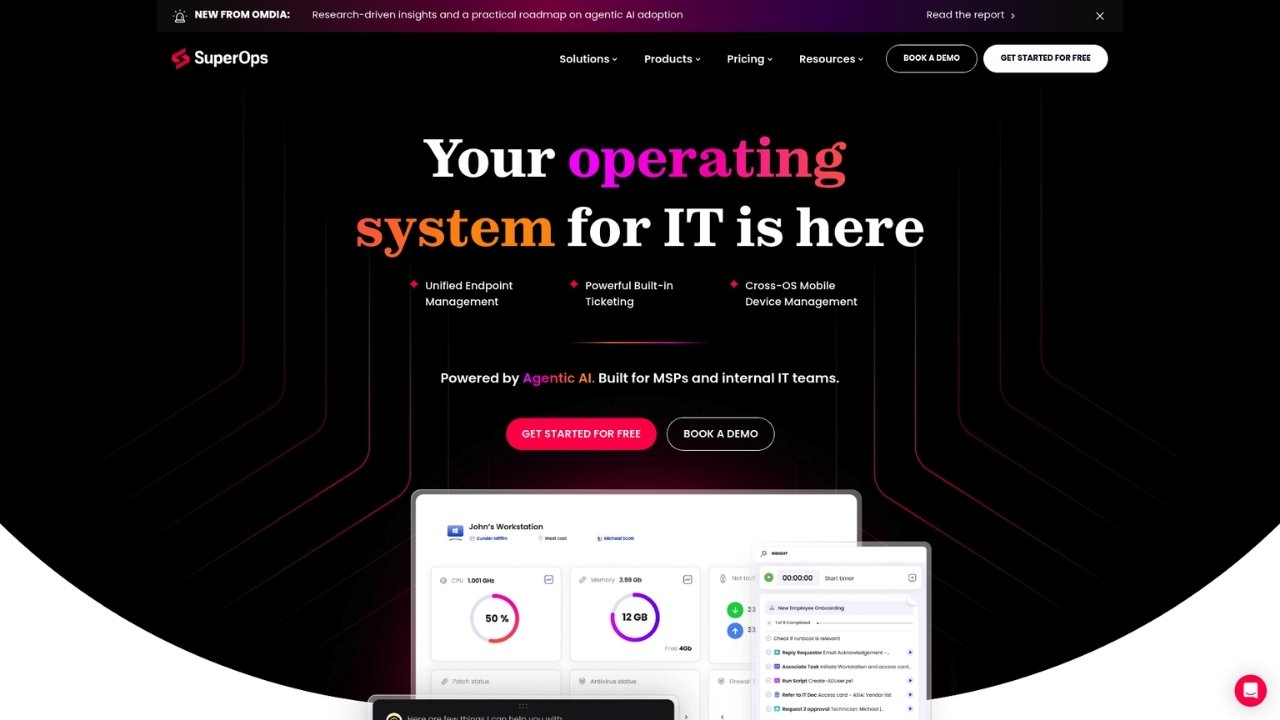
SuperOps is a modern MSP platform built around Agentic AI. It claims to be 28% lower cost than Atera while offering a full PSA-RMM suite.
Key features:
- Monica AI for ticket resolution and automation
- Ticketing, projects, and automated billing
- Windows, Mac, and Linux asset management
- Advanced patching and proactive monitoring
- IT documentation management
- MDM for Apple and Android devices (Super Plus plan)
- Network devices monitoring (Super Plus plan)
Pricing:
| Plan | Price | Endpoints |
|---|---|---|
| Pro | £139/tech/month | 150/tech |
| Super | £169/tech/month | 150/tech |
| Super Plus | £1.70-2.50/endpoint/month | Per-endpoint |
| PSA Only | £79/tech/month | N/A |
| RMM Only | £99/tech/month | 150/tech |
Free trial: 14 days
Best for: AI-forward MSPs wanting a modern interface and flexible pricing. The per-endpoint Super Plus plan can be cost-effective for larger teams.
Pros:
- AI-powered automation included
- Modern, clean interface
- Flexible pricing models
Cons:
- Newer platform with smaller user base
- Some features limited to higher tiers
5. PDQ Connect
PDQ Connect is a cloud-native endpoint management solution focused on Windows and macOS devices. It's known for speed and simplicity.
Key features:
- Rapid patch management for Windows and macOS
- Device inventory and custom reporting
- Prebuilt and custom software packages
- Remote desktop access (Plus and Premium)
- Vulnerability scanning and prioritization (Premium)
- One-click CVE resolution (Premium)
- API access (Premium)
Pricing:
| Plan | Price per device/year | Minimum Cost |
|---|---|---|
| Basic | $12 | $1,200/year (100 devices) |
| Plus | $18 | $1,800/year |
| Premium | $28 | $2,800/year |
Discounts: 10% off for nonprofits and schools; volume pricing for 500+ devices
Free trial: 14 days, up to 250 devices, no credit card required
Best for: Windows-centric environments with 100+ endpoints. The per-device pricing is transparent and predictable.
Pros:
- Transparent per-device pricing
- Fast performance
- Strong vulnerability management (Premium)
Cons:
- 100 device minimum
- Windows and macOS only (no Linux)
6. ManageEngine Endpoint Central
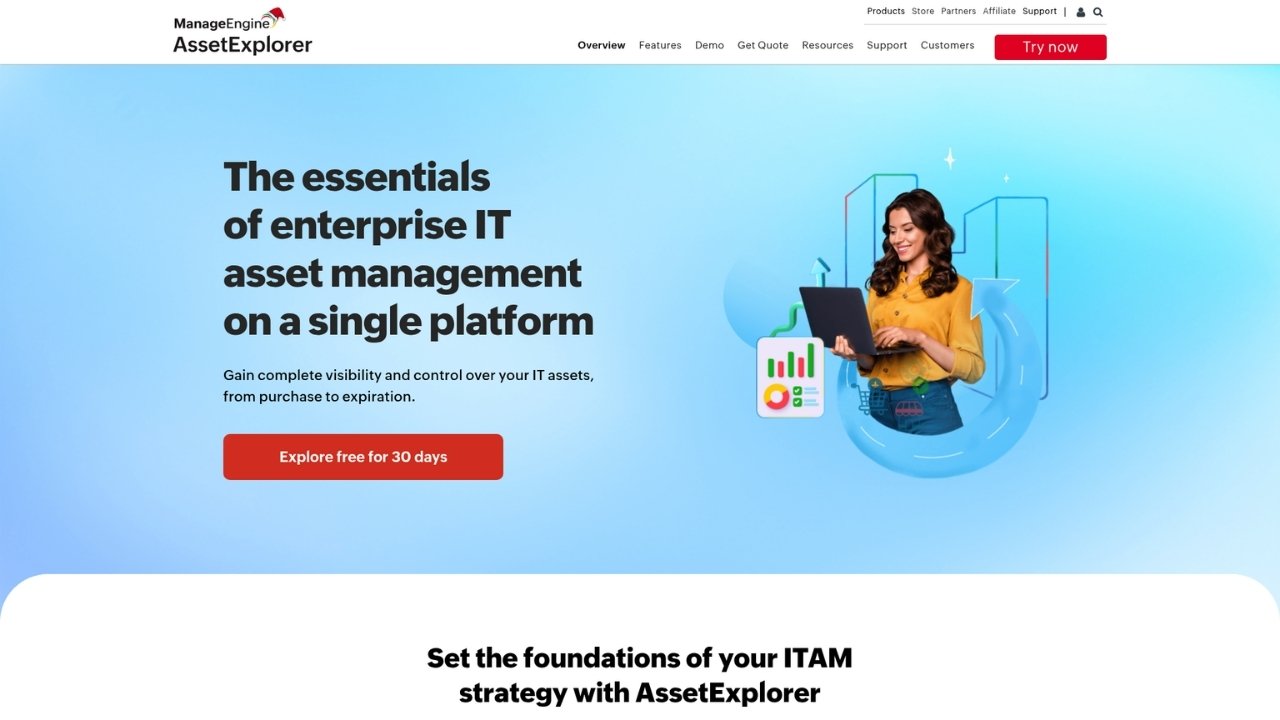
Endpoint Central is a unified endpoint management and security solution from ManageEngine (Zoho). It offers both cloud and on-premise deployment options.
Key features:
- Patch management for Windows, Mac, and Linux
- Mobile Device Management for iOS, Android, ChromeOS
- OS imaging and deployment
- IT asset management with license tracking
- Ransomware protection and data loss prevention
- Browser security and application control
- Remote troubleshooting and desktop sharing
Pricing:
| Edition | Annual Price (50 endpoints) |
|---|---|
| Free | $0 (up to 25 endpoints) |
| Professional | $795 |
| Enterprise | $945 |
| UEM | $1,095 |
| Security | $1,695 |
Free trial: 30 days, no credit card required
Best for: Enterprises needing deployment flexibility (cloud or on-prem) and comprehensive security features. The free tier is great for small teams.
Pros:
- Free tier for up to 25 endpoints
- On-premise option available
- Comprehensive security features
- Privacy-first (no data sold to advertisers)
Cons:
- Complex pricing structure
- Can be overwhelming for small teams
Atera alternatives comparison table
Here's a quick comparison of all six alternatives:
| Platform | Pricing Model | Starting Price | Best For | Free Trial |
|---|---|---|---|---|
| Syncro | Per-technician | $129/tech/month | Growing MSPs | 14 days |
| NinjaOne | Per-device | ~$3.75/device | Enterprise IT | 14 days |
| Pulseway | Per-endpoint | $44/month (20 devices) | Mobile-first teams | Available |
| SuperOps | Per-tech or per-device | £139/tech or £1.70/endpoint | AI-forward MSPs | 14 days |
| PDQ Connect | Per-device | $12/device/year | Windows-centric teams | 14 days |
| ManageEngine | Per-endpoint | Free (25 devices) | Enterprises, flexible deployment | 30 days |
How to choose the right Atera alternative
The best choice depends on your specific situation:
Small MSPs (1-5 technicians): Start with ManageEngine's free tier (up to 25 endpoints) or PDQ Connect if you're Windows-focused.
Growing MSPs (5-20 technicians): Syncro offers the best balance of features and predictable pricing. The unlimited endpoints per technician is a major advantage.
Enterprise teams: NinjaOne or ManageEngine provide the comprehensive feature sets and compliance certifications large organizations need.
Mobile-first teams: Pulseway is the clear winner if you need to manage infrastructure from your phone.
AI-focused teams: SuperOps builds AI automation into the core platform, not as an expensive add-on.
Making the switch from Atera
Migrating from one RMM/PSA to another takes planning. Here's how to make it smoother:
- Audit your current workflows document what you use daily in Atera
- Trial multiple platforms most offer 14-day trials, use them
- Check integration compatibility ensure your accounting, documentation, and security tools connect
- Plan data migration tickets, asset data, and configurations need to transfer
- Train your team schedule time for everyone to learn the new platform
Most platforms offer migration assistance or documentation to help with the transition.
Find the best Atera alternative for your MSP
There's no single "best" alternative to Atera. The right choice depends on your team size, endpoint count, budget, and which features matter most to you.
If per-technician pricing is your main pain point, look at PDQ Connect or NinjaOne with per-device models. If you need unlimited endpoints, Syncro is hard to beat. For mobile management, Pulseway stands out.
All six platforms offer free trials. Start with the one that best fits your use case and budget, then test it with your actual workflows before committing.
Frequently Asked Questions
Which Atera alternatives offer the best pricing for small MSPs?
ManageEngine Endpoint Central offers a free tier for up to 25 endpoints, making it ideal for small teams. PDQ Connect starts at $12 per device per year with a 100-device minimum, which works out to $1,200 annually.
Do any Atera alternatives include AI features without extra costs?
Yes. SuperOps includes Monica AI for ticket resolution and automation in all plans, not as a paid add-on. Syncro's Team plan also includes AI ticket resolution.
What Atera alternatives work best for mobile management?
Pulseway is specifically designed for mobile-first management with full-featured iOS and Android apps. NinjaOne and ManageEngine also offer strong mobile device management capabilities.
Are there Atera alternatives with on-premise deployment options?
ManageEngine Endpoint Central offers both cloud and on-premise deployment options across all editions. This is rare among modern RMM platforms.
Which alternative has the most transparent pricing?
PDQ Connect and Syncro have the most transparent pricing with clear per-device or per-technician rates published online. NinjaOne and some others require contacting sales for exact quotes.
Can I try these Atera alternatives before buying?
Yes. All six alternatives offer free trials ranging from 14 to 30 days. Most don't require a credit card to start. ManageEngine offers the longest trial at 30 days.