
This post in 30 seconds.
- The "pet receptionist" tools ranking for this term were built for groomers and kennels booking appointments. A Shopify pet brand selling food and supplements online has a completely different phone problem.
- The calls that actually come in: where's my order, can I skip this month's autoship, is this safe for my puppy, and the occasional call from someone whose dog just died.
- The one rule that makes AI safe on a pet line is the emotional-call handoff. Built for $10M-$100M Shopify pet brands keeping a paid helpdesk and a visible phone number.
Search "AI receptionist for pet brands" and you'll get a page of tools built for groomers and boarding kennels. They book appointments, manage a calendar, and answer "are you open Saturday." Useful if you run a grooming salon. Useless if you run a pet brand on Shopify doing $20M a year in dog food and supplements.
Your phone problem is different. The calls coming into a DTC pet brand are about orders, autoship, and product questions, with a hard demographic skew toward customers who'd rather talk to a person than dig through your FAQ. It's the same after-hours coverage gap every Shopify brand hits, just with a higher cost when the caller is a recurring subscriber. I listened back to a week of real pet-brand call logs on Ringly and counted what the calls were actually about. Almost none of them were "can I book an appointment." Most were the same five things, over and over, and a big chunk of them landed after 6 p.m. when the team had already logged off.
Most pet brand founders on Shopify run a small CS team and a phone line nobody picks up on weekends. That's where the autoship cancels happen and where the "is this food okay for a senior dog" questions go to voicemail. We've launched AI phone agents for 50+ Shopify brands trying to close exactly that gap. Book a 30-min call and we'll map your call routing for you, including which calls should always go to a human.
What an AI receptionist actually does for a pet brand
Forget the calendar-booking framing. For a Shopify pet brand, an AI receptionist is a phone agent that picks up your inbound calls 24/7 and handles the routine ones end to end.
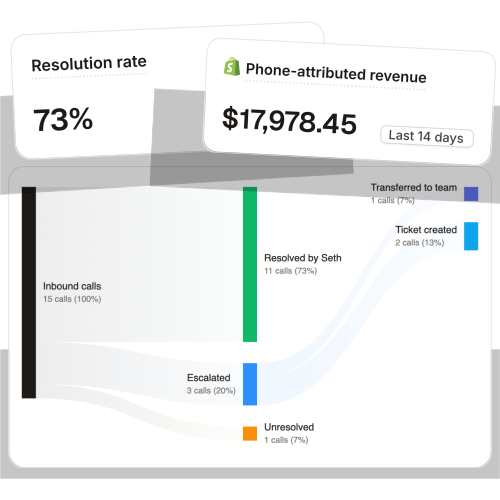
The point isn't to answer the phone, it's to resolve the call without pulling a rep off the work that actually moves revenue. Here's what that looks like on a pet line:
- Order status / WISMO: it finds the order in your Shopify store and tells the customer where their bag of food is, by name, on the call.
- Returns and exchanges: wrong size, wrong formula, damaged bag. It starts the return without a ticket.
- Product and ingredient questions: "is this safe for a dog with a chicken allergy" gets answered from your knowledge base, not guessed at.
- Autoship pause, skip, and swap: the calls that decide whether a subscriber stays or churns.
- Abandoned-cart follow-up: an outbound nudge on the carts worth chasing.
Calls it can't or shouldn't handle escalate cleanly to your team through whatever helpdesk you already run, Gorgias, Gladly, or Re:amaze. Across 50+ brands the AI resolves 73% of calls on its own, at roughly $0.42 per resolved call versus the $7 to $16 a human call costs at a BPO. You can book a 30-min call and hear it on a real line before you decide anything.
The pet-brand call mix nobody else handles right
When I went through that week of call logs, the calls sorted into five buckets. A groomer's receptionist tool is built for none of them.
First, WISMO. "Where's my order" is 30-40% of support tickets in a normal week and over 50% at peak, according to Salesforce. Pet food buyers are reorder-driven, so they call when a bag is late because the dog eats on a schedule.
Second, autoship. Pause, skip, swap to the senior formula, change the delivery date. These are the highest-stakes calls you get, because the average online pet retailer churns about 18% of customers a year and roughly 30% of that churn traces back to poor post-purchase support (Ringly internal data on pet ecommerce retention). Pet subscriptions also get swapped 2-3x more often than supplements, because diets shift as the animal ages (Springer). A skip call answered fast keeps the subscription. A skip call sent to voicemail becomes a cancel.
Third, product and life-stage questions. Breed, age, allergies, "can I mix this with kibble." Older customers especially want to talk these through, and 92% of pet owners say fast response times matter when they pick where to buy.
Fourth, recalls and safety. DTC pet food sees recall surges several times a year, and a recall spikes call volume hard and fast. TechCraft Studio, a brand on Ringly, handles 88% of its calls without a human, which is the kind of headroom you want before a recall day hits.
Fifth, the emotional calls. Grief, a sick pet, end of life. Those get their own section below, because they're the reason a lot of pet founders hesitate on AI in the first place.
Big brands like Chewy, BarkBox, and The Farmer's Dog have whole teams tuned to this mix. A $20M brand has three people and a voicemail box. The AI is how you close that gap without hiring a night shift.
The one rule that makes AI safe for pet calls
Here's the objection I hear from every pet founder. "I am not putting an AI on a call from someone whose dog just passed away." Good. Neither am I.
The rule is the emotional-call handoff, and it's hard-coded before the AI ever takes a call. Certain trigger words, sick, passed, put down, allergic reaction, recall, route the call straight to a human on your team with a warm transfer. The AI doesn't try to be a grief counselor. It hands off.
Handle the routine 90% with AI so your people are actually present for the 10% that need a human. That's the whole pitch. Your rep isn't buried under "where's my order" when a real one comes in, so they have the bandwidth to do it right. Chewy built its reputation on exactly those moments, the flowers-when-a-pet-dies stories that go viral. You can't automate that, and you shouldn't. You can automate everything around it so your team has room to deliver it.
"My customers also feel like it's a normal person. They feel like they can communicate if they have questions."
— Claudia Droge, TechCraft Studio
You set the transfer rules, so you decide what stays with the AI and what always reaches a person. That's the part the groomer tools don't think about, because a grief call isn't part of their world. It's central to yours.
What an AI receptionist costs vs a CS team
The groomer-focused tools quote $2,400 to $6,000 a year and call it 80% savings. That math is built for a one-location business. For a Shopify pet brand the real comparison is your CS payroll.
Pet brands don't get steady high call volume. They get weekend spikes and emotionally heavy calls. Here's a typical $20M pet brand:
- 3 weekday reps × $4K loaded = $12,000/mo
- 1 weekend rep × $4K loaded = $4,000/mo
- Total: $16,000/mo, with weekends still understaffed
An AI receptionist handling the WISMO, autoship, and breed-specific routine calls runs a fraction of that, and the emotional calls escalate to your team through the handoff rule above. The savings shape we see is roughly $11,000/mo, about $132K/yr, and your weekend customers stop hitting voicemail. Per resolved call that's around $0.42 versus the $7 to $16 a human-handled call costs at a BPO.
The leak you're not pricing in is the missed call itself. 85% of callers who can't reach a person never call back, and 62% switch to a competitor. For a pet brand where a single customer is a recurring autoship worth a year of orders, one missed Saturday call isn't a $40 loss, it's an LTV loss.
Real numbers from WashCo, a Shopify brand we launched recently:
- $22,664 in attributed revenue, first 7 days post-launch
- 271 calls handled
- 85% deflection rate
- 66% resolution rate
- $0.91 per call vs $2.70 per human-handled call
Source: Ringly dashboard, verified live data.
The call makes sense if:
- You're a Shopify (or Shopify Plus) pet brand doing $10M-$100M
- You run a paid helpdesk like Gorgias, Zendesk, or Intercom
- You have a visible phone number on your store
- Your CS team is 3-12 people
If that's you, the math usually works. Book a 30-min call and we'll run it live on your store.
What happens on the call.
- We pull your last 7 days of missed calls live, on the call. No homework for you.
- We show you the recovered revenue at the resolution rates we see for pet brands.
- You decide if it's worth a deeper conversation. No deck, no follow-up sequence.
If you're weighing this against your current setup, book a 30-min call and we'll do the math live on your store.
How to set up an AI receptionist for your pet brand
Setup is faster than most people expect. When we onboard a pet brand, the first thing we hard-code is the grief-call handoff, before anything else goes live. Then:
- Connect Shopify and your knowledge base. The AI pulls orders and answers product questions from your existing docs. No rebuild.
- Set the escalation and handoff rules. Decide which triggers always reach a human (grief, sick pet, recall) and which the AI owns.
- Pick the voice. Match it to your brand register. If your customers say "pet parents," the agent can too, without forced cuteness.
- Test the demo line. Call it yourself. Ask it the questions your customers ask. Hear whether it sounds like a person.
- Go live. Most brands are answering calls the same day.
You keep your number, your helpdesk, and your workflows. The AI sits in front of them and takes the routine calls. Ringly is AI phone support for Shopify brands, with a 14-day Launch Sprint where we build it for you, not a tool we hand you and walk away from. Pricing runs Grow at $349/mo, Pro at $799/mo, and Enterprise by call for higher-volume brands. See the full breakdown on the pricing page.
Frequently asked questions
What's the difference between an AI receptionist for a pet brand and one for a pet groomer? A groomer's AI receptionist is built to book appointments and manage a calendar. A pet brand's AI receptionist is an ecommerce phone agent: it looks up orders, handles autoship changes, answers product questions from your knowledge base, and escalates to your helpdesk. Same word, different job.
Can an AI receptionist handle emotional calls about a sick or lost pet? It shouldn't try to, and a good setup doesn't let it. You hard-code trigger words like "sick," "passed," and "recall" to route straight to a human with a warm transfer. The AI handles the routine calls so your team has the room to be present for the hard ones.
Will my customers know they're talking to AI? The most repeated thing customers tell us after a call is "you don't sound like AI." Pet customers skew older and high-touch, so voice quality matters more here than in most verticals. Call the demo line and judge for yourself before you commit.
Does it work with my Shopify store and helpdesk? Yes. It connects to Shopify to pull order and subscription data, and it escalates to Gorgias, Gladly, Re:amaze, or whatever helpdesk you already run. You control exactly what escalates and when.
How much does an AI receptionist for a pet brand cost? Plans start at $349/mo (Grow) and $799/mo (Pro), with Enterprise priced by call for higher-volume brands. The better comparison is your CS payroll: most pet brands we work with cut roughly $11,000/mo by routing the routine calls to the AI.
We're not high-volume. Is an AI receptionist worth it? If you genuinely take only a handful of calls a day, a lower plan or a different tool may fit better, and we'll tell you that on the call. But for a pet brand, the value isn't volume, it's never missing the autoship or high-LTV call that walks to a competitor when it hits voicemail.
Talk to us

If you run a Shopify pet brand and your phone rolls to voicemail after 6 p.m., a 30-min call is the fastest way to see what those calls were worth. We'll pull your missed calls live and route the emotional ones to your team, so the AI only ever handles what it should.
The 3-layer guarantee.
- Live in 14 days or it's free until launched.
- 65% resolution in 90 days or we refund the last 3 months of subscription fees.
- We keep working free until we hit 65%.
Ruben (Ringly co-founder) takes these calls personally.