
The CBD-brand phone line is the single most under-built channel in DTC. Customers call with questions about milligrams, drug interactions, the legal status in their state, what to take for sleep versus anxiety, whether the gummies will show up on a drug test. They want answers, in voice, before they spend $80 on a 30-day supply.
Most CBD brands take those calls one of three ways: a founder picks up between meetings, a part-time rep takes them when she's not packing orders, or the line rolls to voicemail. None of those scale past $3M in revenue. By the time a CBD brand hits $10M, the phone line is either a measurable retention lever or a measurable retention leak. There is no middle.
An AI receptionist for a CBD brand handles the 70-80% of phone calls that are routine (where my order is, when my next subscription ships, dosage from your vetted FAQ, return inside policy) and escalates the rest to a human with full context. The cost gap is real: $0.42-$0.91 per resolved call against $7-$14 for a human BPO. The trust gap is the other half. A buyer who actually got a voice on the line at 9 PM converts at 2-3x the rate of a buyer who hit voicemail.
This guide covers what an AI receptionist actually does on a CBD-brand call, the 4 calls it should be running for you, the compliance guardrails that are non-negotiable, and the 5 setup decisions that determine whether it works at $10M+.
Most calls are simple. Hear what AI phone support sounds like on your store. Book a 30-min call to walk through the math on your own volume.
TL;DR
- CBD brands route 40-55% of their phone volume into 4 call types (WISMO, dosage, compliance/legal questions, subscription changes). An AI receptionist resolves about 68-78% of those autonomously when wired to Shopify and a vetted dosage doc.
- Cost-per-call drops from $7-$14 (human BPO or in-house rep) to $0.42-$0.91, with the regulatory guardrails that text-based AI chat cannot enforce on a phone call.
- The 5 setup decisions that matter: which 4 call types you launch on, how dosage and compliance answers are sourced, the FDA-language escalation triggers, the subscription pause/skip wiring, and after-hours cart recovery.
What an AI receptionist for a CBD brand actually does
An AI receptionist for a CBD brand is a voice agent that picks up your phone, reads from your Shopify order data and your internal compliance/dosage docs, and handles 24/7 the calls that would otherwise go to voicemail, a BPO charging $7-$14 a ticket, or a CS rep who only works 9-to-5.
The category is different from the generic "AI receptionist for small business" tools you see ranked alongside dental offices and law firms. Those products are appointment-booking engines. A CBD-brand AI receptionist is closer to a CS rep with hard FDA guardrails: it pulls live order tracking, processes refunds inside policy, looks up subscription state, and refuses to answer regulated medical-claim questions, escalating them to a human instead.
The typical CBD-brand call mix the agent runs:
| Call type | What the agent does | Typical resolution rate |
|---|---|---|
| WISMO ("where is my order") | Pulls live tracking from Shopify, reads status, texts tracking link | 78-85% |
| Dosage / "how many mg" | Reads from your vetted dosage FAQ, refuses regulated medical claims | 50-65% |
| Compliance / legal status | Reads from your state-by-state legal doc, escalates anything ambiguous | 60-72% |
| Subscription skip / pause / cancel | Updates Recharge / Skio / Loop in real time, confirms by SMS | 70-82% |
| Returns / refund | Checks order date against policy, processes refund or sends return label | 60-75% |
| Drug-test / interaction question | Auto-escalates (this is the bright line) | 0% (intentional) |
The intentional zero on the last row is the design choice. Drug-test concerns and prescription-drug-interaction questions are the calls that get a CBD brand sued. The agent doesn't try to resolve them. It says "I'm going to have one of our team call you back today" and queues the callback.
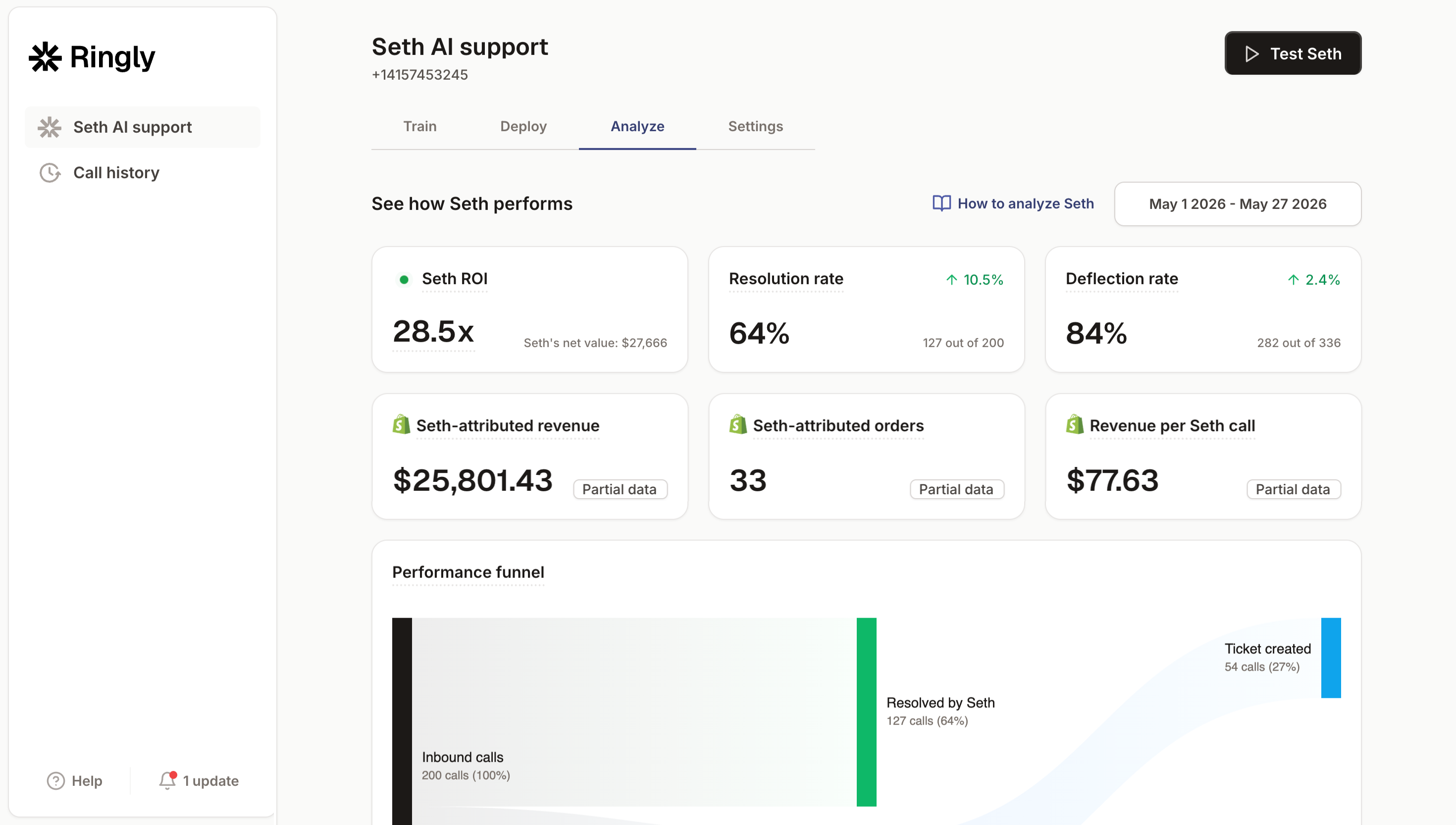
Across 50+ Shopify brands on Ringly, the average resolution rate is 73% autonomously. CBD brands trend slightly lower (68-72%) because the call mix has more compliance escalations. BioLongevity Labs, a health-adjacent brand on Ringly with overlapping call patterns, hits 79% end-to-end resolution. Useful as a directional benchmark, with the caveat that CBD has more regulated calls than pure supplements.
Why CBD brands need phone coverage more than most verticals
Three structural reasons CBD phone volume is higher than the average Shopify brand:
1. The category requires education. CBD buyers ask more pre-purchase questions per dollar of cart value than any other supplements-adjacent vertical. The product is technical (mg, full-spectrum vs isolate, terpene profiles), the use cases are personal (sleep, anxiety, pain, recovery), and the buyer is often new to the category. They will call before they buy. If you don't answer, they go to a competitor.
2. Compliance creates voice-only questions. Customers who ask about drug-test risk, prescription interactions, or shipping to certain states won't trust a chatbot's answer on those. They want a voice. A phone line that answers those questions correctly (or escalates correctly) is a trust signal the homepage cannot match.
3. Subscription LTV depends on the pause flow. A CBD subscriber who can't reach you when they want to skip a shipment cancels instead of skipping. That's the difference between $0 saved and $200-$400 LTV preserved. The phone-line miss has a direct subscription-retention cost.
For more on how brands set up the save flow specifically, see our breakdown of CBD ecommerce customer retention and the broader customer service for CBD brands guide.
How much it costs
The fully-loaded numbers, comparing the four ways CBD brands handle phone calls today:
- In-house rep: $4-$8 per call (US salary, helpdesk seat, supervisor overhead). Higher for 24/7 coverage.
- Outsourced BPO (Philippines, Latin America): $7-$14 per call. Includes compliance-training time most BPOs don't actually deliver on CBD specifically.
- Voicemail: $0 per call answered, $80-$200 per missed sale, plus subscription-pause-not-cancel LTV loss.
- AI receptionist (Ringly Pro tier): $0.42-$0.91 per resolved call, blended over plan + overage.
Quick math for a 1,000-order/month CBD brand running ~500 calls/month at 40% phone-share of CS volume:
| Setup | Cost per call | Monthly (500 calls) | Annual |
|---|---|---|---|
| In-house rep | $7 | $3,500 | $42,000 |
| Outsourced BPO | $10 | $5,000 | $60,000 |
| Voicemail (60% miss rate) | $0 / $120 per missed sale | -$36,000 lost revenue | -$432,000 |
| AI receptionist (Ringly) | $0.58 | $349-$799 | $4,200-$9,600 |
Again, the headline isn't the cost-per-call delta. It's the voicemail row. Most CBD brands at $5M-$15M revenue run the voicemail strategy without writing it down. The line rings, nobody picks up, the customer hangs up and either comes back or doesn't. The "doesn't" tail is the largest line item nobody puts in the P&L.
Hear sample calls on your own Shopify URL. Book a 30-min call and we'll model the resolution math on your real call volume.
The call makes sense if
- Your CBD brand does $5M-$50M in annual Shopify revenue and has a phone number visible on your site
- More than 25% of your CS volume runs on the phone, or you suspect it would if the line were actually staffed
- You run an active subscription program (Recharge, Skio, Loop)
- You currently miss more than 30% of inbound calls after hours
- Your team has spent any meaningful time writing compliance docs or dosage FAQs (the agent reads from those)
What happens on the call
A 30-minute call with Ringly's founder, not a sales rep. You paste your Shopify URL in advance, we pull demo calls, walk through the resolution math on your real volume, and you leave with a clear go / no-go and a cost model. No pitch, no deck.
The 5 setup decisions that determine whether it works
The vendor comparison is downstream of these. Pick wrong here and the best AI receptionist on the market resolves 45% of your CBD calls. Pick right and a mid-tier vendor resolves 72%.
1. Which 4 call types you launch on
Don't deploy on every call type day 1. The brands that get to 70%+ resolution within 90 days launch on the 4 highest-volume routine call types FIRST and add the harder ones over months 2-4.
The right starting four for most CBD brands:
- WISMO (highest volume, easiest win, 78-85% resolution)
- Subscription skip / pause (highest LTV-protection)
- Basic FAQ (shipping cost, return policy, where to find COAs)
- Reorder confirmation (the agent can complete the transaction)
Dosage, compliance, and refund disputes get added in months 2-3 once the dosage doc and compliance doc are fully vetted.
2. How dosage and compliance answers are sourced
This is the bright-line decision for CBD specifically. Three patterns:
- Conservative: the agent reads only from a single vetted dosage doc your medical/compliance team approved. Every other dosage question hands off.
- Moderate: agent reads from a broader product knowledge base, with hard guardrails: interaction questions, drug-test questions, contraindications, pregnancy, all auto-escalate.
- Permissive: agent paraphrases from site copy. Never deploy this for CBD. One wrong answer about a prescription-drug interaction is the kind of thing that creates regulatory exposure your CFO will discover three months later.
Most CBD brands above $10M run the Moderate pattern. The Conservative pattern is fine for newer brands without a vetted doc.
3. The FDA-language escalation triggers
Make these explicit at setup, not after a near-miss. Trigger words the agent should always escalate on:
- "Drug test" / "fail a drug test" / "show up on". Auto-escalate
- "Prescription" / specific drug names. Auto-escalate
- "Pregnant" / "breastfeeding" / "kids" / "child". Auto-escalate
- "Heart" / "blood pressure" / "diabetes" / specific medical conditions. Auto-escalate
- Any sentiment score below threshold. Auto-escalate
- Customer says "talk to a human". Auto-escalate (zero questions)
Escalations should arrive at the human with the full transcript, the trigger that fired, and what the agent already said.
4. The subscription wiring
Read-write integration with Recharge, Skio, or Loop is required. Read-only is not enough. If the customer calls to skip a shipment and the agent has to say "I'll have someone email you", you've burned the trust the call was supposed to build. The wiring quality matters more than the choice of vendor. A clean Recharge integration that skips in real time beats fancier voice quality with a brittle integration.
5. After-hours cart recovery
The most overlooked use case. CBD brands get measurable phone volume between 9 PM and midnight from customers who almost-checked-out and want one answer before committing. If your AI receptionist can take the call, answer the question, and complete the purchase, you're recovering revenue that otherwise died in the cart. Brands on Ringly recover $10-$100 per attributed after-hours call on average. One after-hours push at launch (4/20, Black Friday, podcast spike) can flip the agent ROI from 5x to 15x in a single month.
How to evaluate vendors
For a CBD brand specifically:
Required:
- Native Shopify integration (not "via Zapier". That breaks at 100 calls/day)
- Read-write Recharge / Skio / Loop integration
- Real voice quality (have them call YOUR phone, not just demo audio)
- The agent can text mid-call (tracking links, refund confirmations, COA links)
- Audit log of every call, transcript, and resolution status
- Compliance-aware escalation triggers configurable per-brand
Nice to have:
- Outbound (callback queue, abandoned-cart follow-up)
- Multi-language (Spanish for US CBD brands)
- A founder takes the demo call. If you're routed through a BDR and an AE, you're not the customer they're optimizing for.
Red flags:
- "We can resolve any CBD call". The FDA-bright-line calls should NEVER resolve. A vendor that brags about resolving them is a vendor that doesn't understand the category.
- A pricing page that hides per-minute overage. Overage math determines whether the agent stays affordable at volume.
- No CBD or health-adjacent customer references. Generic "we work with ecommerce" without compliance specifics means they haven't done the work.
The broader breakdown of the AI receptionist category covers cross-vertical context, and our AI receptionist for ecommerce page covers the Shopify-specific landscape.
What the vendors look like
The actual names that show up in CBD-brand buying conversations. Not exhaustive.
Ringly. Built for Shopify brands. Native Shopify, Recharge, Skio, Loop. 73% average resolution across 50+ brands. Configurable compliance escalation triggers. Pricing: Grow $349/mo, Pro $799/mo, Enterprise by call. 65% resolution guarantee or refund the last 3 months. Best for: $5M-$50M CBD brands that want the integration depth out of the box. See pricing.
RingCentral AI Receptionist. Strong for office and SMB use cases. Weak on ecommerce-specific compliance. Best if you also need a phone system. See RingCentral alternatives.
Synthflow. Build-your-own voice infrastructure. Strong if you have an engineer; weak if you want it productized for CBD with compliance guardrails out of the box. See Synthflow alternatives.
Retell AI. Same category as Synthflow. Voice infrastructure, not a productized CBD solution. See Retell AI alternatives.
Goodcall. Generic SMB AI receptionist. Lightweight, fast setup, weak on ecommerce data integrations and zero compliance-aware features. See Goodcall alternatives.
Smith.ai. Human-staffed answering service with light AI layered on. Per-call cost lands at $2-$5. Best for brands not ready for AI but wanting better-than-voicemail coverage. See Smith.ai alternatives.
The honest framing: most generic AI receptionist tools work fine for an office. Almost none are built for a CBD brand's call mix (compliance, dosage, FDA bright lines, Shopify order data, subscription billing). For most $10M+ CBD brands, the real comparison is "Ringly vs build it ourselves on Retell / Synthflow / Vapi".
"My customers also feel like it's a normal person. They feel like they can communicate if they have questions." Claudia Droge, TechCraft Studio
Talk to us
Ruben (Ringly co-founder) takes these calls personally. 30 minutes, you paste your Shopify URL in advance, we pull demo calls from your real product data, walk through the resolution math on your call volume, and you leave with a go / no-go.
Three-layer guarantee:
- Live in 14 days or it's free until launched.
- 65% resolution in 90 days or we refund the last 3 months of subscription fees.
- We keep working free until we hit it.
Book a 30-min call with Ruben.
Frequently asked questions
What is an AI receptionist for a CBD brand?
An AI receptionist for a CBD brand is a voice agent that answers your phone line 24/7, looks up live Shopify order data, handles subscription changes in Recharge / Skio / Loop, reads dosage and compliance answers from your vetted internal docs, and auto-escalates regulated questions (drug-test risk, prescription interactions, contraindications) to a human with full call context. It is purpose-built for the CBD call mix, which has more compliance-sensitive calls than other Shopify verticals.
How much does an AI receptionist for a CBD brand cost?
Plans for Shopify-integrated AI receptionists start around $349/month for ~1,000 minutes (Ringly Grow) and scale to $799/month for 2,500 minutes (Pro). Per-call cost lands at $0.42-$0.91 once you spread the plan over actual call volume. That compares to $4-$8 for an in-house rep and $7-$14 for outsourced BPO. Enterprise pricing for high-volume CBD brands (3K-20K+ minutes) is quoted on a call.
What percentage of CBD-brand calls can an AI receptionist resolve?
Across 50+ Shopify brands on Ringly, the average is 73% autonomously. CBD brands specifically trend slightly lower at 68-72% because the call mix has more compliance-sensitive calls that intentionally escalate (drug-test questions, prescription-interaction questions, pregnancy/breastfeeding questions). Those calls should NEVER resolve autonomously. A vendor claiming 90%+ on CBD is either misclassifying calls or escalating things it shouldn't.
Can the agent answer dosage questions for CBD products?
Yes, from a vetted dosage doc your medical or compliance team approves. The agent reads the dosage answer directly from your doc. Questions that go beyond what the doc covers, or that touch FDA-regulated language (medical claims, drug-test risk, interactions with prescription drugs), auto-escalate to a human. Never deploy a permissive setup that lets the agent paraphrase site copy on dosage.
How does it handle drug-test and interaction questions?
Auto-escalate, always. Trigger words like "drug test", "show up on a test", any prescription drug name, any medical condition, and the agent does not attempt to resolve. It says "I'm going to have one of our team call you back today" and queues the callback to a human. This is the bright line. A vendor that claims otherwise is creating regulatory exposure for your brand.
Does it integrate with Recharge, Skio, or Loop?
The good ones do. Read-write access is required, not optional. The agent needs to skip or pause a shipment in real time during the call. Read-only integrations break customer trust. Ringly supports Recharge, Skio, Loop, and native Shopify Subscriptions out of the box.
Will it know about my state's CBD legal status?
Yes, if you provide the legal-status doc. The agent reads from a state-by-state legality doc you write or that your legal team approves. Anything ambiguous (new state-level legislation, recently changed status, a state you don't ship to) auto-escalates. The agent does not opine on legal questions outside what your doc covers.
What happens after-hours and on weekends?
The AI receptionist runs 24/7/365. After-hours calls for CBD brands are typically the highest-ROI calls: almost-checkout customers, subscribers trying to skip an order before it bills, customers comparing your product to a competitor's at 10 PM. Voicemail captures 0% of these. Human answering services capture 40-60%. An AI receptionist captures 70-85% with a complete resolution, including completing the checkout on the call.
How long does it take to set up?
Ringly's Launch Sprint runs 14 days end-to-end. Day 1-3 covers integrations (Shopify, Recharge, helpdesk). Day 4-7 trains the agent on your dosage, compliance, and state-legality docs. Day 8-12 runs supervised calls on a small share of your volume. Day 13-14 goes fully live. The 65% resolution guarantee starts at 90 days post-launch. If we miss it, we refund the last 3 months and keep working free until we hit it.