

This post in 30 seconds.
- What it is: an AI phone agent that answers your specialty food brand's calls 24/7, handles the ship-by, freshness, and order-status questions, and routes the spoiled-order and phone-order calls to a human.
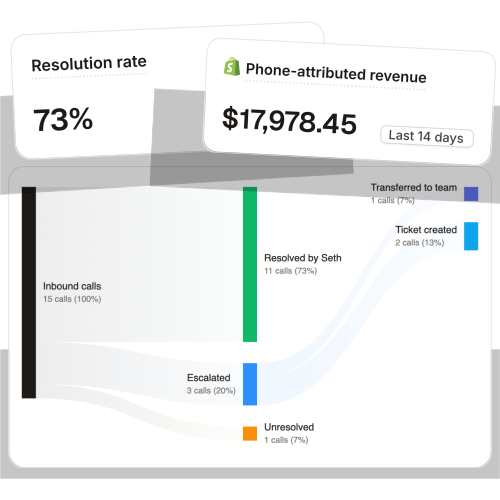
- The number: across 50+ Shopify brands the AI resolves about 73% of inbound calls on its own, at roughly $0.42 per resolved call versus $7 to $16 at a human call center.
- Built for: founders, COOs, and Heads of CX at $10M-$100M Shopify specialty food brands (pantry, condiments, snacks, coffee and tea, gourmet) with a visible phone number.
Specialty food has a phone problem that nothing else in your stack solves. The calls come in bursts, usually right when you're least staffed, and a chunk of your customers won't touch the website. They call to ask when the box ships, whether the chocolate survives a July delivery, or to place the same standing order they've placed for three years. Most of those calls roll to voicemail. The customer hangs up and orders from someone who picked up.
If you run customer experience at a Shopify specialty food brand doing $10M-$100M, you already know the gifting-season spike and the Friday-afternoon "will it arrive before the weekend" panic. This is what 50+ brands we work with do with that volume instead of hiring a night shift. Book a 30-min call and we'll pull your missed calls and show you what's leaking.
What "AI customer service" means for a specialty food brand
Most articles about AI in food are about restaurants: reservation bots, menu recommendations, drive-thru order-taking. That's a different business. You ship a physical product on a clock to people who bought it on Shopify, and your support channel that's actually breaking is the phone.
So when we say AI customer service here, we mean an AI phone agent that picks up your inbound calls and resolves the routine ones end to end, not a chat widget bolted to your homepage. It answers in your brand's voice, finds the order in Shopify, reads ship windows and freshness info from your own knowledge base, and hands the genuinely hard calls to your team with the full context attached.
The reason phone is the right place to point this is volume math. Order-status questions alone run 30-40% of all support tickets in normal periods and over 50% at peak, according to Salesforce. For a specialty food brand, those same "where's my order" and "will it still be fresh" questions show up on the phone, where you have the least coverage. The AI doesn't get tired at 9 p.m. on a Sunday in December, which is exactly when your gift buyers call. It's the same logic behind running 24/7 ecommerce phone support without a 24/7 payroll.
The calls a specialty food brand actually gets
Before you decide whether AI can carry your phone line, look at what's actually on it. Across our food and beverage customers the call mix is remarkably consistent, whether the brand sells single-origin coffee, hot sauce, artisan pantry staples, snack boxes, or gourmet gift sets.
- Order status and ship-by. "When does it ship, when does it arrive, did it leave the warehouse." This is the biggest bucket. Customers know the perishable clock and they want a real answer, not a tracking link they already have.
- Freshness and cold-chain. "Will the chocolate melt, is the cheese still good after two days in transit, what's the roast date." Summer and any perishable launch spike these.
- Gift orders. "I need it to arrive by Friday for my dad's birthday." Gift-mode is emotional and the delivery date is the whole order.
- Phone orders. A real slice of older customers call specifically to place an order because they don't trust the checkout. One coffee-brand founder put it plainly on a call with us: a majority of his calls are people who want to order by phone because they don't feel comfortable on the website.
- Product questions. "What's the difference between the dark and medium, is this gluten-free, what pairs with it." Customers here use product names, never SKUs.
- Spoiled or late. The unhappy ones. A box arrived warm, or a day late, and they want a human.
One specialty brand we work with, Gear Rider, handled 1,595 calls in 90 days without a single phone rep on payroll. I went through the call logs across our food and beverage accounts before writing this, and the pattern holds: the first five buckets above are the same questions over and over, and they're the ones the AI is built to close.
The mix shifts a little by sub-category, but not as much as you'd think. A single-origin coffee brand gets more roast-date and grind questions. A hot-sauce or condiment brand gets more "is this in stock again" and reorder calls. A snack-box or pantry brand gets more subscription-timing and "skip my next box" requests. Gourmet gift brands get the heaviest gift-delivery and arrives-by load, especially Nov-Dec. Underneath all of it is the same skeleton: a customer who can't see the product before it ships, wants reassurance on timing and freshness, and would rather talk than type. That's why one phone setup covers the whole category instead of needing a different tool per niche.
What the AI handles versus what still goes to your team
This is where most AI tools oversell and lose trust, so here's the honest split.
The AI handles, end to end:
- Order status and WISMO. It looks up the order in Shopify and tells the customer where it is. This is the single highest-volume call type and the cleanest win. It's the same engine behind WISMO automation on Shopify.
- Ship-by and delivery timing. It reads your cutoffs and shipping windows from your knowledge base and gives a straight answer.
- Freshness and product questions. Roast date, harvest, ingredients, pairings, storage. You write the rules once, it answers consistently.
- Gift-delivery logistics. Arrival dates, gift notes, address confirmation.
Still goes to your team:
- Spoiled or damaged orders. These are emotional and they're a retention moment. The AI flags it and transfers to a human with the order context already pulled, so your rep isn't starting cold.
- Phone orders. We don't take payment over the phone. For brands where phone-ordering is a real chunk of volume, the AI either transfers to a human or sends an SMS payment link to the caller. If most of your revenue is phone orders, be upfront on the call so we can scope that honestly.
- Anything regulatory. Wine and spirits with state-by-state age and shipping rules escalate by default.
You control the routing with smart call transfer rules. The goal isn't to replace your team. It's to take the 70-80% of repeatable calls off them so they can actually be present on the spoiled-gift call that matters.
Why phone is the channel you're leaving unstaffed
Here's the part that surprises operators. You probably have chat covered, email mostly covered, and the phone running on hope. Calls come in, nobody's free, they go to voicemail, and the voicemail never gets returned in time.
The cost of that is bigger than it looks. 85% of callers who can't reach a person never call back, and 62% switch to a competitor, per a 2026 PCN study. 78% abandon the brand after a single unanswered call. And voicemail isn't the safety net you think: 80% of callers routed to voicemail hang up without leaving a message. One coffee brand's phone system, under load, played a "we're busy fulfilling orders" message and then disconnected the call. That's not a missed call. That's a customer you paid to acquire, told to go away.
"My customers also feel like it's a normal person. They feel like they can communicate if they have questions."
— Claudia Droge, TechCraft Studio
That quote matters more in specialty food than anywhere else, because your demographic skews older and more skeptical. The single most repeated thing customers say after talking to our AI is "you don't sound like AI." If you've been burned by a chatbot, that's the bar. This is also why a phone line beats pushing everyone to chat: a lot of these customers will simply not use a chat widget or a Gorgias macro, they want to talk.
There's a seasonal version of this that's even more expensive. Specialty food is one of the most gift-driven categories there is, and your call volume can triple in the six weeks before the holidays. You can't hire and train four seasonal reps fast enough to absorb that, and even if you do, they're cold on your products by the time they're useful, then gone in January. An AI phone agent absorbs the spike on day one. The same setup that quietly handles 40 calls a day in March handles 140 in December without you touching anything, which is the whole reason the order-tracking and WISMO load stops being a staffing fire drill.
What this costs you today versus with an AI phone agent
Let's do the math the way your CFO will.
Specialty food brands run a small team year-round and a much bigger one for the Nov-Dec gifting rush. A typical $20M brand looks like this:
| Line item | Today | With an AI phone agent |
|---|---|---|
| 4 reps × $4K loaded, year-round | $16,000/mo ($192K/yr) | — |
| 4 seasonal reps × $4K × 3 months | $48,000/yr peak | — |
| AI phone agent | — | ~$3,000-$5,000/mo |
| True annual CS spend | ~$240,000/yr | ~$48,000-$60,000/yr |
| Net savings | — | ~$140K-$180K/yr |
That's roughly 70-80% of repeatable calls (order status, ship-by, freshness, gift timing) routed to the AI. The 20-30% that need a human still go to your team, who now have time to actually solve them. Per resolved call you're looking at about $0.42 versus the $7 to $16 a human call center charges. The savings differential is the point, not the sticker price.
Real numbers from WashCo, a Shopify brand we launched recently:
- $22,664 in attributed revenue, first 7 days post-launch
- 271 calls handled
- 85% deflection rate
- 66% resolution rate
- $0.91 per call vs $2.70 per human-handled call
Source: Ringly dashboard, verified live data.
The call makes sense if:
- You're a Shopify (or Shopify Plus) brand doing $10M-$100M
- You run a paid helpdesk (Gorgias, Zendesk, Gladly, Re:amaze, or Intercom)
- You have a visible phone number on your store
- Your CS team is 3-12 people
What happens on the call.
- We pull your last 7 days of missed calls live, on the call. No homework for you.
- We show you the recovered revenue at the resolution rates we see for food and beverage brands.
- You decide if it's worth a deeper conversation. No deck, no follow-up sequence.
If that's you, the math usually works. Book a 30-min call and we'll run it live on your store.
How to set it up across your catalog
The setup is the same whether you sell coffee, condiments, or gift boxes. Here's the order it actually happens in.
- Connect Shopify. The AI reads orders so it can answer "where's my order" without a human. Live in under an hour for a standard store. See check order status.
- Load your knowledge. It scrapes your site daily and you can upload PDFs and FAQs: ship windows, roast dates, storage instructions, freshness guarantees. This is your knowledge base.
- Write the rules. "Never guarantee Saturday delivery." "Always transfer spoiled-order calls." "For wine, confirm the shipping state first." The rules are how you keep a food brand's answers safe and on-brand.
- Set escalation. Decide what the AI closes and what it transfers, with business-hours and after-hours modes.
- Keep your number. Forward your existing line. Caller ID stays the same, your customers never know the plumbing changed.
Ringly.io is AI phone support for Shopify brands. The phone shouldn't be a tax on your support team. The AI answers inbound calls 24/7, finds orders in your Shopify store, answers product and freshness questions from your knowledge base, and escalates cleanly to Gorgias, Richpanel, or whatever helpdesk you already run. Across 50+ brands it resolves 73% of calls autonomously at roughly $0.42 per resolved call. Plans: Grow $349/mo, Pro $799/mo, Enterprise custom. Live in under an hour, backed by a 65% resolution guarantee. If you're comparing options, our AI phone agents for Shopify breakdown and the pricing page have the rest. For the operational side of this, our specialty food phone support playbook goes deeper on staffing.
Frequently asked questions
Can AI handle calls for a specialty food brand 24/7? Yes. The AI answers every inbound call around the clock, including the Sunday-night and gifting-season spikes when you have no one staffed. Calls it can't close get transferred or logged for your team with full context.
Can the AI take orders over the phone? Not natively, and we won't pretend otherwise. For brands where phone-ordering is real volume, the AI transfers to a human or sends an SMS payment link to the caller. If most of your revenue is phone orders, tell us on the call so we scope it honestly.
What happens with spoiled or late perishable orders? Those escalate to your team by default. The AI recognizes the call type, pulls the order context, and hands it off so your rep starts with the full picture instead of cold. Emotional, retention-critical calls stay human.
Will older customers accept talking to AI? This is the most common worry in specialty food, and it comes down to voice quality. The most repeated thing customers tell us is "you don't sound like AI." Hand us your number and listen to it yourself before you decide.
Does it work with Gorgias or my existing helpdesk? Yes. Calls that need a human escalate cleanly to Gorgias, Richpanel, Re:amaze, or whatever you already run. You keep your stack and your phone number, and you control what escalates. See our take on Gorgias alternatives if you're evaluating the full picture.
How much does AI customer service cost for a specialty food brand? Self-serve plans start at $349/mo (Grow) and $799/mo (Pro). Enterprise is custom, set on a call, and usually lands near 20% of your current CS team spend. Per resolved call you're at roughly $0.42 versus $7 to $16 at a human call center.
Talk to us

If you run a $10M-$100M Shopify specialty food brand and your phone goes to voicemail after hours, a 30-min call is the fastest way to see what you're leaving on the table during the gifting rush and the perishable-season spikes.
The 3-layer guarantee.
- Live in 14 days or it's free until launched.
- 65% resolution in 90 days or we refund the last 3 months of subscription fees.
- We keep working free until we hit 65%.
Ruben (Ringly co-founder) takes these calls personally.