

The short version.
- An AI phone agent handles the routine pet-food calls. Your team keeps the ones that need a human.
- TechCraft Studio, a Ringly customer, handles 88% of its calls without a person, and pet parents still say it sounds like one.
- Built for $10M-$100M Shopify pet food brands running a paid helpdesk with a visible phone number.
A pet food support line is a strange thing. One missed call can be a recall-safety question and a churned autoship subscriber at the same time. The caller wants to know if the bag in their pantry is the one in the news, and whether their next delivery is still coming, and they want a person, not a voicemail beep.
If you run customer experience at a Shopify pet food brand doing $10M to $100M, you already know this. The phone rings on weekends. It rings during a recall. It rings at 9 p.m. when someone's dog runs out of food on Friday and they're worried. I read through pet food brands' support call logs and sorted every inbound call into five buckets. Recall questions, ingredient and allergy questions, autoship changes, feeding and transition questions, and where's-my-order made up almost all of it.
Most pet food brands on Shopify run a small support team and a phone line that goes quiet after 6 p.m. We've launched AI phone agents for 50+ Shopify brands trying to fix exactly that. Book a 30-min call and we'll show you what your store is leaving on the table after-hours.
What an AI phone agent actually handles for a pet food brand
Most AI vendors pitching pet brands are selling chat. A widget on the website, deflecting questions before they become tickets. That's useful, but it misses where pet food buyers actually go when they're worried: the phone. The demographic skews older, the relationship is emotional, and a bag of contaminated food is not something anyone wants to type into a chat box.
For a pet food brand, the useful question is which calls an AI phone agent can take off your CS team, and which ones it should never touch.
The model is simple: the AI handles the routine 90% so your humans can be present on the 10% that actually need them. The routine calls are the same questions over and over, order status, autoship changes, ingredient lookups. The 10% are the calls where a real person matters, and we'll get to those.
Recall calls are the part pet food brands underestimate. They aren't rare. There were 13 FDA pet food recalls in 2025, totaling 166,071 pounds of food and treats pulled (Truth About Pet Food). Each one is a sudden spike of anxious callers, and they all hit your line the same day. A human team that's already stretched on a normal Tuesday cannot absorb that.
TechCraft Studio, a Ringly customer, handles 88% of its calls without a person. The AI picks up on the first ring, every hour, recall day or not.
The four pet food calls AI handles best (and the one it shouldn't)
Group the buckets and four of them are a clean fit for an AI phone agent. The fifth is the one you want it to walk away from.
Recall calls: lot number lookup, calm script, human handoff
When a recall hits, callers want one answer: is my bag affected? The AI takes the lot number, checks the recall status from your knowledge base, and tells them plainly whether their food is on the list.
If it is affected, or if the caller is upset, the AI hands the call to a person and logs it. The point isn't to automate empathy. It's to make sure the 200 people calling about a recall on a Saturday actually reach someone instead of a full voicemail box.
Ingredient and allergy questions
"Can my dog with a chicken allergy eat this formula?" is a question your AI should answer, but only from data you've loaded. Allergen lists, formulas, sourcing. No guessing.
The line you draw matters here. A question about what's in the bag is fine. A question that crosses into "is this safe for my sick dog" is a veterinary question, and the AI is built to escalate it, not answer it.
"My customers also feel like it's a normal person. They feel like they can communicate if they have questions."
— Claudia Droge, TechCraft Studio
Autoship pause, skip, swap, and cancel-save, run on the call
This is the one that pays for itself. Autoship is the pet category's whole economic engine. Chewy's Autoship drives roughly 82% of its net sales (Chewy Q4 2024), and pet replenishment subscriptions churn at only 4-7% a month when they're managed well. Every cancel call you save is months of retained revenue.
Most brands route those calls to a rep, and after hours they roll to voicemail. The subscriber who wanted to skip one month cancels instead, because nobody picked up. Auto-ship discounts alone lift retention by around 29% (Rivo), so losing a saver over a missed call is expensive. An AI phone agent looks up the subscription, runs the pause, skip, swap, or cancel-save flow you've defined, and texts a confirmation. The keep-or-cancel moment stops rolling to voicemail.
Feeding and life-stage transition guidance
"How much do I feed a 12-week puppy?" "How do I switch my senior dog to the new formula?" These are high-frequency, low-complexity, and they pull straight from your feeding guides. The AI answers them the same way your best rep would, just without the wait and without burning out the team on the same five questions.
Then there's WISMO, where's-my-order, which is its own category for a perishable product. "My dog runs out Friday, is it coming?" The AI pulls the order and tracking from Shopify and answers in seconds. We wrote more about that pattern in our guide to WISMO calls.
The call it should not handle: the sick pet
Here's the one to keep human. When a caller says their pet is sick, in pain, or has died, that call should go straight to a person on your team with no AI in the path. We hard-code the handoff on those trigger words.
This is the difference between an AI phone agent built for pet food and a generic chatbot that tries to handle everything. Brands like Chewy and The Farmer's Dog built their reputations on the human moments. You protect those by automating everything around them, not by automating them.
What this costs vs a pet food CS team
Pet food brands don't usually run a huge steady-state team. They run a few reps and get crushed on weekends and recall days. Take a typical $20M pet food brand:
- 3 weekday reps × $4,000 loaded = $12,000/mo
- 1 weekend rep × $4,000 loaded = $4,000/mo
- Total: $16,000/mo, and weekends are still understaffed
An AI phone agent at roughly $3,000 to $5,000/mo handles the WISMO, autoship, and ingredient calls and escalates the emotional ones. Net savings land around $11,000/mo, or $132,000/yr, and your weekend callers stop hitting voicemail.
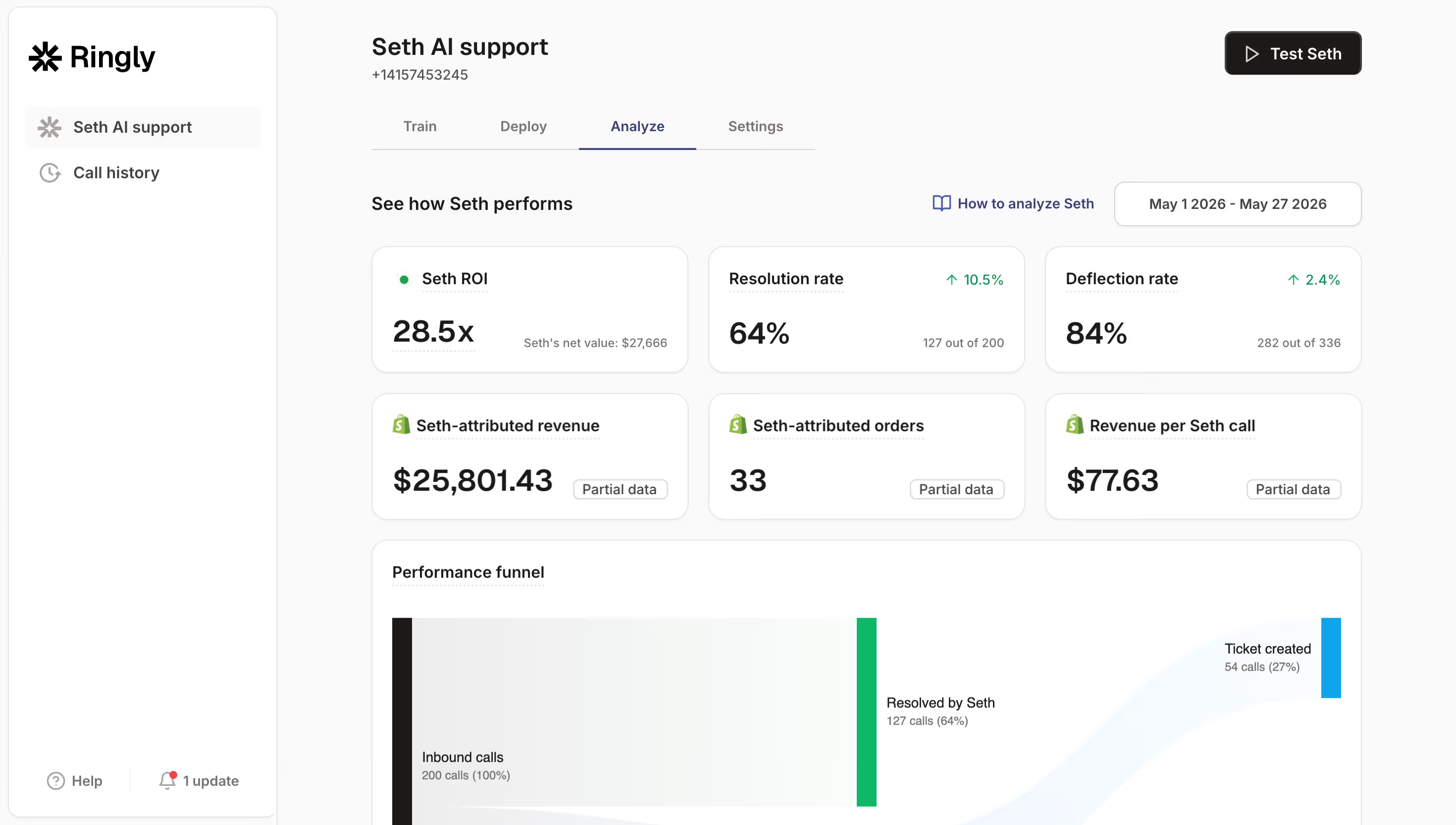
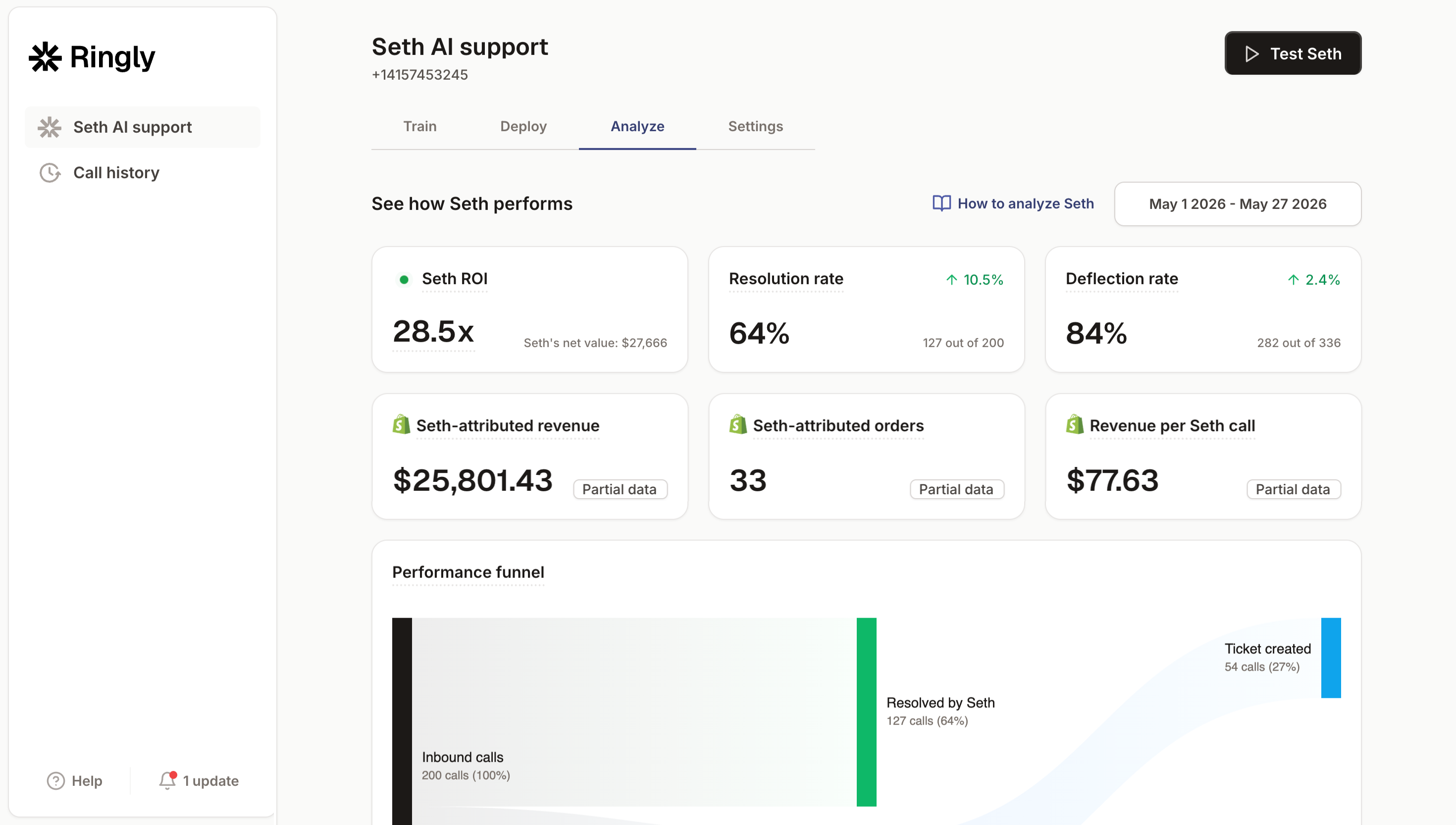
Real numbers from WashCo, a Shopify brand we launched recently:
- $22,664 in attributed revenue, first 7 days post-launch
- 271 calls handled
- 85% deflection rate
- 66% resolution rate
- $0.91 per call vs $2.70 per human-handled call
Source: Ringly dashboard, verified live data.
That deflection number is the part pet food brands feel fastest, because so much of the volume is the same handful of questions. Across 50+ brands, the AI resolves 73% of calls on its own at roughly $0.42 per resolved call, versus $7 to $16 for a human at a BPO.
The call makes sense if:
- You're a Shopify or Shopify Plus pet food brand doing $10M-$100M
- You run a paid helpdesk (Gorgias, Zendesk, Gladly, or Re:amaze)
- You have a visible phone number on your store
- Your CS team is 3-12 people
What happens on the call.
- We pull your last 7 days of missed calls live, on the call. No homework for you.
- We show you the recovered revenue at the resolution rates we see for pet food brands.
- You decide if it's worth a deeper conversation. No deck, no follow-up sequence.
If that's you, the math usually works. Book a 30-min call and we'll run it live on your store.
How to set up AI customer service for your pet food brand
The setup is less work than most brands expect, because the AI sits in front of the helpdesk you already run. You don't rip anything out.
- Load the knowledge base. Formulas, allergen data, feeding guides, lot numbers, and recall status. This is what the AI answers from, and it's why it won't guess.
- Connect Shopify and your helpdesk. Orders, tracking, and subscriptions for live lookups. Calls that need a person escalate cleanly into Gorgias, Zendesk, Gladly, or Re:amaze.
- Define your escalation rules. The big one for pet food: sick-pet, illness, and grief trigger words go straight to a human. You decide what else escalates.
- Keep your phone number. No new number, no porting headache. The AI answers the line you already publish.
Most brands are live in under an hour, and the full build runs on a 14-day Launch Sprint where the setup is on us, not you. You can see the whole flow on the pets industry page, and pricing is on the pricing page if you want to self-serve the smaller plans first.
Frequently asked questions
Will the AI give vet advice or handle a sick-pet call? No. Any call that crosses into a pet being sick, in pain, or dying is hard-coded to hand off to a person on your team, with no AI in the path. The AI answers product and order questions, not medical ones.
Can the AI cancel or pause an autoship subscription on the phone? Yes. It looks up the subscription in Shopify, runs the pause, skip, swap, or cancel-save flow you define, and texts the caller a confirmation. That keeps the cancel moment from rolling to voicemail after hours.
How does it handle a recall? The AI takes the caller's lot number, checks it against the recall status in your knowledge base, and tells them whether their bag is affected. Affected or distressed callers are handed to a human and logged.
Does it replace our customer service team? No. It takes the routine calls, order status, autoship changes, ingredient lookups, so your team can focus on the emotional and complex ones. Most brands keep their team and stop hiring the next rep.
Will pet parents know they're talking to AI? The most common compliment we hear is "you don't sound like AI." You can also test the line yourself before you launch and decide if the voice quality clears your bar.
Does it work with Gorgias or our current helpdesk? Yes. It sits in front of Gorgias, Zendesk, Gladly, or Re:amaze and escalates cleanly into whatever you already run. You control what escalates.
How much does AI pet food customer service cost? Plans start at $349/mo (Grow, ~500 calls) and $799/mo (Pro, ~1,250 calls), with custom Enterprise pricing for higher volume. For a $20M brand replacing weekend coverage, the savings usually run around $11,000/mo.
How fast can we get set up? Live in under an hour once your knowledge base is loaded, with the full tuned build on a 14-day Launch Sprint.
Talk to us

If you run a pet food brand on Shopify and your phone rolls to voicemail after 6 p.m., a 30-min call is the fastest way to see what you're leaving on the table. We'll pull your missed calls and show you the recall, autoship, and after-hours volume you're not capturing today.
The 3-layer guarantee.
- Live in 14 days or it's free until launched.
- 65% resolution in 90 days or we refund the last 3 months of subscription fees.
- We keep working free until we hit 65%.
Ruben (Ringly co-founder) takes these calls personally.