

This post in 30 seconds.
- A drop day can turn a 100-call afternoon into a 900-call one, and most cosmetics teams answer the phone for none of it.
- You'll see exactly which beauty support calls an AI phone agent should handle on its own (WISMO, returns, ingredient lookups) and which it should hand to a human (uncertain shade matches, anything that sounds like an allergy).
- Built for $10M-$100M Shopify cosmetics and skincare brands running a paid helpdesk with a phone number on the site.
A customer calls your beauty brand at 8:40 p.m. She wants to know if the new foundation runs warm or neutral, and whether the formula is safe to use while pregnant. Nobody picks up. She leaves a voicemail you'll see Monday, orders the wrong shade from a competitor by 9 p.m., and returns it three weeks later anyway.
That single call is three of your biggest cost lines at once: a missed sale, a support voicemail nobody returns, and a shade-mismatch return that you eat almost entirely because opened makeup can't go back on the shelf. The phone is where beauty customer service quietly leaks the most money, and it's the channel almost nobody staffs properly.
If you run customer experience at a Shopify cosmetics or skincare brand doing $10M-$100M, you already know the launch-week phone queue. This post is about what to put on the other end of that line so the routine calls get answered and your team gets the ones that actually need a person. We've launched AI phone agents for 50+ Shopify brands trying to fix exactly this. Book a 30-min call and we'll pull your missed calls live and show you what's leaking.
Here's the quick version of which calls go where:
| Beauty call type | AI phone agent | Route to a human |
|---|---|---|
| Where's my order (WISMO) | Handles it | — |
| Returns and exchanges | Handles it | If outside policy |
| Ingredient / "is it vegan / fragrance-free" | Handles from your KB | If it sounds like an allergy or medical question |
| Shade / undertone match | Handles clear cases | Uncertain match goes to a beauty advisor |
| Order edits, address changes | Handles it | — |
| Pricing, promo codes, loyalty | Handles it | — |
| Influencer / drop-day call spike | Absorbs all of it | Escalations only |
That table is the whole strategy. The rest of this post is how each row actually works.
What customer service actually looks like at a cosmetics brand
Most beauty support calls are the same five questions, and four of them never needed a human in the first place.
Walk a normal Tuesday queue at a $30M skincare brand and you'll see it. Where's my order. Can I change my shade before it ships. Is this safe with retinol. What's your return window. Do you have it back in stock. The volume is repetitive, the answers live in your help docs, and your reps are reading the same paragraph for the fortieth time that day.
Then there's the part that's specific to cosmetics. Shade and undertone questions carry real money on both sides: get it right and you save a sale, get it wrong and you eat a return. Makeup return rates run 12-15%, and shade mismatch alone drives a large share of color-cosmetics returns (Eightx). A beauty return is close to a total loss, since opened product can't be resold and processing can run a meaningful chunk of the item's price (Banuba).
WISMO is the other constant. "Where's my order" is 30-40% of support tickets in a normal week and over 50% at peak (Salesforce). It's the single most automatable call type you have, and it's eating reps who could be doing higher-value work.
The thing that breaks a beauty team isn't the steady volume. It's the drop. An influencer posts, a product sells through, and your phone goes from a 100-call afternoon to a 900-call one inside 48 hours. A four-person team handles 80-120 calls a day comfortably. There is no way to staff for a 600-1,200-call surge that lasts two days and then disappears, and hiring for it means paying for idle reps the other eleven months of the year.
Which beauty support calls an AI phone agent should handle (and which it shouldn't)
This is the part the chatbot roundups skip, and it's the most important decision you'll make.
The AI should fully own the calls where a confident answer saves money, and route the calls where a wrong-but-confident answer costs money.
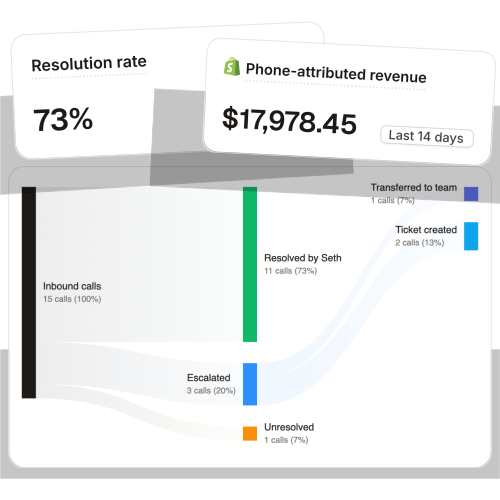
The first bucket is easy. WISMO, order edits, return initiation, restock dates, promo codes, "is this fragrance-free," loyalty-tier questions. These have one correct answer that lives in your Shopify store or your knowledge base. An AI phone agent reads order data and your docs and resolves them end to end, the same way it would on any ecommerce customer service line. Across 50+ brands, that's how the AI resolves 73% of inbound calls without a human touching them.
The second bucket is where beauty is different from supplements or pet. Two call types should route to a person almost every time:
- Uncertain shade and undertone matches. A clear match ("I'm a 2N in brand X, what am I in yours") the AI can answer from a conversion chart. A genuinely uncertain one ("I can never find my undertone, can you help") should go to a beauty advisor or trigger a sample offer. The return cost of a confident wrong shade is far higher than the cost of the extra call.
- Anything that sounds like an allergy or a medical question. "Is this safe with my eczema." "I had a reaction to your serum." The AI gives the ingredient facts from your KB and hands the call to a human. It never offers medical advice. That's a hard-coded rule, not a hope.
TechCraft Studio, a Ringly customer, handles 88% of its calls without a human and routes the rest cleanly. The point of the routing isn't to dodge hard calls. It's to give your team the calls where a human voice actually changes the outcome, and stop making them read the WISMO paragraph for the fortieth time.
If you've ever wondered why a launch spike still feels chaotic even after you bought a chat widget, this is why. Chat catches the typing customers. The phone, the highest-CSAT and highest-resolution beauty support channel, is still the one rolling to voicemail.
How AI handles the cosmetics-specific calls
Voice quality is the first thing beauty buyers ask about, and it should be. Your brand voice is half your product. The most repeated thing customers say after talking to our AI agent is "you don't sound like AI," and in beauty that compliment matters more than anywhere else.
"My customers also feel like it's a normal person. They feel like they can communicate if they have questions."
— Claudia Droge, TechCraft Studio
A female-voiced agent that uses your brand's exact product vocabulary will outsell a generic male bot every time, which is why voice is a setup choice, not an afterthought. Beauty brands almost always want a female voice ("we're a female e-commerce brand," as one founder put it), and that's a toggle, not a custom build. You pick the voice from a library, and the agent learns your product names so it pronounces your hero SKU correctly instead of spelling it out.
Here's how the cosmetics-specific calls actually run:
- Ingredient and formulation questions. The agent answers from your knowledge base, which scrapes your site daily and takes uploaded PDFs and FAQs. "Is the night cream non-comedogenic" gets a clean answer. "Is it safe while breastfeeding" gets the ingredient facts plus an escalation to your team.
- Shade conversions. Feed the agent your shade chart and cross-brand conversion notes and it handles the "what am I in your line" calls. The uncertain ones route out, as above.
- WISMO and order status. It checks order status live in Shopify and reads the customer their tracking, the same flow covered in our WISMO calls guide.
- Returns and exchanges. It initiates the return inside your policy and can text a label, which keeps your returns management clean.
- SMS follow-ups. When a caller wants a product photo or a link, the agent texts it mid-call. Beauty customers ask for this constantly.
- Escalation. Calls that need a person transfer cleanly, or open a ticket in Gorgias, Zendesk, or whatever you already run. You keep your stack and your call transfer rules.
It runs 24/7 in 40 languages, which means the 8:40 p.m. shade-and-pregnancy call from the intro gets answered instead of going to a voicemail you read three days later.
What this costs vs a human launch-staffed team
Beauty brands don't run on steady-state support. They run hot during a launch and crawl between them, and most of them staff for the launch and pay the load all year.
Take a typical $50M beauty brand that staffs eight reps to survive launch month:
| Line item | Today | With Ringly |
|---|---|---|
| 8 reps x $4K loaded per rep | $32,000/mo | — |
| Ringly (~$8K/mo) | — | $8,000/mo |
| Net monthly CS spend | $32,000/mo | $8,000/mo |
| Monthly savings | — | $24,000/mo |
| Annual savings | — | $288,000/yr |
That's $384K a year for a team that's effectively idle nine months of the twelve. An AI phone agent absorbs the launch spike without the headcount, and the routine calls the rest of the year route to it too.
The per-call math is just as stark. Here's a verified example from one Shopify brand we launched:
Real numbers from WashCo, a Shopify brand we launched recently:
- $22,664 in attributed revenue, first 7 days post-launch
- 271 calls handled
- 85% deflection rate
- 66% resolution rate
- $0.91 per call vs $2.70 per human-handled call
Source: Ringly dashboard, verified live data.
What happens on the call.
- We pull your last 7 days of missed calls live, on the call. No homework for you.
- We show you the recovered revenue at the resolution rates we see for beauty brands your size.
- You decide if it's worth going further. No deck, no follow-up sequence.
The call makes sense if:
- You're a Shopify or Shopify Plus cosmetics or skincare brand doing $10M-$100M
- You run a paid helpdesk (Gorgias, Zendesk, Gladly, Re:amaze, or Intercom)
- You have a phone number on your store
- Your CS team is 3-12 people
If that's you, the math usually works. Book a 30-min call and we'll run the numbers live on your store.
How to deploy an AI phone agent on your cosmetics support line
Before I wrote this, I called the published phone lines of nine beauty brands after 6 p.m. on a weekday. Seven rolled straight to voicemail and two rang out. Not one got answered. That's the baseline you're competing against, and it's why deploying this is less work than it sounds.
You can be live on the routine calls in under an hour, then tune the beauty-specific routing over the first week. Here's the order that works:
- Forward your phone number. Keep your existing number and forward it to the AI agent. Caller ID stays the same. You can forward just after-hours first if you want to start cautious.
- Build the knowledge base. Point it at your site so it scrapes your product and policy pages, then upload your shade chart, ingredient FAQs, and return policy. This is where your brand vocabulary gets loaded.
- Set the escalation rules. Hard-code two: any uncertain shade match routes to a beauty advisor or a sample offer, and anything that reads as an allergy or medical question hands to a human. Add your business-hours-vs-after-hours transfer logic, the same setup our AI customer support phone agent for Shopify page walks through.
- Pick the voice. Choose a female voice if that fits your brand, set product-name pronunciations, and confirm the tone matches your copy.
- Go live and review weekly. Listen to a sample of calls each week and tighten the KB where the agent flagged a gap. Beauty brands usually need one or two rounds on shade-chart edge cases, then it holds.
For a deeper vertical walkthrough, our AI phone support for cosmetics brands guide and the cosmetics and skincare industry page go further on the setup. If you're weighing it against your current stack, the 24/7 ecommerce phone support breakdown is a good next read, and you can see plans on the pricing page.
Want to compare this to what you're paying now? Book a 30-min call and we'll do the math on your actual call volume.
Frequently asked questions
Can an AI phone agent handle shade-matching calls for a cosmetics brand? It handles clear conversions well, like "I'm a 2N in another brand, what am I in yours," using your shade chart. For genuinely uncertain undertone matches it routes the caller to a beauty advisor or offers a sample, because a confident wrong shade costs you a near-total-loss return.
Will customers be annoyed that they're talking to AI? In beauty this is the biggest worry and the smallest problem. The most repeated thing customers say after a call is "you don't sound like AI," and you can pick a female voice that matches your brand. Hand them the demo number and listen for yourself.
Can it answer ingredient and allergy questions safely? It answers ingredient facts straight from your knowledge base ("is this fragrance-free," "is it vegan"). Anything that reads as an allergy or medical question is hard-coded to hand off to a human, and it never gives medical advice.
How does it handle a launch-day call spike? It absorbs the surge instantly. A four-person team handles 80-120 calls a day, but a drop can push 600-1,200, and an AI agent answers all of them at once instead of sending the overflow to voicemail.
Does it work with my existing helpdesk and phone number? Yes. You keep your number and forward it, and calls that need a person escalate cleanly to Gorgias, Zendesk, Re:amaze, or whatever you already run. You control what escalates.
How much does it cost? Plans start at Grow $349/mo and Pro $799/mo, with Enterprise by call for higher-volume brands. There's a 65% resolution guarantee: if the AI resolves under 65% of your calls in 90 days, we refund the last 3 months.
Talk to us

If you run a $10M-$100M Shopify cosmetics or skincare brand and your phone goes to voicemail after 6 p.m. or buckles on drop days, a 30-min call is the fastest way to see what you're leaving on the table. We'll pull your missed calls live and map the shade-and-allergy routing for your line specifically.
The 3-layer guarantee.
- Live in 14 days or it's free until launched.
- 65% resolution in 90 days or we refund the last 3 months of subscription fees.
- We keep working free until we hit 65%.
Ruben (Ringly co-founder) takes these calls personally.