

This post in 30 seconds.
- A coffee brand's phone gets five kinds of calls all day. Four of them never need a human, and that's where AI phone support earns its keep.
- Gear Rider, a brand on Ringly, closed 1,595 sales and support calls in 90 days without a phone rep on the line.
- Built for $10M-$100M Shopify coffee brands that keep a paid helpdesk and a visible phone number, and watch most of it go to voicemail after 6 p.m.
A coffee brand's phone rings most when the roastery is dark. Late evening, Sunday morning, the three weeks before Christmas when gift orders triple. That's exactly when there's nobody to pick up, so the call rolls to voicemail, and roughly 80% of voicemail-routed callers hang up without leaving a message (Eden). For a coffee brand, a lot of those callers are 55 or older, the demographic that won't place an order on the website and reaches for the phone instead.
If you run support at a Shopify coffee brand doing $10M-$100M, you already know the call mix: WISMO, gift timing, "can you pause my subscription," and a question about grind. To write this I built a test coffee store, loaded it with roast dates, a grind guide, and a subscription knowledge base, and called it after midnight to see which calls an AI phone agent could actually close. The short version is below, and if you want to skip ahead, book a 30-min call and we'll pull your last week of missed calls and walk the routing live.
The 5 calls a coffee brand actually gets
Pull a week of call logs from any specialty coffee brand and the calls collapse into five conversations. Four of the five are the same questions over and over, and a coffee brand answers them with a human only because nobody set up anything else.
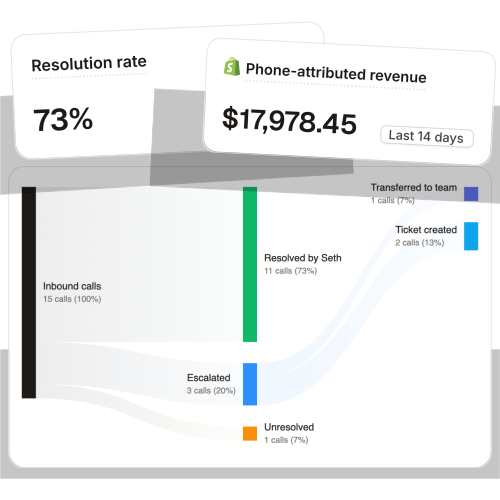
Here's the mix:
- WISMO, with a freshness tail. "Where's my order?" runs 30-40% of ecommerce support tickets and climbs past 50% at peak (Salesforce). For coffee it doesn't stop at a tracking number. The caller wants to know it'll still be fresh when it lands, so they ask about roast date and transit time in the same breath. See our WISMO calls breakdown for the full ticket math.
- Gift timing. "Will it arrive before the 24th?" Gifting is a huge slice of coffee revenue in Q4, and the FTC requires sellers to ship within the window they promised or offer a refund (FTC). A late gift is a refund and a lost customer.
- Subscription skip, swap, or pause. Coffee subscription churn averages around 11% a month industry-wide, and the best brands hold it at 3-4% (Moriondo). A lot of that gap is service. A subscriber who can't reach anyone to skip a month cancels instead. We go deep on this in the coffee subscription customer service playbook.
- Product and grind questions. "Which roast is closest to the one I had at the cafe?" "Do you grind for a Moka pot?" Routine, repeatable, knowledge-base stuff.
- The hard one. A gift arrived spoiled. An order was wrong twice. Someone is genuinely upset. This call needs a person.
Gear Rider, a brand on Ringly, handled 1,595 of these routine calls in 90 days without a phone rep picking up. That's the volume a single AI phone agent can absorb. Coffee call volume looks a lot like that: bursty, seasonal, and mostly the first four conversations.
Which 4 the AI takes, and the 1 it shouldn't
The honest version of "AI for coffee brand customer service" isn't "the AI handles everything." It's that an AI phone agent takes the four routine calls so your reps get the fifth one with time to actually fix it.
The four it takes:
- WISMO plus freshness. It pulls the order from Shopify, reads back the tracking, and reassures on roast date and transit. No human needed.
- Gift ETA. Same order lookup, framed around the arrival date the caller cares about.
- Subscription skip and swap. It reads the subscription and runs the change as a defined action. (Full cancels we treat as a custom action, more on that below.)
- Grind and roast FAQ. Answered from the knowledge base you already wrote.
The one it shouldn't:
A spoiled-gift call or a twice-wrong order is an emotional call, and you want a human on it. So you hard-code an escalation rule: anything that smells like a complaint, a refund dispute, or an upset caller transfers to your team. The AI's job is to clear the 70-80% that's routine so your reps aren't burnt out answering "where's my order" when the real complaint comes in. That's the same split we describe in voice AI for coffee brands.
Worth being clear on what "takes the call" means in practice. On a WISMO call, the agent doesn't read a tracking number off a script. It looks up the order in Shopify, sees the carrier scan, and tells the caller their bag roasted on Tuesday and ships today, so it'll land well inside the freshness window. On a subscription call, it confirms which blend, which interval, and runs the skip. The caller gets a real answer and hangs up, and your team never sees the ticket. That's the difference between a phone tree that says "press 1 for order status" and an agent that actually closes the loop.
Why the seasonal spike is the real reason to deploy
Most coffee brands could limp along with the existing phone setup eleven months a year. November and December are where it breaks. Gift orders triple, the calls are time-sensitive ("will it get there by Christmas?"), and the cost of a missed one is a refund plus a customer who tells the recipient the gift was late.
Hiring eight seasonal reps for a six-week spike is the worst unit economics in customer service. You pay to recruit and train them in October, they're useful for maybe forty days, and the WISMO volume they handle is the most automatable work you have. An AI phone agent absorbs the same spike at the same cost it runs the rest of the year, which is why the seasonal pattern, more than the after-hours gap, is what pushes coffee brands to set this up. The agent resolves up to 90% of inbound calls on its own, and that number doesn't drop in December the way a green seasonal team's does.
How I tested an AI phone agent on a coffee call flow
I'm Ruben, co-founder of Ringly. We run AI phone support for Shopify brands, so I evaluate this stuff as a buyer, not a critic. Before writing this I spent a few days running a real coffee call flow through our own agent on a test store, because most "AI for customer service" articles review chat tools from their marketing pages and never dial a phone.
Here's what I actually did:
- Loaded a real roast-date knowledge base. I wrote a KB with roast dates, origin notes, and a grind guide, then asked the agent the freshness question a real caller asks. It read back roast date and transit time, not just a tracking link.
- Ran the grind disambiguation. Coffee buyers describe products by name, not SKU ("the dark roast," not item #1247). I gave it the kind of vague request that breaks chatbots and checked whether it asked the right clarifying question.
- Read a live Shopify subscription. I connected a test Shopify store with an active subscription and asked the agent to skip a delivery, then watched whether it could see the subscription and run the change.
- Tested gift ETA plus reassurance. I called as a worried gift-buyer three weeks out and listened for whether it gave a real arrival window, not a canned "3-5 business days."
- Called it at 11 p.m. as the failure mode. I dialed after midnight with a deliberately messy "my order came smashed and it was a gift" call to confirm it escalated to a human instead of trying to resolve an emotional complaint on its own.
The agent closed the first four cleanly and transferred the fifth. That's the bar. If a tool can't read your Shopify order graph or doesn't know what a roast date is, it isn't built for a coffee brand, no matter what its homepage says.
Setting it up: knowledge base, Shopify, and escalation
Deployment is less work than most teams expect. Three pieces:
The knowledge base. This is where coffee brands win or lose. Feed the agent your roast dates, your grind guide, your shipping and freshness policy, and your gift cutoffs. The knowledge base is what lets the agent answer "is the Ethiopian still fresh if it ships Friday?" the way a good barista would.
The Shopify connection. Order lookup and subscription reads happen through your store. The agent can check order status and run defined custom actions like a subscription skip. Note the honest limits: a full subscription cancel runs as a custom action you define, and order tracking refreshes daily rather than in real time. If you need true real-time inventory, say so on the call.
Escalation rules. This is the part that protects the older-buyer relationship. You decide what transfers to a human and what the agent handles. Smart call transfer routes the emotional and the complex calls to your team, and everything else stays automated. One thing the agent does not do natively: take a brand-new order by phone. For that it transfers to a rep or texts a payment link. If most of your revenue is phone orders, you'll want to talk that through first.
"My customers also feel like it's a normal person. They feel like they can communicate if they have questions."
Claudia Droge, TechCraft Studio
It sits in front of the helpdesk you already run. Calls that need a human escalate cleanly to Gorgias, Richpanel, Reamaze, or whatever you use. If you're weighing whether to keep the phone line staffed at all, our coffee brand phone support guide covers the staffing math, and Gorgias plus most chat-first tools cover email and chat but were never built phone-first.
What this costs a coffee brand
Coffee brands run a small team year-round and a much bigger one for the Nov-Dec gifting rush. A typical $20M specialty brand looks like this:
| Line item | Today | With Ringly |
|---|---|---|
| 4 reps × $4K loaded, year-round | $16,000/mo | n/a |
| 4 seasonal reps × $4K × 3 months | ~$48,000/yr peak | n/a |
| AI phone agent | n/a | ~$3K-$5K/mo |
| True annual CS spend | ~$240,000/yr | ~$48,000-$60,000/yr |
The AI handles the roast-date, gift-ETA, WISMO, and subscription calls year-round and absorbs the gifting spike without seasonal hiring. Net savings land around $140K-$180K a year depending on volume. And the calls it answers carry revenue, not just cost.
Real numbers from WashCo, a Shopify brand we launched recently:
- $22,664 in attributed revenue, first 7 days post-launch
- 271 calls handled
- 85% deflection rate
- 66% resolution rate
- $0.91 per call vs $2.70 per human-handled call
Source: Ringly dashboard, verified live data.
The call makes sense if:
- You're a Shopify or Shopify Plus coffee brand doing $10M-$100M
- You run a paid helpdesk (Gorgias, Zendesk, Gladly, Re:amaze, or Intercom)
- You have a visible phone number on your store
- Your CS team is 3-12 people
If that's you, the math usually works.
What happens on the call.
- We pull your last 7 days of missed calls live. No homework for you.
- We show you the recovered revenue at the resolution rates we see for coffee and specialty food.
- You decide if it's worth going further. No deck, no follow-up sequence.
If your phone goes quiet after 6 p.m. and you want to see the number, book a 30-min call and we'll do the math on your store.
The older-buyer question: will it sound like AI?
This is the objection that matters most for coffee, because your callers skew older. Around 75% of US coffee drinkers are 55 or older, and that demographic both prefers the phone and is the most skeptical of anything robotic (BlueCart).
So voice quality isn't a side detail here, it's the whole game. The single most repeated thing customers say after talking to our agent is that you don't sound like AI. The agent resolves up to 90% of inbound calls on its own, and the older callers are usually the ones who don't realize they weren't talking to a person.
A few honest guardrails. If more than half your revenue comes from orders placed by phone, you're not a clean fit yet, because we transfer for orders rather than take them. And if your stack is unusual (heavy custom Shopify build, non-numeric order numbers), setup takes more hand-holding. We'll tell you on the call if it's not a fit. You can also see how the same approach plays out for other specialty food brands and across after-hours coverage generally.
Frequently asked questions
Can AI handle "where's my order" calls for a coffee brand? Yes, and it's the highest-value thing it does, since WISMO is 30-40% of tickets and over 50% at peak. The agent pulls the order from Shopify, reads back tracking, and answers the freshness and roast-date follow-up that coffee callers always ask.
Will older coffee customers know they're talking to AI? Usually not, and that's the point. Voice quality is the reason coffee brands can put an AI agent on a line full of 55-plus callers without complaints, and the most common feedback is that it sounds like a normal person.
Can the AI take a coffee order over the phone? Not natively. It transfers to a rep or texts a payment link for new orders. If phone orders are most of your revenue, talk to us first, because that changes the fit.
Does it know roast dates and grind options? It knows whatever you put in the knowledge base. Load roast dates, origin notes, and a grind guide, and it answers those questions the way a good barista would, including the clarifying question when a request is vague.
Can it pause or skip a coffee subscription? Skips and swaps run as defined actions against your Shopify subscription. A full cancel is set up as a custom action you control, so you decide whether it saves the subscriber first or processes the cancel.
How much does AI phone support cost for a coffee brand? Ringly is priced on Pay per call: $99 a month for the first 50 conversations, then $1.99 each.
Does it replace my Gorgias or helpdesk? No. It sits in front of your helpdesk and handles phone calls. Anything that needs a human escalates cleanly to Gorgias, Richpanel, Reamaze, or whatever you already run.
Talk to us

If you run a $10M-$100M Shopify coffee brand and your phone goes to voicemail after-hours and through the gifting spike, a 30-min call is the fastest way to see what you're leaving on the table.
Our 3 promises.
- Live in under 1 hour. Setup and test calls are free.
- 30-day money back on the $99 plan fee.
- 65% resolution guarantee: if Seth resolves under 65% of your support calls in a month, that month comes back as credit (after 90 days on Pay per call).
Ruben (Ringly co-founder) takes these calls personally.