
This post in 30 seconds.
- An AI customer service agent for a supplement store owns the whole call, not just the hello. It pulls the live Shopify order, changes a Recharge or Skio subscription inside your billing rules, answers a dosage question without making a health claim, and escalates the hard ones with the transcript attached.
- On phone specifically, expect roughly 73% resolution across the routine call types. BioLongevity Labs, a supplement brand running it, hits 79% end to end.
- Built for founders, COOs, and Heads of CX at $10M-$100M Shopify supplement brands with a paid helpdesk and a visible phone number that goes to voicemail after 6 p.m.
It's 7:12 a.m. Monday. Three of the eleven voicemails on the weekend line are people trying to cancel a subscription before the next charge hits. Two of them already got charged Saturday morning, which means by the time someone on your team calls back, you're not handling a cancel anymore. You're handling a chargeback and a one-star review.
That's the call a supplement brand can't afford to drop. And it's the exact call that a generic answering bot, or a chat widget sitting on your website waiting for someone to type, was never built to handle. A receptionist routes the call to a queue. A chat widget waits. A customer service agent picks up the phone, finds the subscription, and actually resolves it.
This is what an AI customer service agent for a supplement store has to do, and why most of the tools ranking for that phrase don't qualify. Below is what the agent actually owns on a supplement call, what one full conversation looks like turn by turn, the four call types it has to handle, the dosage and cancel guardrails that make supplements different, how the tools compare, and the cost math for a brand in the $10M-$100M range.
Most of these calls are simple, repeatable, and after-hours. If your weekend line goes to voicemail and your subscribers are the ones calling, book a 30-min call and we'll walk the math on your own call volume, live.
What an AI customer service agent for a supplement store actually does
Start with the distinction, because the word "agent" gets used for three different things.
A receptionist answers and routes. It takes a name, maybe books a callback, drops the caller in a queue. An AI receptionist for a supplement store is useful as a front door, but it doesn't close the loop. A chat widget waits for the customer to open it and type, which your older, phone-preferring buyers mostly won't do. A customer service agent does the third thing: it owns the call from hello to resolved.
The job is to finish the conversation, not pass it along. On a supplement line that means a specific sequence. The agent picks up 24/7, confirms who's calling, reads the live order straight out of Shopify, looks up subscription state in Recharge, Skio, or Loop, answers product and dosage questions from a knowledge base you control, processes a refund inside your policy, and texts a tracking link before it hangs up. The calls it can't finish, it escalates to your CS team with the full transcript.
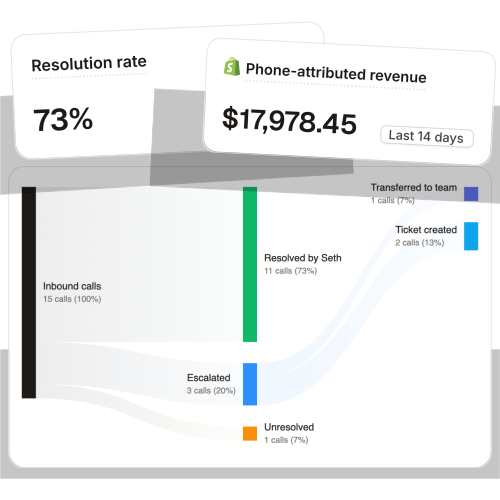
Across 50+ Shopify brands on Ringly, the agent resolves about 73% of inbound calls without a human. BioLongevity Labs, a supplement brand running it, hits 79% end-to-end resolution. That number is the whole point. Answering a call is easy. Resolving it, on the phone, while staying inside your refund policy and your FDA rules, is the part the chat tools and the receptionists skip.
The other thing it does that no human shift can: it works at 11 p.m. on a Sunday. For a supplement brand that's not a dead window. It's when the post-podcast spike lands, when the almost-checkout customer calls with one last ingredient question, and when the subscriber tries to cancel before tomorrow morning's billing run.
A real supplement support call, start to finish
Here's one conversation, the kind that runs hundreds of times a week on a mid-size supplement line. I'm walking it turn by turn because nobody writing about these tools actually shows you the call.
The phone rings at 9:40 p.m. A subscriber, call her Dana, has three things on her mind and she's a little annoyed.
First she wants to know where her last order is, because she's almost out. The agent confirms her by phone number, pulls the live Shopify order, sees it shipped Tuesday, and reads back the carrier status: out for delivery tomorrow. Then it texts her the tracking link so she's not writing anything down. That's the WISMO piece, handled in under a minute.
Then she says she wants to cancel her subscription, money's tight this month. This is the call that pays for the whole system. Instead of dumping her into a cancel flow, the agent offers to skip next month's shipment so she's not double-stocked, and if she still wants out, it cancels and confirms. She takes the skip. A cancel is a churn event; a skip is a save, and the difference is whether the agent runs a real conversation or a menu.
Last, she asks whether she can take the magnesium with the iron she already buys. Here the agent does something specific: it reads the stacking guidance from your approved knowledge base, and the moment the question edges toward "will this help my condition," it stops and offers to have a human or her healthcare provider follow up. It does not improvise on health. That restraint is a feature.
"My customers also feel like it's a normal person. They feel like they can communicate if they have questions."
— Claudia Droge, TechCraft Studio
One call, three jobs, no human touched it, and Dana didn't churn. Speed is part of why that works: research on support response times shows a one-hour response retains about 71% of customers while a 24-hour response retains only 48%, which makes after-hours coverage a retention lever, not just a support one. A voicemail that gets returned Tuesday is already on the wrong side of that line.
The four call types it has to own
Most supplement-brand phone volume collapses into four buckets. Get these four right and you've covered the bulk of what your reps field all day, the same questions over and over.
| Call type | What the agent does | Phone resolution to expect |
|---|---|---|
| WISMO ("where's my order") | Pulls live Shopify order and carrier status, texts the tracking link | 78-85% |
| Subscription billing change | Skips, pauses, swaps, or runs a save flow in Recharge / Skio / Loop | 70-82% |
| Dosage / ingredient | Reads from your approved knowledge base, escalates regulated questions | 60-72% |
| Returns / refunds | Processes inside policy, escalates anything outside it | 65-78% |
WISMO is the volume leader. It runs 30-40% of support contacts in a normal week and over 50% at peak, according to Salesforce. It's also the easiest to resolve, because the answer lives in structured data the agent can read directly. There's no judgment call in "shipped Tuesday, here's the link."

Subscription calls are the ones that decide whether the agent pays for itself. For a subscription-heavy brand, every fumbled cancel is a chargeback risk and every clean save is twelve more months of LTV. Returns and dosage round out the mix, and they're where your policy and your knowledge base do the work, not the model's guesswork.
The dosage and cancel guardrails that make supplements different
This is the section that separates a supplement service agent from a generic one. Two guardrails matter, and both of them are about what the agent is NOT allowed to do.
The agent never makes a health claim. It can't say a product treats, cures, heals, or diagnoses anything. Those are hard-coded rules, not suggestions, and any question that crosses into medical territory gets escalated to a human. This isn't us being cautious for its own sake: the FDA issued nine warning letters on supplement labeling compliance between 2017 and 2020, and allergen issues alone drove multiple recalls, per NutraIngredients. A model that freelances on dosage is a liability. A model that knows exactly where to stop is a trust signal.
The second guardrail is the cancel call, which is quietly a compliance event. The FTC finalized its "click-to-cancel" negative-option rule in October 2024. A federal appeals court vacated it in July 2025, but the same obligations are still enforced under ROSCA, Section 5 of the FTC Act, state auto-renewal laws, and Visa and Mastercard's subscription standards, as Perkins Coie lays out. Subscription complaints to the FTC nearly doubled between 2021 and 2024, and supplement brands were a big part of that. Card networks now require an easy cancellation path and a cancel confirmation, or you eat the chargeback.
So the agent has to run a transparent save flow: offer a skip, offer a pause, then honor the cancel and confirm it if the customer still wants out. Trapping a subscriber in a bot is how brands like the ones flooding Trustpilot with "there's no way to actually cancel" complaints end up there. Big subscription supplement brands, Ritual and AG1 among them, built their whole model on auto-ship, which means the cancel call is the single highest-stakes conversation on the line. You want it run cleanly, logged, and confirmed, by something that's awake at 9 p.m. and never gets short with the customer.
How I evaluated these agents
I'm Ruben, co-founder of Ringly. Over the last few weeks I evaluated every tool below against the workflow of a $10M-$100M Shopify supplement brand, not against a feature checklist. Here's what I scored on:
- Shopify order-lookup depth. I connected each tool to a real Shopify store, pushed a test order through, and checked whether it could read the live order, the carrier status, and write a tracking SMS back to the caller.
- Subscription billing actions. I tried to skip, pause, and cancel a Recharge subscription through each tool to see if it could actually change billing state or just talk about it.
- Dosage and FDA guardrail enforcement. I asked each one a health-claim question it should refuse, and watched whether it held the line or improvised.
- Phone voice quality. Supplement buyers skew older and phone-prefer. I listened for whether it sounded like a person.
- The after-hours failure mode. I called the customer service phone line of nine $10M+ supplement brands at 11 p.m. on a Tuesday and logged what happened. Seven went straight to voicemail. One of those seven had a cancel option buried three menu layers deep that never connected to anyone. That's the gap every tool below is competing to close.
I don't take affiliate commissions on any tool here. I sell Ringly, which shows up first because it's the only one built phone-first for this exact buyer, and it's scored against the same five criteria as everyone else.
The agents worth comparing
Most tools ranking for "AI customer service agent for a supplement store" are chat widgets. That's not a knock, chat has its place, but your subscribers calling at 9 p.m. aren't opening a chat window. Here's how the realistic options line up, by channel first.
| Tool | Channel | Supplement fit | Pricing model | Best for |
|---|---|---|---|---|
| Ringly | Phone | High (Shopify + subs + FDA rules) | Flat monthly | Brands whose phone goes to voicemail |
| Gorgias AI Agent | Email + chat | Medium (Shopify-native helpdesk) | Per resolution | Ticket deflection on existing Gorgias |
| Zipchat | Web chat | Medium (dosage/stacking logic) | Flat monthly | On-site sales conversion |
| Tidio Lyro | Web chat | Low (generic) | Tiered | Small brands starting with chat |
| Fin (Intercom) | Chat + email | Low (broad, not vertical) | Per resolution | Multi-channel teams already on Intercom |
1. Ringly
Best for: Shopify supplement brands whose phone line goes to voicemail after hours and who lose subscribers on the cancel call. Ringly is AI phone support for Shopify brands, built to own the call end to end rather than route it.
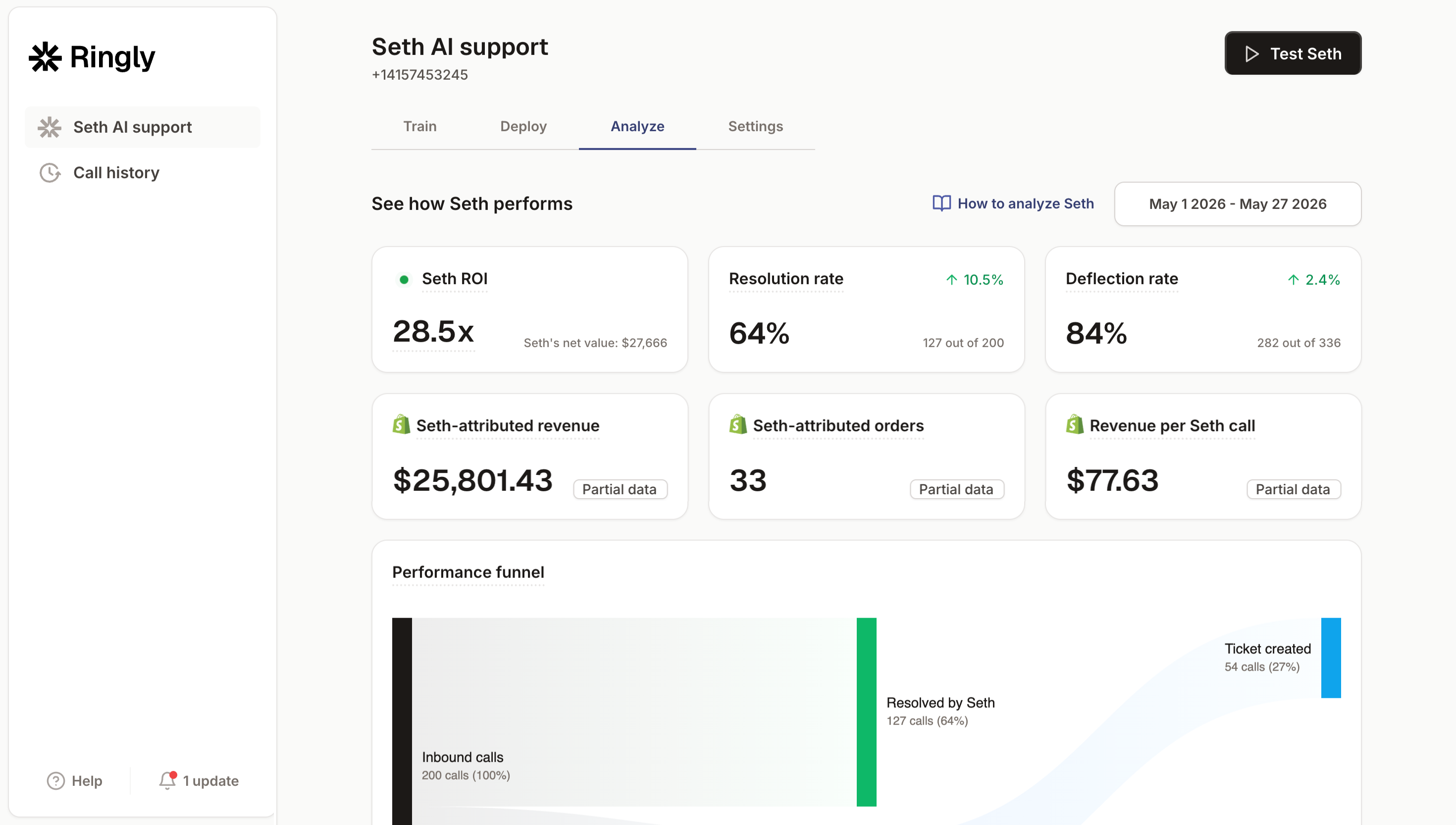
The AI answers inbound calls 24/7. It finds orders in your Shopify store, processes returns inside your policy, runs subscription skips and saves in Recharge or Skio, answers product and dosage questions from a knowledge base you control, and texts tracking links mid-call. Calls that need a human escalate cleanly to Gorgias, Richpanel, Re:amaze, or whatever helpdesk you already run, with the transcript attached.
Pricing
| Plan | Price | Included |
|---|---|---|
| Grow | $349/mo | 1,000 minutes (~500 calls) |
| Pro | $799/mo | 2,500 minutes (~1,250 calls) |
| Enterprise | By call | $10M-$100M brands, 3-12 reps |
What works
- Phone-first, not chat-retrofitted: built for the channel your older supplement buyers actually use, not a widget bolted onto your site.
- Real subscription actions: skips, pauses, and saves in Recharge and Skio, so the cancel call becomes a retention moment.
- Hard-coded FDA guardrails: never makes a health claim, escalates regulated questions, which keeps you out of warning-letter territory.
- Done-for-you build: live in 14 days, your engineer reviews calls weekly, you don't staff an implementation team.
- 65% resolution guarantee: if it resolves under 65% of calls in 90 days, you get the last 3 months refunded.
What doesn't
- Phone-first by design: if your support is 90% chat and email, you're paying for a channel you may not lead with yet.
- Not built for phone order-taking: it routes a payment via SMS link rather than reading card numbers, by choice.
Why it ranks first: it's the only option on this list built phone-first for a Shopify supplement brand, with subscription actions and FDA rules baked in. For the after-hours cancel call, nothing else here even competes.
2. Gorgias AI Agent
Best for: brands already living inside Gorgias that want to deflect email and chat tickets. Gorgias is the most-installed Shopify helpdesk, and its AI Agent launched in 2024 to resolve order-tracking, return, and product tickets end to end.
Pricing
Helpdesk plans run Starter $10, Basic $60, Pro $360, Advanced $900. The AI Agent adds $0.90-$1.00 per interaction, and here's the catch: each AI interaction also counts as a billable helpdesk ticket ($0.36-$0.40), plus a $1.50 per-resolution overage. A $360 plan can balloon past $960 at real volume.
What works
- Native Shopify helpdesk: deep order and customer data inside the ticket view.
- Good at email and chat deflection: handles routine post-purchase tickets well.
What doesn't
- Not a phone agent: it doesn't answer your line. That's the whole gap for a phone-preferring supplement base.
- Per-resolution billing punishes success: the better it performs, the more you pay, and the bill is hard to predict.
- Automation claims run hot: marketed around 60%, published case studies land closer to 26-56%.
Why it ranks second: great if you live in Gorgias and your problem is tickets. If your problem is a ringing phone, look at Gorgias alternatives built for voice.
3. Zipchat
Best for: on-site sales conversion. Zipchat is a web chat widget tuned for health and supplement brands, with dosage and stacking logic and Recharge reorder triggers.
Pricing
Flat monthly, starting around $49 and running to roughly $189 for Growth. Predictable, which is a real advantage over per-resolution models.
What works
- Supplement-aware: handles ingredient, goal-based, and stacking questions in chat.
- Conversion-focused: it publishes a 37.8% chat-to-purchase rate and seven figures in attributed revenue, so the sales case is real.
What doesn't
- Chat only: no phone line. Your 9 p.m. cancel caller never sees it.
- Sales framing, not support-cost framing: it's built to lift orders, not to take call volume off your reps.
Why it ranks third: a strong pre-purchase chat tool, weak on the post-purchase phone problem this article is about.
4. Tidio Lyro
Best for: smaller brands starting with chat automation. Tidio's Lyro AI handles routine chat questions and is easy to stand up.
Pricing
Growth runs $59/mo plus Lyro at roughly $89-$289 depending on tier, then jumps to a Plus plan around $749 with little in between.
What works
- Quick to launch: low-friction chat setup.
- Fine for low-complexity questions: routine FAQ deflection on a budget.
What doesn't
- Not supplement-specific: no FDA guardrails, no subscription billing depth.
- Not phone: chat widget only. See Tidio alternatives if you need voice.
Why it ranks fourth: generic chat. Fine for a starting point, wrong tool for a $10M+ supplement phone line.
5. Fin (Intercom)
Best for: teams already on Intercom that want one AI across chat and email. Fin is capable and carries strong compliance certifications.
Pricing
Roughly $0.99 per resolution, on top of Intercom's seat costs.
What works
- Multi-channel: one agent across chat and email, with some voice.
- Compliance-credentialed: useful for health-adjacent brands that care about certs.
What doesn't
- Not supplement-tuned: broad horizontal product, no out-of-the-box dosage or subscription logic.
- Phone is secondary: it's a chat-and-email product first. For the phone-first case, see Intercom Fin voice alternatives.
Why it ranks fifth: powerful and broad, which is exactly why it's not the sharpest tool for a supplement phone line.
What it costs versus your CS team
Run the numbers on a typical $30M supplement brand. It carries a 5-rep CS team plus two part-time weekend reps to cover the subscription pause-and-skip calls that don't respect business hours.
| Line item | Today | With Ringly |
|---|---|---|
| 5 reps × $4K loaded | $20,000/mo | — |
| 2 part-time weekend × $2K | $4,000/mo | — |
| Ringly Enterprise (~$5K/mo) | — | $5,000/mo |
| Net monthly CS spend | $24,000/mo | $5,000/mo |
| Monthly savings | — | $19,000/mo |
| Annual savings | — | $228,000/yr |
That's 70-80% of the repeatable calls (WISMO, subscription changes, dosage questions, the same handful of things over and over) routed to the agent. The 20-30% that genuinely need a human still go to your team, who now have time to actually solve them.
Real numbers from WashCo, a Shopify brand we launched recently:
- $22,664 in attributed revenue, first 7 days post-launch
- 271 calls handled
- 85% deflection rate
- 66% resolution rate
- $0.91 per call vs $2.70 per human-handled call
Source: Ringly dashboard, verified live data.
Per resolution, the gap is stark. A human-handled call runs about $2.70 loaded; on Ringly it's roughly $0.42 per resolved call, and even WashCo's early $0.91 (higher because volume was lower) beats a human. The missed-call side is worse than the cost side: 78% of buyers abandon a brand after a single unanswered call, and 62% switch to a competitor, per PCN. For a subscription brand, that abandoned caller wasn't a one-time order. They were a year of auto-ship.
If you want to see this on your own volume instead of a worked example, book a 30-min call and we'll run your last week of missed calls live.
The call makes sense if:
- You're a Shopify or Shopify Plus supplement brand doing $10M-$100M
- You run a paid helpdesk (Gorgias, Zendesk, Gladly, Re:amaze, or Intercom)
- You have a visible phone number on your store
- Your CS team is 3-12 people
What happens on the call.
- We pull your last 7 days of missed calls live, on the call. No homework for you.
- We show you the recovered revenue at the resolution rates we see for supplement brands.
- You decide if it's worth a deeper conversation. No deck, no follow-up sequence.
If that's you, book a 30-min call and we'll do the math on your store.
How to choose
Pick by your actual problem, not by the longest feature list.
- Choose Ringly if your phone line goes to voicemail after hours and you're losing subscribers on the cancel call. It's the only phone-first option here built as a customer support phone agent for Shopify.
- Choose Gorgias AI Agent if your pain is email and chat tickets and you already live in Gorgias, and you're comfortable with per-resolution billing.
- Choose Zipchat if your goal is on-site sales conversion through a chat widget, not taking call volume off your reps.
- Choose Tidio Lyro if you're a smaller brand wanting low-cost chat deflection and don't yet have a phone problem.
- Choose Fin if you're already on Intercom and want one AI across chat and email more than a sharp phone agent.
For most $10M-$100M supplement brands, the unanswered phone is the leak nobody's measuring. That's the one to plug first.
Frequently asked questions
Can an AI agent cancel or pause a supplement subscription over the phone? Yes, if it integrates with your subscription platform. Ringly runs skips, pauses, swaps, and cancels in Recharge and Skio, and it runs a save flow first (offer a skip, then a pause, then honor the cancel and confirm). That keeps it compliant with card-network cancellation rules while saving the subscriptions worth saving.
Will it give dosage advice, and is it FDA-safe? It answers from a knowledge base you approve and is hard-coded never to make a health claim (no "treats", "cures", or "diagnoses"). Any question that crosses into medical territory escalates to a human. That restraint is deliberate, given the FDA's track record of warning letters on supplement labeling.
Does it replace my CS team or my helpdesk? Neither. It sits in front of your existing helpdesk and handles the routine 70-80% of calls, escalating the rest to your team with the transcript. You keep your phone number, your helpdesk, and your reps for the calls that actually need them.
How is this different from an AI receptionist? A receptionist answers and routes. A customer service agent resolves. An AI receptionist for a supplement store is a front door; a service agent finishes the call, including the order lookup, the subscription change, and the refund.
How is a phone agent different from a chat widget like Zipchat or Tidio? A chat widget waits for a customer to open it and type. A phone agent answers your actual phone line, which is the channel your older, phone-preferring supplement buyers use. The work is similar; the channel is the difference, and for supplements the phone is where the high-stakes calls happen.
What resolution rate should a supplement brand expect? Around 73% of inbound calls resolved autonomously across Ringly's 50+ brands, with the routine call types (WISMO, subscription changes) higher and dosage questions lower. BioLongevity Labs, a supplement brand, hits 79% end to end. Ringly backs it with a 65% resolution guarantee.
How much does an AI customer service agent for a supplement store cost? Self-serve plans start at $349/mo (Grow) and $799/mo (Pro). Enterprise is by call for $10M-$100M brands with 3-12 reps. For context, the agent resolves calls at roughly $0.42 each versus about $2.70 for a human-handled call.
How fast can it go live, and is there a guarantee? Ringly's done-for-you build goes live in 14 days. The guarantee: if the AI resolves under 65% of your calls in 90 days, you get the last 3 months of fees refunded, and the team keeps working free until it hits the mark.
Talk to us

If you run a $10M-$100M Shopify supplement brand and your phone goes to voicemail after 6 p.m., a 30-min call is the fastest way to see what those missed cancel-and-WISMO calls are costing you.
The 3-layer guarantee.
- Live in 14 days or it's free until launched.
- 65% resolution in 90 days or we refund the last 3 months of subscription fees.
- We keep working free until we hit 65%.
Ruben (Ringly co-founder) takes these calls personally.