
This post in 30 seconds.
- An AI customer service agent for a cosmetics brand handles the whole phone conversation, not just the pickup: it identifies the caller, pulls their order from Shopify, resolves the routine stuff, and hands the hard calls to a human with the full thread attached.
- Across 50+ Shopify brands the agent resolves 73% of calls on its own at about $0.42 a call, and WashCo recovered $22,664 in its first 7 days live.
- Built for $10M-$100M Shopify cosmetics and skincare brands running a paid helpdesk and a visible phone line, not for salons booking facials.
A customer calls because the concealer she ordered showed up a shade too light and she wants to swap it before a wedding on Saturday. Your rep has to find her order, check whether the product's been opened, read her your exchange policy, set up the replacement, and text her a return label, all while she's a little stressed and a little short. That's not one question. That's a whole conversation with five or six moves in it, and your team runs dozens of them a day.
If you run customer experience at a Shopify cosmetics or skincare brand doing $10M-$100M, that conversation is the unit of work that eats your week. I read 30 days of real call transcripts across the beauty brands we run to write this, and the surprise wasn't the questions, it was the shape: every support call is the same five-stage conversation, and an AI customer service agent earns its keep in the middle of it. If your line still goes to voicemail after 6 p.m., book a 30-min call and we'll show you what those after-hours conversations are costing you.
What an AI customer service agent actually does for a cosmetics brand
It helps to be precise about the words, because three different things get sold under the same banner.
An AI receptionist is a front-desk job: it picks up the line and points the caller somewhere. A chatbot lives in the corner of your site and handles typed questions, async, when someone's already on the page. An AI customer service agent is the one that does the actual support work on the phone, the full conversation from "hi, I have a question about my order" to "your replacement ships today, I just texted you the label." It's the voice agent that handles the support conversation end to end, not the one that just answers.
So a cosmetics-brand CS agent is closer to a trained rep who knows your catalog and your policies cold. It picks up, looks up the caller's order in Shopify, answers ingredient and routine questions from your knowledge base, processes returns and exchanges inside your policy, and texts a tracking link or a return label mid-call. The point isn't to thin out your team, it's to take the routine 70% off their plate so your advisors spend their hours on the calls that actually need a person.
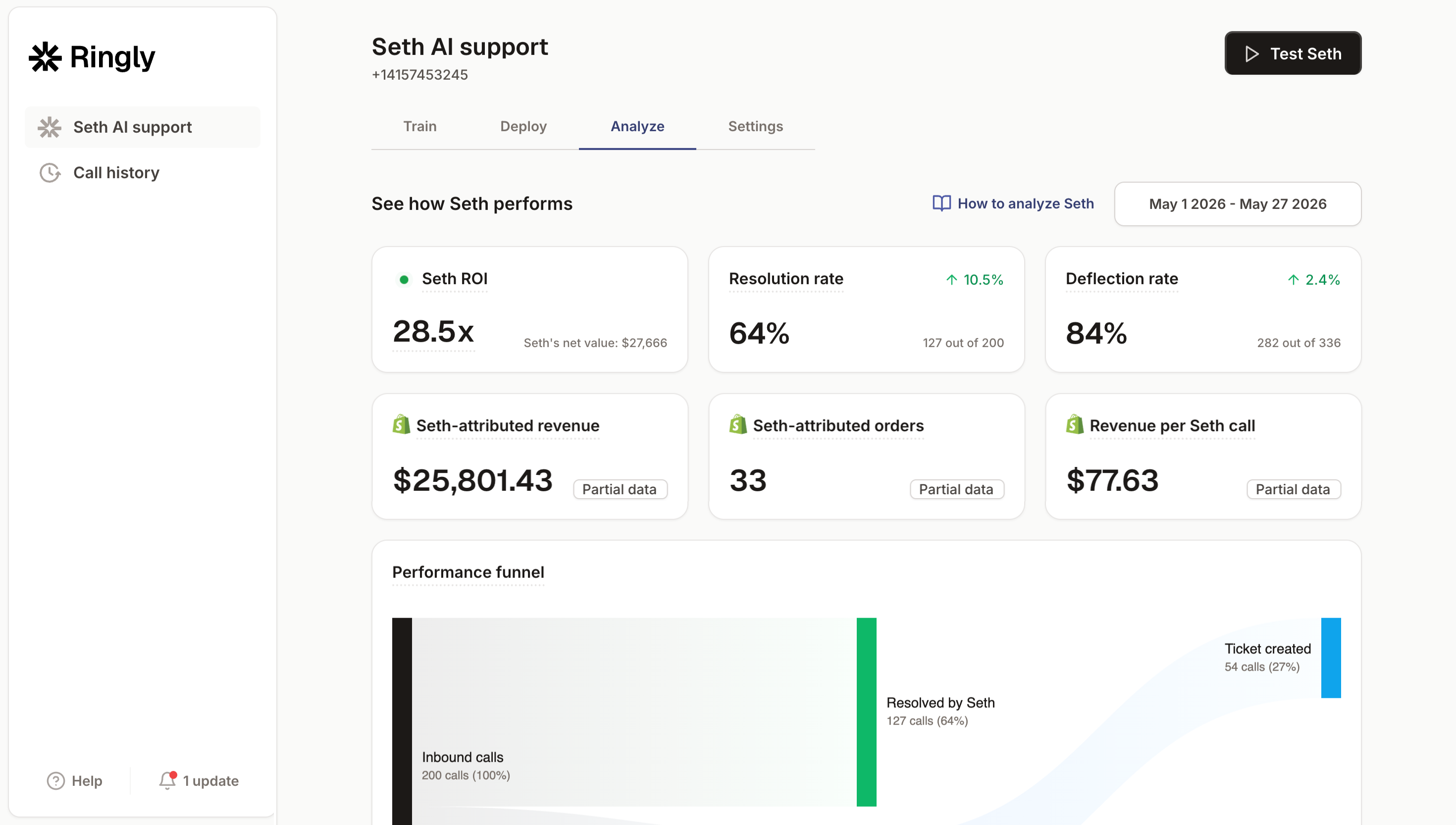
Across 50+ Shopify brands, Ringly resolves 73% of inbound calls autonomously at roughly $0.42 per resolved call. It's the same idea as an AI voice agent for customer support, tuned for the cosmetics and skincare call mix. The calls it can't finish, it escalates cleanly into whatever helpdesk you already run, with the conversation attached so the human isn't starting cold. (If you want the front-desk angle specifically, the receptionist version covers picking up the line; this post is about handling the whole conversation.)
The cosmetics support conversation has five stages
Here's what the transcripts showed. Every support call, no matter what it's about, runs through the same five stages. Knowing where they are tells you exactly where an agent should do the work and where it should step aside.
- Greet and identify. The agent picks up, gets the caller's name and email or phone, and matches them to an account. No menu tree, no "press 2 for returns."
- Pull the context. It looks up the order in Shopify, sees what shipped, where it is, and what the customer bought before. This is the step a human spends 40 seconds toggling between tabs to do.
- Resolve the routine. WISMO, the where's-my-order call, restock and waitlist questions, and most returns and exchanges get finished here. WISMO alone is 30-40% of support tickets and over 50% at peak.
- Hold the hard call. Shade uncertainty, a reaction, a sensitive complaint. The agent recognizes it's out of its lane.
- Escalate with the thread. It hands stage 4 to a human advisor with the full call context already attached, so the customer doesn't repeat herself.
An agent earns its keep in the middle three stages, identify, pull, resolve, and that's most of the volume. Stages 1 and 5 are mechanical. Stage 3 is where the routine conversations close without a human ever touching them. The two judgment-heavy moments, the hard shade call and the genuine complaint, stay with your team, but now your team gets them clean instead of buried under WISMO.
The agent does stage 2 better than a person, because it pulls the Shopify order and the knowledge base instantly instead of flipping between screens. TechCraft Studio handles 88% of its calls without a human by letting the agent own those middle stages and routing the rest.
"My customers also feel like it's a normal person. They feel like they can communicate if they have questions."
— Claudia Droge, TechCraft Studio
The calls a good agent will not resolve
This is the part most vendors get backwards, and it matters more in beauty than anywhere else.
Two kinds of cosmetics calls should never be resolved by an AI on the first pass: a reaction or sensitivity issue, and a genuinely uncertain shade or undertone match. Not because the agent can't form a sentence about them, but because the cost of getting it wrong is lopsided. A wrong-shade "resolution" isn't a resolution, it's a return waiting to happen.
The math is brutal in this category. Shade mismatch drives 12-25% of color-cosmetics returns, and a beauty return is close to a total loss, because opened product can't go back on the shelf and processing alone can run up to 65% of the item's price. So a call that "closed" in 90 seconds by guessing a shade can cost you $30 on the back end against a couple of dollars saved on the call. You'd have been better off if the agent had said "let me get you a sample set" and routed you.
That's exactly what a good setup does. On a hard shade or sensitivity call the agent offers a sample, books a follow-up with a beauty advisor, or transfers to a human with the context attached. It means a deliberately lower resolution rate on those calls, and that number is correct, not a failure. If a vendor quotes you 90%+ resolution on a cosmetics line, ask how they're counting the shade and reaction calls, because the honest answer is you don't want those counted as wins.
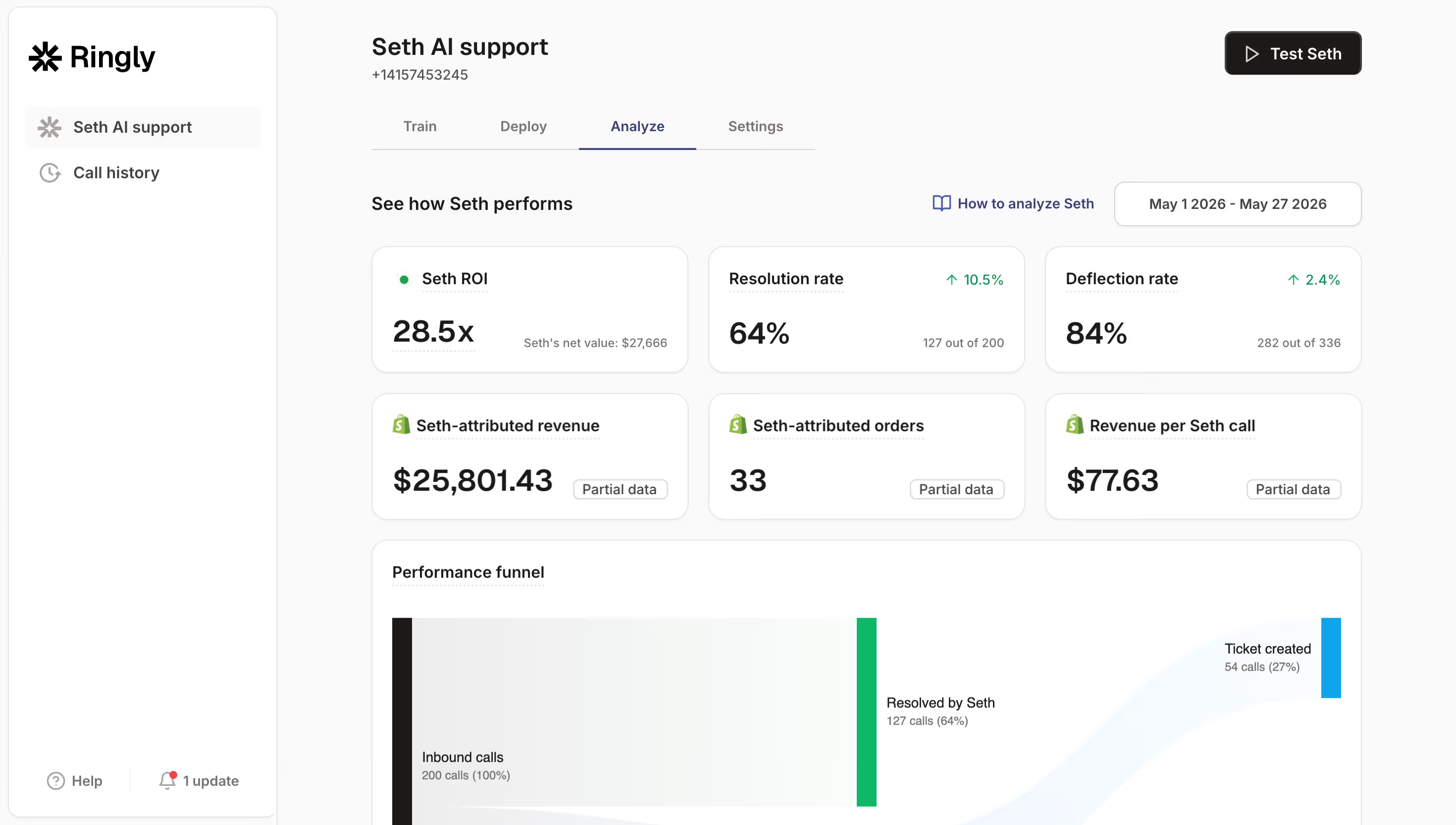
Real numbers from WashCo, a Shopify brand we launched recently:
- $22,664 in attributed revenue, first 7 days post-launch
- 271 calls handled
- 85% deflection rate
- 66% resolution rate
- $0.91 per call vs $2.70 per human-handled call
Source: Ringly dashboard, verified live data.
The recovered revenue comes from the routine calls the agent closes and the after-hours calls it stops dropping to voicemail, not from gambling on shade.
Agent vs human reps vs BPO: what each call actually costs
There are three ways to staff a cosmetics phone line, and they don't cost remotely the same per conversation.
| Approach | Cost per call | Coverage | Ramp | Where it wins |
|---|---|---|---|---|
| In-house CS reps | ~$2.70 loaded | Business hours | 6-8 weeks per hire | The hard shade and sensitivity calls, brand-voice consults |
| Outsourced BPO | $7-$16 | Contracted hours | Weeks, plus quality variance | Burst capacity if you don't mind script-reading |
| AI customer service agent | $0.42-$0.91 | 24/7 | Days | The routine 70%: WISMO, returns, restock, after-hours |
The headline isn't just the per-call number, it's the math underneath the human line. Replacing one CS rep costs about $14,113, and beauty teams churn hard because launch months burn people out. The agent doesn't quit after a viral drop, doesn't need retraining every quarter, and doesn't go quiet at 11 p.m. when your East Coast customers are still ordering.
The right answer is rarely all-or-nothing. Most brands we work with keep their advisors for the consultative calls, drop the BPO contract or never sign one, and put the agent in front of everything as the first line. If you're weighing outsourced support against this, the outsourcing cost benchmarks are worth a look first.
What this costs a $50M beauty brand
Beauty brands don't run on a steady CS team, they run hot during launches and quiet between them. A typical $50M beauty brand staffs around 8 reps to survive launch month and pays for that team all year.
| Line item | Today | With an AI agent |
|---|---|---|
| 8 reps × $4K loaded per rep | $32,000/mo | — |
| AI customer service agent (enterprise, illustrative) | — | ~$8,000/mo |
| Net monthly CS spend | $32,000/mo | $8,000/mo |
| Monthly savings | — | ~$24,000/mo |
| Annual savings | — | ~$288,000/yr |
That's roughly $384K a year for a team that's idle 9 months of the 12. Move the routine WISMO, returns, and restock conversations to the agent and you absorb the seasonal spike without the headcount, while your advisors handle the shade consults that need them. Exact pricing gets set on a call, these are the savings shapes we see across 50+ Shopify brands.
What happens on the call.
- We pull your last 7 days of missed calls live, on the call. No homework for you.
- We show you the recovered revenue at the resolution rates we actually see for beauty brands.
- You decide if it's worth a deeper conversation. No deck, no follow-up sequence.
The call makes sense if:
If that's you, the math usually works. Book a 30-min call and we'll run it live on your store.
Frequently asked questions
What is an AI customer service agent for a cosmetics brand? It's a voice agent that handles your phone support conversations end to end: it identifies the caller, pulls live Shopify order data, resolves routine returns, WISMO, and restock questions inside your policy, and escalates the hard shade and sensitivity calls to a human with full context. It's tuned for the cosmetics call mix, which leans heavier on returns and shade questions than other Shopify verticals.
How is it different from an AI receptionist? A receptionist is a front-desk role that picks up the line and routes the caller. A customer service agent does the actual support work on the call, finishing the routine conversation itself rather than just answering and transferring. In practice the same platform can do both, but if you're hiring for "handle the whole conversation" you want the agent framing.
What percentage of cosmetics calls can it resolve? Across 50+ Shopify brands the average is 73% autonomously, and cosmetics brands track close to that on the routine call mix. Shade and sensitivity calls resolve lower on purpose, because the right move there is sample-and-route or escalate. A vendor claiming 90%+ on cosmetics is usually counting calls it shouldn't.
Can it handle shade matching? For simple shade questions answerable from a shade matrix, yes. For genuinely uncertain undertone matching, the agent should offer a sample set or route the customer to a live beauty advisor rather than guess, because the return cost of a wrong-shade resolution is far higher than the saving on the call.
Can I use a female voice? Yes. You pick the voice from the library during setup, and most beauty brands choose a female voice for their customer base. A custom brand voice clone is available as a later upgrade.
Does it work with my helpdesk? Yes. The agent sits in front of Gorgias, Gladly, Re:amaze, Zendesk, or Intercom and escalates the calls that need a human, with the conversation attached. You keep your current stack and workflows.
Will customers know they're talking to AI? The single most repeated thing customers say after a call is "you don't sound like AI." Voice quality is the one place beauty buyers won't compromise, and it's where the agent earns trust on the first conversation.
Talk to us

If you run a $10M-$100M Shopify cosmetics brand and your CS team is drowning in the same questions over and over, a 30-min call is the fastest way to see what the routine conversations are costing you.
The 3-layer guarantee.
- Live in 14 days or it's free until launched.
- 65% resolution in 90 days or we refund the last 3 months of subscription fees.
- We keep working free until we hit 65%.
Ruben (Ringly co-founder) takes these calls personally.