
This guide in 30 seconds.
- The reframe. Stop shopping for a chat widget. Start designing the support layer your store actually loses money without, and that means chat plus phone, not chat alone.
- What to automate. Order status, returns triage, and the same five product questions all day. What stays human: angry escalations, safety calls, the messy refunds.
- The part the listicles skip. Every "best ecommerce chatbot" article is chat-only. After-hours phone is where the revenue quietly leaks. Built for $10M-$100M Shopify brands with a visible phone number.
Search "AI chatbot for ecommerce website" and you get a dozen listicles ranking the same chat widgets. They all answer the wrong question. The question isn't which widget has the prettiest bubble. It's what you should automate, on which channel, and what you should keep a human on.
I'm Ruben, co-founder of Ringly. To write this I put the same real Shopify order question, "where is order #1043", through eight ecommerce chatbots, then asked the same thing by phone. The results split the field in a way no comparison table I'd read had captured. So this is a buyer's guide written for an operator, not a feature sheet.
If you run support at a Shopify brand doing $10M-$100M, you already know the shape of the problem: the same questions over and over, a Gorgias queue that never empties, and a phone line that rolls to voicemail after 6 p.m. We've built AI phone agents for Shopify brands trying to close that last gap. Book a 30-min call and we'll show you what your store leaves on the table after-hours.
What an AI chatbot for an ecommerce website actually does in 2026
The old chatbot was a decision tree. You clicked "track my order", it showed you a canned menu, and if your question wasn't on the menu you were stuck. That's not what people mean anymore.
A 2026 ecommerce AI chatbot is a language model grounded in your knowledge base and wired into Shopify. It reads the question in plain English, looks up the real answer, and acts. The good ones do four jobs:
- Answer product questions from your knowledge base, not a generic FAQ. Ingredients, sizing, compatibility, shipping windows.
- Check order status by pulling the live order from Shopify, so "where's my order" gets a real tracking link instead of "please check your email."
- Start returns and exchanges, collecting the order, the reason, and the next step without a rep touching it.
- Escalate cleanly when the question is out of scope, handing the customer to your team with the full context attached.
The whole point of a real one is that it resolves the request, it doesn't just route it. A bot that collects a question and dumps it into your helpdesk hasn't saved you anything. Your rep still does the work.
This matters because of where the volume sits. "Where's my order" alone is 30 to 40% of all support tickets in a normal week and over 50% at peak, according to Salesforce. If your AI handles WISMO and nothing else, you've already taken the single biggest repeat task off your team's plate. The rest of this guide is about how to pick one that actually does that, and which channel you're forgetting.
How to evaluate one: the rubric a $10M+ operator should use
Here's where the eight-bot test got interesting. Asked "where is order #1043", three of the eight chatbots gave a generic "check your shipping confirmation email" reply. Two asked me to type my email and then looped. Only three pulled the actual order. When I asked the same question by phone to a voice agent, it read the tracking status back to me in one breath. Same question, wildly different depth.
So score tools against criteria that reflect real work, not demos:
- Shopify action depth. Can it find the order, modify it, start a return, and write back, or does it just read a FAQ? This is the line between a real agent and a search box with a face.
- Knowledge-base grounding and guardrails. Does it answer only from your approved knowledge base, or will it improvise? A bot that invents a discount code or a shipping date is a brand-risk, not a feature.
- Escalation into your helpdesk. When it hands off, does the ticket land in Gorgias or Zendesk with full context, or does the customer repeat themselves to a human?
- Channel coverage. Does it cover chat only, or chat and phone? Most don't do phone, and phone is where your older and higher-intent buyers actually go.
- Pricing predictability. Per-conversation and per-resolution billing can balloon on a good sales month. Intercom Fin, for example, charges around $0.99 per resolution on top of seats, which is fine until a launch triples your volume.
- Voice quality, if it touches phone at all. The most repeated compliment our customers report is "you don't sound like AI." If a voice option sounds robotic, customers hang up and the deflection you bought evaporates.
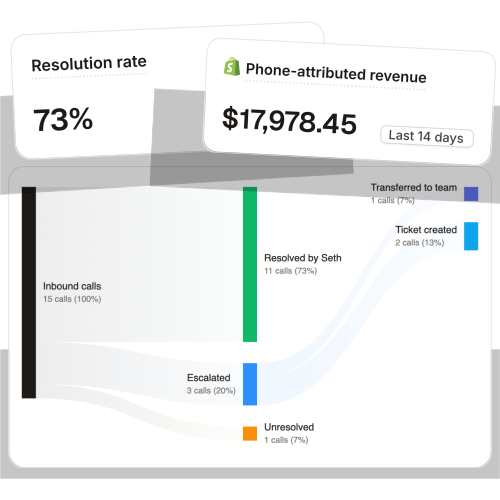
Run a tool through those six and the field thins fast. BioLongevity Labs, a supplement brand on Ringly, resolves 79% of its calls end to end because the agent is grounded, connected, and escalates the rest. That's the bar: high autonomous resolution, clean handoff on the remainder.
What to automate, and what to keep human
Most founders I talk to guess that 70 to 80% of their support is the same repeatable stuff. They're usually right. The skill is drawing the line in the right place, because automating the wrong calls is how brands end up in a screenshot on X.
Here's the split that works across the brands we've launched:
| Automate this | Keep a human on this |
|---|---|
| Order status and tracking (WISMO) | Angry escalations and refund disputes |
| Return and exchange triage | Safety, recall, or grief calls |
| Store hours, policies, shipping windows | Complex multi-order or wholesale issues |
| Product availability and basic specs | High-value VIP relationships |
| Subscription pause and skip questions | Anything legal or compliance-sensitive |
The 70% that's repeatable should run on its own, and the 27% that's genuinely hard should land on a rep who now has time to handle it well. That's the trade. Ringly resolves up to 90% of inbound calls autonomously, and the rest escalate with context so the human starts the conversation already informed.
The mistake is treating this as all-or-nothing. You don't automate to fire your team. You automate the boring volume so the team you already have stops drowning in WISMO and gets to do the work that actually keeps customers.
Chat is solved. Phone is the hole
Now the part the listicles skip. Read any "best ecommerce chatbot" roundup and notice what's missing: the phone. Every tool on those lists lives in a chat widget. Meanwhile the channel that leaks the most revenue is the one nobody's writing about.
The numbers on missed calls are brutal. PCN's 2026 study found 85% of callers who can't reach a person never call back, and 62% switch to a competitor. Most businesses answer only 37.8% of their inbound calls, per AmbsCallCenter. And "just send them to voicemail" isn't a plan: 80% of voicemail-routed callers hang up without leaving a message, according to Eden. For a $10M+ DTC brand with an older or higher-AOV customer base, that's real orders walking out the door at 9 p.m.
Chat and voice are the same brain on two channels. The chatbot and the voice agent read the same knowledge base, take the same Shopify actions, and follow the same escalation rules. The only difference is whether the customer typed or called. So once you've built the brain for chat, adding phone is mostly turning on the channel, not starting over.
"My customers also feel like it's a normal person. They feel like they can communicate if they have questions."
— Claudia Droge, TechCraft Studio
This is where Ringly fits. Ringly.io is AI phone support for Shopify brands. It answers the calls your chat widget can't, 24/7, finding orders and handling returns the same way your chatbot handles them on the site. WashCo, a Shopify brand we launched recently, generated $22,664 in attributed revenue in its first 7 days from calls that would otherwise have hit voicemail. If your store has a visible phone number and a chat widget, you've solved half the problem and left the louder half open.
The tools, side by side
There's no single "best AI chatbot for an ecommerce website." There's the best one for the channel you're trying to cover. Here's the honest layout.
| Tool | Channel | Shopify depth | Pricing | Best for |
|---|---|---|---|---|
| Ringly.io | Phone (+ chat-grounded brain) | Deep: orders, returns, KB, checkout links on the call | From $99 a month (50 conversations included) | Shopify brands losing calls after-hours |
| Tidio (Lyro) | Chat | Moderate | From ~$29/mo, AI billed per conversation | Small-to-mid stores wanting a fast widget |
| Intercom Fin | Chat, email | Moderate | Seats + ~$0.99/resolution | Larger orgs already on Intercom |
| Gorgias AI | Chat, email tickets | Deep (Shopify-native helpdesk) | Per-ticket, AI billed on top | Brands already running Gorgias |
| Zendesk AI | Omnichannel | Moderate, enterprise setup | Per-seat + AI add-ons | Multi-channel enterprise support orgs |
A few honest notes. Tidio Lyro is genuinely easy to stand up and fine for a small store's chat. Gorgias is the Shopify-native helpdesk most brands already run, and its AI is solid on text tickets, though the per-ticket billing can climb. Zendesk is built for big omnichannel teams and gets expensive fast. They're all good at chat. None of them was built to pick up the phone for a DTC brand.
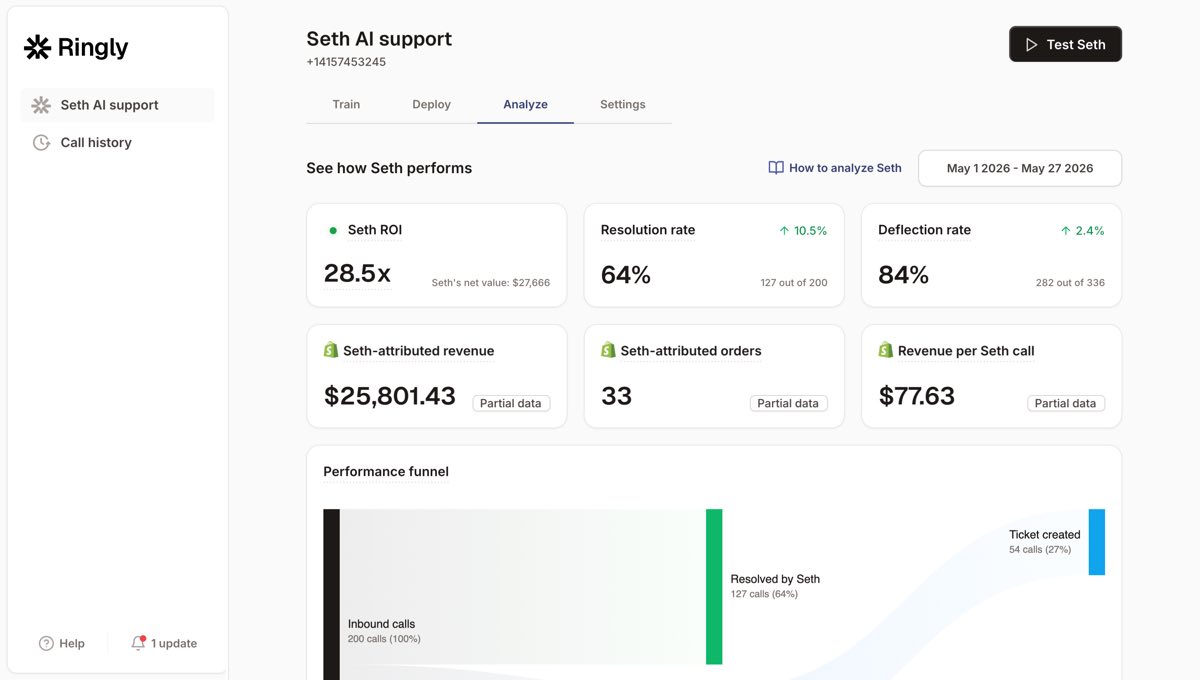
Ringly is the one built for phone. Your team wasn't hired to answer the same call 50 times a day. Instead of growing your headcount every time call volume spikes, the AI takes the routine inbound calls so your team can focus on the work that moves revenue. It answers 24/7, finds orders in your Shopify store, processes returns and exchanges, answers product questions from your knowledge base, and cancels orders when a caller asks. It resolves up to 90% of calls autonomously, and calls that need a human escalate cleanly to Gorgias, Richpanel, or whatever helpdesk you already run. Pay per call is $99 a month for the first 50 conversations, then $1.99 each, with a 65% resolution guarantee.
How it sits in front of Gorgias, Zendesk, and Shopify
A fair worry: "I already pay for a helpdesk, do I need another tool?" The answer is that a good AI agent doesn't replace your helpdesk, it sits in front of it.
Think of it as a filter on the channel. Calls and chats hit the AI first. The routine 70% get resolved and never become a ticket. The hard 30% escalate into Gorgias or Zendesk with the order, the history, and a summary already attached, so your rep starts informed instead of cold.
On the Shopify side, the agent reads live order data, so order status answers are real, not "please check your email." You keep your current phone number, your helpdesk, and your workflows. You're adding a layer that handles the volume, not swapping out the stack you already trained your team on. That's the difference between buying another tool and actually reducing the work.
What this costs vs what you're spending now
Strip out the feature talk and the math is simple. Take a typical $50M Shopify brand running a 6-rep support team.
| Line item | Today | With Ringly |
|---|---|---|
| 6 reps x $4K loaded per rep | $24,000/mo | — |
| Ringly (~$5K/mo) | — | $5,000/mo |
| Net monthly support spend | $24,000/mo | $5,000/mo |
| Monthly savings | — | $19,000/mo |
| Annual savings | — | $228,000/yr |
That's roughly 70% of repeatable calls routed to the AI. The other 30%, the genuinely complex ones, still go to your team, who now have time to actually solve them.
Frequently asked questions
What is an AI chatbot for an ecommerce website?
It's a language model grounded in your store's knowledge base and connected to your commerce platform, so it can answer product questions, check order status, and start returns in plain English. The 2026 version resolves requests instead of just routing them to a human. The best ones cover both chat and phone, not chat alone.
Do AI chatbots work with Shopify?
Yes. A good one connects directly to Shopify to read live order data, modify orders, and process returns, rather than reading a static FAQ. Ringly does this on the phone channel and escalates anything complex into your existing helpdesk.
Can an AI chatbot handle phone calls too, not just chat?
Most can't, and that's the gap. Ringly is built for phone first: it answers calls 24/7, finds orders, and handles returns the same way a chat agent would on your site. Since the voice agent shares the same knowledge base, adding phone to your chat setup is mostly turning on the channel.
Will the AI make something up and embarrass my brand?
That risk is real with poorly grounded bots, which is why knowledge-base grounding and guardrails are an evaluation criterion, not a nice-to-have. A well-built agent answers only from your approved content and escalates anything it's unsure about. Ask any vendor how they prevent the AI from inventing discounts or shipping dates before you buy.
How much does an ecommerce AI chatbot cost?
It ranges widely. Chat tools like Tidio start around $29/mo with AI billed per conversation, while resolution-based pricing (Intercom Fin at ~$0.99/resolution) can climb on high-volume months. Ringly is $99 a month for the first 50 conversations, then $1.99 each, with a 65% resolution guarantee.
Do I still need my human support team?
Yes, just for different work. The AI takes the repeatable 70%, order status, returns, and the same product questions, and your team handles the 30% that genuinely needs a person. You're not cutting the team, you're giving them back the hours that were going to WISMO.
Talk to us

If you run a $10M-$100M Shopify brand and your phone goes quiet after 6 p.m., a 30-min call is the fastest way to see what that silence costs. We'll pull your real numbers and show you which calls you're missing.
Our 3 promises.
- Live in under 1 hour. Setup and test calls are free.
- 30-day money back on the $99 plan fee.
- 65% resolution guarantee: if Seth resolves under 65% of your support calls in a month, that month comes back as credit (after 90 days on Pay per call).
Ruben (Ringly co-founder) takes these calls personally.