
This post in 30 seconds.
- Seven abandoned cart email templates, fully written. Fill in two blanks and ship.
- One per scenario: first nudge, reminder, social proof, objection-handler, urgency, discount, and the phone touch most brands skip.
- Built for founders, COOs, and Heads of CX at $10M-$100M Shopify brands whose recovery flow has gone stale. Abandoned cart emails convert about 10.7% on average (EmailVendorSelection), so the copy matters more than the design.
About 70% of online carts get abandoned (Shopify), so you already know the problem. You don't need another essay on why people abandon carts. You need the words. So this is mostly templates.
I'm Ruben, co-founder of Ringly. We run phone support for 50+ Shopify brands, which means I end up reading a lot of recovery flows. The high-AOV ones almost all had the same hole, and I'll get to it. But first, the part you came for: seven cart recovery emails you can paste into Klaviyo, Shopify Email, or Omnisend, change two things, and send.
If you run a $10M-$100M Shopify brand and your recovery rate has been flat for a year, the templates below are the fast fix. And if you want a human to look at where your flow is leaking, you can book a 30-min call and we'll go through it together.
How to use these templates
Every template has three things you change: [Brand], [Product], and [discount]. Drop them into whatever tool already runs your flows. The copy is the part that moves the number, not the template design. (If you also want paste-ready copy for the rest of your support inbox, we keep a set of ecommerce customer service email templates too.)
Send them as a sequence, not one-offs. Here's the standard shape, and which template fits each slot.
| Slot | Send around | Template to use | The job |
|---|---|---|---|
| Email 1 | 1 hour after abandon | #1 first nudge | Remind, no pressure, no discount |
| Email 2 | 24 hours | #2 reminder or #3 social proof | Bring the product back into view |
| Email 3 | 48 hours | #4 objection or #5 urgency | Knock down the reason they stalled |
| Email 4 | 72 hours | #6 discount (final) | Last call, now you can offer money |
| Touch 5 | 24-72 hours | #7 the phone call | For high-AOV carts email never recovers |
Don't lead with a discount. If email 1 hands out 10% off, you train people to abandon on purpose. Hold the money until the final touch. For the strategy and timing in depth, we wrote a separate abandoned cart email guide; this post is the copy.
The 7 templates
1. The first nudge (no discount)
Best for: the email everyone gets, sent about an hour after they leave. Low pressure. You're just reminding them the cart still exists.
Subject lines:
- You left something in your cart
- Your [Brand] cart is still here
- Forget something?
Body:
Hi [First name],
You left a few things in your cart at [Brand]. We saved them for you, so you can pick up right where you stopped.
No rush. Your cart will be here when you're ready.
[Product image + name + price]
CTA button: Return to my cart
When to send: about 1 hour after they abandon, while the intent is still warm.
2. The helpful reminder with product detail
Best for: email 2, around 24 hours later. This one does the work email 1 didn't: it puts the actual product back in front of them with enough detail to re-trigger the want.
Subject lines:
- Still thinking about the [Product]?
- A closer look at what's in your cart
- [First name], your [Product] is waiting
Body:
Hi [First name],
The [Product] is still in your cart. Here's a quick reminder of why you added it:
- [Key benefit one]
- [Key benefit two]
- [Key benefit three]
If you have a question before you buy, just reply to this email. A real person reads it.
CTA button: Finish checkout
When to send: about 24 hours after abandon.
3. The social-proof template
Best for: the shopper who likes the product but doesn't trust the brand yet. You're borrowing other customers' confidence. Reviews do the convincing.
Subject lines:
- People love the [Product] (here's why)
- 4.8 stars and counting
- See what other [Brand] customers say
Body:
Hi [First name],
Still on the fence about the [Product]? You're not the only one who's looked twice. Here's what customers say after they buy:
"[Real review quote]" ([Customer first name])
"[Second review quote]" ([Customer first name])
[Star rating] from [number] reviews. Your cart's still saved if you want to join them.
CTA button: Complete my order
When to send: 24 to 48 hours after abandon. Works well as email 2 for brands with strong reviews.
4. The objection-handler
Best for: the person who stalled for a specific reason: shipping cost, return worry, or sizing doubt. You name the objection and remove it. Most flows never do this, which is why it converts.
Subject lines:
- About that [Product] in your cart
- Free returns, in case you were wondering
- One thing before you decide
Body:
Hi [First name],
Sometimes a cart sits because of one small question. So in case it helps:
- Shipping: [free over $X / flat rate / 2-day]
- Returns: [30-day, no questions asked]
- Not sure on [size / fit / shade]? Reply and we'll help you pick.
Your [Product] is still saved.
CTA button: Go back to checkout
When to send: about 48 hours after abandon.
5. The urgency / low-stock template
Best for: carts with genuinely limited inventory or a real deadline. Use it only when it's true. Fake scarcity gets noticed and it costs you trust.
Subject lines:
- Your [Product] is selling fast
- Almost gone: the [Product] in your cart
- Don't miss the [Product]
Body:
Hi [First name],
Quick heads up. The [Product] in your cart is running low, and once it's gone we can't promise when it's back.
We're holding your cart for now. If you want it, this is the moment.
[Product image + stock note, e.g. "Only [N] left"]
CTA button: Claim mine now
When to send: 48 to 72 hours after abandon, only when the scarcity is real.
6. The discount / final email
Best for: the last email in the sequence, around 72 hours. Now you can offer money, because you've earned the right and they didn't come back on their own. This is where the discount lives, not email 1.
Subject lines:
- Here's [discount] off your cart
- A little something to finish your order
- Last call on your [Product]
Body:
Hi [First name],
Your [Product] is still here, so we'll make the decision easier. Take [discount] off if you finish your order in the next [24 hours].
Use code [CODE] at checkout. After that, your cart and the offer go away.
[Product image + name + price]
CTA button: Use my [discount]
When to send: about 72 hours after abandon, as the final touch in the email sequence.
7. The phone-call recovery template (the touch most brands skip)
Best for: high-AOV carts that email never recovers. This isn't an email. It's the script for a call, because for some carts a call is the only thing that works.
Here's the hole I mentioned at the top. For brands with an AOV north of $150, a chunk of buyers want to talk to a person before they spend that much. A $250-AOV store sees 12-18% of orders generate a phone call, versus about 3% at a $40 AOV (our Shopify Plus customer service data, and the math behind average order value). Those buyers won't open a fourth email. They'll buy if someone calls.
The call script:
"Hi [First name], this is [Brand]. We noticed you were looking at the [Product] and wanted to check in. Is there anything I can answer for you before you decide? ... Great, I can help you finish that right now."
When to use: 24 to 72 hours after abandon, for carts above your AOV threshold. You can run this with a CS rep, or have an AI phone agent do it automatically. That's the half of recover abandoned carts most brands leave on the table.
A subject-line bank you can swipe
A good subject line is also one of the cheapest ecommerce customer service wins you have, because it costs nothing and runs on every send. The body matters, but the subject line decides whether anyone reads it. Putting the word "cart" in the subject lifts open rate by about 10%, and adding the customer's name adds roughly 22% more (Popupsmart subject-line research). In one dataset, the plain "Your [Brand] Basket" converted at 32.73%. Boring wins when intent is already high.
Here are 18 to swipe, grouped by angle.
Curiosity:
- Forget something?
- Did you change your mind?
- Where'd you go?
Product-named (highest open rate):
- [First name], your [Product] is waiting
- Still thinking about the [Product]?
- Your [Brand] cart: [Product] inside
Value / reassurance:
- Free returns on your cart
- Your cart, plus free shipping
- A question before you buy?
Urgency (use only when true):
- Your [Product] is almost gone
- Last call on your cart
- 24 hours left on your cart
Social proof:
- 4.8 stars on the [Product] you saved
- People love the [Product]
- See why customers come back
Discount (final email only):
- [discount] off, just for you
- Here's a little something to finish
- Your cart + [discount]
When email stops working: the abandoned-cart call
I read recovery flows for a living, more or less. The pattern at high-AOV brands is always the same. The email sequence is fine. It's just capped. Once a buyer is weighing a $200 or $400 purchase, a fourth email doesn't move them. A two-minute call does.
For brands above $150 AOV, the abandoned-cart call recovers what the email sequence structurally can't.
A lot of that is people who would have ignored a fourth email. Ringly.io is AI phone support for Shopify brands. The AI answers inbound calls 24/7, finds orders, handles the where's my order questions, answers product questions from your knowledge base, and rescues abandoned carts with outbound follow-up. Across 50+ brands it resolves 73% of calls autonomously at roughly $0.42 per resolved call, and it escalates the hard ones to Gorgias or whatever helpdesk you already run.
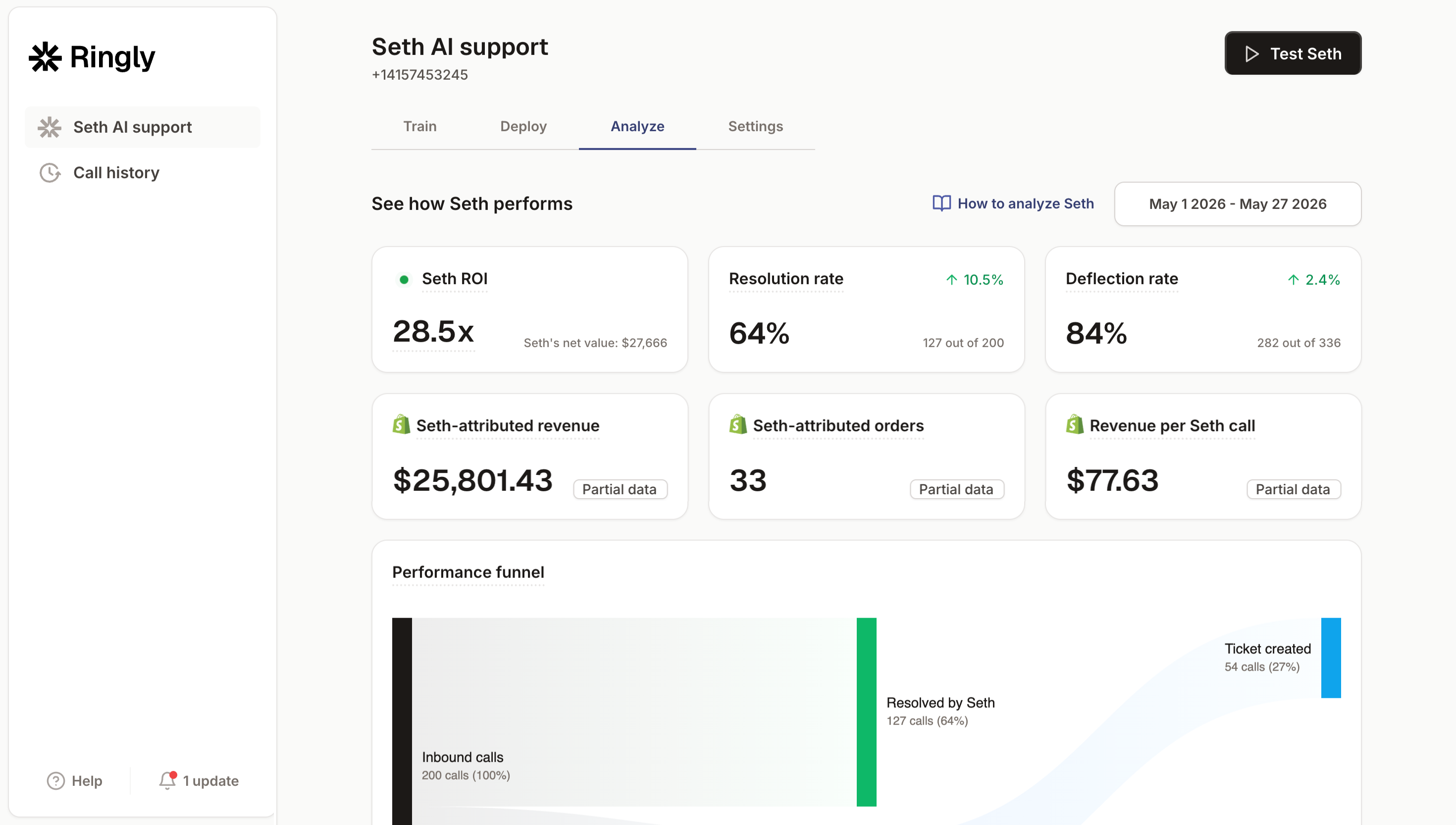
Here's the cost side, because the phone touch sounds expensive until you do the math.
What the recovery call costs you
Take a typical $50M Shopify brand running a 6-rep CS team.
| Line item | Today | With Ringly |
|---|---|---|
| 6 reps × $4K loaded per rep | $24,000/mo | — |
| Ringly Enterprise (~$5K/mo) | — | $5,000/mo |
| Net monthly CS spend | $24,000/mo | $5,000/mo |
| Monthly savings | — | $19,000/mo |
| Annual savings | — | $228,000/yr |
That's roughly 70% of your repeatable calls, the order status and returns and the same questions over and over, routed to the AI. The recovery calls ride on the same system. Your team gets the 30% that actually needs a person, which is usually where your customer retention actually gets won or lost.
If your recovery flow is all email and your AOV is north of $150, book a 30-min call and we'll do the math on your store live.
Frequently asked questions
How many abandoned cart emails should I send?
Three is the standard sequence: one at about an hour, one at 24 hours, one at 72 hours. For high-AOV brands, add a fourth touch, but make it a phone call rather than a fourth email, since the people who ignored three emails won't open a fourth.
Should the first abandoned cart email include a discount?
No. Leading with a discount trains shoppers to abandon on purpose to get the coupon. Hold the discount for the final email in the sequence, once they haven't come back on their own.
What's the best subject line for an abandoned cart email?
Put the word "cart" or the actual product name in it, and personalize with the first name. "Cart" lifts open rate about 10% and the name adds roughly 22% more. Plain beats clever when purchase intent is already high.
When should I send the first abandoned cart email?
About one hour after the cart is abandoned, while the intent is still warm. Some brands test 30 minutes. Past a few hours, the warmth fades and your recovery rate drops with it.
Do abandoned cart emails still work in 2026?
Yes. They convert at roughly 10.7% on average and open at about 45%, more than double a standard promo email (cart abandonment statistics). The copy is what's changed, not whether the channel works.
What about customers who never open email?
That's the gap email can't close, and it's bigger at high AOV. A short abandoned-cart phone call recovers a chunk of the buyers your sequence never reaches, which is why we built the AI to do it automatically.
Talk to us

Copy the templates and your recovery flow gets better this week. But if you run a $10M-$100M Shopify brand and your AOV is high enough that email is leaving money behind, a 30-min call is the fastest way to see what the phone touch would recover.
The 3-layer guarantee.
- Live in 14 days or it's free until launched.
- 65% resolution in 90 days or we refund the last 3 months of subscription fees.
- We keep working free until we hit 65%.
Ruben (Ringly co-founder) takes these calls personally.