
This post in 30 seconds.
- The cadence that recovers the most: a 3-email sequence on a 1-hour / 24-hour / 72-hour clock, plus when a 4th touch earns its place.
- The cart worth the most attention is the one email is worst at recovering. WashCo recovered $22,664 in attributed revenue in 7 days using the channel email can't reach.
- Built for $10M-$100M Shopify brands with a visible phone line and a paid helpdesk.
Across 497 DTC brands, the average abandoned-cart flow is 1.52 emails long, according to Rejoiner. Most stores send one reminder and call it a strategy. The sequence dies long before the money does.
I subscribed to the abandoned-cart flows of 11 DTC brands to write this, timed every send, and pulled recovered-cart data from the 50+ Shopify brands we run phone support for. If you're the founder, COO, or Head of CX at a Shopify or Shopify Plus brand doing $10M-$100M, this is the part that matters: a recovery sequence is not one email, and the highest-value carts need a channel a reminder email never touches.
We run AI phone support for $10M-$100M Shopify brands, which means we see the carts email gives up on, the ones that go to voicemail after 6 p.m. and never get called back. If your high-AOV carts are dying in an inbox nobody opens, book a 30-min call and we'll show you what your store is leaving in the queue.
What a recovery sequence is actually for
Roughly 70.22% of carts get abandoned, per Baymard's meta-analysis of nearly 50 studies. That number is stable, it's not getting better, and chasing it down to zero is a fool's errand. The job of a recovery sequence isn't to stop abandonment. It's to win back the slice of carts that were a real intent-to-buy that got interrupted.
Here's where most strategies fall apart. A single abandoned cart email recovers about 3.33% of recipients at roughly $3.65 per recipient (Klaviyo benchmark, via Shopify). That's fine for a $40 cart. It's a quiet disaster for a $400 one.
A sequence beats a single email by 69% more orders, but most brands stop at email one and leave the compounding on the table. That 69% figure comes from Chase Dimond's flow data cited by Klaviyo, and it lines up with what I saw timing those 11 flows: the brands recovering real revenue were running three touches, not one.
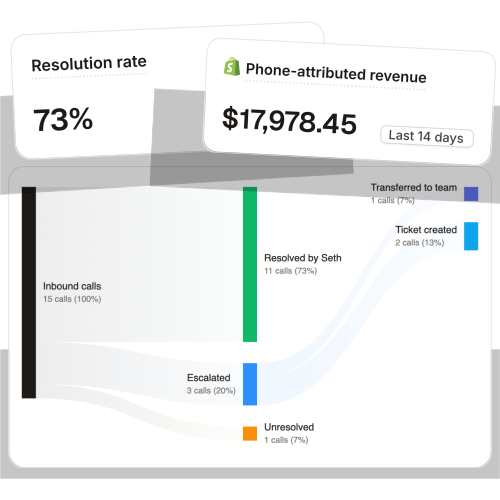
So a recovery sequence is two things at once. It's a series of reminders for the distracted buyer, and it's a triage system for figuring out which carts deserve more than a reminder. Get the cadence right first. Then get the segmentation right. Then decide which carts are worth a human-grade follow-up. We pulled the recovered-revenue numbers in this guide from real cart abandonment data, not from list-price math.
The cadence: how many emails, how far apart, when to stop
The benchmark that recovers the most revenue is a three-email sequence, and the timing is more settled than most marketers think. Send fast, escalate the message, stop before you become spam.
Here's the cadence I'd build by default:
| Touch | Timing | Job | Discount? |
|---|---|---|---|
| Email 1 | 1-2 hours after abandon | Plain reminder. Cart's still warm. | No |
| Email 2 | ~24 hours | Add urgency or social proof (reviews, low stock) | No |
| Email 3 | ~48-72 hours | The incentive, if you need one (free shipping first) | Maybe |
| Phone touch | high-AOV carts only | Live objection handling + after-hours coverage | No |
A few timing rules worth internalizing. The first email does the heavy lifting when it lands inside the first hour, while purchase intent is still hot. Recovery rates drop about 85% within 72 hours, so speed is the whole game in the first day. The best send window across the flows I tracked was 6-9 p.m. local time, with a peak around 7 p.m., which makes sense for DTC where people shop after dinner.
Stop the email sequence around day six. Past that, recovery is negligible and you start eating into your promotional sends and training people to unsubscribe. The point of diminishing returns is real, and pushing a fifth and sixth reminder usually costs you more in list health than it recovers.
WashCo, a Shopify brand we launched recently, generated $22,664 in attributed revenue in the first 7 days post-launch by adding the one touch the email sequence above can't make. More on that below, but keep it in mind while you read the segmentation section, because the cadence table is only half the plan.
Segmentation: not every cart deserves the same sequence
This is where a real strategy separates from a copy-pasted flow. A $35 cart and a $450 cart are not the same business problem, and sending them the same three emails wastes the discount on one and under-serves the other.
The cleanest way to segment is by cart value. Here's the tiering Shopify and Klaviyo both land on, adapted for a high-AOV brand:
- Under $50. Reminder sequence only. No discount, ever. The margin doesn't justify giving anything away.
- $50 to $150. Reminder sequence, then free shipping in email three if it doesn't convert. Free shipping beats a percentage discount here because 48% of shoppers abandon over unexpected costs (Baymard).
- $150 and up. The priority tier. Full sequence plus a human-grade touch. This is the cart where a phone follow-up pays for itself many times over.
Then layer in behavior on top of value. A returning customer who's bought twice doesn't need the same hand-holding as a first-time browser. Segment new versus returning, and split browse-abandon (added to cart, never reached checkout) from checkout-abandon (entered the funnel, bailed at shipping or payment). Checkout-abandoners are closer to the money and deserve the faster, harder push.
Exclude two groups from the sequence entirely: anyone with an open support ticket and anyone who abandoned in the last few days on a different cart. Hitting a customer who's already mid-conversation with your CS team reads as the left hand not knowing what the right is doing, and over-mailing recent abandoners is how you train opt-outs.
The whole point of segmentation is to find the carts worth more than an email. Once you've found them, the strategy question becomes: what do you actually do with a $450 cart that ignored three emails?
Discount logic: lead with value, end with the offer
The single most common mistake I see is leading with a discount. Drop a 15% code in email one and you've taught your best customers to abandon their cart on purpose and wait for the coupon. The discount is the last lever, not the first.
So the rule is simple: the first two touches earn the sale on value, and only the final touch introduces an incentive, and only on carts where the margin allows it. When you do offer something, free shipping usually outperforms a straight percentage off, because the thing people are actually mad about is the surprise cost at checkout, not the base price.
When a discount is the right call, it works. 57% of US customers who used a cart coupon say it influenced their purchase. But that's a closing tool for a warm buyer, not an opener for a cold one.
"My customers also feel like it's a normal person. They feel like they can communicate if they have questions."
— Claudia Droge, TechCraft Studio
That quote matters more than it looks for a recovery strategy. The reason a high-AOV cart stalls is rarely price. It's an unanswered question: will this fit, when will it ship, is this brand legit. A discount doesn't answer any of those. A conversation does.
The mistakes that quietly kill a recovery sequence
Timing and segmentation get all the attention, but the flows I tracked lost most of their recovery to a handful of unforced errors. Worth checking your own setup against these before you add a single new email.
- Sending one email and calling it a flow. This is the big one. With the average brand at 1.52 emails per flow, the easiest recovery win available to most stores is simply turning on emails two and three.
- Leading with the discount. Covered above, but it's the most expensive habit, because it permanently lowers what your best customers are willing to pay at checkout.
- No first-touch speed. A reminder that lands the next morning instead of within the first hour misses the window where intent is highest. The cart's already cold.
- One generic message for every cart. A $35 reminder and a $450 reminder reading identically means you're either over-discounting the small carts or ignoring the big ones. Usually both.
- Treating recovery as email-only. The most valuable carts stall on a question, not a price, and an email can't answer a question in real time. If your strategy stops at the inbox, your highest-AOV carts are the ones it abandons.
- Never measuring recovered revenue by segment. If you can't see which tier of cart your sequence actually recovers, you can't tell whether the discount is paying for itself or just training people to wait. Pull the numbers from your dashboard and split them by cart value.
Fix the under-sending and the discount-first habit and most brands recover more before they touch timing at all. The rest is optimization on top of a sequence that's actually running.
How I built this sequence plan
I'm Ruben, co-founder of Ringly. Over the last few weeks I built this plan from two sources, not from rehashing other people's blog posts.
- I subscribed to 11 DTC brands' abandoned-cart flows with a real email and a seeded cart, then logged the exact timing and content of every send.
- I timed the first-touch delay on each to see who hit the one-hour window and who let the cart go cold for a day.
- I tracked which sequences ever escalated past a reminder into urgency, social proof, or an offer, versus the ones that sent the same email twice.
- I pulled recovered-cart data from the 50+ Shopify brands we run phone support for, including real revenue, resolution, and per-call cost numbers from our dashboard.
- I called a handful of brands' own phone lines after 6 p.m. to see what happens to a high-intent buyer with a question when the store is closed. Mostly: voicemail nobody returns.
The recovered-revenue figures in this post come from that last bucket. They're real numbers from real stores, which is also why this strategy weights the phone touch heavier than the email-only guides do.
The recovery layer email can't reach: the high-AOV cart call
Email recovery tops out around 3.33%. For a brand selling $40 supplements, that ceiling is fine. For a brand selling $400 carts, that ceiling means your most valuable abandoned carts are the ones your strategy gives up on first. The more expensive and complex the purchase, the higher the abandonment, because high-ticket buyers comparison-shop and hesitate (Baymard). The cart worth the most is the cart that stalls the hardest.
That's the gap. A reminder email can't answer the question that froze the buyer. A phone call can. When someone abandons a $450 cart because they weren't sure about the return window or the delivery date, a 90-second conversation closes it. Three emails don't.
The problem is that nobody can staff a phone team to call back every high-value abandoned cart, especially the after-hours ones, which is when most DTC carts get abandoned. That's the layer we built Ringly for.
Ringly.io is AI phone support for Shopify brands. Instead of hiring and training a phone team to chase carts, the AI handles inbound calls 24/7 and runs outbound abandoned-cart follow-up: it finds the order in your Shopify store, answers the product question that stalled the cart, checks the shipping timeline, and recovers the cart on the call. The same agent handles the where's-my-order calls flooding your team the rest of the day. Across 50+ brands, the AI resolves 73% of calls autonomously at roughly $0.42 per resolved call, and anything it can't handle escalates cleanly to Gorgias, Richpanel, Reamaze, or whatever helpdesk you already run.
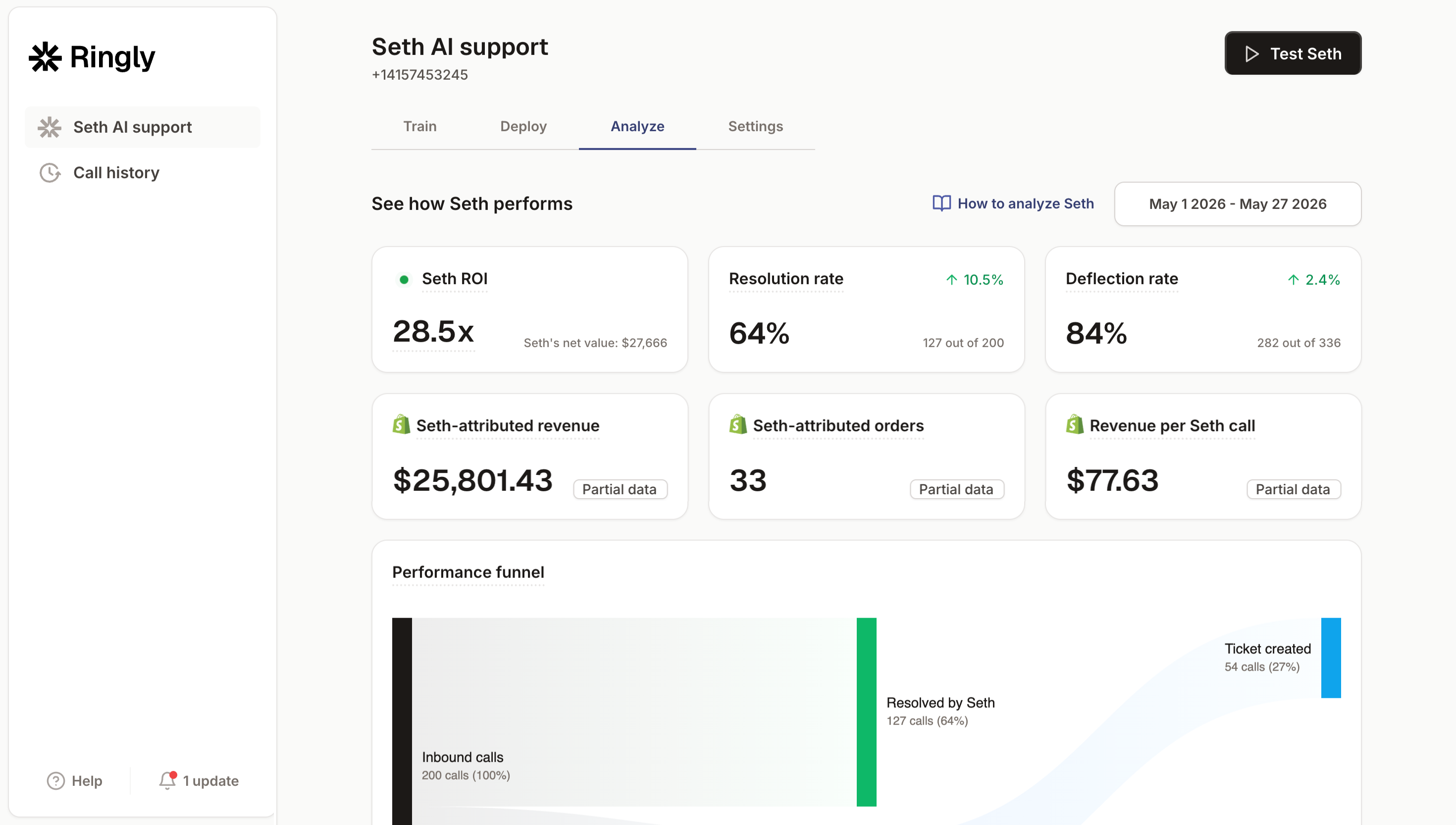
Here's the proof that this isn't theory:
That $22,664 came from the carts and calls the email sequence never closed. It's the recovery layer that sits after your flow, not instead of it.
What the recovery channel costs vs what it recovers
Let's run the operator math nobody else runs, because this is where the high-AOV strategy actually pencils out.
A recovered $400 cart is worth $400. A call that recovers it costs you, in WashCo's real numbers, $0.91. There is no version of that math where chasing your high-value carts by phone doesn't pay for itself. Compare the per-resolution cost across channels:
| Channel | Per-call cost (loaded) | Notes |
|---|---|---|
| In-house CS rep | $2.70/call | US, loaded with payroll and benefits |
| BPO contract | $1.50-$3.50/call | Plus contract overhead and minimums |
| Ringly | $1.20-$2.00/call | Plus 24/7 coverage |
| Ringly (WashCo, verified) | $0.91/call | Real number, real store |
Now the headcount frame. To call back every high-AOV abandoned cart, after-hours included, you'd staff a small phone team. A typical $50M brand running a 6-rep CS team to cover that load is looking at:
| Line item | Today | With Ringly |
|---|---|---|
| 6 reps x $4K loaded per rep | $24,000/mo | — |
| Ringly (illustrative) | — | ~$5,000/mo |
| Net monthly CS spend | $24,000/mo | $5,000/mo |
| Monthly savings | — | $19,000/mo |
| Annual savings | — | $228,000/yr |
That's roughly 70% of repeatable calls, the order-status and product and recovery calls, the same questions over and over, routed to the AI. The other 30%, the genuinely complex ones, still go to your team, who now have time to actually solve them.
If that's you, book a 30-min call and we'll do the recovered-revenue math live on your store, not on a slide.
Your full abandoned cart sequence plan, in one place
Here's the whole strategy as one artifact you can hand to whoever builds your flow:
| Touch | Timing | Channel | Segment | Discount | Job |
|---|---|---|---|---|---|
| 1 | 1-2 hrs | All carts | No | Reminder, cart still warm | |
| 2 | ~24 hrs | All carts | No | Urgency + social proof | |
| 3 | ~48-72 hrs | $50+ carts | Free shipping for $50-150 | Incentive if needed | |
| 4 | within 24-48 hrs | Phone / AI voice | $150+ carts | No | Answer the live objection, close the cart |
| Stop | ~day 6 | — | — | — | Protect list health |
Two reminders earn the sale on value. One closing email adds the offer where the margin allows. And the phone touch handles the high-AOV carts that an inbox was never going to recover. Build the email flow in your ESP, then layer the recovery call on the carts worth a human-grade follow-up. If you want the swipe copy for the emails themselves, the abandoned cart email templates and a teardown of 9 real examples are in the cluster.
Frequently asked questions
How many abandoned cart emails should I send?
Three is the benchmark that recovers the most revenue, sent on a roughly 1-hour, 24-hour, 72-hour clock. Most brands send only 1.52 on average (Rejoiner), which is why their recovery underperforms. For high-AOV carts, add a fourth touch by phone.
What's the best timing for the first email?
Within the first 1-2 hours, while purchase intent is still hot. Recovery rates drop about 85% within 72 hours, so the first day does most of the work. The best send window for later touches is 6-9 p.m. local, peaking around 7 p.m.
Should I include a discount in abandoned cart emails?
Not in the first two emails. Leading with a discount trains customers to abandon on purpose and wait for the code. Reserve incentives for the final touch on higher-value carts, and try free shipping before a percentage off, since extra costs are the top reason people abandon.
When should I stop the sequence?
Around day six. After that, recovery is negligible and extra reminders eat into your promotional sends and drive unsubscribes. The phone touch on high-value carts is the exception, since one call can do what three more emails won't.
How do I segment abandoned cart emails by cart value?
Tier by value: under $50 gets a reminder only, $50-150 gets a reminder plus free shipping, and $150+ gets the full sequence plus a phone follow-up. Then layer behavior on top, splitting new versus returning and browse-abandon versus checkout-abandon, and exclude anyone with an open support ticket.
Do abandoned cart phone calls work better than email?
For high-AOV carts, yes, because a call can answer the live question that stalled the purchase while an email can't. Email recovery tops out around 3.33%, so on a $400 cart it leaves the most valuable carts unrecovered. WashCo recovered $22,664 in attributed revenue in 7 days using a phone layer on top of email.
What's a good abandoned cart recovery rate?
Email-only recovery sits around 3.33% per recipient at roughly $3.65 per recipient. A well-built sequence with segmentation pushes that higher, and adding a phone touch on high-value carts lifts the recovered revenue well beyond what email alone returns.
Does Ringly replace my email flow?
No. Ringly is the recovery layer that sits after your email sequence, handling the high-AOV carts and after-hours calls email can't. It runs your inbound phone support too, resolving 73% of calls autonomously and escalating the rest to your existing helpdesk.
Talk to us

If you run a $10M-$100M Shopify brand, your email flow is recovering the easy carts and quietly giving up on the expensive ones. The fastest way to see what that's costing you is to put your real numbers on a 30-min call and run the recovery math live.
The 3-layer guarantee.
- Live in 14 days or it's free until launched.
- 65% resolution in 90 days or we refund the last 3 months of subscription fees.
- We keep working free until we hit 65%.
Ruben (Ringly co-founder) takes these calls personally.