
This post in 30 seconds.
- Nine real abandoned cart emails, torn down on one rubric, plus the recovery channel none of them use.
- The benchmark spread is brutal: the average abandoned cart flow earns $3.65 per recipient, the top 10% earn $28.89. Same playbook, 8x apart.
- Built for $10M-$100M Shopify brands that already run a recovery flow and keep a phone line on the site.
You don't need another post telling you to build an abandoned cart flow. You have one. It's been running for a year, it recovers a few percent of the carts it touches, and you want to know what the brands at the top of the benchmark are doing that you aren't.
So this is a swipe file with judgment attached. I read through 40-plus recovery emails from real Shopify and DTC brands, kept the nine that teach something different, and tore each one down on the same six things. At the end I'll show you the one recovery channel that shows up in zero of these examples, and what it's worth.
If you run support or growth at a Shopify brand doing $10M to $100M, the gap between your recovery rate and the elite one usually isn't the email design. It's what happens after the email, when a customer is still on the fence and would rather ask a person than click a button. Book a 30-min call and we'll look at where your recovered revenue is leaking, including the calls your cart emails never close.
What makes an abandoned cart email worth copying
Before the examples, here's the rubric I scored each one on. Six things, in the order a reader actually meets them.
- Subject line. Does it earn the open, or is it the 400th "you forgot something" in the inbox?
- Hook. The first line or image. Does it pick up where the subject left off, or restart?
- Offer or no offer. A discount, free shipping, or nothing. The most expensive decision in the whole email.
- Social proof. Reviews, ratings, testimonials on the actual abandoned item.
- CTA. One obvious button back to the cart, or a maze.
- Reassurance. The line that handles the real reason they left.
The offer question is the one operators argue about, so let's settle it up front. Most experienced DTC teams do not put a discount in the first email. You're recovering people who were already interested, and a day-one coupon trains your best customers to abandon on purpose to farm the code. Save the incentive for email two or three, and only if the abandon reason is actually price. According to Baymard's 2026 meta-analysis of 50 studies, 70.22% of carts get abandoned, and the single biggest reason is extra costs like shipping and taxes (48% of abandoners), not the product price.
The number that should change how you think about this: a three-email sequence produced $24.9M in Klaviyo's analysis versus $3.8M from a single email, a 6.5x difference. One reminder is not a flow. If you're sending one email and calling it cart recovery, that's the first thing to fix, before you touch a single subject line. Chase Dimond's data puts the lift at 69% more orders from multiple emails versus one. If you're weighing Klaviyo against other tools for the flow itself, the sequence length matters more than the platform.
Here's how the nine examples stack up.
| Brand | Subject line | The move | Offer? | Steal this |
|---|---|---|---|---|
| Casper | "Did you forget something?" | Brand-humor reminder + proof | No | A pun only your category could send |
| Liquid Death | "Maybe you died?" | Voice-led curiosity | No | A subject only your brand could write |
| Nomad | "Nomad Gear is Selling Out Quick" | Urgency + risk-reversal | No | Never sell urgency without reassurance |
| Dollar Shave Club | "Where did you go?" | Benefits + guarantee | No | The money-back line as the closer |
| SKIMS | (review-led) | Social proof on the item | No | Ratings on what they actually left |
| Recess | "you're so close (to having 10% off)" | Incentive-in-subject | 10% | Lead with the discount, keep copy tiny |
| The Home T | "Oh no! This expires soon." | Free shipping + expiry | Free ship | Free shipping protects margin better |
| Allbirds | "Your Cart Is Waiting" | Reassurance on returns | No | Handle the objection, not the price |
| Native | "Does this count as a humble brag?" | Wordplay + ratings | No | Clever opens, proof closes |
9 abandoned cart email examples, torn down
1. Casper: "Did you forget something?"
The subject is the most generic line on this list, and Casper gets away with it because everything under it isn't. The headline reads "COME BACK TO BED," which is a pun only a mattress brand could send, and the body pairs the product image with testimonials and a link to reviews.
What it does well is layer three jobs into one short email: it reminds, it makes you smile, and it shows you other people slept on the thing and liked it. The CTA button is single and obvious.
Steal this: the category pun. "Did you forget something?" is replaceable. "COME BACK TO BED" is not. Write a line your competitor literally cannot use because it only makes sense for what you sell.
2. Liquid Death: "Maybe you died?"
This is the opposite bet from Casper. The subject does all the work. "Maybe you died?" is unhinged in the best way, and the body leans in with "we're worried about you" before getting to the cart.
It only works because it's on-brand. Liquid Death sells canned water with a death-metal personality, so a morbid joke reads as the brand being itself, not a gimmick. Try that subject from a baby brand and you'd get unsubscribes.
Steal this: write the subject only your brand could send. If a competitor could swap their logo onto your recovery email and nothing would feel off, the email isn't doing its job.
3. Nomad: "Nomad Gear is Selling Out Quick"
Nomad runs FOMO in the subject, then does the thing most urgency emails forget: it reassures. A section titled "Afraid to Make The Leap?" walks through the return policy and the warranty, with multiple CTAs so you can convert at any scroll depth.
Urgency without reassurance just raises anxiety, and an anxious shopper closes the tab. Pairing "selling out" with "here's your safety net" is what turns the pressure into a purchase.
Steal this: never sell urgency naked. Put the risk-reversal directly under the scarcity line, in the same email.
4. Dollar Shave Club: "Where did you go?"
Sent two days after the abandon, this one is a clinic in conversational copy. A scannable bullet list of benefits, a casual tone, and then the closer: "If you're not 100% happy, we'll refund your money." A 100% money-back guarantee, stated plainly.
The guarantee is the whole email. Everything before it builds the case; that line removes the last reason to not click. For a subscription or trial-style purchase, the guarantee does more than any discount could.
"My customers also feel like it's a normal person. They feel like they can communicate if they have questions." Claudia Droge, TechCraft Studio
Steal this: if your product carries any "what if it's not for me" hesitation, the guarantee belongs in the recovery email, not buried on a policy page.
5. SKIMS: proof on the exact item
SKIMS doesn't lean on a clever subject. It leans on star ratings and customer reviews attached to the items sitting in your cart. Not generic brand reviews. The reviews for the thing you almost bought.
That distinction matters more than it sounds. "4.8 stars across our store" is wallpaper. "847 reviews on the exact piece you left" answers the question the shopper was actually asking when they hesitated.
Steal this: wire your reviews app so the recovery email pulls ratings for the abandoned SKU, not a static brand-level badge.
6. Recess: "you're so close (to having 10% off)"
When you do decide to discount, Recess shows you how. The 10% is right in the subject line, the body is tiny, and the button reads "I'm ready." No wall of copy, no ten reasons to buy. The incentive is the reason to buy, so the email gets out of its way.
This is the email to copy for a second or third touch on a price-sensitive abandon, not a first send. Lead with the number, then say almost nothing.
Steal this: if the email's job is the discount, put the discount in the subject and cut the body to two lines. Long copy around a coupon just delays the click.
7. The Home T: "Oh no! This expires soon. Don't miss it."
The Home T runs an expiry-urgency subject and makes the incentive free shipping rather than a percentage off. Given that shipping cost is the number-one abandon reason in Baymard's data (48% of abandoners), removing it is often a sharper move than slicing margin off the product.
Free shipping feels like a full discount to the shopper but costs you far less than an equivalent percentage off, especially at higher AOV. The expiry framing adds the deadline that turns "later" into "now."
Steal this: before you reach for 10% off, test free shipping. It targets the actual objection and protects your margin. If you're not sure what your basket is worth, run your AOV first, because the higher it is, the more free shipping beats a flat percentage.
8. Allbirds: "Your Cart Is Waiting"
Allbirds personalizes the name, then spends the email on return policy benefits and support icons rather than price. For a considered, higher-ticket purchase, the hesitation usually isn't "is this too expensive," it's "what if it doesn't fit and I'm stuck with it."
So the email answers that. It's a reassurance email dressed as a reminder, and for footwear or anything with a fit or sizing question, that's the right call.
Steal this: for higher-ticket or fit-dependent products, handle the return and trust objection in the recovery email. The price was never the problem.
9. Native: "Does this count as a humble brag?"
Native pairs a wordplay subject with star ratings in the body and urgent button copy. The subject is the bait, the proof is the hook, and the button closes.
It's the cleanest example of the open-then-prove structure: spend your creativity on the subject to win the open, then immediately hand the reader hard proof so the click feels safe. The clever line gets them in; the social proof gets them out the door with a purchase.
Steal this: match a creative subject with real proof in the first scroll. A funny subject with a thin body just feels like a brand trying too hard.
The recovery channel these examples all miss
Read those nine again. Every single one is an email. Not one of them picks up the phone.
That's the blind spot in almost every "abandoned cart examples" roundup, including the ones ranking above this post. Email is the right first move, it's cheap and it scales. But a slice of your abandons aren't email problems. They're a customer who wants to ask a person whether the size runs small, when it'll actually ship, or whether your brand is legit before they put $180 on a card. An email can't answer back. A call can.
At $30-plus AOV and $10M-$100M in revenue, that slice is real money. The order-anxiety call and the classic "where's my order" call sit right next to each other, and both convert far better with a human voice on the line than with a fourth follow-up email nobody opens.
This isn't theory. WashCo, a Shopify brand we launched recently, recovered $22,664 in attributed revenue in its first 7 days by letting the AI take exactly these order-anxiety calls instead of routing them to voicemail.
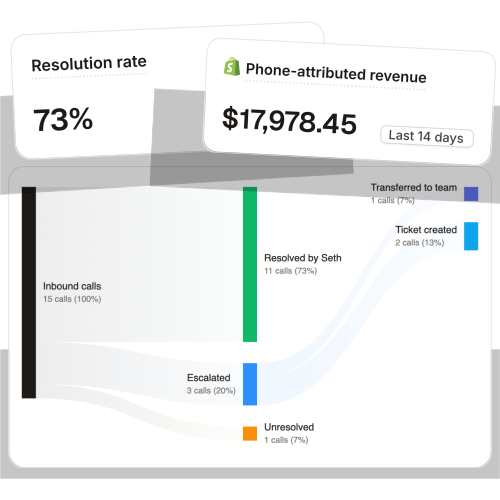
Ringly.io is AI phone support for Shopify brands. Instead of hiring a phone team, the AI answers inbound calls 24/7 and runs outbound follow-ups: order status, returns, product questions, and abandoned cart rescue by calling carts your emails couldn't close. Across 50+ brands the AI resolves 73% of calls autonomously at roughly $0.42 per resolved call. Calls that need a human escalate cleanly to whatever helpdesk you already run.
The point isn't to replace your cart emails. It's that the emails and the phone catch different shoppers. The brands at the $28.89-per-recipient end of the benchmark tend to be the ones recovering revenue on more than one channel, not the ones with a slightly better subject line. If your recovery strategy stops at email, you're leaving the retention revenue from order anxiety on the table. Pairing email with 24/7 phone coverage is how the top of the benchmark actually pulls away.
What this costs you vs what it recovers
Here's the math operators actually run. Take a typical $50M Shopify brand with a 6-rep support team handling the calls and the recovery work.
| Line item | Today | With Ringly |
|---|---|---|
| 6 reps × $4K loaded per rep | $24,000/mo | — |
| Ringly (~$5K/mo) | — | $5,000/mo |
| Net monthly support spend | $24,000/mo | $5,000/mo |
| Monthly savings | — | $19,000/mo |
| Annual savings | — | $228,000/yr |
That's roughly 70% of repeatable calls (order status, returns, the same product questions, the order-anxiety calls behind your abandons) routed to the AI. The genuinely complex calls still go to your team, who now have time to take them.
On the recovery side, the value compounds with your AOV. A single recovered cart is worth $30 to $250 depending on basket size, and the phone channel tends to close the higher-intent abandons the email cooled off. You're not just saving payroll. You're catching orders the order-tracking and email layers were missing. For Shopify Plus support teams running real call volume, the savings line gets bigger, not smaller.
If you want to see your own version of this table, book a 30-min call and we'll run it on your real call volume live.
How to steal these patterns without sounding like everyone else
The mistake is copying the email you liked best. The right move is matching the pattern to why your customers actually abandon. Pick the example that fixes your specific leak, not the one with the funniest subject line.
- Choose the reminder + proof pattern (Casper, SKIMS) if your abandons are mostly "just browsing" shoppers who liked the product but got distracted. They don't need a discount. They need a nudge and a reason to trust the item.
- Choose the reassurance pattern (Nomad, Allbirds, Dollar Shave Club) if you sell higher-ticket, fit-dependent, or trust-sensitive products. The objection is risk, so answer risk with returns, warranty, or a guarantee.
- Choose the free-shipping pattern (The Home T) if your analytics show shipping cost is the top abandon reason, which Baymard says it is for most stores. Remove the actual objection before you discount the product.
- Choose the discount-in-subject pattern (Recess) if you're on email two or three and the abandon is genuinely price-driven. Lead with the number, keep the copy tiny.
- Choose the phone layer if your AOV is $30-plus and a meaningful share of your abandons are order-anxiety calls an email can't answer. That's the channel the other eight examples never reach. An AI voice agent handles it without adding headcount.
And the voice rule that runs through all of them: the email should sound like a human at your brand, not a recovery-software template. The 2026 inbox rewards brands that talk like people. A clever, on-brand line beats a polished generic one every time.
Frequently asked questions
What's the best subject line for an abandoned cart email?
There isn't one winner. The best subject either uses your brand voice (Liquid Death's "Maybe you died?"), reassures (Beauty Bay's "We've saved your bag"), or names the incentive (Recess's "10% off"). Match the subject to the email's job and your brand, not a swipe-file copy-paste.
Should an abandoned cart email include a discount?
Usually not on the first email. You're recovering shoppers who were already interested, and a day-one coupon trains customers to abandon on purpose. Save the incentive for email two or three, and reach for free shipping before a percentage off since shipping cost is the top abandon reason.
How many abandoned cart emails should I send?
Two to three. Klaviyo's analysis found a three-email sequence produced 6.5x the revenue of a single send, and Chase Dimond's data shows 69% more orders from multiple emails versus one. One reminder is leaving money on the table.
When should the first abandoned cart email be sent?
Within one to three hours of the abandon. That's the highest-converting window, while the intent is still warm. Later emails in the sequence go out at 24 hours and a few days after.
What's a good conversion rate for abandoned cart emails?
The average abandoned cart flow converts around 3.33% at $3.65 revenue per recipient, per Klaviyo. The top 10% hit 7.69% conversion and $28.89 per recipient. If you're below the average, the fix is usually a longer sequence and a sharper offer decision, not a redesign.
Can a phone call recover an abandoned cart better than an email?
For a slice of abandons, yes. When the hesitation is order anxiety (sizing, shipping time, trust), a call answers what an email can't. WashCo recovered $22,664 in attributed revenue in 7 days letting the AI take those calls, which is why we'd add the phone layer rather than send a fourth email.
Talk to us

If you run a $10M-$100M Shopify brand and your cart recovery stops at email, a 30-min call is the fastest way to see the revenue the phone channel is leaving behind.
The 3-layer guarantee.
- Live in 14 days or it's free until launched.
- 65% resolution in 90 days or we refund the last 3 months of subscription fees.
- We keep working free until we hit 65%.
Ruben (Ringly co-founder) takes these calls personally.