

The short version.
- What it is: IVR (interactive voice response) is the automated phone system behind every "press 1 for billing" menu. It greets a caller, gives them options, takes input by keypad or voice, then routes the call or handles a task on its own.
- The catch: most IVR sorts the call. It doesn't answer it. For a store, that means the call still lands on a rep's desk.
- Who this is for: founders, COOs, and Heads of CX at $10M-$100M Shopify brands with a visible phone number and a CS team that's tired of the same five questions.
If you've ever called a company and heard "para español, oprima dos," you've already used IVR. Interactive voice response is the automated layer that picks up a phone call, plays a menu, and reacts to what the caller types or says. It's been around since the 1970s, and it's still a roughly $5.4 billion market that's forecast to hit $7 billion by 2030, according to Mordor Intelligence.
I run a company that answers phone calls for Shopify brands, so I spend a lot of time on the other side of these menus. A while back I dialed a stack of real DTC phone lines after 9 p.m. to hear what their systems actually did with me. Most of them did one of two things: dumped me into a menu tree, or sent me to voicemail. Neither one answered my question. That gap is what this post is about.
If you run support at a Shopify brand doing $10M to $100M a year, the IVR question isn't really "which menu builder do I buy." It's whether your phone line can answer the same five questions your reps answer all day, without a human picking up. If your line goes to voicemail after 6 p.m., book a 30-min call and we'll show you what those after-hours calls are actually worth.
In this post:
What is IVR, in one definition
IVR stands for interactive voice response. It's an automated phone system that talks to a caller, collects input, and either routes the call to the right place or completes a task without a human.
The input comes in one of two ways. The caller presses keys on the keypad (that's DTMF, the touch tones), or they speak and the system listens. The classic version is the one everybody pictures: "press 1 for sales, press 2 for support, press 0 to speak to a representative." That menu, and everything it triggers, is IVR.
An IVR system is only as useful as the task it can finish on its own. A menu that just sorts callers into queues moves work around. It doesn't remove any. The systems that actually earn their keep are the ones that complete the call: look up an order, read back a tracking number, start a return, answer a product question. That distinction is the whole game, and we'll come back to it.
Banks, airlines, utilities, and retailers have leaned on IVR for decades because phones don't scale the way websites do. One agent handles one call. An IVR handles as many calls as the lines allow, all at once, at 3 a.m. on a holiday. For ecommerce specifically, we wrote a deeper guide on how IVR works for an online store if you want the store-level version.
How IVR works
The flow is the same whether the system is 30 years old or built last year. There are four steps.
- Greeting. A recorded or synthesized voice picks up. "Thanks for calling [brand], how can I help?"
- The prompt. The system offers options, either a menu ("press 1 for order status") or an open question ("what are you calling about?").
- The input. The caller responds by keypad or voice. The system matches that input to an intent.
- The action. It either routes the call to a department or rep, or it does the thing itself: pulls up an order, takes a payment, reads back shipping info, logs a callback.
The last step is where systems split into two camps. Old IVR mostly stops at routing. It figures out where the call should go and hands it off. Newer, AI-driven IVR tries to finish the job on the line. McKinsey found that AI-driven systems can lift customer satisfaction up to five times and cut human-agent interactions by around 10%, precisely because more calls get resolved instead of transferred.
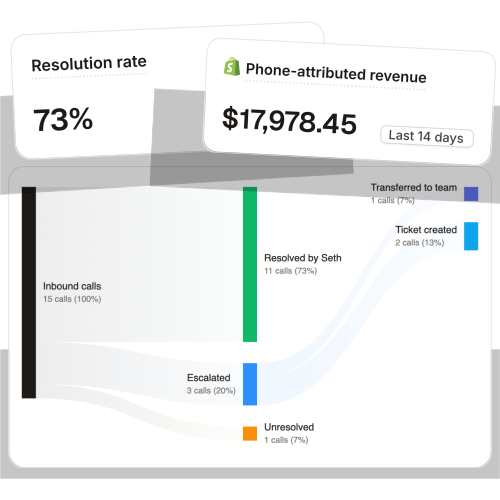
For a sense of what "resolve on the call" looks like in practice: across the 50+ Shopify brands we run phone support for, the AI handles about 73% of inbound calls end to end, no human touch. The other 27% gets a clean handoff. The point isn't the number, it's that the call ended instead of moving to a queue.
The four types of IVR
Not all IVR is the maze you're dreading. There are four flavors, roughly in order of how natural they feel to the caller.
- Touch-tone (DTMF). The oldest and most reliable. Every option maps to one digit. No speech-recognition errors, but rigid. You can only fit so many things into "press 1 through 9."
- Directed dialogue. The caller speaks, but only from a short script. "Say billing, sales, or support." More human than pressing keys, and the small word list keeps errors low.
- Natural language. Uses speech recognition and basic natural language processing to handle an open question. "How can I help you today?" The caller talks in their own words and the system tries to read intent.
- Conversational AI. The newest generation. It replaces the menu tree entirely with real back-and-forth dialogue, follows a caller who changes direction mid-call, and aims to complete the task rather than route it. This is what most people now mean when they say "voice AI."
The first two manage the call. The last two try to handle it. That's the line that matters for a store deciding what to put on its phone number.
How I looked at what IVR actually does on a DTC call
I'm Ruben, co-founder of Ringly. I didn't write this from a glossary. Here's how I pressure-tested what IVR really does for an online store.
- I dialed real DTC lines after hours. I called a batch of Shopify brands after 9 p.m. with the same question ("where's my order") and logged what each system did: menu, voicemail, dead air, or an actual answer.
- I timed the menu trees. I counted how many prompts it took to reach a human, and how often a wrong keypress dumped me back to the start.
- I pulled real resolution data. I looked at the call logs across the 50+ Shopify brands on Ringly to see which question types actually get resolved on the line versus transferred.
- I checked the five questions. I tested whether each system could answer the five things a DTC caller almost always wants: order status, returns, in-stock, shipping time, and changing an order.
The takeaway from all of it: almost nobody's after-hours line answered the question. They sorted it, or they took a message. That's the gap most "what is IVR" articles skip, because they're describing the technology, not what it does to your customer at 11 p.m.
What IVR is good at
IVR earns its reputation for a reason. Used well, it does real work.
- Handles volume. One menu can take hundreds of simultaneous calls. No hold music, no "all our reps are busy," no extra hire when a campaign spikes.
- Covers after-hours. The phone keeps working at 2 a.m. and on weekends, when your CS team is offline and the calls would otherwise roll to voicemail.
- Answers the repeatable stuff. Order status, store hours, return policy, the same questions over and over. FAQ-style calls handled by automation can run far cheaper than a live agent.
- Routes accurately. When it can't finish a call, a good IVR at least sends it to the right person with context attached, instead of bouncing the caller around.
- Stays consistent. It reads the policy the same way every time. No bad-Monday tone, no improvising.
The brands that get value from IVR treat it as a way to remove repeatable calls, not just sort them. If your loaded cost per rep is around $4,000 a month and 70% of your calls are the same five questions, the math on automating those calls gets obvious fast.
Where IVR frustrates customers
Here's the honest part. IVR has a bad name, and a lot of it is earned.
The menu maze is the main offender. Too many options, options that don't match what you're calling about, a wrong keypress that sends you back to the top. Ipsos found that 88% of people would rather talk to a human for a service issue, and Gartner has put the share of consumers who'd prefer companies skip AI for support at 64%. Those numbers aren't a vote against automation. They're a vote against bad automation, the kind that traps you in a tree and never lets you out.
The other failure is nuance. A rigid menu can't handle "my order shipped to my old address and I need it rerouted before tomorrow." It wasn't built to. So the call either dead-ends or transfers, and now the customer is annoyed before a human even says hello.
This is the bar the newer systems have to clear, and it's a high one. The compliment we hear most from our customers' callers is that they didn't realize they were talking to AI.
"My customers also feel like it's a normal person. They feel like they can communicate if they have questions."
Claudia Droge, TechCraft Studio
Frustration with IVR is almost always a design problem, not a technology problem. A short path to the answer, an easy way to reach a human, and a system that can actually finish the call fixes most of it.
What IVR means for a Shopify brand
A bank needs a nine-branch phone tree. Your store doesn't. A DTC brand gets the same handful of calls on repeat, and they're almost all answerable without a human.
Where's my order. Can I return this. Is this back in stock. When will it ship. Can I change my order before it goes out. That's the bulk of it. WISMO calls ("where is my order") alone run 30-40% of support tickets in normal periods and over half at peak, per Salesforce. For a higher-AOV store, phone volume climbs with order value, so the calls aren't going away on their own. It's the same load that pushes brands toward dedicated ecommerce phone support in the first place.
So the real question for an operator isn't "do I need IVR." It's whether the thing on your phone number can answer those five questions, or whether it just routes them to a rep who answers them for the hundredth time that week.
Here's the cost of routing instead of resolving, with round numbers:
| Line item | Today | With AI phone support |
|---|---|---|
| 6 reps × $4K loaded per rep | $24,000/mo | n/a |
| AI phone support (illustrative) | n/a | ~$5,000/mo |
| Net monthly CS spend | $24,000/mo | $5,000/mo |
| Monthly savings | n/a | $19,000/mo |
| Annual savings | n/a | $228,000/yr |
That's roughly 70% of repeatable calls handled without a human, with the genuinely complex 30% still going to your team. WashCo, a Shopify brand we launched, recovered $22,664 in its first 7 days on the phone, much of it from calls that would otherwise have hit voicemail. If you want to see the version of this math for your own call volume, book a 30-min call and we'll run it live.
For the store-level playbook on setting this up, our guide on scaling customer service without hiring goes deeper.
Routing the call vs resolving the call
This is the distinction that decides whether IVR saves you money or just reshuffles the queue.
A routing IVR sorts callers and hands them off. It can reduce wait times and collect a bit of context, but every call still needs a human at the end. Your payroll line doesn't move. A resolving system finishes the call: it reads the order out of Shopify, processes the return, answers the product question from your knowledge base, and only escalates the calls that truly need a person.
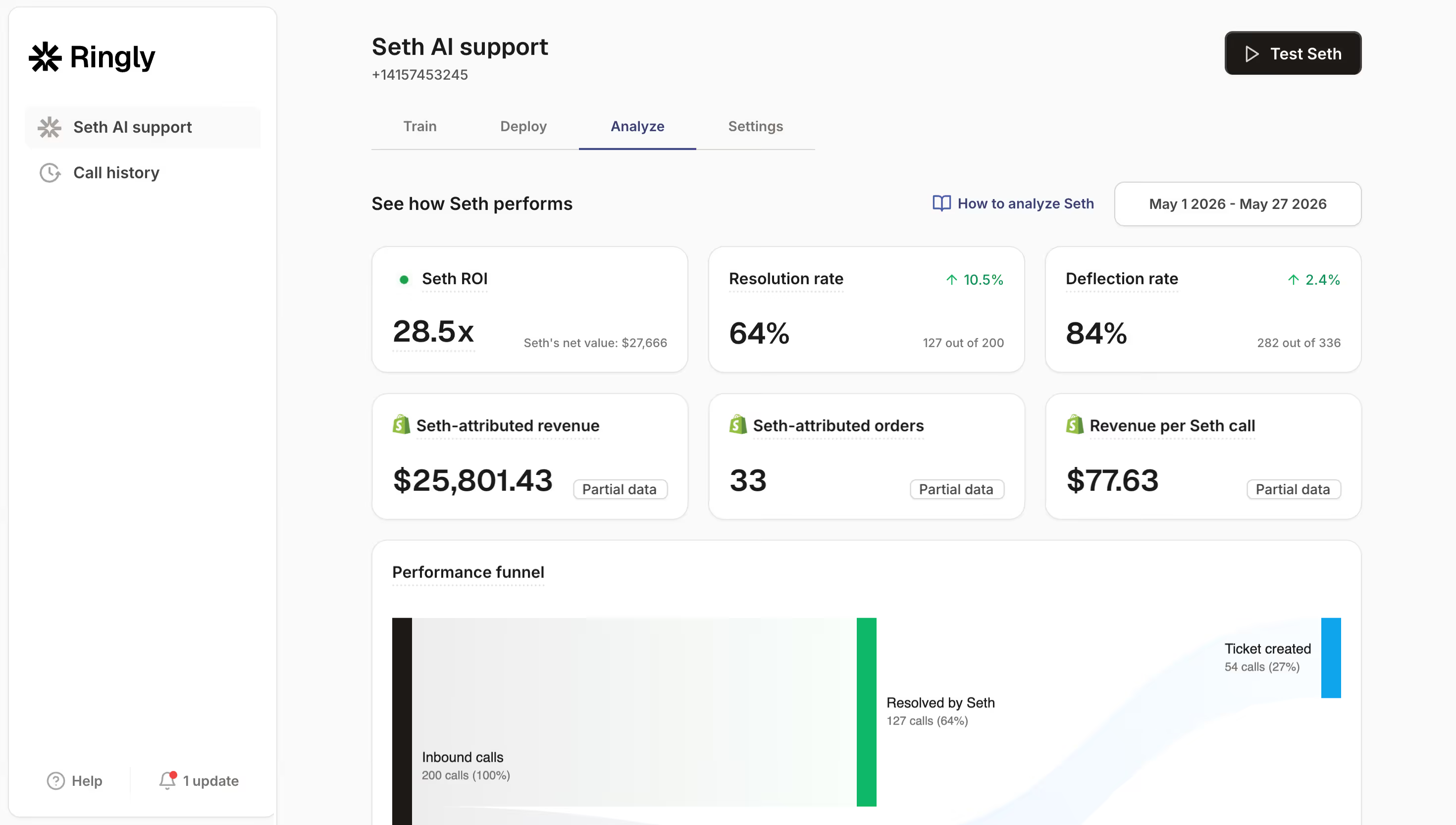
That second category is where Ringly sits, and it's why we don't really describe ourselves as a menu system. Ringly is AI phone support for Shopify brands. It answers inbound calls 24/7, finds orders in your store, processes returns and exchanges, answers product questions from your knowledge base, and rescues abandoned carts. Across 50+ brands it resolves about 73% of calls on its own at roughly $0.42 per resolved call, versus $7 to $16 per call for human BPO. Calls that need a human escalate cleanly to Gorgias, Richpanel, or whatever helpdesk you already run.
It connects to your order-status lookup so the most common call answers itself, and it pairs with the kind of 24/7 ecommerce phone coverage that a voicemail box can't match. Plans run Grow at $349/mo and Pro at $799/mo (full pricing here), with a 65% resolution guarantee: if it resolves under 65% of your calls in 90 days, we refund the last three months.
How to get started with IVR
If you're setting up a phone system for a Shopify store, the order of operations matters more than the brand of software.
- List your five questions. Pull a week of calls. You'll see the same handful: WISMO, returns, stock, shipping, order changes. That list is your spec.
- Decide route vs resolve. A touch-tone menu that routes is cheap and predictable. A conversational system that resolves costs more but takes calls off your team's plate. Pick based on whether you want to sort calls or remove them.
- Connect it to Shopify and your helpdesk. A phone system that can't see the order can't answer "where's my order." Integration is the whole point.
- Set clean escalation rules. Decide which calls always go to a human (an angry customer, a complex address change) and make that path one step, not five.
- Measure resolution, not routing. Track the percentage of calls that end without a human, not just how fast you sorted them. That's the number that moves your payroll.
A reasonable starting place for the ecommerce-specific version is our breakdown of AI voice agents for ecommerce and the AI receptionist for ecommerce overview.
Frequently asked questions
What is IVR and how does it work? IVR (interactive voice response) is an automated phone system that greets a caller, presents options, and acts on keypad or voice input. It either routes the call to the right department or completes a task like an order lookup on its own.
What's the difference between IVR and an auto-attendant? An auto-attendant is a simple menu that only routes calls ("press 1 for sales"). IVR is broader: it can also collect input and complete self-service tasks like checking an order or taking a payment, without transferring to a person.
What are the disadvantages of IVR? Poorly designed IVR frustrates callers with long menus, dead-ends, and no easy path to a human. Rigid systems also can't handle nuanced requests. Surveys show most people would rather talk to a person when the menu gets in the way, which is a design problem more than a technology one.
Is IVR the same as a chatbot? No. A chatbot handles text on a website or in a messaging app. IVR handles voice on a phone call. Some modern systems use the same underlying AI for both, but the channel and the caller's expectations are different.
How much does an IVR system cost? Basic IVR is often bundled into a phone or helpdesk plan for a few dollars per user per month. AI-driven phone support that resolves calls runs higher: Ringly starts at $349/mo for the Grow plan. Per resolved call, automation can be far cheaper than a live agent.
Is IVR still used in 2026? Yes, and the market is still growing, forecast to reach about $7 billion by 2030. What's changing is the type: rigid touch-tone menus are giving way to conversational systems that resolve calls instead of just routing them.
Does IVR work with a Shopify store? It can, but only if it's connected to your store data. A phone system that can read orders from Shopify can answer WISMO and process returns on the call. One that can't is limited to routing.
Talk to us

If your phone line still routes callers into a menu instead of answering them, a 30-minute call is the fastest way to see what that's costing you after hours. We'll pull your recent missed calls and show you which ones an AI could have resolved on the spot.
The 3-layer guarantee.
- Live in 14 days or it's free until launched.
- 65% resolution in 90 days or we refund the last 3 months of subscription fees.
- We keep working free until we hit it.
Ruben (Ringly co-founder) takes these calls personally.