

The short version.
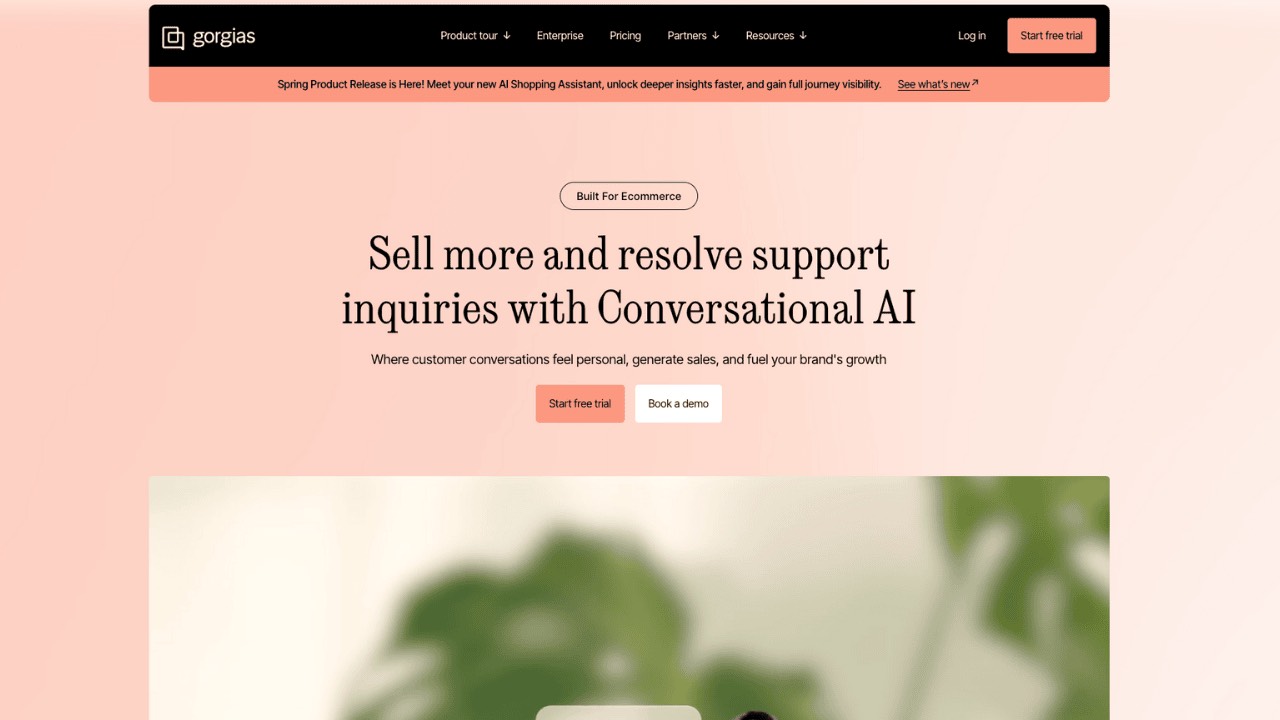
- Gorgias is the ecommerce helpdesk a lot of Shopify brands run their support on. It pulls email, chat, SMS, and social into one inbox and lets agents take real Shopify actions (refunds, edits, order lookups) from the ticket, with an AI Agent that handles the repetitive text questions.
- Pricing is per ticket, not per seat. The catch most teams miss: each AI resolution costs roughly $0.90 to $1.00 and also counts as a ticket, so the bill can climb at volume.
- If you run a $10M to $100M Shopify brand with a busy email and chat queue, Gorgias is a strong fit. The one thing it doesn't really do for you is the phone line, and that's the gap worth knowing about before you commit.
Quick disambiguation first, because the search results are a mess. If you typed "what is Gorgias about" looking for the Plato dialogue, that's a Socratic conversation about rhetoric and justice from around 380 BCE, and you want a philosophy site, not this page. Everyone else, the kind of person running customer support at a Shopify brand, is asking about the software. That's what this guide covers.
Gorgias is a customer support helpdesk built specifically for ecommerce. It's the tool a Founder, COO, or Head of CX at a growing Shopify brand reaches for when the email and chat queue gets too big to run out of a shared inbox. If you're weighing it up and want a second opinion grounded in real Shopify support data, book a 30-min call and we'll talk through your case. Below is the honest read on what it does, what it costs, who it fits, and the one place it stops short.
The short answer: what Gorgias actually is
Gorgias is an ecommerce helpdesk. It takes every customer conversation coming in from email, live chat, SMS, and your social channels and puts them in one shared inbox, so your support team isn't bouncing between five tabs to answer one customer.
The thing that makes it different from a generic helpdesk is how deep it goes into Shopify. When a ticket comes in, your agent sees the customer's full order history right next to the message, and they can issue a refund, cancel or edit an order, or check inventory without ever leaving the screen. On top of that sits an AI Agent that answers the routine stuff (order status, returns, simple product questions) on its own.
Gorgias says it powers around 40% of Shopify brands and that its AI is trained on more than a billion support conversations (Gorgias). Take the 40% figure as marketing, but the point underneath it is real: this is a tool built for one job, supporting online stores, and it's one of the most widely used ecommerce helpdesk tools in the Shopify world.
So when someone asks "is Gorgias a CRM?", the answer is no. It's a helpdesk, not a full CRM. It manages support conversations and the actions attached to them, it doesn't manage your whole customer lifecycle the way a sales CRM would.
What Gorgias does, channel by channel
The pitch is "one omnichannel inbox," and that's a fair description. Here's what actually lands in it.
- Email and live chat. The two channels most brands start with. Live chat sits on your storefront and feeds the same inbox as email.
- SMS, WhatsApp, Instagram, Facebook, and TikTok. DMs and comments from your social channels become tickets, so a complaint on an Instagram post doesn't get lost.
- Phone, through the Gorgias Voice add-on. You can make and receive calls inside the helpdesk, and each call shows up as a ticket. More on this one below, because it's the part people get wrong.
Where Gorgias earns its keep is the Shopify actions attached to each ticket. Your agent can refund an order, edit a shipping address, or check stock from inside the conversation, instead of opening the Shopify admin in another tab. It connects to 300+ apps too (Klaviyo, Recharge, Yotpo and the rest), so the data a rep needs is usually already on the screen.
Then there's the automation layer:
- Macros. Canned replies that auto-fill the customer's name, order number, or tracking link, so a rep answers "where's my order" in two clicks instead of typing it out.
- Rules. If-this-then-that logic that auto-tags, assigns, or auto-replies to tickets based on what they contain.
- The AI Agent. This is the piece Gorgias leans on hardest now. It answers common questions end to end (order status, returns, product questions), works pre-sale and post-sale, and escalates to a human with the full context when it hits something it can't handle. You can read more about what the Gorgias AI Agent does if you want the detail.
One honest note on the AI: Gorgias markets it as automating around 60% of support, but published case studies tend to land in the 26% to 56% range in practice. Good, not magic. Plan around the lower end.
Customers rate the whole package well. Gorgias holds 4.6 out of 5 on G2 across 800+ reviews and 4.7 out of 5 on Capterra across 600+ reviews (G2, Capterra). For text-channel ecommerce support, it's genuinely one of the best tools out there. The full Gorgias feature set goes deeper than we can here.
How much Gorgias costs, and the catch most teams miss
Gorgias bills by ticket volume, not by seat. That's the headline, and it's a genuinely nice model: you can add as many agents as you want without your bill going up. You pay for conversations, not for people.
Here are the plans (billed annually, approximate):
| Plan | Price | Monthly tickets | Overage |
|---|---|---|---|
| Starter | $10/mo | 50 | $0.40/ticket |
| Basic | $60/mo | 300 | ~$40 per 100 tickets |
| Pro | $360/mo | 2,000 | ~$36 per 100 tickets |
| Advanced | $900/mo | 5,000 | ~$36 per 100 tickets |
| Enterprise | Custom | Custom | Custom |
Source: published 2026 pricing breakdowns (eesel, Lindy). For the full picture, our Gorgias pricing breakdown keeps current numbers.
Now the catch. The AI Agent isn't included in those ticket counts. It's billed separately, at roughly $0.90 per resolution on annual plans (up to $1.00 monthly), and here's the part that surprises people: each AI resolution also counts as a helpdesk ticket. So one automated answer can hit your bill twice, the per-resolution fee plus a ticket against your monthly allotment. At low volume it's noise. At scale, it's the difference between the price you quoted your CFO and the price you actually pay. One reviewer flagged over $700 in unexpected overage fees. None of this makes Gorgias a bad deal. It just means you should model your real ticket and resolution volume before you sign, not the sticker price.
Who Gorgias is right for, and who it isn't
Gorgias is a great fit for a specific shape of business, and a poor fit for a few others. Being honest about which one you are saves you a migration later.
Choose Gorgias if:
- You run a Shopify or Shopify Plus store with real ticket volume and you want refunds, edits, and order lookups happening inside the support tool, not in a separate Shopify tab.
- Email and chat are your busy channels. If most of your "the same questions over and over" come in as text, this is squarely what Gorgias is built for.
- You want your whole team in the tool without paying per seat. The ticket-based model rewards that.
Look harder if:
- Your real pain is the phone line. Gorgias can attach a phone channel, but phone is not what it's built around (more below).
- You expected the AI to handle almost everything. Plan for 26% to 56% automation on the text channels, not 60%+.
- You want a full CRM. Gorgias manages support, not your entire customer and sales relationship.
If you're comparing it against other tools, our roundup of Gorgias alternatives walks through where each one is stronger.
Where Gorgias stops: the phone channel
Here's the part the rest of the internet gets fuzzy on, so let me be precise.
Gorgias does offer phone. It's a paid add-on called Gorgias Voice. It lets your team make and receive calls from inside the helpdesk, logs each call as a ticket, and gives you transcripts and recordings (Gorgias Voice docs). That's useful. It keeps the call in the same place as the rest of the customer's history.
But Gorgias Voice is a dialer, not a phone agent. It routes a call into a ticket and then hands the phone to one of your reps. There's no AI inside Gorgias that picks up the phone and resolves the call end to end the way the AI Agent does for chat and email. The phone still costs you a human, every call, every time.
For a lot of brands that's fine. For a brand with a visible phone number on its site, it's the expensive part of the queue. Phone calls are where "where's my order" turns into a 5-minute hold, and the numbers around that are ugly: WISMO is 30% to 40% of support tickets in normal periods and over 50% at peak (Salesforce), and 85% of callers who can't reach a person never call back, with 62% switching to a competitor (PCN). After 6pm, those calls roll to voicemail and most never get returned.
This is the gap we live in. We run AI phone support for 50+ Shopify brands, and on the phone channel we sit in front of Gorgias, so we see exactly where its Voice add-on stops. The AI takes the call, resolves the routine ones, and only the calls that actually need a person get escalated into your Gorgias inbox with the context attached. WashCo, a Shopify brand we launched, recovered $22,664 in its first 7 days on the phone.
If your phone line is the part of support that's leaking, book a 30-min call and we'll look at what your store is missing after hours.
How an AI phone agent fits alongside Gorgias
To be clear, this isn't a "replace Gorgias" pitch. Gorgias is good at what it does, and if it's running your email and chat well, keep it. The point is that the phone is a different problem, and it's worth solving with a tool built for it.
Ringly.io is AI phone support for Shopify brands. Instead of paying a rep to answer every call, the AI handles inbound calls 24/7. It finds orders in your Shopify store, processes returns and exchanges, answers product questions from your knowledge base, and rescues abandoned carts with an outbound follow-up. The calls that need a human escalate cleanly into Gorgias, Richpanel, Reamaze, or whatever helpdesk you already run. You keep your number, your helpdesk, and your workflows. You add an AI that takes the routine calls off your team.
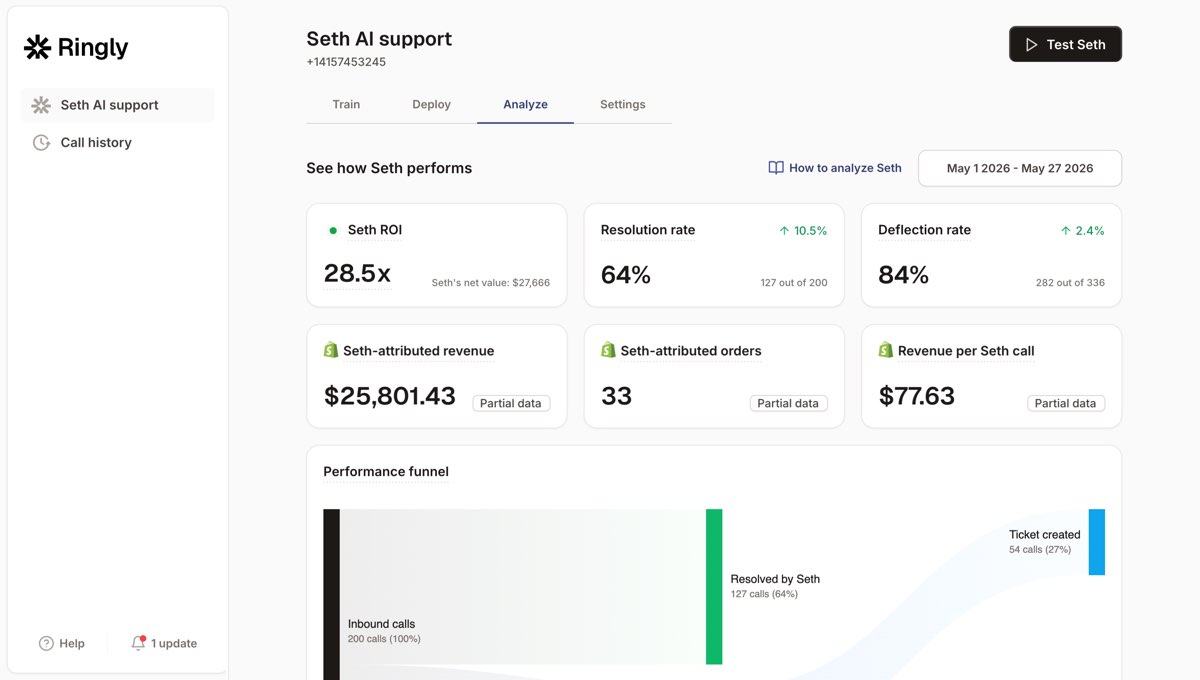
Across 50+ brands, the AI resolves 73% of inbound calls on its own at roughly $0.42 per resolved call, versus the $7 to $16 per call a human BPO runs. It goes live in under an hour, and there's a 65% resolution guarantee: if it resolves under 65% of your calls in 90 days, we refund the last 3 months.
"My customers also feel like it's a normal person. They feel like they can communicate if they have questions."
Claudia Droge, TechCraft Studio
The math is simple enough to do on the back of an envelope. A typical $50M Shopify brand running a 6-rep CS team spends about $24,000 a month on loaded payroll. Route the routine phone and text calls to AI and keep the genuinely hard ones with your team, and that line drops to around $5,000, a net save in the region of $19,000 a month. Your reps stop answering the same five questions all day. They get the calls that actually need them.
If you want to see your own version of that number, book a 30-min call and we'll talk through your case. You can also keep reading on AI phone agents for Shopify and 24/7 ecommerce phone support, or look at how the AI handles order status and knowledge base questions.
How Gorgias compares to the other tools people weigh it against
If you're asking what Gorgias is about, you're probably also asking what it's not, which usually means comparing it to the two other names that come up.
Gorgias vs the generalist helpdesks. Zendesk and Intercom are broad support platforms built to serve any kind of business. Gorgias is narrower on purpose. It's built for ecommerce, so the Shopify actions, the revenue attribution, and the order context are native instead of bolted on. If you run a Shopify store, that narrowness is the feature, not the limitation. If you're a SaaS company or a services business, one of the generalists usually fits better.
The one thing none of them solve. Every one of these tools, Gorgias included, is excellent at text and average-to-thin on phone. They all treat the phone as a channel you staff with people. That's the consistent blind spot across the category, and it's why a brand with a real phone line ends up running a helpdesk for chat and email plus a separate answer for voice. Knowing that upfront is most of what "what is Gorgias about" actually comes down to: it's the best text helpdesk for Shopify, and the phone is a question you solve elsewhere.
Frequently asked questions
Is Gorgias a CRM or a helpdesk? Gorgias is a helpdesk, not a CRM. It manages support conversations across email, chat, SMS, and social, and the Shopify actions attached to them. It doesn't manage your full sales and customer lifecycle the way a sales CRM does.
Does Gorgias work with Shopify? Yes, and it's its strongest integration. Agents can issue refunds, edit or cancel orders, and check inventory from inside the ticket. It also supports Magento, BigCommerce, and WooCommerce, but Shopify is where the integration goes deepest.
Does Gorgias offer phone support? Yes, through a paid add-on called Gorgias Voice. It lets your team make and receive calls inside the helpdesk, logged as tickets. It's a dialer staffed by your reps, though, not an AI that resolves calls on its own, so the phone still costs you a person on every call.
How much does Gorgias cost? Plans run from $10/mo (Starter, 50 tickets) up to $900/mo (Advanced, 5,000 tickets), billed by ticket volume rather than per seat, with Enterprise custom. The AI Agent is billed separately at roughly $0.90 per resolution, and each AI resolution also counts as a ticket, so model your real volume before you commit.
How much does the Gorgias AI Agent actually automate? Gorgias markets around 60% automation, but published case studies usually land between 26% and 56% on the text channels. It's a real productivity gain, just plan around the lower end rather than the marketing number.
Who is Gorgias built for? DTC and Shopify brands with medium-to-high text ticket volume that want refunds, edits, and order lookups happening inside the support tool. It's a strong fit if email and chat are your busy channels.
Do I still need a separate phone solution if I use Gorgias? If you have a visible phone number and real call volume, usually yes. Gorgias Voice routes calls but still needs a human on the line. An AI phone agent like Ringly handles the routine calls on its own and escalates the rest into Gorgias.
Talk to us

If you run a $10M to $100M Shopify brand on Gorgias and the phone line is the part of support that's still costing you a full team, a 30-min call is the fastest way to see what you're leaving on the table after hours.
The 3-layer guarantee.
- Live in 14 days or it's free until launched.
- 65% resolution in 90 days or we refund the last 3 months of subscription fees.
- We keep working free until we hit 65%.
Ruben (Ringly co-founder) takes these calls personally.