
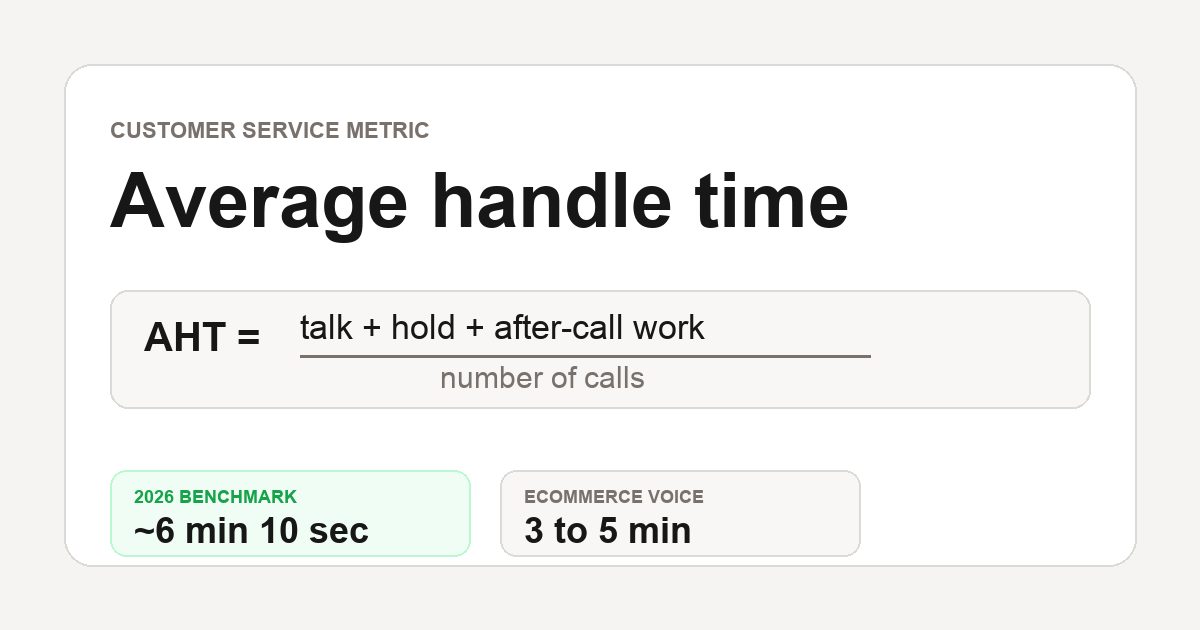
Average handle time (AHT) is the average total time it takes to handle one customer interaction from start to finish. For phone, that's talk time plus hold time plus after-call work, divided by the number of calls handled. The 2026 cross-industry benchmark sits around 6 minutes 10 seconds, but a good ecommerce voice AHT is closer to 3 to 5 minutes.
This post in 30 seconds.
- AHT = (talk time + hold time + after-call work) ÷ number of calls. The after-call work is the piece most teams forget to count.
- The 2026 cross-industry benchmark is roughly 6 minutes 10 seconds; ecommerce voice runs 3 to 5 minutes. There's no single right number, it shifts up to 20% by issue.
- Lowering AHT by rushing reps backfires. The real win is taking the routine calls off the human queue entirely, which is what a $10M to $100M Shopify brand should actually be chasing.
If you run a Shopify brand doing $10M to $100M, AHT is one of those numbers your CFO or your helpdesk dashboard throws at you without much context. You know your reps are drowning in calls, you know a lot of them are the same questions over and over, and you suspect the phone is quietly eating a chunk of payroll. Average handle time is the metric that tells you how heavy each of those calls really is.
Here's what it measures, the exact formula, what counts as good in 2026, and the honest version of how to bring it down without making your customers feel rushed off the line.
Most $25M+ Shopify brands we work with have a 5 to 8 person CS team and a phone line that goes to voicemail after 6 p.m. We've launched AI phone agents for 50+ of them to fix exactly that. Book a 30-min call and we'll pull your real call data and show you where your handle time is actually going.
What average handle time actually measures
Average handle time is the average length of a complete customer interaction, measured agent-side, not just the part where someone is talking.
For a phone call, it's built from three pieces:
- Talk time. The live conversation between the rep and the customer. This is the obvious part, and the part most people assume is the whole metric.
- Hold time. Any stretch where the customer is on hold while the rep looks something up, checks the order in Shopify, or waits on another system.
- After-call work (ACW). Everything the rep does once the call ends: writing notes, tagging the ticket in Gorgias, updating the order, logging the reason code. This is the piece teams forget, and it's often where the minutes hide.
The after-call work is the silent half of average handle time, and it's the part you can shrink the fastest. A rep who spends three minutes on the phone and three minutes writing it up has a six-minute AHT, even though the customer only experienced half of that.
If you run support across channels, the same idea applies with different parts. For chat, talk time becomes active handling time and ACW becomes after-chat work. For this guide we're staying on the phone, because phone is where the handle time gets heavy and where most Shopify brands have the least visibility.
The average handle time formula (with a worked example)
The formula is simple, which is part of why it gets misread. Here it is the way NiCE and Zendesk both state it:
AHT = (total talk time + total hold time + total after-call work) ÷ total number of calls handled
Plug real numbers in and it's obvious. Say one of your reps logs the following over a shift:
| Component | Time logged |
|---|---|
| Total talk time | 100 minutes |
| Total hold time | 11 minutes |
| Total after-call work | 20 minutes |
| Calls handled | 20 |
| Average handle time | 6.55 minutes |
131 minutes of total handling time, divided across 20 calls, gives you an AHT of 6.55 minutes per call. That's it. The math never gets harder than that.
The trap is what you leave out. If your reporting only counts talk time, your AHT looks great and your team still feels buried, because the hold time and the wrap-up are real work that your number is pretending doesn't exist. Count all three or the metric lies to you.
This is usually the moment a founder realizes the phone backlog isn't a staffing problem, it's a measurement problem stacked on a volume problem. If that's where you are, book a 30-min call and we'll do the breakdown on your real numbers.
What is a good average handle time? 2026 benchmarks by industry
There's no universal "good" AHT, which is the first thing to accept. A complex insurance claim should take longer than a "where's my order" call, and pretending both should hit the same target is how teams end up gaming the metric.
That said, here's where the 2026 benchmarks land:
| Sector | Typical voice AHT (2026) |
|---|---|
| Cross-industry average | ~6 min 10 sec |
| Retail / ecommerce | 3 to 5 min |
| Healthcare (routine) | 3 to 6 min |
| Tech support | 7 to 10 min |
| Insurance | 7 to 10 min+ |
| Often-quoted "good" range | 5 to 8 min |
The cross-industry figure of roughly 6 minutes 10 seconds comes from Sprinklr's contact-center data, surfaced in Kayako's 2026 industry-standard analysis. For ecommerce voice specifically, the same data puts the realistic range at 3 to 5 minutes, because retail calls skew toward order status, returns, and quick product questions rather than long troubleshooting.
A flat AHT target across every call type is the single most common way teams break this metric. Handle time can swing up to 20% depending on the nature of the issue, so a number that's "good" for a WISMO call is unrealistic for an angry escalation, and a number set for escalations gives reps permission to drag out the simple stuff.
For a Shopify brand, the useful read isn't "are we above or below 6 minutes." It's "how much of our volume is the routine 3-minute call, and why is a human still answering it."
"My customers also feel like it's a normal person. They feel like they can communicate if they have questions."
Claudia Droge, TechCraft Studio
Why AHT alone is a trap
Average handle time is an efficiency number, not a success number, and the two get confused constantly.
You can make AHT look fantastic tomorrow by telling reps to rush. They'll cut calls short, skip the second question, and your dashboard will glow. Then your first-call resolution drops, the same customer calls back two days later, and your CSAT takes the hit. You didn't get more efficient. You moved the work three days into the future and made the customer angrier on the way.
This is why AHT only means something when you read it next to two other numbers:
- First-call resolution. Did the issue actually get solved on that call, or did a low AHT just push it into a callback?
- CSAT. Did the customer feel handled, or processed?
A 4-minute call that resolves the issue and leaves the customer happy beats a 2-minute call that creates a second call. Lower AHT is only a win when FCR and CSAT hold steady or climb. Read it alone and you'll optimize yourself straight into a worse support operation. AHT belongs on the same dashboard as your other ecommerce customer-service KPIs, never on its own.
How to lower average handle time without wrecking service
Once you've made peace with the fact that speed isn't the goal, there are real, safe ways to bring handle time down. Most of them come from removing friction, not from pushing reps.
- Automate the after-call work. Auto-summary and auto-tagging tools write the call notes and tag the ticket so the rep isn't spending three minutes typing after every call. Since ACW is often a third of AHT, this is the fastest clean win.
- Build a real knowledge base. Industry data shows roughly 81% of customers try to resolve an issue themselves before they ever contact support. A strong knowledge base means the basic questions never become calls, which lowers both volume and AHT.
- Give reps live context. When the customer's order and history surface automatically, the rep stops asking for the order number and digging through Shopify mid-call. That alone cuts hold time on most WISMO calls.
- Fix routing. Skills-based routing sends the call to the rep best suited to it, instead of bouncing the customer between people and adding minutes each time.
- Use real-time AI assist. Research on generative AI in support found agent-assist tools lifted productivity around 14%, and surfacing the answer before the rep has to search for it let teams handle materially more conversations per shift.
- Do the wrap-up on the call. Encouraging reps to log notes while still on the line, rather than after, removes ACW from the handle time entirely.
All of that helps. But here's the part that actually moves the number for a Shopify brand at your size.
You don't lower AHT fastest by making humans faster on each call. You lower it by taking the routine calls off the human queue entirely. Order status, returns, the same five product questions, after-hours voicemails nobody returns. Those calls are roughly 70% repeatable, and a human handling them at 4 to 6 minutes apiece is the most expensive way possible to deliver a 2-minute answer.
I pulled the call logs across the 50+ Shopify brands on Ringly, and the pattern is almost identical store to store: the routine call gets resolved by the AI in around two minutes, end to end, and it never touches a rep. Your team keeps the genuinely hard 30%, the calls where a low AHT was never the point.
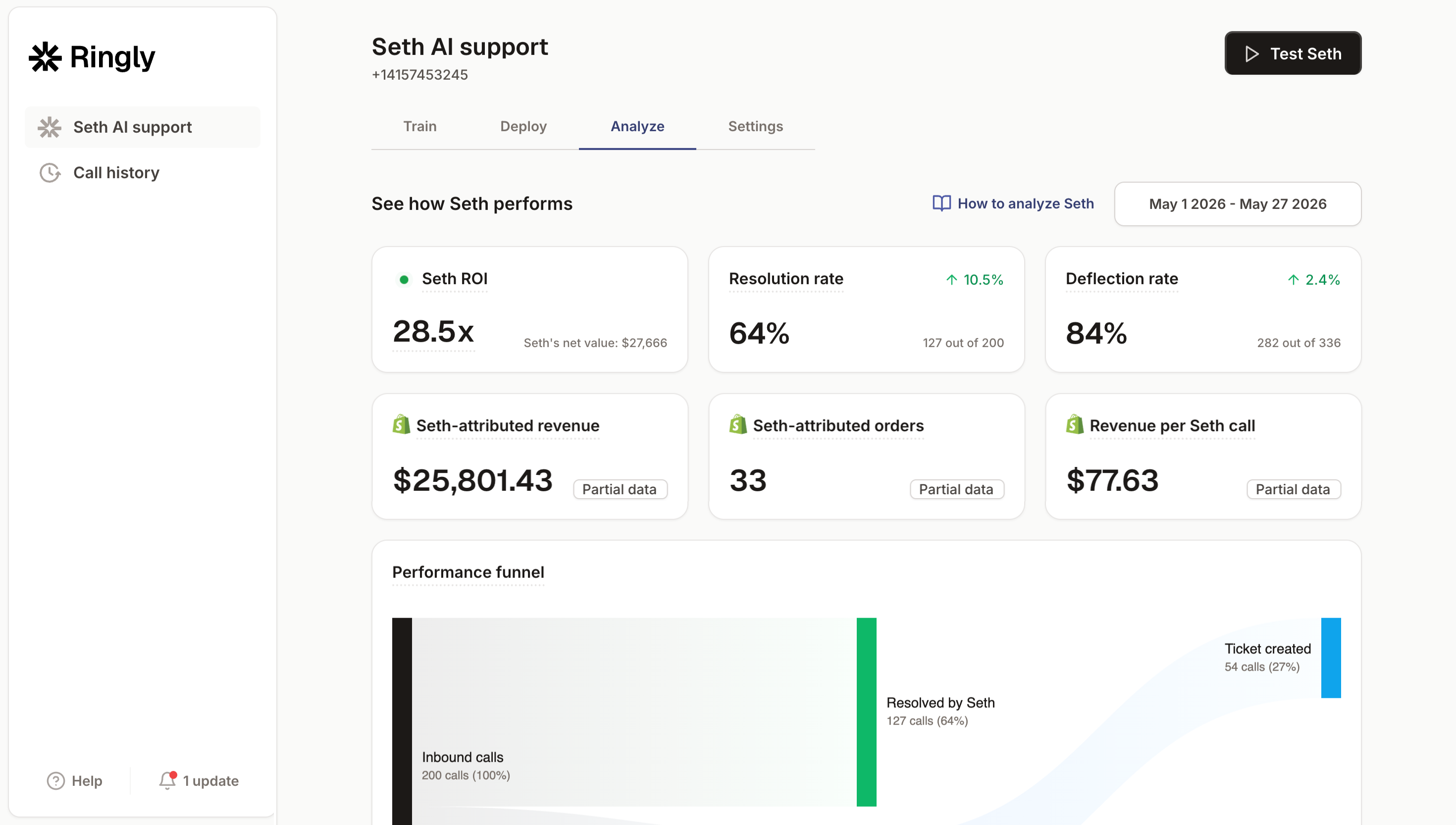
Ringly.io is AI phone support for Shopify brands. The AI answers inbound calls 24/7, finds orders in your Shopify store, processes returns and exchanges, answers product questions from your knowledge base, and rescues abandoned carts. Calls that need a person escalate cleanly to Gorgias, Richpanel, Re:amaze, or whatever helpdesk you already run. Across 50+ brands the AI resolves 73% of calls autonomously at roughly $0.42 per resolved call, versus $7 to $16 per call for human BPO.
WashCo cut their per-call cost to $0.91 versus $2.70 for a human-handled call after launching with Ringly, and generated $22,664 in attributed revenue in the first 7 days, across 271 calls with an 85% deflection rate. BioLongevity, a supplement brand on Ringly, resolves 79% of its calls autonomously.
Here's what that does to the math.
| Line item | Today (6-rep team) | With Ringly |
|---|---|---|
| 6 reps × $4K loaded per rep | $24,000/mo | n/a |
| Ringly (illustrative) | n/a | ~$5,000/mo |
| Net monthly CS spend | $24,000/mo | $5,000/mo |
| Monthly savings | n/a | $19,000/mo |
| Annual savings | n/a | $228,000/yr |
That's roughly 70% of repeatable calls routed to the AI at a 2-minute handle time, with your CS team freed up for the 30% that genuinely need a human. If you want this run on your actual call volume instead of a sample team, book a 30-min call and we'll do the math live.
You can go deeper on the mechanics in our guides to calculating average handle time and average handle time in customer service, or read how brands scale support without hiring and automate WISMO calls on Shopify.
Frequently asked questions
What is included in average handle time? Talk time, hold time, and after-call work (the notes, tagging, and order updates a rep does once the call ends). Some contact centers also fold in conference or transfer time. Talk time alone is not AHT.
What is a good average handle time for ecommerce? Roughly 3 to 5 minutes for voice in 2026, against a cross-industry average near 6 minutes 10 seconds. But the better target is per call type, since a WISMO call and a returns dispute shouldn't share a number.
Is average handle time the same as call duration? No. Call duration is usually just the talk portion. AHT adds hold time and after-call work, so it's almost always longer than the call itself.
What's the difference between AHT and average wait time? Average wait time (or average speed of answer) is how long the customer waits before reaching anyone. AHT starts once the interaction begins. One measures the queue, the other measures the handling.
Does lowering AHT hurt customer satisfaction? It can, if you do it by rushing reps. Cutting calls short drops first-call resolution and CSAT and creates repeat contacts. Lower AHT is only healthy when FCR and CSAT hold or improve alongside it.
How does AI lower average handle time? Two ways. It assists human reps in real time by surfacing the order and the answer so they stop digging mid-call, and more powerfully, it takes the routine calls off the human queue completely so the only calls left are the ones worth a rep's time. See how AI phone agents work for Shopify.
Does Ringly work with my current helpdesk? Yes. Calls that need a human escalate cleanly to Gorgias, Richpanel, Re:amaze, or whatever you already run. You control what escalates and what doesn't.
Talk to us

If you run a $10M to $100M Shopify brand and your phone handle time is climbing while your team burns out, a 30-min call is the fastest way to see what the routine calls are actually costing you and what's left once they're gone.
The 3-layer guarantee.
- Live in 14 days or it's free until launched.
- 65% resolution in 90 days or we refund the last 3 months of subscription fees.
- We keep working free until we hit 65%.
Ruben (Ringly co-founder) takes these calls personally.