
This post in 30 seconds.
- Getting a virtual phone number takes five minutes and a few dollars. Answering it at 11 p.m. is the part that costs you.
- We cover what a virtual number is, how it works, the four types, and the part the provider pages skip: what happens once that number rings around the clock.
- Built for founders and CX leads at $10M-$100M Shopify brands that already have a number on the site and watch it roll to voicemail after 6 p.m.
You can get a virtual phone number in about five minutes for the price of a coffee. Pick a provider, pick a number, point it at your phone. Done.
The hard question is the one nobody on the first page of Google answers: what happens when that number rings at 11 p.m. on a Tuesday? If you run a $10M-$100M Shopify brand, you already have a number sitting in your site footer. The problem was never getting one. The problem is that it rolls to voicemail after hours, and the voicemails you never return are quietly sending callers to a competitor.
So this is two guides in one. First, the straight answer: what a virtual phone number is, how it works, the types, and how to get one. Then the part the VoIP companies leave out, because they sell you the number and walk away.
Most of the brands we work with run a small support team and a phone line that goes quiet after 6 p.m. We've launched AI phone agents for 50+ Shopify brands to fix exactly that, and the missed calls always cost more than anyone guessed. Book a 30-min call and we'll show you what your after-hours line is leaving on the table.
What a virtual phone number actually is
A virtual phone number is a phone number that lives in the cloud instead of being wired to one device, SIM card, or physical line. You can answer it on a mobile app, a laptop, a tablet, or a desk phone, all under one business identity.
The number is software, not hardware, which is why you can hold a number in any area code without setting foot there. A traditional landline ties a number to a copper line at a fixed address. A virtual number ties it to an account, so where you physically sit stops mattering.
That term gets searched about 8,600 times a month, and most of the people searching it are picking a provider for the first time. If you already have a number, the definition matters less than what you do with it. We'll get there.
How a virtual phone number works
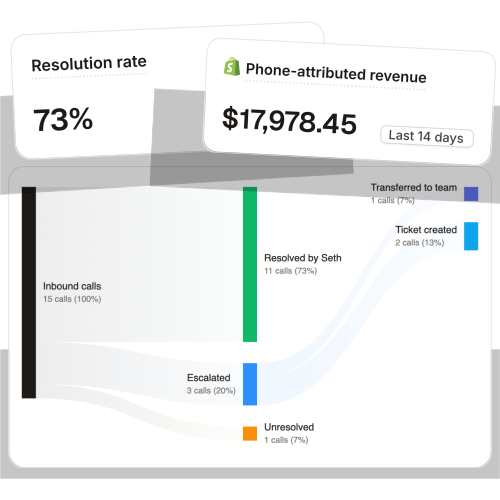
Under the hood, a virtual number runs on VoIP, which stands for voice over internet protocol. Instead of sending your voice down a phone line, it turns the audio into small data packets, ships them over the internet, and rebuilds them into sound on the other end. It happens fast enough that nobody on the call notices.
Here's what that buys you in practice:
- Answer anywhere. A call to your business number can ring a desk phone, a laptop, and three people's cell phones at once, or in sequence.
- Routing rules. You decide what happens to a call: ring the team, send to voicemail, forward to an after-hours line, or hand it to something that answers automatically.
- Keep your number. Most providers let you port an existing number in, so you don't lose the one already printed on your packaging.
- No hardware. No PBX box in a closet. The "phone system" is an app.
The routing layer is where the real decisions get made, because routing a call and answering a call are two very different things. A virtual number is great at moving a call around. It does nothing to actually resolve what the caller wanted.
That distinction trips up a lot of operators. The pitch you read on a provider's homepage is mostly about the move: forward to any device, ring multiple people, send to a transcribed voicemail. All useful. None of it answers the order-status question the caller actually phoned in about. The number is a switchboard, not a person. Once you internalize that, the rest of this guide reads differently, because every feature a virtual number adds is a smarter way to route a call you still haven't answered.
The types of virtual phone numbers
There are four common types, and which one you pick depends on the impression you want to make and where your customers are.
| Type | What it is | Best for | Rough cost |
|---|---|---|---|
| Local | A geographic area-code number | A local feel in a market where you have no office | ~$1-$5/mo |
| Toll-free | An 800, 888, 866, or 877 number, free to the caller | A national support line that feels established | ~$5-$17/mo |
| Vanity | A number that spells a word, like 1-800-FLOWERS | Memorability and brand recall | $5-$30 one-time or a few dollars a month |
| International | A country-specific number | Selling into another country with a local presence | Varies by country |
For most $10M-$100M Shopify brands, a toll-free number is the default, because it reads as a real company and the caller isn't paying to reach you. Some brands run a local number on top to feel approachable in a key market. The mechanics are identical. The only thing that changes is the prefix and the impression.
Virtual vs traditional phone numbers
If you're weighing a virtual number against a traditional landline, the gap is wide on cost and flexibility. It's narrower on the thing that actually matters, which is whether anyone picks up.
| Traditional landline | Virtual number | |
|---|---|---|
| Setup cost | Hardware + install | An app and a few dollars |
| Tied to a location | Yes | No |
| Answer on any device | No | Yes |
| Scale up lines | Slow, physical | Instant |
| Who answers it | A person, in office hours | Still a person, unless you change that |
That last row is the whole point. Switching from a landline to a virtual number makes the number cheaper and more flexible. It does not change the fact that a human still has to be on the other end during the hours you choose to staff. Move to virtual and your 6 p.m. cutoff moves with you.
This is where a lot of brands talk themselves into a false win. They switch to a slick virtual system, get voicemail-to-email and a nice mobile app, and feel like they fixed phone support. What they actually did was lower the cost of the line and add a few conveniences for the team. The customer experience after hours is unchanged: they call, they hit voicemail, and most of them don't leave one. The bill went down. The leak stayed open.
A virtual number is the right foundation. It just isn't the finish line, and the providers ranking for this keyword have no reason to tell you that, because selling you the number is the whole business model.
How to get a virtual phone number
Getting set up is genuinely fast. The steps look the same across providers:
- Pick a provider. Common names include RingCentral, Grasshopper, Dialpad, Nextiva, CloudTalk, and Google Voice.
- Pick a number type. Local, toll-free, vanity, or international, from the table above.
- Choose the number, or port yours in. Search available numbers or move your existing one over so nothing on your packaging breaks.
- Set routing rules. Decide where calls ring, when they go to voicemail, and what your after-hours plan is.
- Test it. Call your own number at 9 a.m. and again at 11 p.m. and see what a customer actually experiences.
On price, the number itself is cheap. A local number runs about $1 to $5 a month. A toll-free number runs about $5 to $17 a month. A full virtual phone system for a team lands around $20 per user per month. Grasshopper starts at $17/mo, Talkroute at $19/mo. None of that is the expensive part.
The expensive part starts on step 5, the minute you call your own number after hours and hear your own voicemail greeting. That's where this guide stops being a setup checklist and starts being about money.
How I pressure-tested what happens after you get the number
I'm Ruben, co-founder of Ringly. We run AI phone support for 50+ Shopify brands, so I look at what happens after the number is live, not just how to get one.
For this guide, here's what I actually did:
- I called the published support lines of a dozen Shopify brands at 11 p.m. on a Tuesday. Most went straight to voicemail. A couple just rang out. One had a full voicemail box.
- I pulled resolution data from our own dashboard across the 50+ brands we run, to see what share of inbound calls get handled without a human.
- I timed the gap between a voicemail being left and a callback going out at a few brands that route after-hours calls to voicemail. The honest answer was usually "next business day," which for a weekend voicemail means Monday.
- I counted how many of those calls were the same handful of questions. Order status, returns, "is this in stock." The repeatable stuff.
None of the provider pages ranking for this term run that test, because their job ends when you buy a number. Mine starts there.
The part the provider pages skip: answering the number
A virtual phone number is a routing tool. It moves a call to a place. Whether that place actually answers and resolves the call is a separate problem, and it's the one that costs real money.
The data on what happens to unanswered business calls is brutal. Businesses answer only 37.8% of their inbound calls; the rest go to voicemail or nothing. And voicemail is not a safety net: 80% of callers routed to voicemail hang up without leaving a message. On hold isn't either, with 60% of callers hanging up within 60 seconds.
Then they don't come back. 62% of callers who can't reach you switch to a competitor, and 78% abandon a brand after a single unanswered call. Every voicemail you never return is a customer you probably lost.
The cruel part is that most of those calls are easy ones, the same questions over and over. WISMO, "where's my order," runs 30-40% of support tickets in normal periods and over 50% at peak. These are calls a knowledge base could answer at 2 a.m. if anything were awake to do it. Want to see the pattern in your own line? Book a 30-min call and we'll walk through your after-hours calls together.
There's a second-order cost too. When the easy calls pile up unanswered, the ones that do get through to your team during the day are a mix of simple and hard, and your reps burn the morning on "where's my order" instead of the genuinely tricky stuff. The repeatable work crowds out the work a human is actually good at. That's how a support team gets to month seven and the best rep quits, not from one hard call but from a thousand identical easy ones.
So you've got a number that rings 24/7 and a team that goes home at 6. The standard fix is to hire a night-shift rep or an answering service. Both work, and both have a problem we'll do the math on next. The other fix is to put something on the line that answers every call, day or night, and only escalates the ones that need a human. WashCo, a Shopify brand we launched, recovered $22,664 in its first 7 days once their number actually got answered around the clock.
What answering a virtual number 24/7 actually costs
Here's the math most operators never run. A virtual number is a few dollars a month. Answering it 24/7 with people is where the budget goes.
Take a typical $50M Shopify brand running a 6-rep support team:
| Line item | Today | With Ringly |
|---|---|---|
| 6 reps × $4K loaded per rep | $24,000/mo | n/a |
| Ringly (~$5K/mo) | n/a | $5,000/mo |
| Net monthly support spend | $24,000/mo | $5,000/mo |
| Monthly savings | n/a | $19,000/mo |
| Annual savings | n/a | $228,000/yr |
That's roughly 70% of the repeatable calls (order status, returns, product questions, the same five things over and over) going to the AI. The other 30%, the genuinely complex ones, still reach your team, who now have time to actually solve them.
Now run the same math on the night shift. Staffing your virtual number after hours with a human means a rep who's idle most of the shift, because after-hours volume is bursty, not steady. You pay the full loaded cost for a few real calls an hour. An answering service is cheaper per hour but reads off a script, can't see your Shopify orders, and ends most calls with "someone will get back to you," which is just a slower voicemail. Replacing a CS rep runs about $14,113 each time, before you count the months of lost productivity while the next hire ramps.
The per-call number tells the same story. A human-handled call runs about $2.70 loaded. Across the 50+ brands we run, a resolved call on Ringly costs about $0.42. You're not paying to own a phone number. You're paying for someone, or something, to pick it up. If you want to compare your current setup line by line, book a 30-min call and we'll do the math live.
How Ringly answers your virtual number
Ringly.io is AI phone support for Shopify brands. You keep your virtual number, your helpdesk, and your workflows. Ringly is the layer that picks up the call.
Instead of hiring a new rep every time call volume climbs, the AI takes the routine inbound calls so your team can focus on the work that moves revenue. It answers 24/7 in 40 languages, finds orders in your Shopify store, processes returns and exchanges, answers product questions from your knowledge base, and rescues abandoned carts with outbound follow-up. Calls that need a person escalate cleanly to Gorgias, Richpanel, Reamaze, or whatever helpdesk you already run.
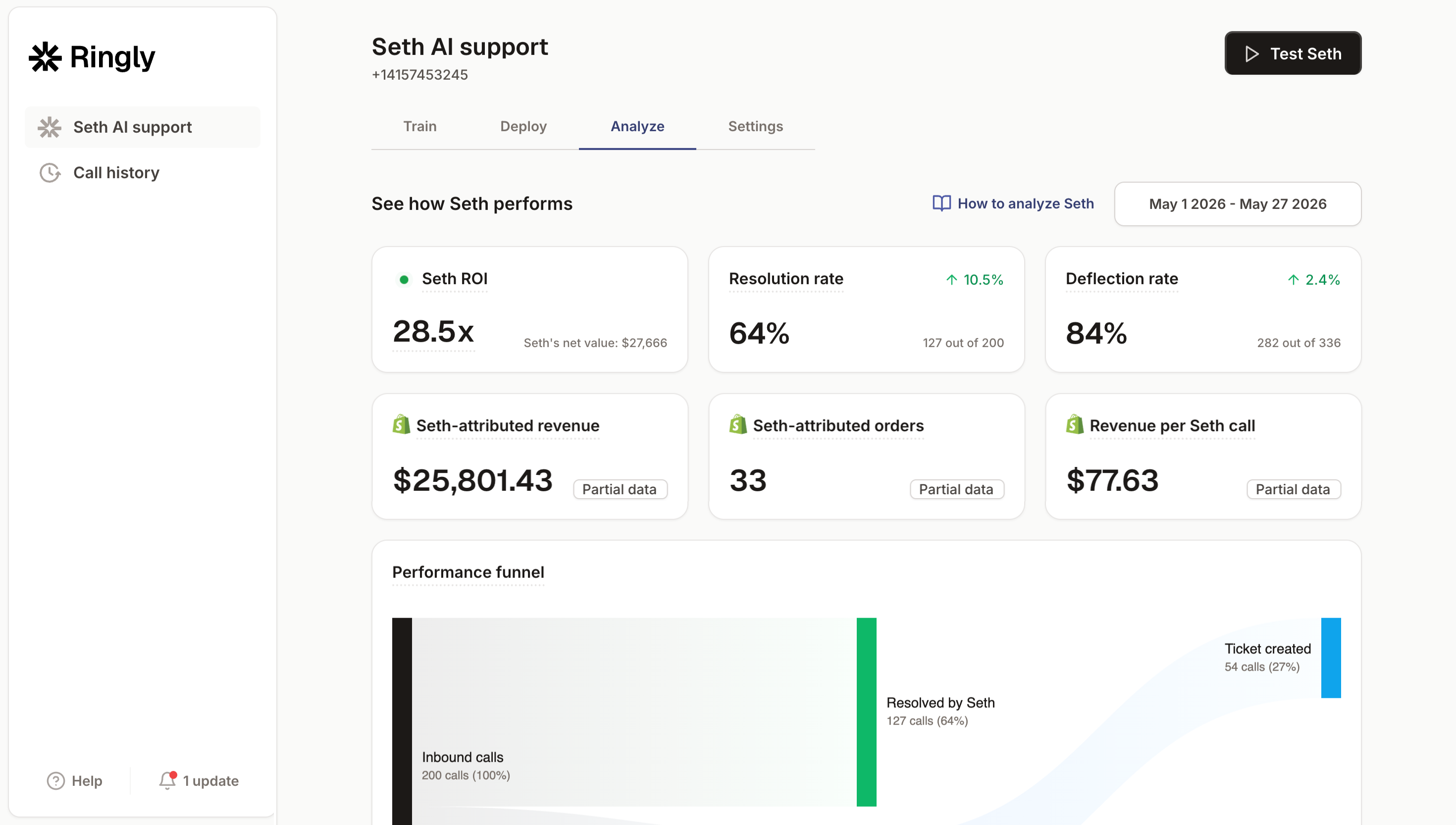
Across 50+ brands, the AI resolves 73% of calls on its own. The most common thing customers say after a call is that it didn't feel like a machine.
"My customers also feel like it's a normal person. They feel like they can communicate if they have questions."
Claudia Droge, TechCraft Studio
Plans are Grow at $349/mo (1,000 minutes), Pro at $799/mo (2,500 minutes), and Enterprise by call. The trial sits on Pro, and you can be live in under an hour. If you've been weighing a virtual receptionist service or an after-hours answering service, this is the same job done by software that already knows your store. It also beats outsourcing customer service on cost and speed, and it's how brands scale support without hiring.
When a virtual number is enough, and when it isn't
Not every business needs more than the number. Here's the honest split.
A plain virtual number is plenty if:
- You're a solo operator or a small team and you can personally answer the line during the hours you publish.
- Your call volume is low and missing the occasional after-hours call isn't costing you real orders.
- Your calls aren't repetitive. If every call is genuinely unique, there's less for software to absorb.
You've outgrown a plain number, and need something answering it, when:
- You're doing $10M+ on Shopify and the phone is a real revenue channel, not a formality.
- 30-40% of your calls are the same questions, mostly order status and returns, and your team is drowning in them.
- Your line goes to voicemail after 6 p.m. and you have no idea what those missed calls are worth.
- You're about to hire CS rep #4, #5, or #6 mostly to keep up with volume, not complexity.
If you're on the second list, the number was never your problem. The answer was. The fastest fix isn't a better number, it's something that picks up every call your virtual number routes and resolves most of them without a human.
Frequently asked questions
Is a virtual phone number free? Some apps offer a free number with limited features, but business-grade numbers run about $1 to $5 a month for local and $5 to $17 for toll-free. The free ones rarely include the routing and call-handling a real store needs. The number is cheap either way. Answering it 24/7 is the actual cost.
Is a virtual phone number the same as VoIP? They're related, not identical. VoIP is the technology that carries the call over the internet. A virtual number is the cloud-based number that rides on that technology. You can't really have one without the other for a modern business line.
Can I get a virtual phone number without a physical address? Yes. That's one of the main reasons businesses use them. You can hold a local number in any area code, or a toll-free number, without an office or address in that region.
Can I keep my existing number? In most cases, yes. Providers let you port an existing number in, so the one already on your packaging, ads, and site keeps working. Confirm portability with the provider before you switch, since a few number types are harder to move.
Local or toll-free for an ecommerce brand? Toll-free is the safe default. It reads as an established company and the caller never pays to reach you. Some brands add a local number to feel approachable in a key market, but the call handling is the same either way.
Is a virtual number reliable enough for a real business? Yes, as long as your internet is solid. Virtual numbers run on the same VoIP technology that powers most modern business phone systems. The reliability question that actually bites brands isn't the number, it's whether anyone answers it after hours.
What's the difference between a virtual number and a virtual receptionist? A virtual number is just the number that receives the call. A virtual receptionist, human or AI, is what actually answers it. You need both. The number routes the call; the receptionist resolves it.
How does a virtual number handle calls after hours? On its own, it sends them to voicemail or a forwarding rule, which is where most revenue leaks out. To actually answer after-hours calls you need a person on a night shift, an answering service, or an AI phone agent that picks up every call and only escalates the hard ones.
Talk to us

If your store's number rings out after 6 p.m., a 30-min call is the fastest way to see what that's costing you. We'll look at your actual after-hours calls, not a generic pitch.
The 3-layer guarantee.
- Live in 14 days or it's free until launched.
- 65% resolution in 90 days or we refund the last 3 months of subscription fees.
- We keep working free until we hit it.
Ruben (Ringly co-founder) takes these calls personally.