
This post in 30 seconds.
- The honest 8: Ringly.io for phone, Gorgias for Shopify chat and email, Intercom Fin for deflection, Zendesk AI for enterprise, plus Siena, Re:amaze, Tidio, and Ada.
- Every "top-rated" list ranks chat and ticket tools. None of them rank the one channel that handles your hardest calls: the phone.
- Written for founders, COOs, and Heads of CX at $10M-$100M Shopify brands running a paid helpdesk and a visible phone number.
Search "top-rated AI customer service tools" and you get the same nine logos in a slightly different order every time. Fin. Zendesk AI. Ada. Sierra. Decagon. Good tools, mostly. But read four of those lists back to back and you notice something: they're all ranking the same thing, which is software that answers text. Chat. Email. Tickets.
Nobody ranks the phone. And if you run a Shopify brand with a real phone number on your site, the phone is the channel quietly costing you the most, because it's the one that goes to voicemail at 7 p.m. while your chat widget happily deflects another return request.
If you run support at a $10M-$100M Shopify brand and you're tired of watching the same after-hours calls roll to voicemail, the tools below are the ones worth your time, ranked for how a DTC team actually buys. We run AI phone support for Shopify brands, so I tested each one against the workflow of a brand that's drowning in repeatable calls. Book a 30-min call and we'll show you what your phone line is leaking after hours.
In this post:
The tools at a glance
The fastest way to read this list: match the AI channel to the channel that's actually hurting you. If your tickets are the problem, you have great options. If your phone is the problem, you have exactly one.
| Tool | Best for | AI channel | Starts at | G2 rating |
|---|---|---|---|---|
| Ringly.io | Shopify brands with a phone line | Voice (phone) | From $99 a month (50 conversations included) | New |
| Gorgias | Shopify chat + email | Chat, email | ~$10/mo + per-resolution | 4.6/5 |
| Intercom Fin | Self-service deflection | Chat | ~$0.99/resolution | 4.5/5 |
| Zendesk AI | Teams already on Zendesk | Chat, email | ~$55/agent/mo + add-on | 4.3/5 |
| Siena AI | DTC chat + social | Chat, email, social | Custom | 4.7/5 |
| Re:amaze | Small multichannel stores | Chat, email | $29/mo | 4.5/5 |
| Tidio (Lyro) | Small stores on a budget | Chat | Free, AI from ~$39/mo | 4.7/5 |
| Ada | Enterprise support orgs | Chat | Custom | 4.6/5 |
Most of these solve the same problem from slightly different angles: deflect repetitive text questions so your team stops answering them. The one that solves a different problem entirely sits at number one.
How I tested these 8 tools
I'm Ruben, co-founder of Ringly. Over the last three weeks I tested every tool on this list against the workflow of a $30M Shopify brand running a 6-rep CS team, a paid helpdesk, and a phone number on every page.
Here's what I scored against:
- Shopify integration depth. I connected each tool to a real Shopify store, pushed a test order through, and checked whether it could see the customer, find the order, and act on a return without a human.
- What it can actually resolve. Not "respond to". Resolve. I ran the same five questions through each: where's my order, can I return this, do you ship to Canada, change my subscription, this arrived broken.
- Pricing you can predict. I modeled each tool at 2,000 conversations a month and looked for the hidden per-resolution and per-ticket charges that don't show on the pricing page.
- Does it sound like a person. I read or listened to the AI's actual output and asked whether a customer would feel handled or fobbed off.
- The real-world failure mode. I called the live customer-service phone line of every tool on this list at 9 p.m. on a Tuesday and logged which ones a real customer could actually reach by phone after hours.
That last test is the one nobody else runs, and it changed how I'd rank this category. I'll come back to it. The five criteria are weighted equally, and I only sell Ringly, which appears below against the same yardstick as everyone else.
The 8 top-rated AI customer service tools
1. Ringly.io: AI phone support for Shopify
Best for: Shopify brands with a visible phone number that's quietly going to voicemail. Ringly.io is AI phone support for Shopify brands, and it's the only tool on this list built for the voice channel instead of the chat box.
The phone shouldn't be a tax on your support team. Ringly answers inbound calls 24/7 in 40 languages, finds orders in your Shopify store, processes returns and exchanges, answers product questions from your knowledge base, and cancels orders when a caller asks. Calls that need a human escalate cleanly to Gorgias, Richpanel, Re:amaze, or whatever helpdesk you already run.
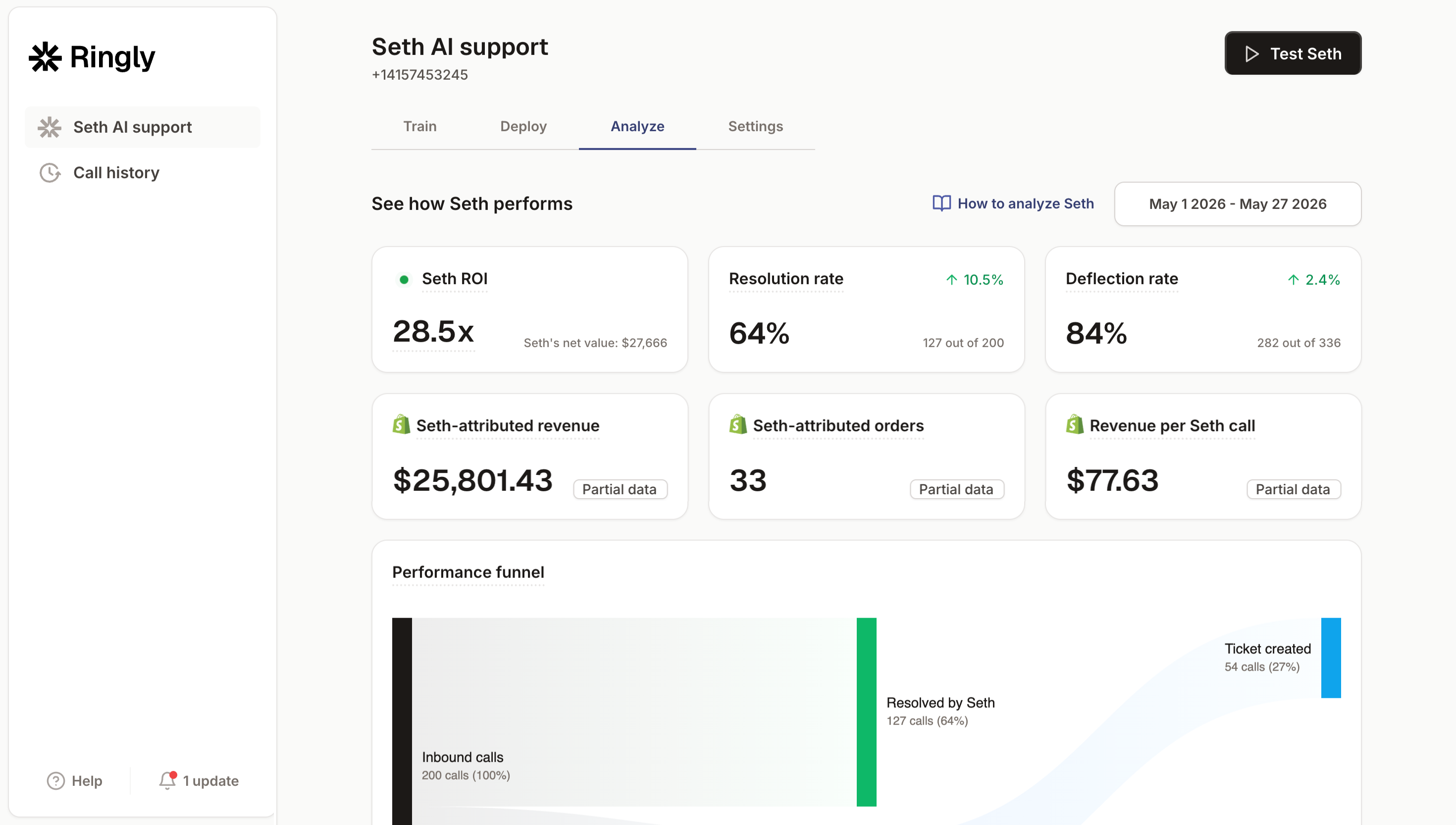
Seth resolves up to 90% of inbound calls autonomously, which is the kind of unit economics that makes a CFO stop arguing. WashCo, a Shopify brand we launched, recovered $22,664 in attributed revenue in its first 7 days on the phone.
Pricing
| Plan | Price | Included |
|---|---|---|
| Pay per call | $99 a month | 50 conversations, then $1.99 each |
Free to try. There's a 65% resolution guarantee: if Seth resolves under 65% of your calls in a month, that month comes back as credit (after 90 days on Pay per call).
What works
- It actually answers the phone. Every other tool here deflects text. Ringly picks up the call, including the 7 p.m. and Saturday calls your reps never get to.
- Native Shopify actions. It pulls order data, processes returns, and checks inventory without custom dev work.
- You don't sound like AI. The single most common thing customers say is they didn't realize they were talking to a bot.
- Live in under an hour. Add your site, docs, or knowledge base and it's ready, no code.
- You stay in control. You decide what escalates and to whom.
What doesn't
- Phone only. Ringly doesn't do chat, email, or social. It hands those off to your helpdesk. If your pain is text deflection, pair it with Gorgias or Zendesk.
- Built for Shopify. If you're not on Shopify, the deep integrations are the whole point, and you lose them.
Why it ranks first
Because every other "top-rated" list pretends the phone doesn't exist, and the phone is where DTC brands leak the most revenue. If you run a Shopify call center or wish you didn't have to, this is the tool the other lists skip.
2. Gorgias: the Shopify helpdesk default
Best for: Shopify and BigCommerce brands that want one inbox for chat, email, and social. Gorgias is the most Shopify-native helpdesk on the market, and its AI Agent now resolves a real chunk of repetitive tickets.
If you've shopped for ecommerce support tools, you've seen Gorgias. It puts email, live chat, and social messages in a unified inbox, shows the customer's order data in a sidebar, and lets you automate macros. The AI Agent layer handles the routine "where's my order" and return questions over text.
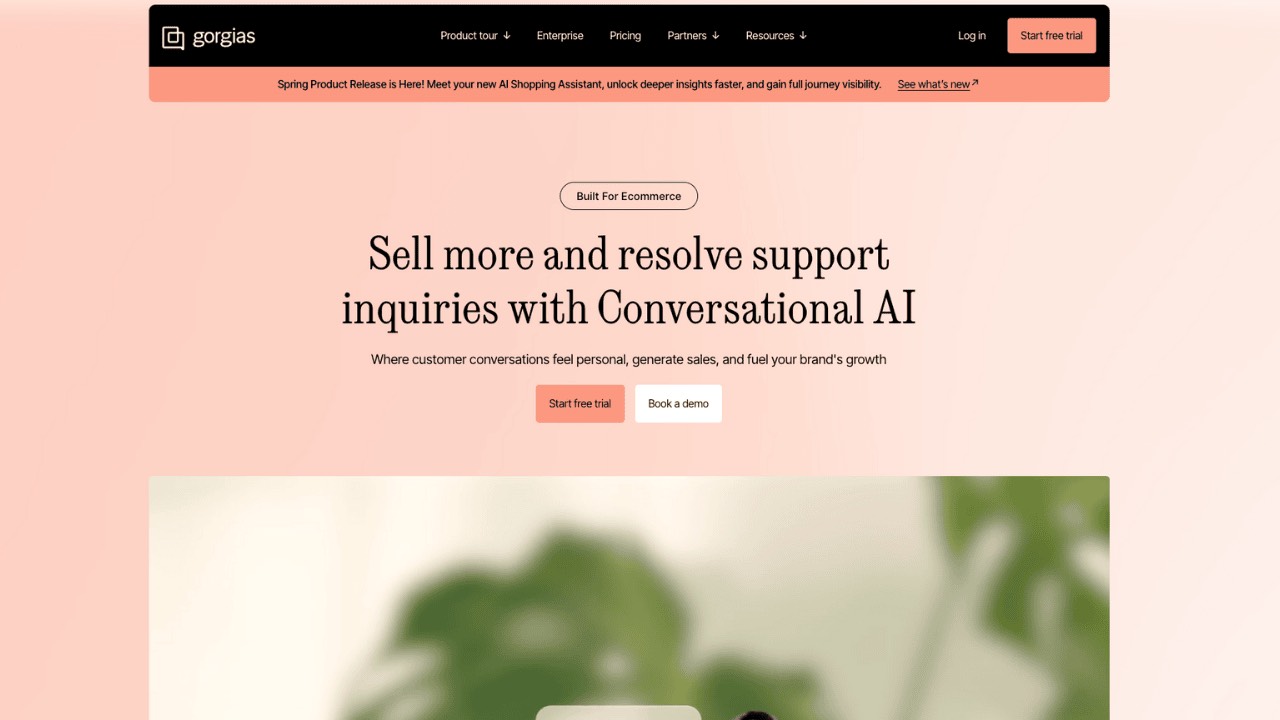
Gorgias is the strongest text-channel helpdesk for Shopify, but its AI is a text agent, not a phone one. It rates 4.6/5 across 539 reviews on G2, which is high for the category.
Pricing
Gorgias prices by ticket volume: a small Starter tier around $10/mo, Basic around $60, Pro around $360, and Advanced around $900/mo. The AI Agent is billed per resolution, roughly $0.90 to $1.00 each. Watch the fine print: an AI-handled conversation can also count as a billable ticket, so the real cost lands closer to $1.26 to $1.40 per AI resolution.
What works
- Deepest Shopify integration of any helpdesk. Order data, refunds, and subscription edits live right in the ticket.
- One inbox for chat, email, and social. Your reps stop tab-hopping.
- Mature automation. Rules, macros, and the AI Agent cover a lot of the repeatable text volume.
What doesn't
- Cost gets unpredictable at volume. Ticket-based pricing plus per-resolution AI charges can spike during a launch or the holiday rush.
- No real phone agent. Gorgias routes voice to humans. The AI is text-first.
Why it ranks second
It's the best tool here for the text channels, full stop. If your problem is chat and email backlog, start with Gorgias. If your problem is the phone, it doesn't touch it. Worth checking the Gorgias alternatives if the pricing model worries you.
3. Intercom Fin: conversational deflection
Best for: teams that want top-tier self-service deflection, especially if they already run Intercom. Fin is the most-reviewed AI agent in the category and it's genuinely good at answering knowledge-base questions in chat.
Fin ingests your help docs and resolves common questions over chat without a human. If you've got a deep knowledge base and a lot of repetitive "how do I" questions, it deflects a high share of them.
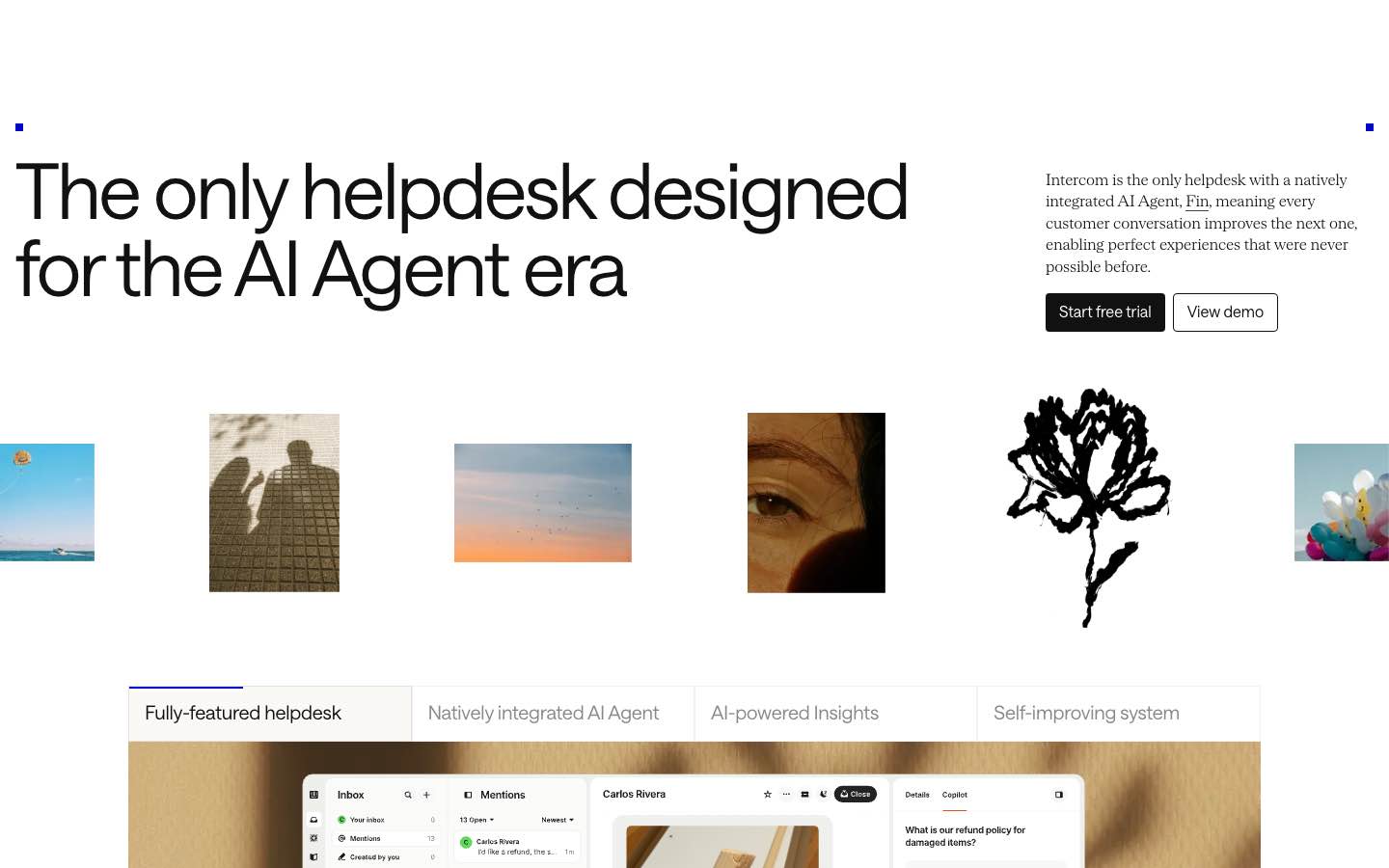
Fin is the deflection leader on paper, but the per-resolution model means your bill grows with your success. It rates 4.5/5 across 3,720 reviews on G2, the largest review base of any tool here.
Pricing
Fin charges $0.99 per resolved conversation. As a standalone agent on top of an existing helpdesk, there's a 50-resolution monthly minimum, so the floor is about $49.50/mo. Intercom seats sit on top of that: Essential around $39, Advanced around $85, Expert around $132 per seat.
What works
- Excellent self-service deflection. For FAQ-style volume, it's one of the best.
- Huge knowledge ingestion. Point it at your docs and it learns fast.
- Best if you're already on Intercom. The setup is near-zero.
What doesn't
- SaaS-leaning, not DTC-native. It's strong on "how do I use the product" and weaker on "where's my package".
- Weak on multi-step backend actions. Real order edits and returns need more than a chat answer.
- No phone. Same blind spot as the rest. Compare the Intercom alternatives if you need order actions, not just answers.
Why it ranks third
Best pure deflection engine on the list, held back for DTC by its SaaS roots and a meter that runs every time it works.
4. Zendesk AI: the enterprise default
Best for: larger teams already standardized on Zendesk who want AI without changing platforms. Zendesk AI is mature, well-integrated, and the safe choice if you're already in the ecosystem.
Zendesk bolts AI onto the suite most enterprise support orgs already run: automated resolutions, agent copilots, and intent detection across email and chat. If switching platforms is off the table, this is the path of least resistance.
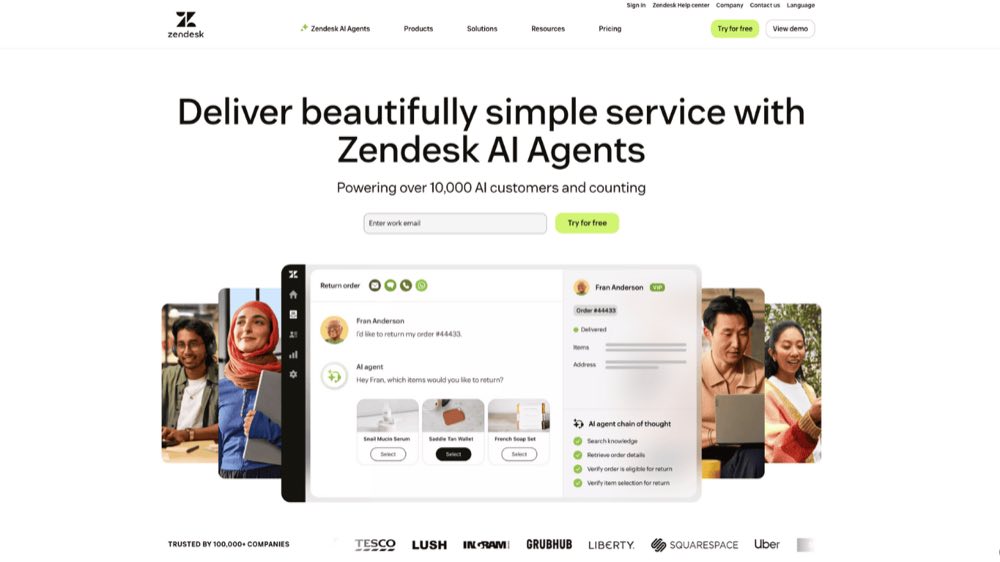
Zendesk AI is the lowest-friction choice for teams already on Zendesk, and the heaviest one for a lean DTC team that isn't. It rates 4.3/5 on G2 across thousands of reviews.
Pricing
The Suite runs roughly $55 to $115+ per agent per month, and the Advanced AI add-on is about $50 per agent per month on top. Agentic "automated resolutions" are priced separately. The costs stack quickly as you add seats.
What works
- Mature and deep. Reporting, integrations, and workflows are enterprise-grade.
- Safe if you're already on it. No migration, no retraining.
- Broad channel coverage. Email, chat, messaging, and a separate voice product.
What doesn't
- Per-agent plus add-on pricing piles up. A small DTC team pays enterprise rates.
- Heavy for a 6-rep brand. It's built for big support orgs.
- Voice is a separate product, not an autonomous phone agent. Zendesk Talk routes to humans. If that's your gap, see the Zendesk alternatives.
Why it ranks fourth
A strong, safe enterprise option that's overbuilt and overpriced for most $10M-$50M DTC brands unless you're already locked in.
5. Siena AI: autonomous DTC chat and social
Best for: DTC brands that want a chat agent with real brand voice across web, email, and social. Siena is purpose-built for ecommerce and handles Instagram and Facebook DMs alongside the website.
Siena leans into the thing most generic tools miss: sounding like your brand. It runs autonomous conversations across chat, email, and social channels, and DTC teams like it for tone control.

Siena is one of the most DTC-native chat agents here, with the caveat that it stops at text. It rates 4.7/5 on G2, among the highest in the category.
Pricing
Siena uses custom, volume-based pricing. There's no public price; you talk to sales and they scope it to your conversation volume.
What works
- Strong brand voice. It reads less like a bot than most.
- Social coverage. Instagram and Facebook DMs are handled, not just web chat.
- DTC-native. Built for ecommerce workflows, not generic SaaS.
What doesn't
- Chat only, no phone. Same channel gap as the rest of the text tools.
- Pricing not public. You can't model it without a sales call.
- Smaller vendor. Less mature than Zendesk or Intercom.
Why it ranks fifth
The best brand-voice chat agent for DTC, ranked here for tone and social coverage rather than scale. See the Siena AI alternatives if you need voice or want public pricing.
6. Re:amaze: affordable multichannel for small stores
Best for: smaller stores that want chat, email, and social plus light AI in one affordable tool. Re:amaze is the value pick, with all the channels in one place at a price small teams can stomach.
Re:amaze bundles email, live chat, social, and SMS into one helpdesk and adds AI replies and chatbots on top. For a store under $10M, it covers a lot of ground cheaply.
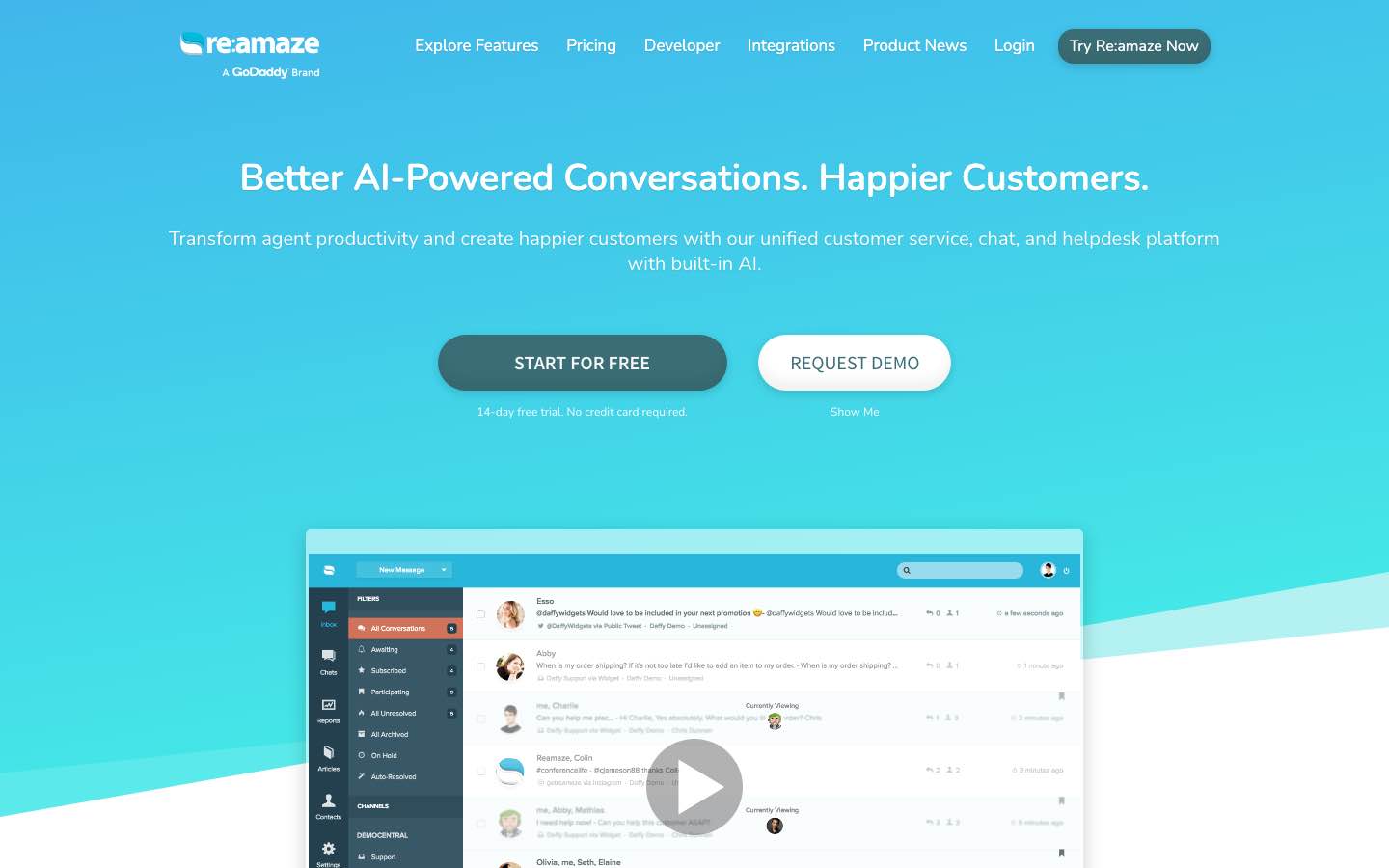
Re:amaze is the best value on this list for a small multichannel team, with thinner AI depth than the leaders. It rates 4.5/5 on G2.
Pricing
Basic is $29/mo per member, Pro is $49, and Plus is $69. The stronger AI features live in the higher tiers.
What works
- Genuinely affordable. Per-member pricing without the per-resolution meter.
- All channels in one place. Email, chat, social, and SMS.
- Easy to run. Light setup, friendly for small teams.
What doesn't
- AI depth is thinner. It automates replies but doesn't resolve complex, multi-step issues like the leaders.
- Built for SMB. A $25M+ brand with real volume will outgrow it.
Why it ranks sixth
A smart, cheap all-in-one for small stores. It just doesn't scale into the resolution depth a growing brand needs.
7. Tidio (Lyro): the cheapest path to AI chat
Best for: small stores that want to try AI chat without a budget conversation. Tidio's Lyro agent is the easiest, cheapest on-ramp to automated chat support.
Tidio is a live-chat tool with the Lyro AI agent layered on. It answers common questions over chat and is the lowest barrier to entry of anything here, with a usable free plan.
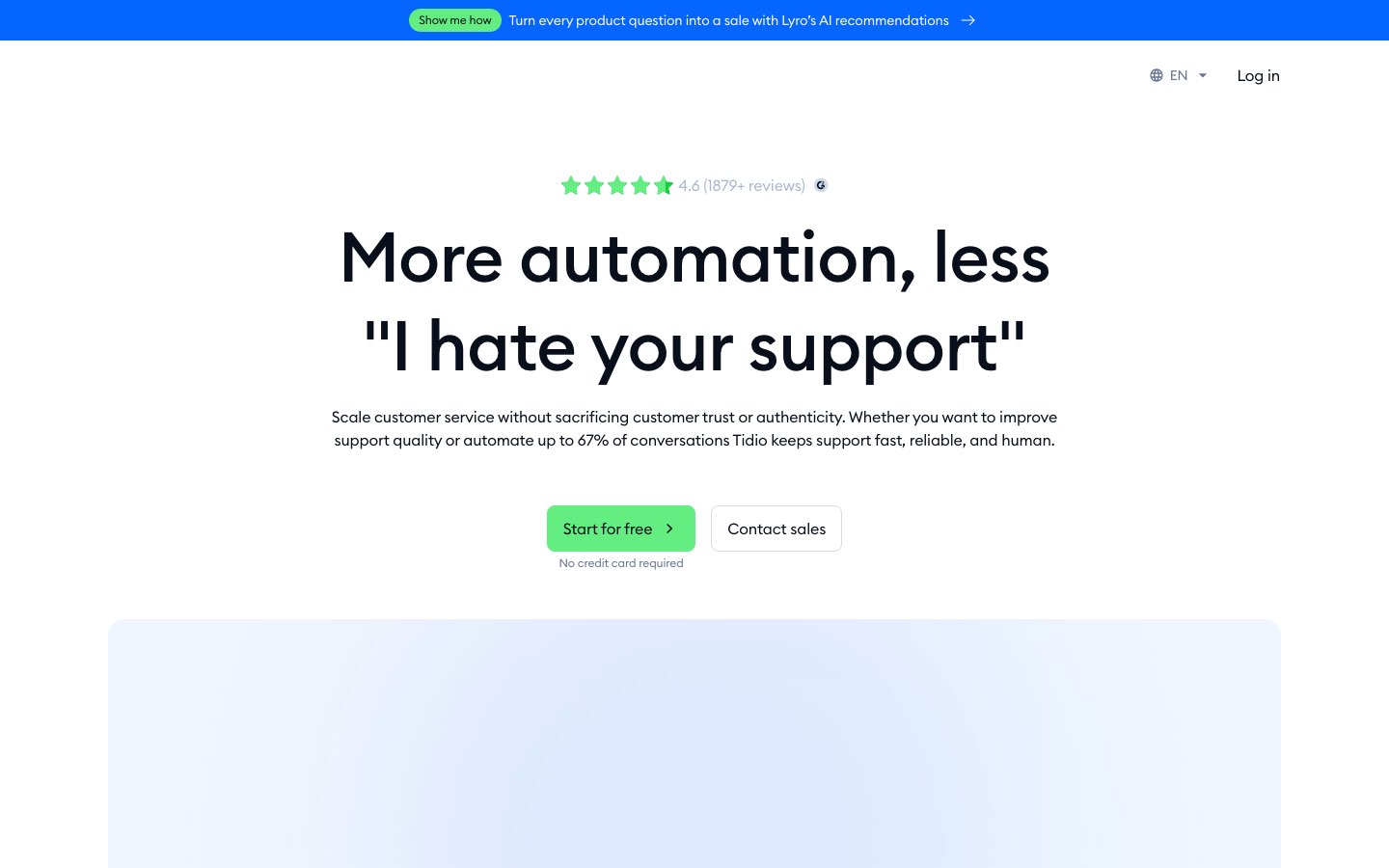
Tidio is the best starter tool on the list and the easiest one to outgrow. It rates 4.7/5 on G2, helped by how simple it is to set up.
Pricing
There's a free plan. The Lyro AI add-on starts around $39/mo and is capped by conversation count, with Growth and Plus tiers above it.
What works
- Cheapest entry to AI chat. A real free plan to test with.
- Fast setup. Live in an afternoon.
- Fine for low volume. Small stores get real value.
What doesn't
- Conversation caps. Costs jump as volume grows.
- Shallow actions. It answers more than it resolves.
- Starter-grade. Not built for a real DTC ops team. The Tidio alternatives are worth a look once you scale.
Why it ranks seventh
A great first AI tool for a small store, ranked low here because the moment you have real volume you'll need something deeper.
8. Ada: enterprise chat automation
Best for: large support organizations that need heavy, no-code chat automation across many languages. Ada is enterprise-grade chat resolution, built for scale most DTC brands haven't hit.
Ada's no-code builder lets big teams design complex automated chat flows, and it handles multilingual support at scale. It's a serious tool for serious volume.
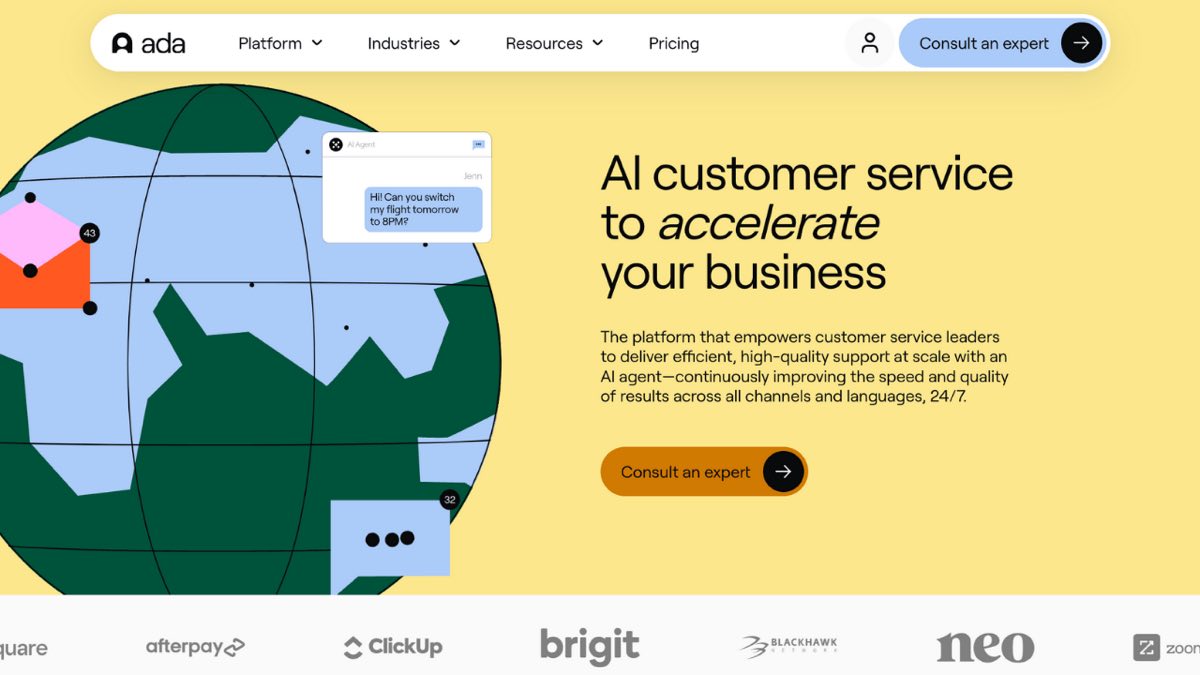
Ada is powerful enterprise chat automation that's usually overkill for a $10M-$50M DTC brand. It rates 4.6/5 on G2.
Pricing
Ada uses custom enterprise pricing. There's no public number, and the deals tend to be sized for large support orgs.
What works
- Powerful no-code automation. Big teams build sophisticated flows without engineers.
- Multilingual at scale. Strong global coverage.
- Enterprise-grade. Built for huge ticket volumes.
What doesn't
- Overkill for most DTC. The power is wasted under a certain size.
- Opaque pricing. Enterprise sales motion, not a quick signup.
- Chat-first, no voice. Same blind spot, bigger price tag.
Why it ranks eighth
A genuinely strong enterprise tool that's the wrong shape for most growing Shopify brands.
Why none of these lists rank the phone
Here's the test that changed how I'd rank this whole category. I called the live customer-service phone line of every tool on this list at 9 p.m. on a Tuesday. Seven of the eight either had no AI on the phone at all or routed me to a human queue and, after hours, to voicemail. One picked up with an AI agent and handled the question.
That's the gap. Every "top-rated" list treats AI customer service as a text problem, because the tools that buy ads and write comparison posts are chat tools. But your customers don't agree. Around 76% of service professionals say the phone is still where complex cases get solved, and when a customer can't reach you by phone, they don't switch to your chat widget. They leave. 85% of callers who can't get through on the first try never call back.
So you can deflect 70% of your chat volume and still bleed money, because the calls are the ones with a credit card attached. The complicated return. The angry reorder. The "I'm about to buy but I have one question" call at 8 p.m. that your chatbot can answer in theory and your phone line drops in practice.
"My customers also feel like it's a normal person. They feel like they can communicate if they have questions."
Claudia Droge, TechCraft Studio
The chat tools on this list are good at what they do. They just leave the highest-value channel unmanned. If your phone support goes to voicemail after 6 p.m. while your chat widget hums along, you're optimizing the cheap channel and ignoring the expensive one.
If you want to see what your own phone line is leaking after hours, book a 30-min call and we'll pull the numbers with you.
What this costs you vs a human team
The reason any of this matters is the math. Most of the tools above are priced to save you money on the cheap channel. The phone is where the loaded cost actually lives, because it's the one you've been staffing with people.
Take a $50M Shopify brand running a 6-rep CS team:
| Line item | Today | With Ringly |
|---|---|---|
| 6 reps x $4K loaded per rep | $24,000/mo | n/a |
| Ringly Enterprise (~$5K/mo) | n/a | $5,000/mo |
| Net monthly CS spend | $24,000/mo | $5,000/mo |
| Monthly savings | n/a | $19,000/mo |
| Annual savings | n/a | $228,000/yr |
That's roughly 70% of repeatable calls, the same five questions over and over, routed to the AI for the price of one part-time hire. The other 30%, the genuinely complex calls, still go to your team, who now have time to actually solve them. Exact pricing is set on a call, but those are the savings shapes we see across Shopify brands.
The chat tools save you on tickets. The phone is where the bigger line item sits, and it's the one the lists never put on the table.
If you want the math run against your real call volume, book a 30-min call and we'll do it live.
How to choose
Match the tool to the channel that's actually hurting, not to whichever list ranked it highest.
Choose Ringly if:
- You run a visible phone number on a $10M-$100M Shopify brand and it goes to voicemail after hours.
- Your reps are burnt out answering the same order-status and return calls all day.
- You want 24/7 ecommerce phone support without hiring a night shift.
Choose Gorgias or Zendesk AI if:
- Your backlog is chat and email tickets, not calls.
- You want one inbox and deep Shopify integration (Gorgias) or you're already standardized on Zendesk.
Choose Intercom Fin, Siena, or Ada if:
- Self-service chat deflection is your main goal.
- You have a deep knowledge base (Fin), want strong brand voice and social (Siena), or run a large enterprise support org (Ada).
Choose Re:amaze or Tidio if:
- You're a smaller store that wants affordable multichannel coverage (Re:amaze) or the cheapest way to try AI chat (Tidio).
The honest answer for most growing Shopify brands is two tools, not one: a text helpdesk for tickets and an AI phone agent for the calls. The lists only sell you the first half.
Frequently asked questions
What are the top-rated AI customer service tools in 2026?
For DTC and Shopify brands, the strongest options are Ringly.io for phone, Gorgias for Shopify chat and email, Intercom Fin for self-service deflection, and Zendesk AI for enterprise teams. Siena, Re:amaze, Tidio, and Ada round out the list for specific needs like social, budget, or large-org scale.
Which AI customer service tool is best for Shopify?
Gorgias is the best text helpdesk for Shopify, and Ringly is the best for the phone channel. Most growing brands end up running both: a helpdesk for chat and email tickets, and an AI phone agent for calls.
Can AI customer service tools handle phone calls?
Almost none of them can. Most "AI customer service" tools are chat and email deflection tools that route phone calls to a human queue. Ringly is the exception on this list, with an AI agent that answers inbound calls and resolves order, return, and product questions autonomously.
How much do AI customer service tools cost?
It ranges widely. Chat tools like Tidio start near $39/mo, per-resolution tools like Intercom Fin charge around $0.99 per resolved conversation, and enterprise platforms like Zendesk and Ada run into per-agent or custom pricing. Ringly starts at $99 a month with a 65% resolution guarantee.
Do AI customer service tools actually resolve issues or just respond?
The metric that matters is resolution rate, not response time. Many tools respond to a lot and resolve far less, especially on multi-step actions like returns or order edits. Ringly resolves up to 90% of inbound calls autonomously.
Will customers know they're talking to AI?
With most chat tools, often yes. With a good voice agent, usually no. The most common thing Ringly customers report hearing is that the caller didn't realize they were talking to a bot.
What's the difference between an AI chatbot and an AI phone agent?
A chatbot answers typed questions in a chat window. An AI phone agent answers actual phone calls, talks to the caller, and takes action in your Shopify store. They cover different channels, which is why most brands need one of each.
Do I have to replace my current helpdesk?
No. Ringly sits alongside whatever you already run and escalates cleanly to Gorgias, Richpanel, Re:amaze, or your existing tool. You keep your phone number, your helpdesk, and your workflows.
Talk to us

If you run a $10M-$100M Shopify brand and the calls are rolling to voicemail after hours, a 30-min call is the fastest way to see what the phone is leaving on the table. We'll look at your real call volume, not a demo.
Our 3 promises.
- Live in under 1 hour. Setup and test calls are free.
- 30-day money back on the $99 plan fee.
- 65% resolution guarantee: if Seth resolves under 65% of your support calls in a month, that month comes back as credit (after 90 days on Pay per call).
Ruben (Ringly co-founder) takes these calls personally.