
This guide in 30 seconds.
- A working ecommerce social CS setup is two layers, not one: the social inboxes where customers DM you, and the phone line the hard ones escalate to. Most brands build the first and forget the second.
- The numbers to know: 67% of customers find social support convenient, 73% will buy from a competitor if you go quiet, and 85% of callers who can't reach a person never call back.
- Built for Founders and Heads of CX at $10M-$100M Shopify brands with a visible phone number and a team already drowning in DMs.
Your Instagram DMs on a normal Tuesday are mostly the same message: where's my order. Then a creator posts, the orders triple, and so do the DMs, the comments, and the calls to the line in your footer. Your two reps are answering DMs with one hand and watching the phone roll to voicemail with the other. By 6 p.m. the queue is still 40 deep and the weekend hasn't even started.
If you run customer experience at a Shopify brand doing $10M to $100M, this is the part of social customer service nobody writes about. We read the real call logs from 50+ Shopify brands, and the same questions that flood social DMs show up on the phone after hours, especially on weekends. So this guide covers both layers: how to run social support that ecommerce customers actually want, and how to catch the calls those DMs turn into. If your phone goes to voicemail after 6 p.m., book a 30-min call and we'll show you what your store leaves on the table after hours.
What ecommerce customers actually expect on social
Customers stopped treating social as a marketing channel a while ago. They treat it as support. Around 39% of customers say it's more convenient to reach a business over social media according to ProProfs, and they show up expecting the same speed they'd get from a friend. For more on the wider channel mix, see our ecommerce customer service guide.
On social, slow is the same as silent, and silent costs you the sale. The 2025 Sprout Social Index found 73% of social media users expect a brand to respond within 24 hours, and industry roundups put it bluntly: 88% are less likely to buy from a brand that leaves complaints sitting in public. That's the part that stings for ecommerce: an unanswered DM isn't a missed ticket, it's a public one your next customer can scroll past.
Here's what the expectation actually looks like by channel:
- Instagram and Facebook DMs: a reply within a few hours, ideally under one. Around 73% of customers expect a response within 24 hours, but a large share want it inside an hour, rising sharply when it's a complaint (Sprout Social).
- Comments and public posts: faster, because everyone can see them. A WISMO comment left for two days reads as "this brand ignores people."
- X (Twitter): the most impatient channel. Top brands reply in around 15 minutes during business hours.
- WhatsApp: growing fast for ecommerce, especially internationally, and customers treat it like texting a person.
The gap between expectation and reality is the opportunity. The average brand still takes 4 to 5 hours to respond on social, which means being merely fast is enough to stand out. The hard part isn't the standard; it's holding the standard when volume spikes and your two reps are also covering email, chat, and the phone.
The ecommerce social customer service playbook
Most social CS advice is written for any business. Ecommerce is its own animal: the questions are predictable, the volume is spiky, and almost everything traces back to an order. Here's how to run it so the routine stuff doesn't eat your team.
Triage by what the question needs, not by which app it came in on. Three buckets:
- Answer in-channel: order status, shipping timelines, sizing, restock dates, store hours. These are public-safe and repeatable. This is 30-40% of your volume on its own.
- Move to a private message: anything with an order number, address, refund, or account detail. Don't expose customer data in a public comment thread, ever.
- Move to a call: a damaged item, a disputed refund, a missing high-value order, an upset customer who types "can someone call me." When a customer wants to talk, making them keep typing is how you lose them.
WISMO is the thing to systematize first. "Where's my order" is 30-40% of ecommerce tickets in normal periods and 50%+ at peak, per Salesforce. We break the WISMO math down further in our guide to WISMO calls. Wire your social inbox to pull the order straight from Shopify so a rep (or an automation) answers with the real tracking link in seconds, not after five minutes of copy-paste. The order-status lookup is the single most useful thing to automate, because it's the same answer over and over.
A few more ecommerce-specific moves:
- Returns and exchanges: give reps a one-tap path to start a return from the conversation. The slow part is usually the rep hunting the order, not the policy.
- Plan for the spike, don't react to it: tie your staffing to your launch and ad calendar. A creator post or a Black Friday push doesn't just lift orders, it lifts DMs and calls 2-3x for the next 48 hours. Knowing it's coming is half the fix. (More on surge handling in our guide to improving ecommerce customer service.)
- Track the same five questions: if you log what comes in, you'll find 70-80% of it is the same handful of questions. That list is your automation roadmap and your FAQ at the same time.
Where ecommerce social customer service quietly breaks
Here's the part the tool listicles skip. Social is the front door. The phone is where the hard ones go.
A customer DMs you about a missing $180 order. You move it to a private message, you ask for the order number, you start digging. Two replies in, they lose patience and do what people do when money is involved: they find the phone number in your footer and call. If it's a Tuesday at 2 p.m., a rep picks up. If it's Saturday night, it rolls to voicemail. And 80% of voicemail-routed callers hang up without leaving a message (Eden), which is why an after-hours answering setup matters more than most brands think.
The DMs you can't close in the app become phone calls, and the phone calls you miss become competitors' customers. The data is brutal here: 85% of callers who can't reach a person never call back, and 62% switch to a competitor (PCN). You spent the ad money to earn that order. Losing it to an unanswered Saturday call is the most avoidable churn there is, and it's exactly the gap that 24/7 phone coverage closes.
This is why a social CS strategy that stops at the social inbox is half a strategy. You've covered the easy questions and left the high-emotion, high-value ones to a phone line nobody staffs at night. WashCo, a Shopify brand we launched, recovered $22,664 in its first 7 days once those after-hours calls actually got answered.
The fix isn't hiring a night shift to sit idle. It's putting an AI phone agent behind the line so the escalations and the after-hours calls get handled the same way your best rep would: find the order, answer the question, start the return, and escalate the genuinely complex ones to your team in the morning. If you want to see what your missed calls look like, book a 30-min call and we'll pull the numbers with you.
Tools to run social customer service for ecommerce
You need two layers covered: a social inbox for the DMs and comments, and a phone layer for the calls those DMs turn into. Here's how the main options stack up.
| Tool | Best for | Channels | Pricing (2026) | Verdict |
|---|---|---|---|---|
| Ringly.io | The phone leg (after-hours + escalations) | Inbound phone | $349-$799/mo | The layer social inboxes skip |
| Gorgias | One Shopify support inbox | Email, social, chat, SMS | $10-$900/mo, ticket-based | Strong if you want tickets unified |
| Sprout Social | Social-as-marketing-plus-support | All social | $199-$399/user/mo | Powerful, priced for bigger teams |
| Shopify Inbox | Starting out on social DMs | Store chat, Messenger, IG DM | Free | Good free start, no comments or phone |
| MyAlice | Messaging-app-heavy DTC | WhatsApp, IG, Messenger, more | $49-$249/mo | Best for WhatsApp-led brands |
| eDesk | Marketplace plus social sellers | Social, marketplaces, email | Quote | Fit for multi-channel sellers |
1. Ringly.io
Best for: the phone calls your social DMs escalate into, especially after hours. Ringly.io is AI phone support for Shopify brands. It's not a social inbox, and we won't pretend it is. It's the layer that catches what the social tools can't: the customer who gives up on the DM and calls, and the caller who rings at 11 p.m. on a Saturday.
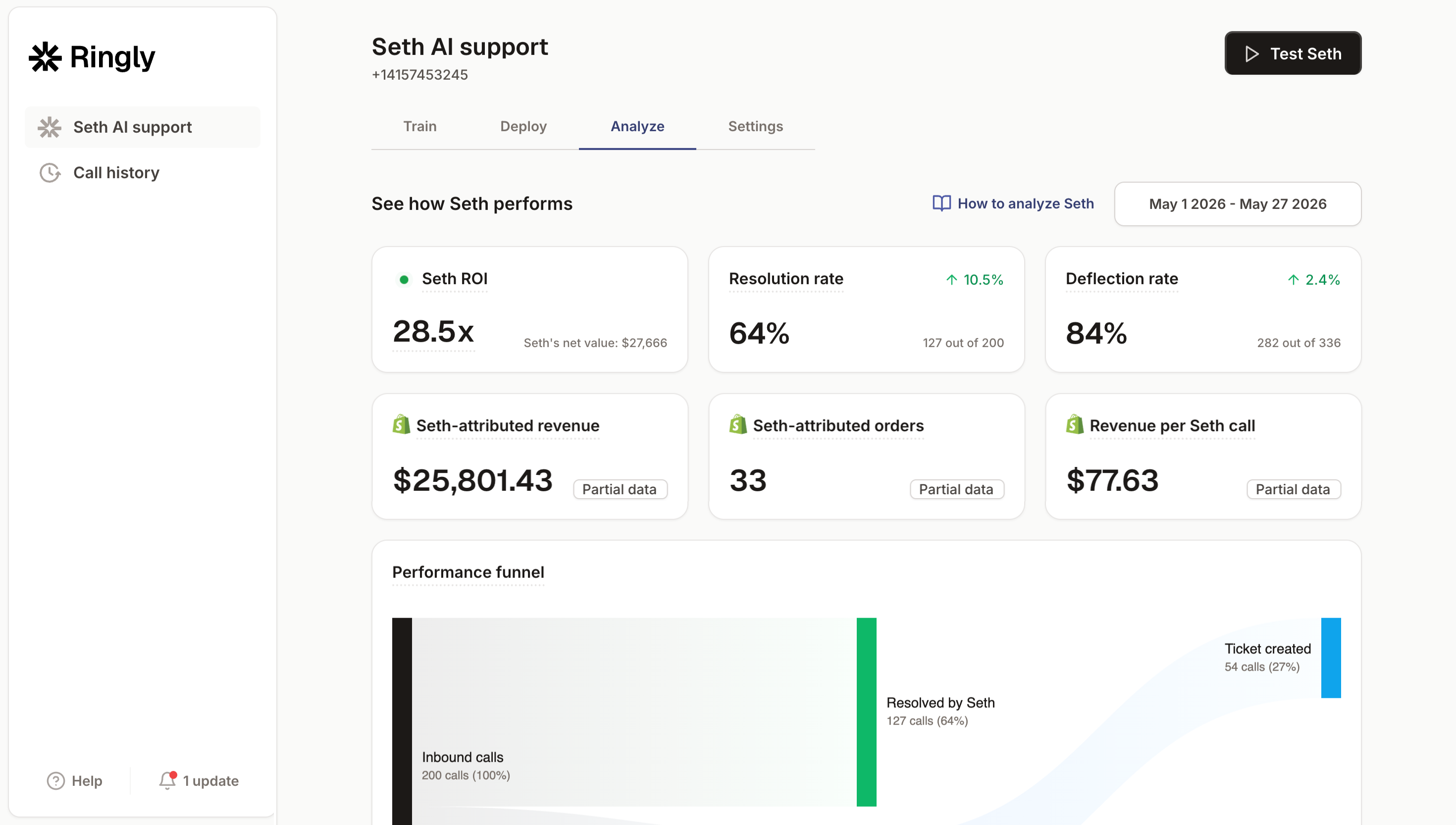
The AI answers inbound calls 24/7 in 40 languages, finds orders in your Shopify store, processes returns and exchanges, answers product questions from your knowledge base, and escalates the genuinely complex calls to your team. Across 50+ brands, it resolves 73% of calls on its own at roughly $0.42 per resolved call. It sits in front of your existing helpdesk, so the calls that need a human still land in your queue.
Pricing: Grow $349/mo (1,000 minutes), Pro $799/mo (2,500 minutes), Enterprise by call. Live in under an hour, with a 65% resolution guarantee.
What works:
- Catches the escalation channel the social inbox can't: when a DM turns into "call me," the phone is actually staffed.
- 24/7 without a night shift: weekend and after-hours calls get answered instead of rolling to voicemail.
- Real Shopify actions: order lookup, returns, exchanges, product answers, not just a recorded message.
What doesn't:
- It's phone only. You still need a social inbox for DMs and comments.
- No subscriptions or phone-order taking out of the box; those need a workaround or a custom action.
Why it's row 1: because it's the piece every other tool on this list leaves out. Pair it with one of the social inboxes below and you've actually covered the funnel.
2. Gorgias
Best for: Shopify brands that want email, social, chat, and SMS in one ticketing inbox. Gorgias is the most common ecommerce helpdesk for a reason: deep Shopify integration and a single view of a customer across channels.
Pricing: Starter around $10/mo up to Advanced around $900/mo, plus Enterprise. It's ticket-based, with overage around $0.36-$0.40 per ticket once you pass your plan limit, which can climb fast at volume.
What works:
- Social DMs and comments live next to email and chat, so a rep sees the whole history.
- Native Shopify data in the ticket: order, customer, fulfillment.
What doesn't:
- Ticket-based billing surprises at peak volume.
- Phone is the weakest leg; if calls matter, you'll still want a dedicated phone layer. (More on the ecommerce phone support side.)
3. Sprout Social
Best for: brands that run social as a marketing and support function together, with a bigger team. Sprout gives you a combined view of DMs and replies across every social channel, plus scheduling and listening, with a Shopify integration that surfaces customer history.
Pricing: Standard $199/user/mo, Professional $299, Advanced $399, billed annually. 30-day free trial.
What works:
- One view of social DMs, mentions, and comments across channels.
- Listening and analytics that double as marketing tooling.
What doesn't:
- Per-seat pricing gets expensive for a support team.
- Built for social, not the rest of support; it won't touch your phone line or your email queue the way a helpdesk does.
4. Shopify Inbox
Best for: smaller Shopify brands starting on social DMs without buying a helpdesk yet. It pulls online-store chat, Facebook Messenger, and Instagram DMs into one place, free with your Shopify plan.
Pricing: free.
What works:
- Free and native: no extra contract, lives where you already work.
- Order context from Shopify in the conversation.
What doesn't:
- Doesn't capture post comments on Instagram or TikTok.
- No phone, and limited automation as you scale. You'll outgrow it.
5. MyAlice
Best for: DTC brands that live in messaging apps. MyAlice unifies WhatsApp, Messenger, Instagram, Viber, Telegram, and Line, and pulls Shopify, WooCommerce, or Magento order data into the dashboard.
Pricing: Growth $49/mo (3 seats), Pro $249/mo (5 seats), plus a custom WhatsApp tier. Free trial.
What works:
- Strong messaging-app coverage, especially WhatsApp for international ecommerce.
- Affordable entry point for small teams.
What doesn't:
- Less mature than Gorgias or Zendesk on deep helpdesk workflows.
- No phone layer.
6. eDesk
Best for: sellers spanning marketplaces and social. eDesk unifies social DMs with Amazon, eBay, and other marketplace messages plus email.
Pricing: tiered, quote-based on higher plans.
What works:
- Marketplace plus social in one place for multi-channel sellers.
- AI reply assists on common questions.
What doesn't:
- Marketplace focus means it's less Shopify-native than Gorgias.
- No phone support.
A quick way to choose: if you're small and social-only, start with Shopify Inbox or a Shopify customer service app. If you want one ticketing inbox, Gorgias. If WhatsApp is your main channel, MyAlice. And whichever social tool you pick, put a phone layer behind it so the escalations don't leak.
What this costs you today vs what it costs with the right setup
The reason brands leave the phone leg uncovered is they assume the fix is hiring. Run the math on a typical $50M Shopify brand with a 6-rep team:
| Line item | Today | With an AI phone layer |
|---|---|---|
| 6 reps x $4K loaded per rep | $24,000/mo | n/a |
| AI phone agent (~$5K/mo) | n/a | $5,000/mo |
| Net monthly CS spend | $24,000/mo | $5,000/mo |
| Monthly savings | n/a | $19,000/mo |
| Annual savings | n/a | $228,000/yr |
That's roughly 70% of the repeatable calls (the WISMO, the returns, the same five product questions) handled without a human, while your reps stay on the DMs and the genuinely hard calls. A social interaction runs about $1 versus $6+ for a voice call, so the goal isn't to push everyone to the phone, it's to make sure the phone calls you do get are actually answered cheaply and around the clock.
If you're weighing this against hiring your next rep, book a 30-min call and we'll do the math live against your real call volume.
Frequently asked questions
What is social media customer service for ecommerce? It's handling customer questions and complaints that come in through social channels like Instagram, Facebook, WhatsApp, and X, alongside the orders behind them. For ecommerce specifically, most of it is order status, returns, and product questions tied to a Shopify order.
How fast should an ecommerce brand respond on social media? Aim for under an hour on DMs and faster on public comments. Most customers expect a reply within 24 hours and a large share want it inside the hour, while the average brand still takes 4 to 5 hours, so being fast is a real edge.
Which social channels matter most for ecommerce support? Instagram and Facebook DMs carry the most volume for most DTC brands, with WhatsApp growing fast internationally and X being the most time-sensitive. Cover where your customers already are rather than spreading thin across all of them.
Should I use a separate handle for customer support? For higher-volume brands, a dedicated support handle keeps your main marketing feed clean and routes questions to the right team. Smaller brands can usually handle support from the main account until volume forces a split.
What's the best software for ecommerce social customer service? For a unified Shopify inbox, Gorgias is the common pick; for messaging-app-heavy brands, MyAlice; and Shopify Inbox is a solid free start. Whichever you choose, pair it with a phone layer so escalations don't leak.
How does social customer service connect to phone support? The hard DMs (disputed refunds, missing high-value orders, upset customers) usually escalate to a call, and after-hours those calls roll to voicemail. An AI phone agent answers them 24/7 so the funnel that starts in a DM actually closes instead of churning.
Talk to us

If you run a $10M-$100M Shopify brand and your social DMs are sharp but your phone line goes quiet after 6 p.m., a 30-min call is the fastest way to see what those missed calls are costing you. We'll look at your real volume and map what an AI phone layer behind your social channels would catch.
The 3-layer guarantee.
- Live in 14 days or it's free until launched.
- 65% resolution in 90 days or we refund the last 3 months of subscription fees.
- We keep working free until we hit 65%.
Ruben (Ringly co-founder) takes these calls personally.