
This post in 30 seconds.
- A self-service returns flow on Shopify is the best thing you can give the shopper who wants to send something back at 9pm. It is not the thing that ends your returns calls.
- 81% of customers want self-service options, but only about 48% of retailers offer a portal. Turning yours on is an easy win. Believing it kills the phone is the trap.
- Built for founders, COOs, and Heads of CX at $10M-$100M Shopify brands running a paid helpdesk and a visible phone number.
Picture the shopper, not the admin screen. It's 9pm, the jeans don't fit, and they want this dealt with before bed. A self-service returns portal is the thing that lets them handle it without writing you an email and waiting until Tuesday. That part works. What we kept seeing in the call logs across 50+ Shopify brands, over more than 150,000 calls, is that the portal almost never failed on its own. The customer stopped before the portal could finish helping, and then dialed the number on their order confirmation.
If you run a $10M-$100M Shopify brand with a paid helpdesk and a phone line people can actually reach, you've felt this. You turned on self-serve returns, the easy "how do I start a return" volume dropped, and a second, stickier wave took its place: where's my refund, I got stuck, I wanted to swap not refund. This post is about the customer side of self-service returns, what a good experience looks like, and the returns calls a portal hands you instead of removing. If you want to see which of your own returns calls are still landing on a human, book a 30-min call and we'll walk through your last week of them.
What self-service returns actually look like from the customer's chair
Forget the Shopify admin for a second. The whole point of self-service returns is the shopper never has to think about your admin at all.
Here's the flow they see. They land on a returns page, usually from the order status page or the Shop app. They type an order number and email. They pick the item, choose a reason, and Shopify either hands them a prepaid label or offers an exchange. No email, no waiting for a rep, no phone call. According to Shopify's own documentation, customers submit the whole request from the order status page without contacting you, and you approve or decline it from the admin.
A good self-service returns experience is one the customer finishes in under a minute and never has to second-guess. That means no login wall, eligibility that's obvious before they start, and a label or exchange offered on the spot. When any of those break, the customer doesn't keep clicking. They reach for the phone.
And the demand is real. Roughly 81% of customers want more self-service options to manage their online purchases and returns. So this isn't a feature you're forcing on people. It's the one they're already asking for. Your job is to make the experience good enough that they finish it, and to have a plan for the ones who don't. For the broader picture of how returns flow through a store, our Shopify returns process guide walks the full path.
The adoption gap is the opportunity, and also the limit
If 81% of customers want self-service and only about 48% of retailers offer a portal, the math is friendly. Turning self-serve returns on is one of the cheapest customer-experience wins available to a Shopify brand.
There's a reason to move past "it's a cost center," too. Returns policy is a pre-purchase decision, not just a post-purchase chore. 67% of online shoppers check the return policy before they buy, and 76% of first-time customers who get an easy return say they'll shop again, while 71% who get a bad one say they won't. The returns experience is doing sales work before anyone has bought anything.
The catch is that Shopify's native self-serve returns have hard edges, and customers hit them. Three matter most:
- No customer-initiated exchanges. In native self-serve, a customer can request a return but not an exchange. You add exchange items when you approve the request. So the shopper who wanted to swap a size, not get their money back, often can't do it in the flow.
- A 250-line-item cap. Per Shopify, a single self-serve request can't exceed 250 line items. Rare for most stores, real for high-SKU wholesale-adjacent orders.
- Return-rule bounce-outs. Window expired, final sale, gift order with no order number handy. The rules that keep returns sane also kick edge-case customers out of the flow, and out of the flow means onto the phone.
None of these mean the portal is bad. They mean the portal has a shape, and the customers who fall outside that shape need somewhere to go.
Exchange-first is the revenue the portal is really there to save
Most posts about self-service returns sell you on deflection: fewer tickets, less work. That's fine, but it misses the bigger prize. The real reason to invest in the returns experience is to keep the revenue.
When a return ends in an exchange or store credit instead of a refund, the money stays on your books. An optimized returns flow can shift up to 60% of returns into exchanges or store credit, and at a 40% exchange-uptake rate a brand retains roughly $30,000 a month, about $360,000 a year, that a refund-by-default flow would have handed straight back. 77% of customers repurchase after a good return experience. The return isn't the end of the relationship. Handled well, it's the start of the next order.
Here's the friction. Native Shopify self-serve can't take a customer-initiated exchange, which means the single most revenue-positive request, "can I swap this instead," is the one the portal punts. That request shows up somewhere. Usually it's a phone call, and usually it's a call your team can convert if a human picks up and a refund if nobody does.
WashCo, a Shopify brand we launched, recovered $22,664 in its first 7 days on the phone. Not from new traffic. From calls that were already coming in and weren't being answered. The exchange-and-rescue conversation is one of those calls.
"My customers also feel like it's a normal person. They feel like they can communicate if they have questions."
Claudia Droge, TechCraft Studio
For the mechanics of turning swaps into retained revenue, our Shopify exchanges guide and our returns best-practices post both go deeper than this section can.
The returns calls a self-service portal still sends to your phone
This is the part the setup guides skip. A portal answers one question well: "how do I start a return." It does not answer the questions that come after, and those are the ones that ring your phone.
Here's what's actually on the other end of a returns call once your portal is live:
- "I sent it back five days ago, where's my refund?" This is the big one. The customer can't see the box arrive at your warehouse, can't see it inspected, can't see finance cut the refund. So they call to get a number and a date from a human. A refund that lands in two days with an email confirmation produces silence. A refund that takes ten days with no update produces a call, maybe two.
- "I started the return and it said I'm not eligible." A return-rule edge case bounced them. They don't read it as a rule, they read it as a wall, and they call to argue or ask.
- "I wanted to exchange, not get a refund." The native gap, arriving by phone. This is the revenue call.
- "It's a $400 order, I just want to make sure this is handled." High-value reassurance. The form did its job, but the customer wants a person to confirm it.
The portal didn't fail any of these customers. It just isn't built to finish their specific conversation, so the conversation moves to the channel that can. The trap is assuming a live portal means a quiet phone. It doesn't. It means a different, harder set of calls, the ones a form can't close, sitting on whatever's left of your support team.
If those calls are going to voicemail after hours, or eating your reps' afternoons, book a 30-min call and we'll pull your missed-call list and sort it by type. You'll see how much of it is "where's my refund" you could already answer.
How the phone backs up the portal on Shopify
The fix isn't a better portal. The portal is doing its job. The fix is having something on the phone line that can finish the conversations the portal starts.
That's what Ringly.io is. Ringly is AI phone support for Shopify brands. It answers inbound calls 24/7, finds the order in your Shopify store, tells the caller exactly where their refund is, processes the return or the exchange, and answers product questions from your knowledge base. When a call genuinely needs a human, it escalates cleanly to Gorgias, Richpanel, Reamaze, or whatever helpdesk you already run. You keep your portal, your phone number, and your stack. You add a layer that picks up when the form runs out of road.
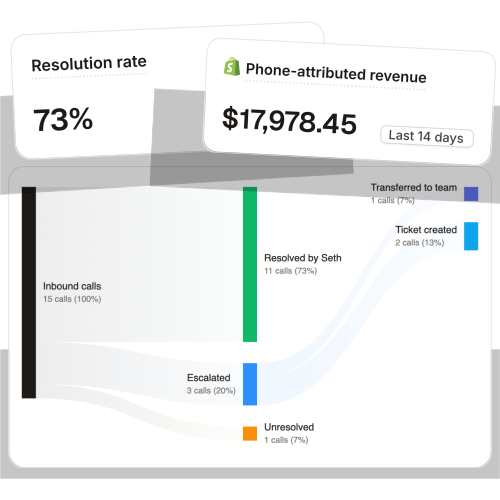
Across 50+ Shopify brands, the AI resolves 73% of inbound calls on its own, at roughly $0.42 per resolved call versus $7 to $16 for a human BPO. The "where's my refund" call, the one your own system can already answer, is exactly the kind it closes without waking anyone up.
The cost case is simpler than the usual headcount spreadsheet. A human handling returns calls runs about $2.70 a call loaded. Ringly runs closer to $1 to $2. But the bigger number isn't the cost you cut, it's the exchange you save: every swap a human or an AI converts instead of refunding is revenue that stays. For the order-status side of that conversation, our check order status feature is what powers the refund-status answer, and the AI phone agent for Shopify page shows how the whole thing sits behind your existing setup.
A few related reads if you're building out the rest of the returns operation: our returns management guide, the sibling self-serve returns setup post, our Shopify refunds breakdown, the order-tracking guide that kills a lot of "where's my refund" before it starts, and a roundup of Shopify returns apps if your native flow has outgrown its edges.
Frequently asked questions
What are self-service returns on Shopify? Self-service returns let a customer start a return on their own from the order status page or the Shop app, without emailing or calling you. They enter an order number and email, pick the item and a reason, and get a prepaid label or an exchange option. You approve or decline each request from the Shopify admin.
Can customers request an exchange through Shopify self-serve returns? Not in native Shopify self-serve. Customers can request a return, but you add the exchange items when you approve the request, so a customer-initiated swap isn't possible in the flow. That gap is one reason exchange requests, the most revenue-positive ones, often come in by phone instead.
How much does a self-service returns portal actually deflect? Self-service generally pulls a meaningful chunk of "how do I start a return" volume out of the queue, and a portal can cut return-related tickets substantially. But it deflects the easy question and surfaces a harder one: where's my refund. Plan for both.
Why do customers still call when I have a returns portal? Because the portal answers "how do I start a return" and not "where's my refund," "I got stuck," or "I want to swap, not refund." The customer who can't finish online reaches for the phone, so a live portal changes which returns calls you get rather than ending them.
Is Shopify's native self-serve returns enough, or do I need an app? Native is solid for basic refunds and works with your return rules, but it can't take customer-initiated exchanges and caps requests at 250 line items. If exchange-first revenue retention matters to you, an app like Loop, ReturnGO, or AfterShip adds the flows native leaves out.
How do I reduce "where is my refund" calls? Make the return trip as visible as the original delivery. Proactive tracking and an email the moment a refund is issued turn a ten-day wait of silence into a wait the customer can see, which stops most of the calls before they happen. For the rest, have something on the phone that can read the order status back to the caller.
Does a returns portal replace phone support? No. It replaces the start-a-return call and creates the refund-status call. The two channels work together: the portal handles the self-service shoppers, and the phone handles the exceptions, the exchanges, and the reassurance the form can't give.
Talk to us

If your returns portal is live and your phone still rings about refunds you can already see in your own system, that gap is where the revenue leaks. A 30-min call is the fastest way to see what's actually landing on your team and what an AI could close before it ever reaches a human.
The 3-layer guarantee.
- Live in 14 days or it's free until launched.
- 65% resolution in 90 days or we refund the last 3 months of subscription fees.
- We keep working free until we hit it.
Ruben (Ringly co-founder) takes these calls personally.