
This post in 30 seconds.
- A self-serve returns portal lets customers start their own returns and exchanges on a web page, which clears most of the routine "I want to send this back" volume off your team.
- The data is real: a returns portal can cut return-related tickets by up to 80%, and self-service generally pulls 25-30% of call volume out of the queue. The catch is the calls it can't close still land on your phone line.
- Built for founders, COOs, and Heads of CX at $10M-$100M Shopify brands running a paid helpdesk plus a phone number that still rings.
A returns portal is the single fastest way to stop your CS team from re-typing the same return instructions forty times a day. Customer wants to send back the wrong size, they open a page, pick the item, print a label, done. No ticket, no rep, no back-and-forth.
But here's where most operators get surprised. The portal handles the customer who is happy to self-serve on a web form. It does nothing for the customer who calls instead, and on a Shopify brand doing real return volume, a lot of them still call.
If you run support at a Shopify brand somewhere between $10M and $100M, you already know the post-purchase phone queue: half of it is "where's my order," a good chunk is returns and exchanges, and your reps are answering the same five things over and over. We've launched AI phone support for Shopify brands trying to fix exactly that side of it. Book a 30-min call and we'll map which of your return calls a portal will deflect and which ones won't.
In this post:
What self-serve returns actually means on Shopify
Self-serve returns means the customer initiates the return themselves, without ever contacting a person. They land on a branded returns page, enter an order number and email, pick the item and a reason, and get a prepaid label or an exchange option on the spot.
A good self-serve portal turns a five-minute support conversation into a thirty-second web form the customer does alone. That's the whole pitch, and for routine returns it works.
Most brands run this through a dedicated app rather than Shopify's native returns, because the native flow is thin once you want exchanges, store credit, return rules, or anything branded. Here's the short version of the apps that show up most for Shopify brands. For the full rundown, we keep a separate guide on the best Shopify returns apps.
| Tool | Best for | Self-serve flow | Starting price |
|---|---|---|---|
| Loop Returns | $1,000+ returns/mo, exchange-first | Shop Now, Instant Exchange, bonus credit | Volume-based, mid-to-high |
| ReturnGO | Complex return rules + automation | Rule engine, auto-approve/route | Mid-tier |
| AfterShip Returns | Budget-conscious, carrier breadth | Standard portal, 1,100+ carriers | From ~$9/mo |
| Shopify native returns | Tiny volume, no exchanges | Basic return request | Free, limited |
| Ringly (phone layer) | The return calls a portal can't close | AI answers, finds the order, processes the return by voice | From $99 a month (50 conversations included) |
The first three are all good at what they do. Loop Returns runs millions of returns a month and leans hard on exchanges over refunds. ReturnGO is the most configurable if you have a messy policy. AfterShip is the cheap, well-reviewed entry point. None of them answer the phone, which is the part this post is actually about.
How much a portal really deflects
The deflection numbers are good enough that every brand should run a portal. They're just not the whole picture.
Self-service portals pull roughly 25-30% of call volume out of the queue, according to Forrester data summarized by Fluid Topics. On the returns side specifically, parcelLab reports one brand cutting email and chat inquiries by 18% and phone calls by 26% after switching to a self-serve returns portal, with another dropping "where's my order" contacts by 20%. With proactive status updates layered on top, LateShipment data shows return-related tickets falling by up to 80%.
The portal is the single best move you can make for the easy half of the returns load. Here's the part the app listicles skip.
Returns are a big number to begin with. The average ecommerce return rate in 2026 sits around 20%, and for apparel it runs 20-40% depending on category. Every one of those returns is a potential contact, and a single return costs $10 to $65 to process once you count shipping, labor, and restocking. So even a portal that deflects 80% of return tickets leaves a 20% tail. On a brand processing thousands of returns a month, that tail is a real phone queue.
And returns are not even your biggest contact driver. For most Shopify brands, "where's my order" is. WISMO runs 40-60% of support volume on a typical Shopify store and climbs past 50% during the seasonal spike, per ShippyPro's WISMO breakdown. A returns portal does nothing for those. We dug into the WISMO side separately in our piece on WISMO calls.
The returns calls a portal can't close
I pulled the real call-reason mix from the Shopify brands we run phone support for, and sorted the return-related calls into the ones a portal closes and the ones it pushes straight onto the phone line. The second list is longer than most operators expect.
A self-serve returns portal can't close these:
- The customer who can't find or won't use the portal. Older demographics, gifting customers, and a lot of specialty-food and supplement buyers will call before they'll fill out a web form. The portal exists, they just don't use it.
- The exception the portal rejects. Final sale, past the return window, international, a gift with no order number. The rule engine says no, the customer calls to argue, and now it's a phone conversation about policy.
- The high-AOV order. When someone is about to ship back a $400 item, they often want a human to confirm before they put it in a box. The portal feels too risky for the money involved.
- The return that's really a WISMO call. "I sent it back two weeks ago, where's my refund." The portal started the return. The follow-up about the refund still rings your phone.
- The exchange that needs a recommendation. "This didn't fit, what should I order instead." That's a sale waiting to happen, and a web form usually fumbles it.
None of those are failures of the portal. They're the calls a web form was never going to handle. The problem is they all land in the same place: your phone line, your reps, your after-hours voicemail. So the brand that "fixed returns" with a portal still has a CS team answering return calls all day, just a different slice of them.
"My customers also feel like it's a normal person. They feel like they can communicate if they have questions."
Claudia Droge, TechCraft Studio
That's the gap. If you want to see your own version of this list, book a 30-min call and we'll pull a week of your real return calls and sort them the same way.
Where Ringly fits behind the portal
Ringly.io is AI phone support for Shopify brands. The portal handles the customer who self-serves online. Ringly handles the one who calls.
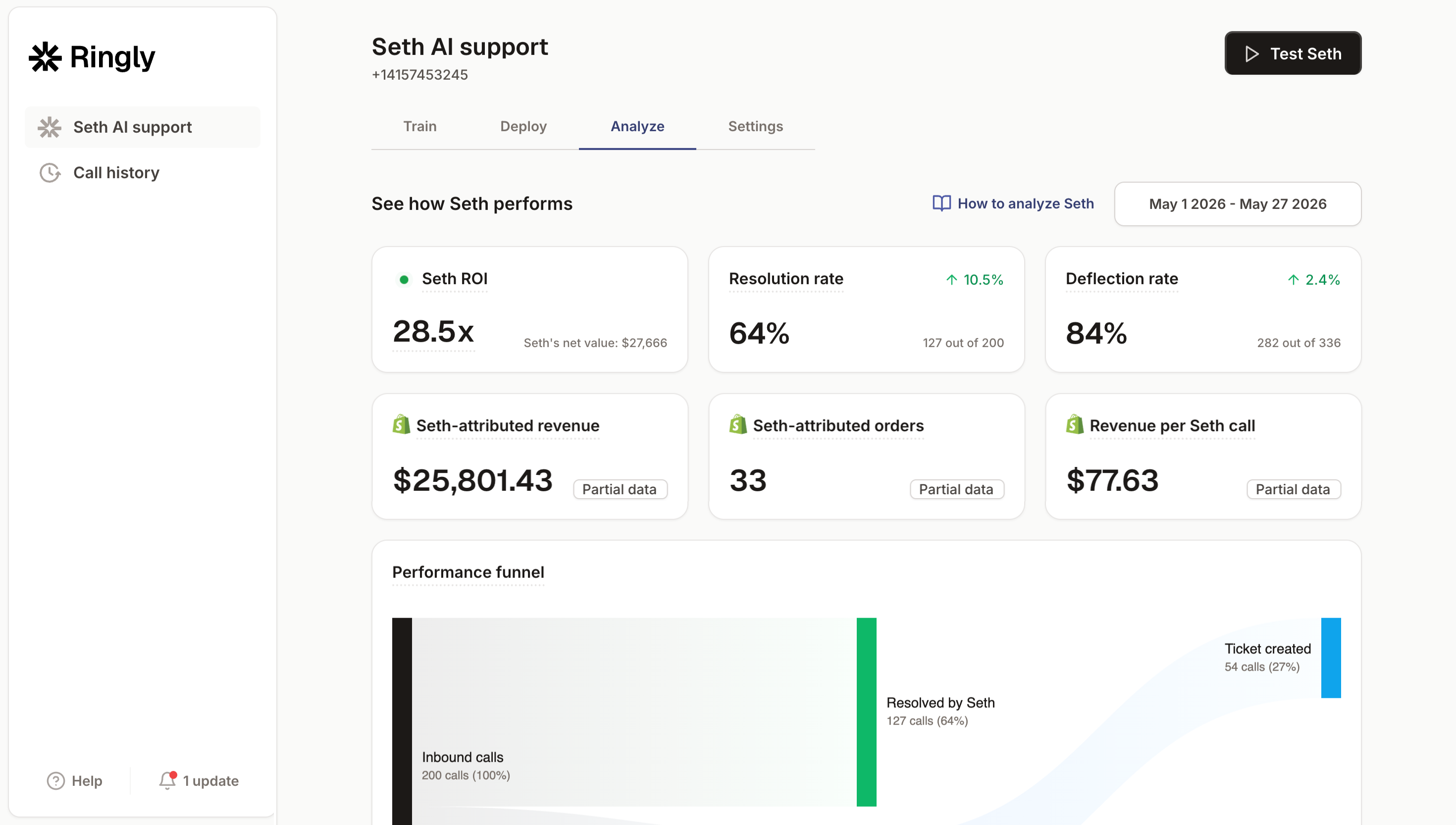
The AI answers your inbound calls 24/7. When someone calls about a return, it finds their order in Shopify, checks it against your return policy, and either processes the return and exchange by voice or sends the prepaid label by text. If it's a WISMO call riding on a return, it reads the live tracking. If it's the exception your portal rejected, it follows your escalation rules and routes a clean handoff to a rep instead of dumping the customer to voicemail. Calls that need a human escalate to Gorgias, Richpanel, Re:amaze, or whatever helpdesk you already run.
Seth resolves up to 90% of inbound calls on its own. TechCraft Studio handles 88% of its calls without a human. WashCo, a Shopify brand we launched, recovered $22,664 in attributed revenue in its first 7 days on the phone, partly by catching exchange and re-order calls a voicemail box would have lost.
It connects in under an hour. You point it at your store and your knowledge base, set your escalation rules, and it starts answering. You can see exactly how it's working in the order-status feature and the knowledge base setup. There's more detail on the full setup in our guide to the AI customer support phone agent for Shopify.
So the stack is simple. The returns portal deflects the web returns. Ringly deflects the return and WISMO calls the portal pushed onto the phone. Your CS team keeps the hard, judgment-call stuff, which is what they were hired for.
What this costs vs a returns-call CS team
The honest comparison isn't portal vs phone agent. It's "keep staffing reps to answer return calls" vs "let the AI take the routine ones."
Take a typical $50M Shopify brand running a 6-rep CS team:
| Line item | Today | With Ringly |
|---|---|---|
| 6 reps x $4K loaded per rep | $24,000/mo | n/a |
| Ringly (~$5K/mo) | n/a | $5,000/mo |
| Net monthly CS spend | $24,000/mo | $5,000/mo |
| Monthly savings | n/a | $19,000/mo |
| Annual savings | n/a | $228,000/yr |
That's roughly 70% of repeatable calls (return status, refund timing, exchange swaps, "where's my order," the same five things over and over) routed to the AI. The other 30%, the genuinely complex calls, still go to your CS team, who now have time to solve them instead of drowning in calls.
Compare that to the per-contact math everyone already knows: a human-handled return or WISMO contact runs $5 to $22 once you count agent time and overhead. The AI on Ringly runs $1.99 a call after the first 50. Run that across a few thousand return-adjacent calls a month and the portal-plus-phone setup pays for itself fast.
Book a 30-min call to compare this to your current setup. We'll do the math live against your real call volume.
How to set up self-serve returns plus phone backup on Shopify
This is the order I'd do it in if I were standing up returns on a Shopify brand from scratch. The numbers above come from real Ringly customer billing across 50+ active Shopify brands, plus the loaded cost of a US CS rep ($4K/month) that the buyer profile uses on every call.
- Install a returns portal first. Loop, ReturnGO, or AfterShip depending on volume and how complex your policy is. This is the cheapest, highest-impact move and it deflects the easy web returns immediately. See our returns management guide for the policy side.
- Turn on proactive tracking updates. Most of the WISMO that piggybacks on returns disappears when customers get status texts. This alone can cut "where's my order" contacts meaningfully.
- Tighten your return rules. Decide what auto-approves and what escalates. Clear rules mean fewer policy-argument calls, and they tell your phone layer when to hand off. Our notes on exchanges and refunds cover the common policy decisions.
- Add a phone layer for the calls the portal can't close. This is where Ringly answers the exceptions, the high-AOV confirmations, and the return-plus-WISMO follow-ups, then escalates cleanly when a human is needed.
- Watch the call log for a week. Sort your inbound calls into "portal could have handled this" and "always needed a human." That mix tells you where the remaining money is going.
Do the first three and you've handled the self-serve web returns. Add the fourth and you've handled the phone line too, without hiring a fifth and sixth rep to answer the same calls.
Frequently asked questions
What is a self-serve returns portal on Shopify?
It's a branded page where customers start their own return or exchange without contacting support. They enter an order, pick the item and reason, and get a prepaid label or exchange option. Apps like Loop, ReturnGO, and AfterShip add this on top of Shopify's basic native returns.
Does Shopify have a built-in self-serve returns feature?
Yes, but it's basic. Shopify's native returns let a customer request a return, but you lose the exchange-first flows, store credit, return rules, and branding that the dedicated apps offer. Most brands above a few hundred returns a month move to an app.
How much does a returns portal reduce support volume?
Self-service generally pulls 25-30% of call volume, and return-specific tickets can drop up to 80% with proactive status updates. The deflection is real, but it only covers customers who self-serve online. The ones who call still reach your phone line.
Can a self-serve portal handle return phone calls?
No. A portal is a web form, so it can't answer the customer who calls instead of using it. Those calls (exceptions, high-value orders, refund follow-ups, exchange questions) still need either a rep or an AI phone agent like Ringly.
Do I need a returns portal and a phone agent, or just one?
Most $10M-$100M Shopify brands need both. The portal deflects the easy web returns, and the phone agent handles the return and WISMO calls the portal can't close. Together they keep your CS team focused on the calls that need real judgment.
How does Ringly handle returns over the phone?
It answers inbound calls 24/7, finds the order in your Shopify store, checks it against your return policy, and processes the return or exchange by voice. If a call needs a human, it escalates to your helpdesk. It resolves up to 90% of calls on its own.
Talk to us

If you run a $10M-$100M Shopify brand and your returns portal is live but your phone is still ringing with return calls, a 30-min call is the fastest way to see what's slipping through.
Our 3 promises.
- Live in under 1 hour. Setup and test calls are free.
- 30-day money back on the $99 plan fee.
- 65% resolution guarantee: if Seth resolves under 65% of your support calls in a month, that month comes back as credit (after 90 days on Pay per call).
Ruben (Ringly co-founder) takes these calls personally.