
This post in 30 seconds.
- The Shopify returns process is a 5-stage workflow you design once (policy, request, approval, fulfillment, refund), plus a sixth stage almost nobody maps: the calls every return generates.
- The average DTC store now sees a return rate near 14%, and each return costs $10 to $65 to process before a single customer picks up the phone to ask where their refund is.
- Built for founders, COOs, and Heads of CX at $10M-$100M Shopify brands running a paid helpdesk and a phone line that goes quiet after 6 p.m.
Most operators treat returns as a setting they flip on once and forget. Turn on self-serve, pick a return window, done. Then the return rate climbs, the warehouse gets backed up, and the phone line starts ringing with the same three questions all day: what's your return window, did you get my package, where's my refund.
That's not a setting. That's a workflow. And the part that quietly eats your CS team isn't the admin clicks. It's the calls the workflow sends to a phone line nobody planned for. If you want to see what that's costing you, book a 30-min call and we'll map your returns call volume live.
Returns are climbing for everyone. The average ecommerce return rate sits around 19-20.8% across all categories in 2026, up from roughly 11% in 2020, with DTC brands closer to 14% (Eightx). If you run customer experience at a $10M-$100M Shopify brand, your returns process isn't a help-doc you read once. It's a system you operate every day, and the seasonal spike makes it worse. We've built AI phone agents for Shopify brands trying to keep that system from drowning their reps. Book a 30-min call and we'll show you which of your return calls a human actually needs to touch.
How I mapped the Shopify returns workflow
I'm Ruben, co-founder of Ringly. To write this, I didn't read Shopify's help docs and paraphrase them. I set up the returns process on a real Shopify store the way an operator would, ran test returns through it end to end, and counted every point where a human has to touch the order.
Here's what I scored:
- Where the workflow lives. I traced each stage to where it actually happens: the Shopify admin, the customer's account, the warehouse, the helpdesk, or the phone line.
- Where a human must touch it. I marked every stage that can't move forward without a person making a decision or an action.
- What each touch costs. I put a loaded-cost number on the manual touches, using the $4,000/month a US CS rep runs.
- Which touches are repeatable. I separated the routine touches (status updates, refund-timing answers, policy questions) from the genuine exceptions.
- The phone second wave. I called the store's own return line at 8 p.m. on a weeknight to see what happens to a return-status call after the team logs off.
The stage that surprised me wasn't in the admin at all. It was the phone. Every return Shopify processed cleanly still generated one to three inbound calls that the workflow itself never accounted for, and after hours those calls went straight to voicemail. That's the gap this guide is really about.
Why your returns process is really a workflow, not a setting
A return isn't one event. It's a chain: a customer changes their mind, requests a return, waits for approval, ships the item back, waits for it to arrive, waits for inspection, then waits for a refund to hit their card. Each "waits for" in that sentence is a moment the customer might call you.
Every stage you don't design is a stage your CS team handles by hand, on the phone, one call at a time. That's the real cost of treating returns as a setting.
The processing cost alone is steep. Handling a single ecommerce return runs $10 to $65 once you count inbound shipping, warehouse labor, inspection, and restocking (Eightx). Return rates also swing hard by category: apparel runs 20-40%, footwear 17-30%, electronics 8-15%, and beauty 4-12% (Richpanel). If you sell apparel at $40M, returns aren't a side process. They're a second operations team.
And that's before the phone. The processing cost shows up on a P&L. The call volume the returns generate usually doesn't, because it's buried inside your general support headcount. For more on where returns sit in the bigger ops picture, our guide to ecommerce returns management covers the warehouse side in depth.
The 5 stages of a Shopify returns process (the map)
Before any tool or app, here's the workflow itself. Five stages, plus the sixth that lives on your phone line.
| Stage | What happens | Where it lives | Who touches it | Repeatable? |
|---|---|---|---|---|
| 1. Policy + rules | Return window, fees, eligible items | Shopify admin (Settings) | Set once by ops | Set-and-forget |
| 2. Request | Customer asks to return an item | Customer account | Customer (self-serve) | Yes |
| 3. Approval | Approve or decline the request | Shopify admin | A human, every time | Yes, mostly |
| 4. Fulfillment | Label, ship back, inspect, restock | Admin + warehouse | Warehouse + ops | Partly |
| 5. Refund or exchange | Money back or swap sent | Shopify admin | A human | Yes |
| 6. The calls | "Where's my refund?" and friends | Phone line | Your CS team | Very |
Stages 1 through 5 are what Shopify's docs and every returns app talk about. Stage 6 is the one that decides whether your CS team has a calm week or a buried one. We'll build the first five, then spend real time on the sixth.
Stage 1-2: Set your policy and return rules, then turn on self-serve
The first two stages turn returns from a phone call into a structured request. Get them right and most customers never need to reach a human to start a return.
Return policy and return rules
Return rules are where you encode your policy into Shopify so it enforces itself. In your admin, go to Settings, then Policies. Return rules let you set the return window (a preset like 30 days or a custom number, counted from the delivery date), restocking or return fees, and which items are final sale (Shopify Help). The rules apply automatically when a customer places an order, so the terms are locked in at purchase.
A clear policy is also a returns-deflection tool. If your window, fees, and exceptions are obvious on the product page and in the order confirmation, fewer customers call to ask. If you're still drafting yours, our return policy generator and our breakdown of a solid ecommerce return policy are good starting points.
Self-serve returns
Self-serve is the stage that takes the request off your reps' plates. You turn it on in the Customer accounts section of your admin (Shopify Help). Once it's live, a customer logs into their account, selects the item, picks a reason, and submits a return request. You get a notification and review it in the admin.
Self-serve doesn't eliminate the work. It moves the easy part to the customer and leaves the decisions to you. That distinction matters a lot at the next stage. If you want a deeper look at the apps in this space, our roundup of Shopify returns apps compares the options.
One thing self-serve quietly fixes: it cuts the "how do I return this?" call before it happens. A customer who can log in and start the return in two clicks doesn't dial your line. But it only works if customers know it exists. Brands that bury the returns portal three clicks deep in the footer still take those calls. Put the self-serve link in the order confirmation, the shipping email, and the account page, and you deflect a real slice of the first wave of return calls before stage 6 ever loads. The brands that skip this step end up with reps reading customers their own return policy over the phone, which is exactly the kind of repeatable, low-value call that should never need a human.
Stage 3: Approval, and the auto-approval gap nobody warns you about
Here's the part that catches most operators off guard. Shopify's native self-serve returns can't approve themselves.
Every single return request has to be reviewed and approved or declined by you or your team, one at a time. Even Shopify Flow can't fully automate the approval (Shopify Help, ReturnZap). So if you're doing 400 returns a month on native self-serve, that's 400 manual approvals your team clicks through. The "self-serve" label makes it feel automated. The approval step is anything but.
This is where third-party apps earn their keep. Tools like Loop, ReturnGO, and ReturnZap add conditional auto-approval, so a return that fits your rules (in-window, non-final-sale, standard reason) clears without a human, and only the edge cases route to a person. If your return volume is high, that one capability is usually worth the app fee on its own.
The operator decision at this stage is simple to state and easy to get wrong: which returns auto-approve, and which ones a human looks at. Get the rules too loose and you eat fraud and abuse. Too tight and your team is back to clicking 400 approvals a month. Most brands land on auto-approving in-window, standard-reason returns under a dollar threshold and routing everything else.
Stage 4-5: Label, inspect, restock, refund or exchange
Once a return is approved, the physical and financial side kicks in. When you approve, you can add exchange items, send shipping instructions, and attach a return label, then communicate the estimated refund to the customer. After the item arrives, you mark the return as received, inspect it, restock it if it's still sellable so your inventory stays accurate, and issue the refund to the original payment method or fulfill the exchange.
Two operator notes here.
First, lean toward exchanges. A refund is lost revenue. An exchange keeps the sale and often the customer. Shopify lets you offer an exchange item at the approval step, and the brands that default to "exchange or store credit first, refund second" protect a meaningful slice of revenue that would otherwise walk. Our guides to Shopify exchanges and Shopify refunds walk through both flows.
There's also a sequencing decision most operators don't make on purpose: do you refund on receipt, or on inspection? Refund-on-receipt is faster and friendlier, but you eat the loss if the item comes back damaged or isn't what they shipped. Refund-on-inspection protects you from abuse but adds days to the customer's wait, which adds calls. High-trust, low-fraud categories usually refund on receipt. Higher-ticket or higher-abuse categories inspect first. Pick one deliberately, because the gap between "you got my return" and "I got my money" is the single most-called moment in the whole workflow.
Second, the refund creates a waiting period, and waiting periods create calls. A refund can take five to ten business days to actually land on the customer's card. The customer can't see that progress. So they call. This is the start of the second wave, and it's the part of the returns process that the admin walkthrough never mentions. For the wider context on how returns sit alongside the rest of your support load, our guide to ecommerce customer service is a useful companion read.
Stage 6: The calls your returns workflow generates
You can design stages 1 through 5 perfectly and still bury your CS team, because every return sets off a small chain of inbound calls that no returns app can see. Returns are the second-largest support bucket after order-status questions, and "where is my order" alone already runs 30-40% of support tickets in normal periods and 50%+ at peak (Salesforce).
Returns add a second wave on top of that. Three calls show up again and again:
- "What's your return window?" They didn't read the policy. They want to start a return and they want a human to confirm they're in time.
- "Did you get my return?" The package is in transit or just arrived, the status hasn't updated, and they're anxious about their money.
- "Where's my refund?" Approved, received, refunded on your end, but the money hasn't landed and they can't see the five-to-ten-day clock running. This is the WISMR call, the returns version of WISMO.
These calls hit your phone line, and your returns app can't answer a phone. Loop, ReturnGO, and the rest live on your website and in email. The customer who calls instead of clicking lands in your phone queue, and after 6 p.m. they land in voicemail. That's expensive. 78% of buyers abandon a brand after one unanswered call, 85% who can't reach a person never call back, and 62% switch to a competitor (PCN).
This is the stage Ringly was built for. We're not a returns app and we don't replace Loop or ReturnGO. We sit on your phone line, in front of Gorgias or whatever helpdesk you run, and answer the return-status, refund-timing, and return-window calls the moment they come in, day or night. The agent pulls the order, checks the return status, and tells the customer exactly where their refund is in the cycle. The genuinely complex calls still transfer to your team.
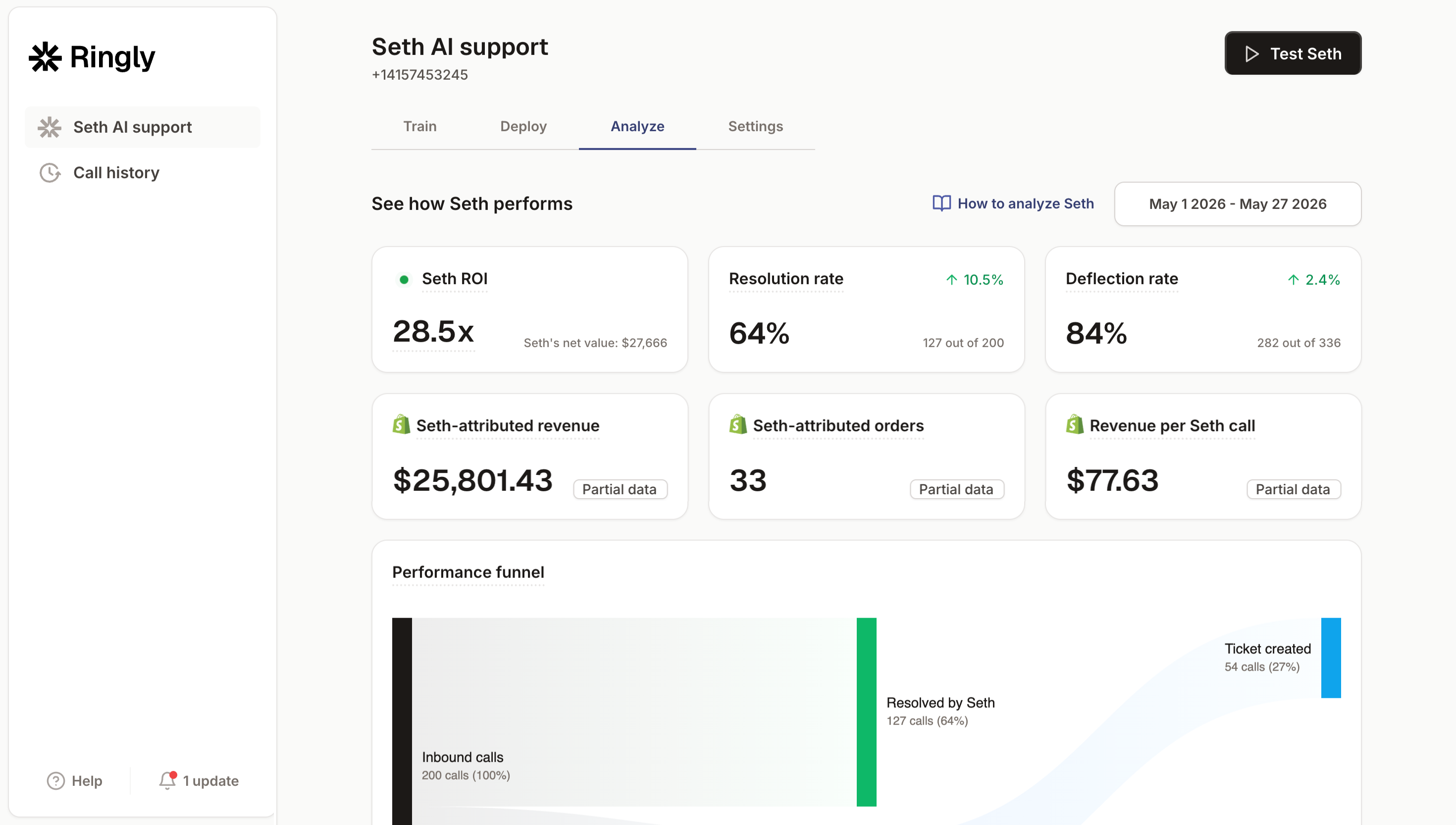
The numbers hold up. Seth resolves up to 90% of calls autonomously, at $1.99 a call after the first 50. WashCo, a Shopify brand we launched, recovered $22,664 in its first 7 days on the phone. TechCraft Studio handles 88% of its calls without a human ever picking up.
"My customers also feel like it's a normal person. They feel like they can communicate if they have questions."
Claudia Droge, TechCraft Studio
If your return line goes to voicemail after hours, that's the leak. Book a 30-min call and we'll listen to a few of your real return calls together. For the broader pattern, our piece on WISMO calls and WISMO automation on Shopify goes deeper on the order-status half of this.
What the manual returns loop costs your CS team
Put a number on it. Take a typical $50M Shopify brand running a 6-rep CS team, where a chunk of every rep's day is approving returns and answering the three return calls above.
| Line item | Today | With Ringly |
|---|---|---|
| 6 reps × $4K loaded per rep | $24,000/mo | n/a |
| Ringly (~$5K/mo) | n/a | $5,000/mo |
| Net monthly CS spend | $24,000/mo | $5,000/mo |
| Monthly savings | n/a | $19,000/mo |
| Annual savings | n/a | $228,000/yr |
That math assumes roughly 70% of repeatable calls (return status, refund timing, return-window questions, the same five things over and over) routed to the AI phone agent. The other 30%, the genuinely complex returns and the upset customers, still go to your CS team, who now have time to actually solve them instead of reading tracking numbers aloud.
The comparison runs in Ringly's favor on raw cost too. A human-handled call runs $7 to $16 at BPO rates against $1.99 on Ringly after the first 50, and replacing a single CS rep who burns out on repetitive return calls runs $14,113 (Insignia). The returns themselves still cost $10 to $65 each to process, but the call volume around them doesn't have to cost a rep's whole afternoon. Book a 30-min call and we'll run these numbers against your actual call data. Our outsource Shopify customer service and ecommerce phone support guides cover the staffing side.
Four ways the returns workflow breaks
After mapping this on a real store and watching it run across Shopify brands, the same four failure points show up over and over.
- Treating self-serve as the finish line. Turning on self-serve and walking away leaves the approval, refund, and call stages unowned. Self-serve is stage 2 of 6, not the whole thing.
- No deliberate auto-approval rule. Because Shopify native can't auto-approve, teams either click every request by hand or never tighten the rules in their returns app. Decide which returns clear on their own and which a human sees, then write it down.
- Silent refund windows. The five-to-ten-day refund gap is invisible to the customer. If you don't set the expectation at the refund step and answer the inevitable "where's my refund?" call, that silence becomes your busiest call type.
- Leaving the phone line out of the design. This is the big one. The returns workflow generates calls, the workflow doesn't account for them, and after 6 p.m. they hit voicemail. A return process that ends at "refund issued" is only five-sixths designed.
A returns workflow that ignores the phone isn't finished, it's just quiet until the phone rings. If your team is buried under repetitive return calls, our breakdown of running a Shopify call center pairs well with this guide.
Frequently asked questions
How do I set up the returns process in Shopify?
Start in Settings, then Policies, to create return rules (window, fees, eligible items). Then turn on self-serve returns in the Customer accounts section so customers can request returns themselves. From there you approve requests, send labels, inspect and restock returned items, and issue refunds or exchanges in the admin.
Can Shopify automatically approve returns?
Not natively. Shopify's self-serve returns require a human to review and approve or decline every single request, and Shopify Flow can't fully automate it (Shopify Help). Third-party apps like Loop, ReturnGO, and ReturnZap add conditional auto-approval based on rules you set.
What's the difference between a return policy and return rules?
Your return policy is the customer-facing terms (how long, what's eligible, who pays shipping). Return rules are how you encode those terms inside Shopify so they apply automatically to every order. The policy is the promise; the rules are the enforcement.
How long do Shopify refunds take?
Once you issue a refund, it typically takes five to ten business days to land on the customer's original payment method. The customer can't see that clock running, which is exactly why "where's my refund?" becomes a recurring call. Setting expectations at the refund step cuts some of those calls, but not all.
Do I need a returns app like Loop or ReturnGO?
If you're doing low return volume, native self-serve plus return rules is enough. Once manual approvals and exchange logic start eating real rep time, a returns app that adds auto-approval and exchange-first flows usually pays for itself. It won't touch your phone line, though.
How do I handle "where's my refund?" calls?
The durable fix is to answer them automatically. A returns app can't, because it lives on your website. An AI phone agent like Ringly pulls the order, checks the refund status, and tells the customer where they are in the five-to-ten-day cycle, 24/7, so the call never reaches a tired rep.
Should I offer exchanges instead of refunds?
When you can, yes. An exchange keeps the revenue and often the customer; a refund loses both. Shopify lets you offer an exchange item at the approval step, so default your flow to exchange or store credit first and refund second.
What's a good return window?
Thirty days from delivery is the common default and what most customers expect. Some brands extend to 60 or 90 days as a trust signal, betting that a longer window lowers purchase anxiety more than it raises returns. Match the window to your category's return rate and your margins.
Does Ringly replace my returns management app?
No. Ringly is an AI phone agent, not a returns app. Loop, ReturnGO, and ReturnZap handle the on-site return request and approval flow; Ringly answers the inbound calls that flow generates (return status, refund timing, policy questions) on your phone line, in front of your helpdesk. They're complementary, not competing.
Talk to us

If you run a $10M-$100M Shopify brand and your return line goes to voicemail after 6 p.m., a 30-min call is the fastest way to see what those missed return calls are costing you. We'll pull a few of your real calls and listen together.
Our 3 promises.
- Live in under 1 hour. Setup and test calls are free.
- 30-day money back on the $99 plan fee.
- 65% resolution guarantee: if Seth resolves under 65% of your support calls in a month, that month comes back as credit (after 90 days on Pay per call).
Ruben (Ringly co-founder) takes these calls personally.