

This post in 30 seconds.
- "Shopify POS customer service" means two different things. One is how you reach Shopify when your card reader dies. The other is how you handle your own customers when you run a Shopify store online and a counter in the real world. This post is about the second one.
- The hidden cost is the single phone number doing double duty: store questions all day, WISMO and pickup calls after close. Most of it is the same five questions over and over.
- Built for founders, COOs, and Heads of CX at $10M-$100M Shopify brands running both online and retail, with a visible phone number and a paid helpdesk.
Search "shopify pos customer service" and you get two completely different problems wearing the same words. The first is yours when something breaks: the card reader drops, the scanner won't pair, and you need a human at Shopify. The second is the one that actually eats your week. You run a Shopify store and a physical counter, and one phone line catches every "is my order ready", "are you open Sunday", and "where's my package" from both sides of the business.
If you run customer experience at a Shopify brand doing $10M-$100M with stores AND a website, you already know which problem costs you more. It's not the card reader. It's the phone that rings all day with the same five questions, and the after-hours calls nobody picks up. We've launched AI phone agents for 50+ Shopify brands trying to fix exactly that. Book a 30-min call and we'll show you what your store is leaving on the table after close.
What "Shopify POS customer service" actually means
There are two readings, and conflating them is why most of the advice online is useless to an operator.
The first reading is about reaching Shopify. If your store is on the Retail plan or you use Shopify POS Pro, you get phone and email support; otherwise you're routed through chat and callbacks inside the Help Center (per Shopify's own support docs). Useful to know when the hardware acts up. Not what we're here for.
The reading that costs you real money is the second one: how your brand answers its own customers across online and in-store on one phone line. That's a customer service operation, not a support ticket. And it's the version of "Shopify POS customer service" almost nobody writes about, even though it's the one with payroll attached.
Here's why the two get tangled. When you add a counter to a Shopify store, you don't add a second phone number. The number on your website is the number a walk-in customer calls to check your hours, the same number an online buyer calls to ask where their order is. One line, two jobs, and your customer service team is stuck in the middle of both.
The POS makes it worse in a specific way. A store gives customers a reason to expect a fast, human, local answer. They've stood in your shop, they have your number, and they assume someone will pick up. So the bar is higher than a pure online brand, and the volume is lumpier, because store traffic and online orders peak at different times and your one line absorbs both.
Before we go deeper, here's the short version of how brands actually handle that shared line.
| Approach | Cost shape | After-hours | Best for |
|---|---|---|---|
| In-house reps | ~$4K/mo loaded per rep, scales with volume | Only if you staff a night shift | Complex, high-touch calls |
| BPO / call center | $1.50-$3.50/call plus minimums | Possible, quality varies | Steady high volume, cost focus |
| Answering service | Per-minute, message-taking only | Yes, but takes messages, rarely resolves | Overflow + after-hours catch |
| AI phone agent | Flat monthly, ~$0.42 per resolved call | 24/7, resolves not just records | Repeatable calls across online + in-store |
We'll break each one down later. First, the calls.
The calls a POS-era Shopify brand actually gets
Walk the call log of a retail-plus-online Shopify brand and a pattern shows up fast. The volume isn't random. It clusters into four buckets, and three of them are pure repeat work.
WISMO is the single biggest one. "Where's my order" is the number one query retailers field, and 73% of consumers want an instant response (Envive omnichannel data, 2026). For a brand with a counter, WISMO arrives by phone more than by email, because the customer already has your number from the receipt or the storefront. We've written a full breakdown of WISMO calls if you want the deep version.
Then there's pickup. Buy-online-pickup-in-store sounds clean until the phone starts ringing with "is it ready yet", "what time do you close", and "can I send my partner instead". Failed pickups and abandoned orders trace back to slow or no answers more than anything else (RetailWire). Most of these are answerable from data you already have in Shopify, which is the whole argument for WISMO automation on Shopify: if the answer lives in the order record, a human doesn't need to read it out loud.
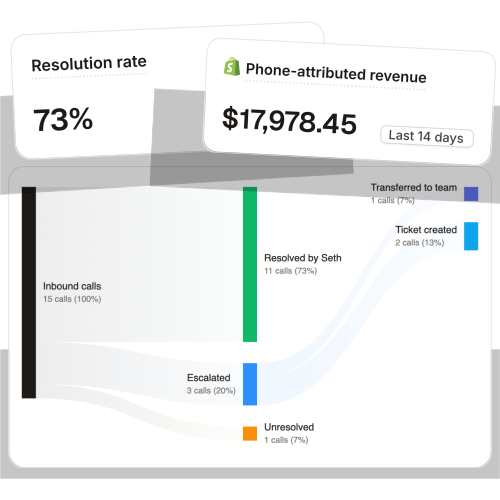
The third bucket is plain store stuff: hours, directions, "do you have this in stock", "is the sale still on". The fourth is everything after close, which is where it gets expensive. When I read the call logs across the 50+ Shopify brands we run, the most common after-hours call at retail-plus-online brands was a pickup or order-status question. The exact thing you can't justify staffing a $4K/mo rep to catch at 9 p.m.
Roughly 70-80% of those calls are repeatable, which means a human is doing work a system could do. The customer doesn't need empathy to hear that their order shipped. They need an answer, fast, on the channel they already chose.
And the channel matters more than people assume. The same shopper who texts a friend will still pick up the phone when an order goes sideways, because a real-time answer beats a ticket that sits in a queue. That's the case for keeping 24/7 phone support live even as you push self-service everywhere else. Drop the call and you don't just lose the answer, you lose the order, and often the customer.
Why staffing both online and in-store breaks
The math is the part operators avoid looking at. So let's look at it.
One phone line, two jobs, means your reps context-switch all day between a walk-in question and an online WISMO. That's fine at low volume. It falls apart on a busy Saturday or during a seasonal spike, when both demands peak at once and calls roll to voicemail. And 69% of consumers still want a phone option for anything complex (Nextiva, 2026), so the line never goes quiet.
Here's the trap with hiring your way out. After-hours volume isn't steady, so a night-shift rep sits idle most of the shift while still costing $4K/mo loaded. Long hold times are the number one cause of abandoned calls, and an abandon rate under 5% is considered good (Call Centre Helper). Most retail phone lines aren't close to good, because the staffing never matches the spiky demand.
WashCo, a Shopify brand we launched, recovered $22,664 in its first 7 days on the phone, almost entirely from calls that would have hit voicemail before. That's the shape of the leak: it's not that the calls are hard, it's that nobody's there to take them when they come.
There's a second hidden cost: the reps you do have burn out fastest on the repeat calls. Reading the same tracking number forty times a day is exactly the work that pushes a good rep to quit, and replacing one costs you months of ramp. So the real question for a POS-era brand isn't "how do we hire faster". It's "how do we cover a shared, spiky phone line without paying for idle reps or burning out the good ones". You can read our full take on scaling support without hiring and our broader notes on customer service for Shopify for the long version. The omnichannel pressure isn't slowing down either, as the 2026 omnichannel retail numbers make clear.
What this costs you today vs with an AI phone agent
Take a typical Shopify brand running a 6-rep customer service team to cover the store and the website.
| Line item | Today | With Ringly |
|---|---|---|
| 6 reps x $4K loaded per rep | $24,000/mo | n/a |
| Ringly (~$5K/mo) | n/a | $5,000/mo |
| Net monthly CS spend | $24,000/mo | $5,000/mo |
| Monthly savings | n/a | $19,000/mo |
| Annual savings | n/a | $228,000/yr |
That's roughly 70% of the repeatable calls (order status, pickup, returns, the same five things over and over) routed to the AI. The other 30%, the genuinely complex calls, still go to your team, who now have time to actually solve them instead of reciting tracking numbers.
The savings number isn't the whole story, though. The bigger shift is that the line stops dropping calls. Every after-hours WISMO that used to hit voicemail now gets answered, every pickup question gets resolved before it turns into a no-show, and your reps stop context-switching between a walk-in and a phone queue. The math above is the floor. The revenue you stop leaking after close is the part most operators never measured because they couldn't see it.
If you want to compare that to your current setup, book a 30-min call and we'll do the math on your real call volume.
How brands handle the Shopify POS phone load
Four real options. Each works for someone. Only one fits a spiky, shared, repeatable phone line.
In-house reps. The default. Great for the hard calls, the complaints, the high-value account that wants a human. The problem is cost scales linearly with volume, and you can't staff a night shift for calls that arrive in bursts. This is your escalation layer, not your whole answer.
BPO or outsourced call center. Cheaper per seat, can run 24/7. But you're now managing a vendor, quality drifts, and per-call costs ($1.50-$3.50 loaded) plus monthly minimums add up. Good for steady high volume, less good for a brand where the volume swings with store hours and launches.
Answering service. Cheap, covers after-hours. The catch is it takes messages, it doesn't resolve. The customer who wanted their tracking number gets a callback promise instead, which is most of the way to a refund request. For a brand where most calls are answerable from the order record, paying someone to write down a question and hand it back to your team the next morning is the worst of both worlds: you pay for the call AND you still answer it.
AI phone agent. This is the one built for the shared line. Ringly.io is AI phone support for Shopify brands. Your team wasn't hired to answer the same call 50 times a day, so the AI takes the routine inbound (order status, pickup, returns, product questions, abandoned cart follow-up) and your reps handle what's left.
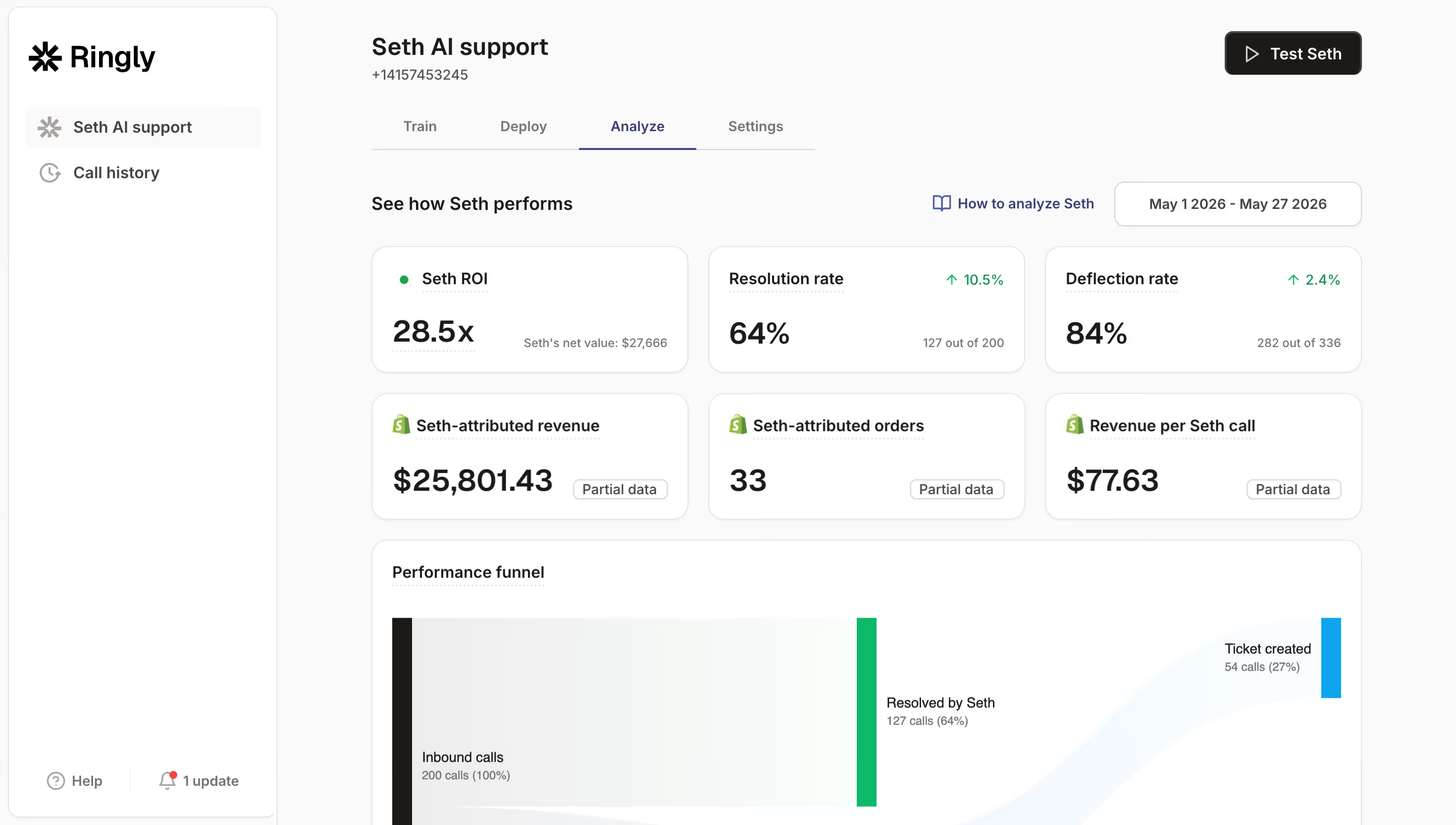
The AI answers calls 24/7, finds orders in your Shopify store, processes returns and exchanges, and answers product questions from your knowledge base. Across 50+ brands it resolves 73% of calls autonomously at roughly $0.42 per resolved call (versus $7-$16 a call for a human BPO). Calls that need a person escalate cleanly to Gorgias, Zendesk, Richpanel, or whatever helpdesk you already run. You keep your phone number, your helpdesk, and your workflows.
"My customers also feel like it's a normal person. They feel like they can communicate if they have questions."
Claudia Droge, TechCraft Studio
Plans are flat monthly: Grow at $349/mo (1,000 minutes), Pro at $799/mo (2,500 minutes), and a custom Enterprise tier for $10M-$100M brands with 3-12 reps. There's a 65% resolution guarantee: if the AI resolves under 65% of your calls in 90 days, we refund the last 3 months. For the full operator playbook on this, see our guide to Shopify Plus customer service and our breakdown of AI phone agents for Shopify.
The point isn't to replace your team. It's to stop paying skilled reps to recite tracking numbers and store hours so they can do the work that actually keeps customers. Omnichannel shoppers spend 16% more per order (Envive), and they notice when the phone gets answered.
Frequently asked questions
How do I contact Shopify POS support? Open the Shopify POS app, tap the icon, then Support, then Contact support to get the right channel for your account. Phone support is available if you're on the Retail plan or using POS Pro; otherwise you'll get chat or a callback through the Help Center. That's support for the app and hardware, separate from how you handle your own customers' calls.
Can an AI phone agent handle both my online and in-store calls? Yes. The same agent answers the one phone line that catches WISMO, pickup questions, store hours, and product questions, then escalates anything complex to your team. It's built for exactly the shared-line problem a retail-plus-online Shopify brand has.
Does it work with my existing helpdesk? Yes. Calls that need a human escalate cleanly to Gorgias, Zendesk, Richpanel, or whatever you already use. You keep your stack and your phone number; the AI sits in front of it.
Will customers know they're talking to AI? The most repeated thing customers say after a call is "you don't sound like AI". You control the voice, the rules, and what escalates, so it behaves like a well-trained rep, not a phone tree.
How much does it cost? Grow is $349/mo (1,000 minutes), Pro is $799/mo (2,500 minutes), and Enterprise is custom for larger brands. Pricing is flat monthly, and a 65% resolution guarantee backs it.
How fast can it go live? Live in under an hour for self-serve, or a 14-day Launch Sprint for Enterprise where we build it for you. You add your store, docs, and knowledge base, and the AI is ready.
Talk to us

If you run a $10M-$100M Shopify brand with a store and a website, the shared phone line is quietly the most expensive part of your support, and the easiest to fix. A 30-min call is the fastest way to see what you're leaving on the table after close.
The 3-layer guarantee.
- Live in 14 days or it's free until launched.
- 65% resolution in 90 days or we refund the last 3 months of subscription fees.
- We keep working free until we hit 65%.
Ruben (Ringly co-founder) takes these calls personally.