

This post in 30 seconds.
- In April 2026 Shopify pushed most B2B features (company accounts, custom catalogs, net terms, PO numbers) down to every paid plan, so "do I still need Plus?" is now a real question instead of a given.
- Plus still earns its keep for bigger wholesale operations: unlimited catalogs, a dedicated B2B storefront, deposits, and custom checkout. But no plan tier answers your phone.
- Built for $10M-$100M Shopify and Shopify Plus brands selling both DTC and wholesale, where one phone line now carries consumer "where's my order" calls and wholesale reorder calls at the same time.
Shopify spent the start of 2026 making the same point everyone in the wholesale world is now repeating: on April 2, native B2B features stopped being a Plus-only perk and rolled out to Basic, Grow, and Advanced. Company profiles, up to three custom catalogs, net terms, vaulted cards. The platform question got easier overnight.
So I went looking for the question nobody was asking. I called the order lines of nine Shopify brands that sell both DTC and wholesale, at 9 p.m. on a Tuesday. Seven went straight to voicemail. The two that picked up were the founder's cell. That is the part Shopify Plus B2B does not touch, and it is the part that quietly costs the most.
If you run support or operations at a $10M-$100M Shopify or Plus brand that sells direct AND wholesale, this is for you. You can book a 30-min call and we'll look at your missed calls together, or read on first.
Most brands at this stage have a Gorgias instance, a visible phone number, and a small support team that is already drowning in calls before wholesale even enters the picture. We've launched AI phone agents for 50+ Shopify brands trying to fix exactly that, and the after-hours wholesale call is one of the leakiest spots we find. Book a 30-min call and we'll map where your line is dropping orders.
What Shopify Plus B2B actually does in 2026
Shopify B2B is the native wholesale toolkit baked into the platform. You set up your wholesale customers as companies, give each one its own pricing, and let them reorder without a sales rep typing it in for them.
The headline shift in 2026 is that most of this no longer needs Plus. As of April 2, company accounts (up to 50 locations each), up to three custom catalogs with tailored pricing, volume and quantity rules, net payment terms like Net 30/60/90, purchase order numbers, and self-serve buyer ordering all work on Basic, Grow, and Advanced. Shopify's own data says merchants on B2B see up to a 4.1x increase in reorder frequency versus DTC orders, and up to a 33% increase in self-serve orders within six months (Shopify, April 2026).
What stays behind the Plus paywall is the heavier end of wholesale:
- Unlimited pricing catalogs instead of the three-catalog cap, so you can price every account or segment differently.
- A dedicated B2B storefront on its own domain, separate from your DTC shop.
- Deposits and partial-payment workflows, plus vaulted cards for buyer accounts.
- Checkout extensibility through Shopify Functions, for custom rules at the point of order.
- 2026 additions like EDI integration (SPS Commerce, Crstl), per-Market theme customization, store credit for company locations, and ACH payments.
If you want the full feature breakdown, our Shopify Plus features guide goes deeper, and the Shopify B2B ecommerce overview covers the setup side. The short version: the storefront and catalog problem is basically solved now, on every plan.
Plus versus every other plan: the quick split
Here's the part most readers actually came for. Shopify Plus runs around $2,300/mo (Uncap), so the only question that matters is whether the wholesale-specific extras pay for that jump.
| Capability | Basic / Grow / Advanced | Shopify Plus |
|---|---|---|
| Company accounts + net terms | Yes | Yes |
| Custom catalogs | Up to 3 | Unlimited |
| Dedicated B2B storefront (own domain) | No | Yes |
| Deposits / partial payments | No | Yes |
| Custom checkout (Functions, EDI) | No | Yes |
| Approx. monthly cost | $39-$399 | ~$2,300 |
The rule of thumb the agencies land on: most wholesale operations under about $5M in wholesale revenue do not need what Plus adds (Uncap). Above that, the unlimited catalogs and custom checkout usually start to earn the price.
Choose Shopify Plus if you run dozens of pricing tiers, need a separate wholesale domain, take deposits on large orders, or push orders through EDI. Stay on a lower plan if three catalogs cover your accounts and your buyers are happy ordering through the same storefront. For a closer look at the tier below Plus, our Shopify Plus vs Advanced breakdown and Shopify Plus benefits post both help.
The thing no plan tier fixes: the phone
Here's what every "Plus vs not" comparison leaves out. None of those features answer a phone call.
Wholesale buyers still call. They call to reorder a case they buy every month, to check whether something is back in stock before they commit, to chase a PO that hasn't shipped, to ask which net-terms invoice a payment landed against. These are the same WISMO calls your DTC side already gets, just with bigger order values attached. Shopify's own enterprise team puts it plainly: B2B buyers reorder from saved lists, place partial orders based on availability, and often call or email to negotiate (Shopify Enterprise). A self-serve portal reduces that volume. It never zeroes it out.
How real is the phone cost? Laird Superfood moved its wholesale buyers off phone-in orders and onto a password-protected Shopify portal, and that migration alone saved them an estimated $50,000 to $60,000 a year. Most brands never run that migration. The buyers keep calling, and after 6 p.m. the line keeps rolling to voicemail.
For a brand selling both DTC and wholesale, the real problem is that one phone line now carries two completely different kinds of call. A consumer rings about a $40 order. A wholesale account rings about a case reorder worth a few thousand. Same line, same after-hours voicemail, very different stakes when the call gets missed. WISMO style "where's my order" questions already make up 30-40% of support tickets in a normal week and 50%+ at peak (Salesforce). Layer wholesale reorders on top and your team is fielding the same questions over and over from two audiences at once.
The math on a missed call is brutal. 85% of callers who can't reach a person never call back, and 62% switch to a competitor (PCN). Most businesses answer only about 37.8% of inbound calls in the first place (AmbsCallCenter). For a wholesale account that reorders monthly, losing one to a missed call isn't one lost sale. It's the whole relationship, on autopilot, gone to whoever picked up instead.
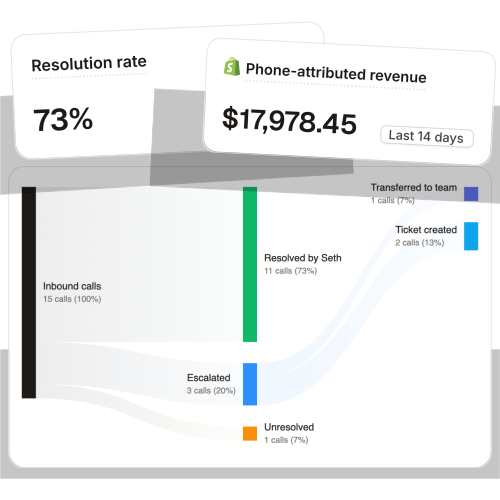
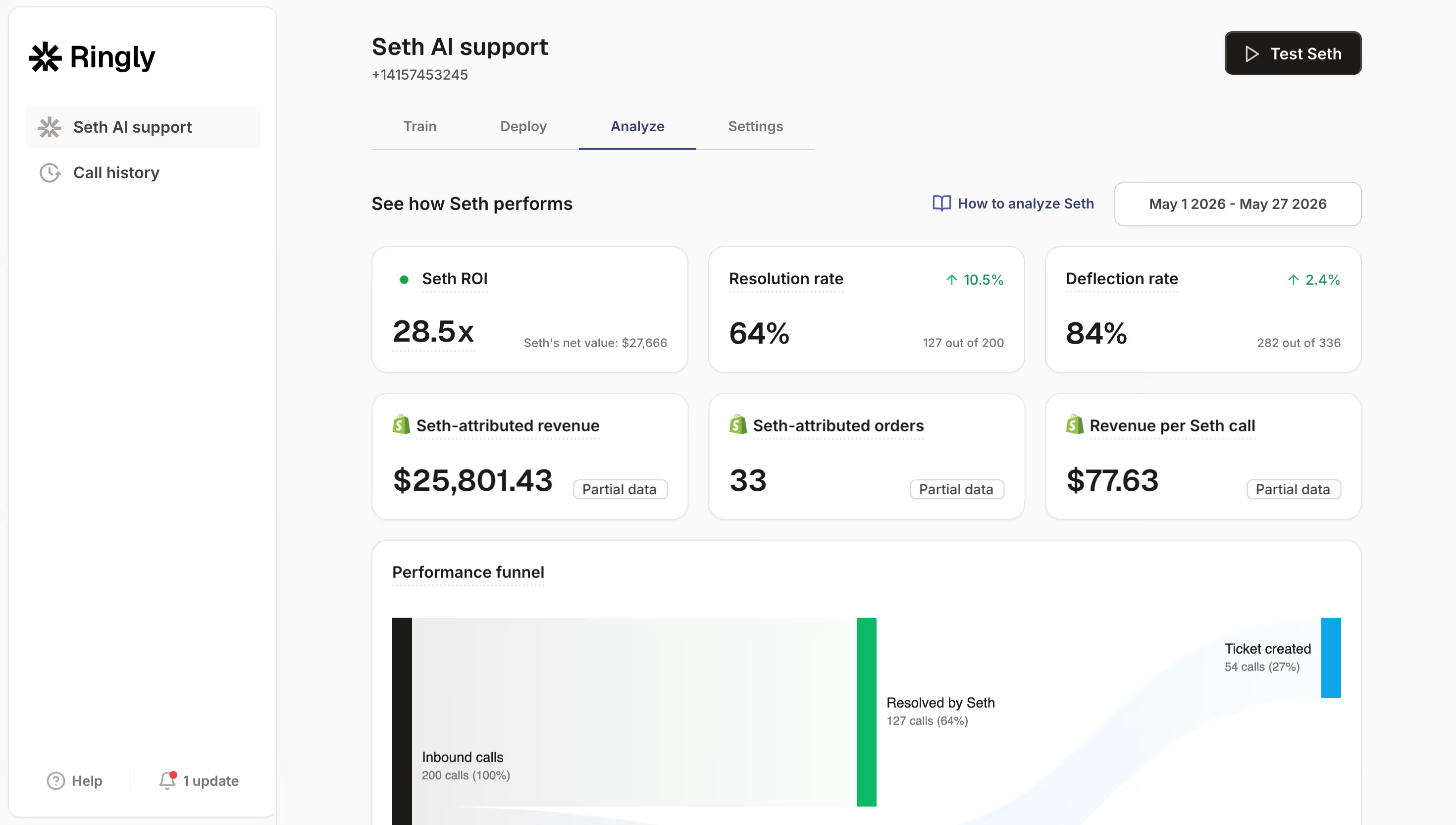
This is the gap our customers are closing. Ringly.io is AI phone support for Shopify brands. It answers inbound calls 24/7, finds orders in your store, checks stock, answers the routine reorder and policy questions, and escalates the calls that need a human to your team. Across 50+ brands it resolves 73% of calls autonomously, at roughly $0.42 per resolved call versus $7-$16 for a human BPO.
"My customers also feel like it's a normal person. They feel like they can communicate if they have questions."
Claudia Droge, TechCraft Studio
If your wholesale line goes to voicemail after hours, that's the most expensive voicemail box you own. Book a 30-min call and we'll pull your last 7 days of missed calls and see what's leaking.
What this costs you, and what it costs with an AI phone agent
Put a number on it. Take a typical brand running a 6-rep support team to cover both DTC and wholesale calls.
| Line item | Today | With Ringly |
|---|---|---|
| 6 reps × $4K loaded per rep | $24,000/mo | n/a |
| AI phone agent (~$5K/mo) | n/a | $5,000/mo |
| Net monthly support spend | $24,000/mo | $5,000/mo |
| Monthly savings | n/a | $19,000/mo |
| Annual savings | n/a | $228,000/yr |
That's roughly 70% of the repeatable calls (reorder status, stock checks, PO lookups, the same five questions over and over) routed to the AI. The genuinely complex calls, a price negotiation or a disputed invoice, still go to your team, who now have time to actually handle them well. WashCo, a Shopify brand we launched, recovered $22,664 in attributed revenue in its first 7 days on the phone.
Ringly sits in front of Gorgias, Zendesk, or whatever helpdesk you already run. It doesn't replace your stack. It answers the phone in front of it and hands off cleanly. You keep your number, your catalogs, and your team. For the full cost-side picture, see our Shopify Plus customer service guide. Book a 30-min call and we'll do this math live against your real call volume.
How to keep wholesale phone support live without hiring
You don't need a night shift and you don't need hire #5. You need a clean split between what's repeatable and what isn't.
- Route the routine to the AI. Reorder status, stock checks, PO and tracking lookups, net-terms questions, order status for both DTC and wholesale. These are the same questions over and over, and an AI phone agent that checks order status handles them from your live Shopify data.
- Hard-code the escalations. New-account setup, price negotiation, disputes, and anything legal go straight to a named human on your team. You decide the rules in the knowledge base.
- Keep your portal pushing self-serve. The Shopify B2B portal still does the heavy lifting for buyers who'd rather click than call. The phone agent catches the ones who won't.
- Cover after-hours and the seasonal spike. This is where the voicemail backlog forms. 24/7 phone coverage means a wholesale buyer reordering at 9 p.m. gets a real answer, not a callback you may never make.
That combination keeps phone support live for both audiences without growing the team every time call volume does. Our guide to scaling customer service without hiring and the Shopify call center breakdown go further on the operational side.
Frequently asked questions
Do I still need Shopify Plus for B2B in 2026? Often no. Since April 2026, company accounts, up to three custom catalogs, net terms, and PO numbers work on Basic, Grow, and Advanced. Most wholesale operations under roughly $5M in wholesale revenue can run B2B without paying for Plus.
What B2B features are Plus-only? Unlimited pricing catalogs, a dedicated B2B storefront on its own domain, deposits and partial payments, custom checkout via Shopify Functions, and EDI integrations. If you need those, Plus at around $2,300/mo is usually worth it.
Do wholesale buyers really still call instead of using the portal? Yes. A self-serve portal cuts call volume but never zeroes it. Buyers call to chase a PO, check stock before a big order, or ask a net-terms question. Laird Superfood saved $50,000 to $60,000 a year just by moving wholesale orders off the phone, which tells you how much phone volume was there to begin with.
Can an AI phone agent handle wholesale reorder calls? Yes, for the repeatable ones. Reorder status, stock checks, PO and order lookups, and net-terms questions pull from your live Shopify data. Price negotiations and disputes escalate to your team on rules you set.
Does this replace my helpdesk like Gorgias or Zendesk? No. Ringly sits in front of your helpdesk and answers the phone, then escalates cleanly into Gorgias, Zendesk, Re:amaze, or whatever you run. You keep your existing stack and workflows.
How much does AI phone support cost versus a rep? Roughly $0.42 per resolved call versus $7-$16 per call for a human BPO. Plans start at $349/mo, and a 6-rep team running about $24,000/mo loaded typically drops to around $5,000/mo with the AI handling the repeatable volume.
Talk to us

If you run a $10M-$100M Shopify or Plus brand selling both DTC and wholesale, and your phone line is the thing no plan tier fixes, a 30-min call is the fastest way to see what after-hours is costing you on both sides.
The 3-layer guarantee.
- Live in 14 days or it's free until launched.
- 65% resolution in 90 days or we refund the last 3 months of subscription fees.
- We keep working free until we hit 65%.
Ruben (Ringly co-founder) takes these calls personally.