

This post in 30 seconds.
- What it really is: Shopify order management is the whole path from "order placed" to "customer stops asking where it is," not just fulfilling and shipping.
- The miss: most guides treat it as a warehouse problem. The expensive half is the post-purchase question load, and a big slice of it lands on your phone.
- Built for: founders, COOs, and Heads of CX at $10M-$100M Shopify brands with a paid helpdesk and a visible phone number.
Picture the Monday. Your Orders page is clean, routing is set, the warehouse is moving. And the phone still won't stop. Half the calls are some version of "where's my order," from people who already got a tracking email they didn't open. You hired a team to grow the brand, and they're reading order numbers off a screen all day.
That's the part of Shopify order management nobody scopes. If you run a $10M-$100M brand on Shopify with a Gorgias instance and a phone line on the site, the warehouse side is mostly solved. The phone side of order management is where your CS payroll quietly goes. If you want, book a 30-min call and we'll show you what your order-status calls are actually costing you each month.
What Shopify order management actually covers
Start with what the platform gives you, because it's good. You manage everything from the Orders page in your Shopify admin: capture payment, review the order, print the shipping documents, fulfill, and push tracking back to the customer. You can pull orders from every channel you sell on (your store, Instagram, Google, Amazon) into one list, then save custom views with the columns and filters your team actually uses.
Under the hood, every order moves through a set of states: unfulfilled, partially fulfilled, fulfilled, delivered, and returned. Inventory updates in real time across locations as orders come in and returns go out, and smart order routing picks the fulfillment location that makes sense. For a lot of brands, that native setup is the entire system. According to Shopify, a dedicated order management layer can speed processing by roughly 40% and cut errors by more than half, and Shopify Flow gets you a chunk of that automation natively.
Native Shopify handles the operations side of order management well. What it does not do is answer the phone when the customer wants a human to read them the status. That gap is the whole reason this post exists. If you want a deeper read on the platform itself, our Shopify Plus customer service guide covers where the native tools stop.
The order lifecycle, and where it actually breaks
Shopify frames automated order management as six stages: capture, validation, routing, fulfillment, communication, and reconciliation. The first four are warehouse mechanics. They break loudly when they break (a wrong address, a split shipment), but they're the part most operations teams have already tightened.
Stage five is where the quiet leak is. Communication means the tracking update goes out. The problem is that the customer doesn't always read it, doesn't trust it, or wants to hear it from a person. So they call. And the order is now "managed" in every sense except the one that's costing you money.
Worth saying plainly: this isn't a failure of your operations team. The order shipped, the email sent, the data is correct. The customer just behaves like a customer. A returning buyer who's anxious about a birthday gift doesn't open a tracking link, they dial the number on your site. So the better your order management gets on the warehouse side, the more the remaining cost concentrates in this one place, the phone. That's why teams that have tightened everything else still feel like they're drowning in calls.
When I read through the call logs across the Shopify brands we run phone support for, the single most common reason a phone rings is an order whose status the customer could already see. That tracks with the wider data. Salesforce puts "where is my order" at 30-40% of support tickets in normal periods and over 50% at peak, and each one costs around $5 to resolve when a human handles it by email. On the phone it costs more, because a call ties up a rep for the whole conversation, not a 90-second reply between three other tickets.
A perfectly routed order that still generates a human phone call hasn't been fully managed, it's just been shipped. Most of those calls are the same five questions over and over. We break the actual question patterns down in our WISMO calls guide, and the broader picture in our ecommerce customer service breakdown.
The hidden tax: order-status calls
Here's why the order-status call is worth singling out. It's the most automatable call in your building, because Shopify already holds the answer. The order state, the tracking number, the carrier, the expected date, all of it lives in the order record. A human reading it back to a caller is doing data lookup, not judgment.
Two things make this worse than it looks on a ticket count. First, timing. A lot of orders get placed in the evening and on weekends, which means the questions stack up after-hours and hit your line first thing Monday, or roll to voicemail nobody returns. Second, the cost of a missed one. PCN's 2026 study found 85% of callers who can't reach a person never call back, and 62% switch to a competitor. And most brands answer far fewer calls than they think: AmbsCallCenter pegs the average answered rate at 37.8%. So the order-status call isn't just a cost, an unanswered one is a churned customer.
This is the angle our own brands lean on. WashCo, a Shopify brand we launched, recovered $22,664 in its first 7 days on the phone, mostly by catching order and pre-purchase calls that used to go nowhere. The order-status call you automate well is also a call you stop losing. For the customer-facing side of this, our order tracking guide covers the self-serve layer.
The automation playbook: 5 moves that drain the phone backlog
You don't fix this by hiring a night shift to read tracking numbers. You fix it by making sure the order-status answer reaches the customer before, or instead of, a human conversation. Here's the order I'd run it in.
- Get proactive on comms. The biggest reducer most brands underuse is telling the customer before they ask. A delay message ("weather held your order, new date is Thursday") kills the call that would have come. Wire it through Shopify Flow or your email tool so it fires on status change.
- Make self-serve actually self-serve. A real order status page, linked in the confirmation and shipping emails, catches the customers who are willing to look. See our walkthrough on letting customers track order status on Shopify.
- Template the helpdesk. Macros plus Shopify Flow rules (auto-tag WISMO tickets, hold suspicious orders, route returns) keep the email and chat side from eating rep time. If you're still picking a helpdesk, compare options in our Gorgias breakdown.
- Decide native vs a dedicated OMS. Most $10M-$100M brands plug leaks rather than swap systems. We cover the call below and in our best Shopify OMS guide.
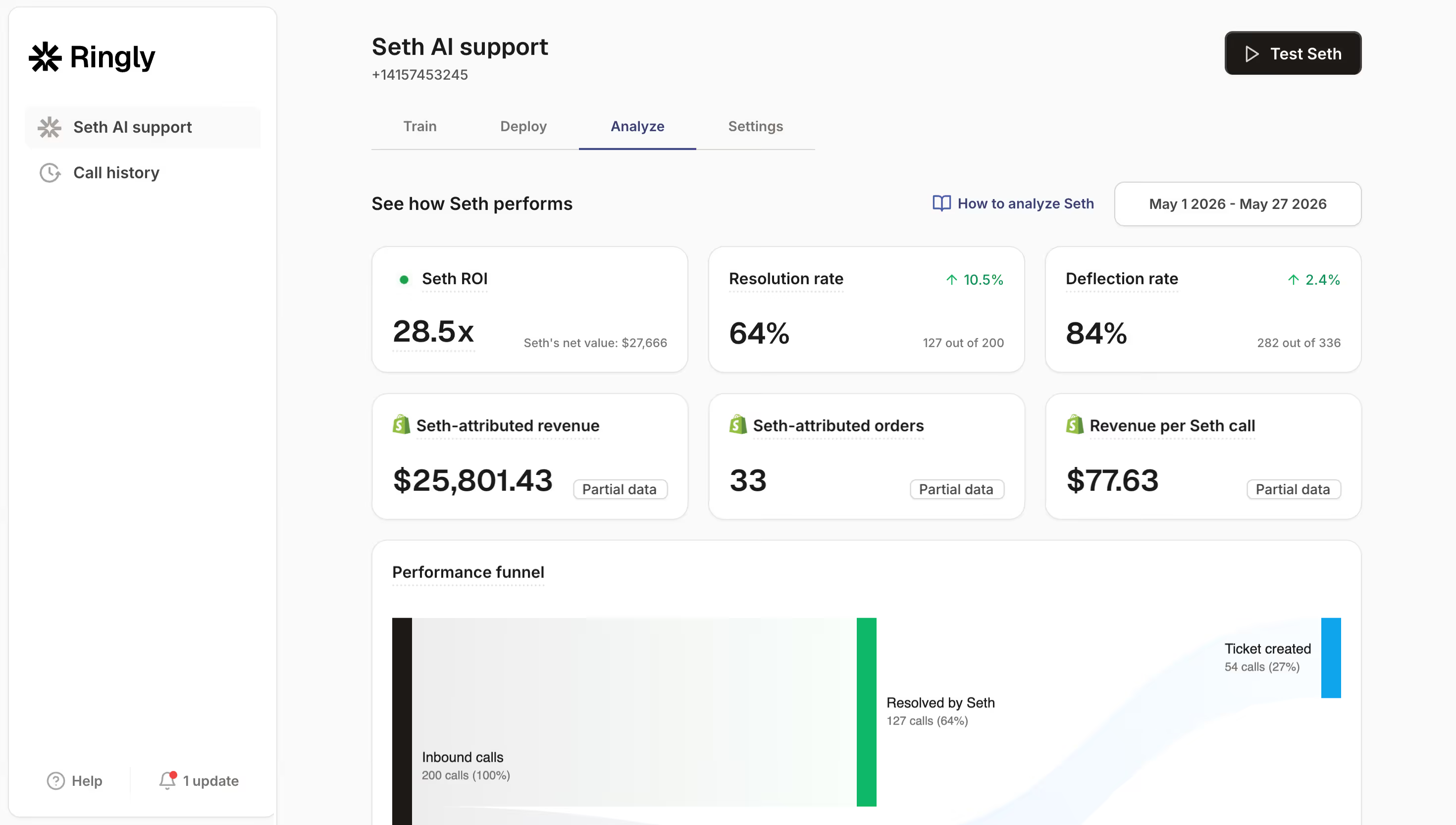
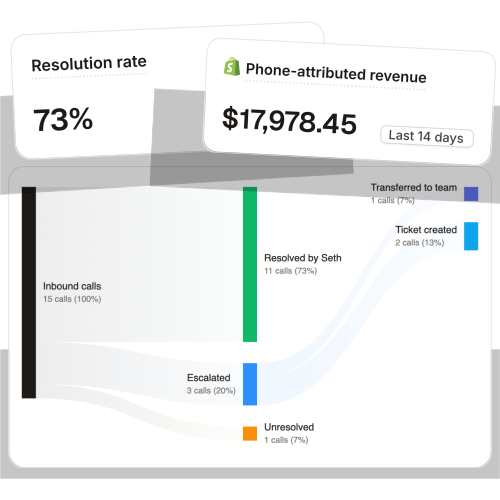
- Add the phone layer. This is the one nobody ships. An AI phone agent answers the order-status call 24/7, looks up the order in Shopify, reads the status, and escalates the genuinely hard calls to your team. That's what we build at Ringly.io. Across 50+ brands, the AI resolves 73% of inbound calls on its own at roughly $0.42 per resolved call.
Order status is the safest workflow to automate because it's structured and repeatable, which is exactly why it's the fastest place to get your phone backlog down. For brands fighting volume spikes, our high call volume playbook goes deeper.
Native Shopify vs a dedicated OMS: when to upgrade
People reach for "do I need an OMS" when what they actually have is a phone problem and an inventory problem wearing the same coat. Separate them. The table below is how I'd think about it for a brand in our range.
| Layer | Stay native if | Add it if |
|---|---|---|
| Shopify Orders (built-in) | One main channel, simple location logic, tight catalog | n/a (you already have it) |
| Dedicated OMS app | Multi-warehouse, multi-channel, complex routing, 3PL handoffs | Native routing is forcing manual workarounds daily |
| Phone layer (AI phone agent) | You have no phone line and never will | A real share of order-status questions arrive by phone |
The honest version: most brands in the $10M-$100M band don't need to rip out native Shopify order management. Roughly half of fulfillment operations are still mostly manual, so there's usually easy automation left on the table before a full OMS swap is justified. The phone layer is almost always the cheaper, faster lever, because it's the one that's been completely unowned. Our Shopify OMS integration guide covers the data plumbing if you do upgrade.
One trap to avoid: buying a big OMS to solve a problem the phone layer would solve for a fraction of the price. An OMS project is months of integration work and a real line item. If the daily pain you're feeling is reps reading tracking numbers off a screen, that's not an inventory problem, and a new OMS won't touch it. Scope the actual leak before you scope the spend. If most of your manual workarounds are routing and 3PL handoffs, an OMS earns its keep. If most of them are order-status conversations, the cheaper fix is making sure those conversations don't reach a human in the first place.
What this costs you today vs what it costs with a phone layer
Put real numbers on it. Take a brand running a 6-rep CS team where a meaningful chunk of the day is order-status lookups.
| Line item | Today | With a phone layer |
|---|---|---|
| 6 reps x $4K loaded per rep | $24,000/mo | n/a |
| AI phone agent | n/a | ~$5,000/mo |
| Net monthly CS spend | $24,000/mo | $5,000/mo |
| Monthly savings | n/a | $19,000/mo |
| Annual savings | n/a | $228,000/yr |
That's roughly 70% of repeatable calls (order status, returns, the same product questions over and over) handled by the AI. The other 30%, the genuinely complex ones, still go to your team, who now have time to actually solve them. Exact pricing gets set on a call, but the savings shape is what we see across 50+ brands. Plans start at $349/mo on the pricing page, and there's a 65% resolution guarantee behind it.
If you want this run against your real call volume, book a 30-min call and we'll do the math live.
"My customers also feel like it's a normal person. They feel like they can communicate if they have questions."
Claudia Droge, TechCraft Studio
Voice quality is usually the first worry, and it's a fair one. TechCraft Studio handles 88% of calls without a human, and the thing customers say most after talking to the agent is that it doesn't sound like AI. That's the bar order-status automation has to clear, because a bad-sounding call is worse than a voicemail.
Frequently asked questions
Does Shopify have a built-in order management system? Yes. The Orders page in your Shopify admin captures, reviews, fulfills, and tracks orders across every sales channel, with real-time inventory and smart order routing. For single-channel brands with simple logic it's often the whole system. The gap is the post-purchase phone questions it doesn't answer.
What are the order statuses in Shopify? The core fulfillment states are unfulfilled, partially fulfilled, fulfilled, delivered, and returned, plus payment and archive states. These are the same signals an AI phone agent reads when a customer calls to ask where their order is.
When do I need a dedicated OMS instead of native Shopify? Add a dedicated OMS when you're running multiple warehouses, complex routing, or 3PL handoffs that force daily manual workarounds. Most $10M-$100M brands don't need a full swap, they need to automate the leaks first. Order-status calls are usually the biggest unowned leak.
How do I reduce order-status (WISMO) questions? Proactive shipping and delay messages, a real self-serve tracking page, and helpdesk macros cut the email and chat side. For the phone side, an AI agent that looks up the order in Shopify and reads the status handles the calls those tools miss. Salesforce data puts WISMO at 30-40% of tickets, so the upside is large.
Can order-status phone calls actually be automated? Yes, and it's the safest call to automate because the answer already lives in Shopify. The AI looks up the order, reads the state and tracking, and escalates anything genuinely complex to a human. Order status is structured and repeatable, which is why it's the fastest workflow to get ROI on.
What does it cost to handle an order-status call manually? Industry data puts a WISMO ticket around $5 to resolve by email, and a phone call costs more because it ties up a rep for the whole conversation. At volume, that's thousands a month for work the order record could answer on its own.
Will an AI phone agent replace my Shopify order management setup? No. It sits in front of your existing stack and answers calls, then escalates to Gorgias, Richpanel, or whatever helpdesk you run. You keep your phone number, your order data, and your workflows. It just stops the routine order-status calls from reaching a human.
Talk to us

If you run a $10M-$100M Shopify brand and your order-status calls are eating rep hours, a 30-min call is the fastest way to see what you're leaving on the table. We'll pull your real numbers and show you the share of calls that never needed a human.
The 3-layer guarantee.
- Live in 14 days or it's free until launched.
- 65% resolution in 90 days or we refund the last 3 months of subscription fees.
- We keep working free until we hit 65%.
Ruben (Ringly co-founder) takes these calls personally.