
This post in 30 seconds.
- Easy returns aren't a portal you switch on. They're a loop: clear policy, self-serve start, exchange-first, fast refund, and someone who answers the "did you get my return?" call.
- 92% of shoppers buy again after an easy return (Invesp), but the loop breaks the moment a return-status call rolls to voicemail.
- Built for $10M-$100M Shopify and Shopify Plus brands running a paid helpdesk and a visible phone number.
Most guides on Shopify easy returns stop at the portal. Turn on self-serve returns, write a clean policy, add an exchange step, done. That covers the part the customer sees before they ship the box back. It misses the part that fills your phone line after.
If you run support at a $10M-$100M Shopify brand, you already know the second wave. A customer drops the package at UPS, then calls three days later to ask if you got it and when the refund hits. Easy returns made the front half effortless and quietly moved the friction onto your CS team. We've launched AI phone agents for 50+ Shopify brands trying to close that gap, and the calls tell a consistent story. Book a 30-min call and we'll show you what your return-status calls actually look like.
Why easy returns are worth the work
Returns feel like pure cost until you look at what they do to repeat purchase. A clean returns experience is one of the cheapest retention levers a Shopify brand has.
92% of consumers say they'll buy again from a store if the return was easy, and 67% read the return policy before they ever place a first order (Invesp). That second number is the one operators underrate. The policy isn't a back-office document. It's a conversion asset that sits between the add-to-cart and the checkout.
There's a revenue angle too. When a returns flow offers an exchange before it offers a refund, brands typically hold onto 30-40% of the revenue that would otherwise walk out the door as a refund (Refundid, Synctrack ecosystem data). Refundid also reports that instant refunds get customers repurchasing up to 3x faster. So "easy" isn't just nice. It compounds straight into ecommerce customer retention.
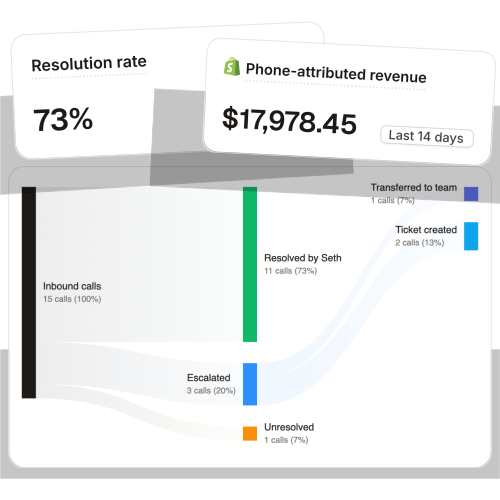
Here's the catch nobody puts in the stats. Every one of those benefits assumes the customer never hits a wall during the return. The 92% repurchase number quietly depends on the refund landing on time and on someone picking up when they call to check. Break either, and the easy return becomes the thing they screenshot.
The five friction points that make returns feel hard
Customers don't experience "returns." They experience five separate moments, and any one of them can turn a smooth return into a support ticket. Most brands fix three of the five and wonder why the calls keep coming.
- Policy clarity. Vague policies create the "can I return this?" call. Write the window, the condition, and the exclusions in plain English. 30 days is the standard; 30-90 is the safe range. State final-sale and personalized-item exclusions up front so nobody finds out at the worst moment.
- Self-serve initiation. Shopify's self-serve returns let a customer start a return from the order status page without emailing you. If they have to message support to begin, you've already added a ticket before the box has moved.
- Exchange-first, not refund-first. Shopify's native flow makes a refund the easy path. That's backwards for your margin. Surface the exchange or store-credit option before the refund, so the customer who just wanted a different size never becomes a lost sale.
- Refund speed and visibility. The slow, silent refund is the single biggest driver of return-status calls. If the customer can't see where their refund is, they'll call to ask. Every day of silence is a day of phone risk.
- The status answer. This is the one the portal doesn't cover. Once the box is in transit back to you, the customer's only question is "did you get it and where's my money," and they ask it by phone more often than operators expect.
Fix the first four and you've built a genuinely good Shopify easy returns flow. The fifth is where most brands quietly lose the plot.
The return-status phone wave nobody plans for
When we onboard a new Shopify brand, one of the first things we do is read their real call logs. Across 50+ brands, the pattern in the return-status calls is almost boringly consistent. After the box ships back, customers call to confirm you received it and to ask when the refund clears. Call it the second WISMO wave: not "where's my order" but "where's my refund."
It makes sense when you think about the emotion. The customer has already given the product back. Now they're waiting on money with no visibility, and waiting on money makes people pick up the phone. A returns portal handles the request. It does nothing for the call that comes three days later.
This matters because WISMO-style questions already make up 30-40% of support tickets, and over 50% at peak (Salesforce). Returns add a parallel wave on top of that, concentrated in the days right after a return ships. For a brand running 3-12 reps, that wave lands on the same team that's already drowning in the order-status calls. It's the same questions over and over, on a channel most returns apps don't touch. We dug into this pattern in detail in our breakdown of WISMO calls and how to handle them with WISMO automation on Shopify.
"My customers also feel like it's a normal person. They feel like they can communicate if they have questions."
Claudia Droge, TechCraft Studio
The brands that get returns genuinely easy are the ones that treat the phone as part of the flow, not as a separate cost center. The portal answers the request. Something still has to answer the call.
Build the easy-returns loop end to end
Easy returns is a loop, not a feature. Here's the full version, in the order the customer experiences it.
- Write a plain-English policy and put it where buyers look: product page, cart, footer, order confirmation. A clear return policy prevents the pre-purchase "can I return this?" question entirely. If you don't have one drafted, our return policy generator gives you a starting point.
- Configure return rules in Shopify. Set the window, mark final-sale items, pick your shipping strategy, and add a restocking fee if you use one. Rules stop ineligible requests before they hit your queue.
- Turn on self-serve returns so customers start from the order status page. This is the single biggest ticket-reducer in the Shopify returns process. We covered exactly what a self-serve portal fixes and what it can't separately.
- Lead with the exchange. A dedicated Shopify returns app surfaces exchanges and store credit before the refund, which is where the revenue retention comes from.
- Make refund status visible. Proactive "we got your return, refund is processing" messages cut the status calls before they happen. Layer this on and return-related contacts drop hard.
- Answer the call. When a customer still calls to check, that call has to be picked up, including after hours and on weekends. This is where Ringly fits.
Ringly.io is AI phone support for Shopify brands. Instead of growing your support headcount every time return volume spikes, the AI handles the inbound calls: order status, return status, product questions, and refund-timing checks. It finds the order in your Shopify store with order-status lookup, checks where the return and refund stand, and answers in plain language, even after hours and on weekends. Across 50+ brands, the AI resolves 73% of calls autonomously at roughly $0.42 per resolved call. Anything it can't close escalates cleanly to Gorgias, Richpanel, or whatever helpdesk you already run.
That's the difference between a returns flow that's easy on the screen and one that's easy all the way through. If your return-status calls go to voicemail after 6 p.m., book a 30-min call and we'll map your routing.
What this costs vs what easy returns earn back
The phone side of easy returns usually gets framed as a hiring problem. You hit a volume of return-status calls, you add a rep, you do it again next quarter. Here's the math on the alternative.
Take a $50M Shopify brand running a 6-rep CS team:
| Line item | Today | With Ringly |
|---|---|---|
| 6 reps x $4K loaded per rep | $24,000/mo | n/a |
| Ringly (about $5K/mo) | n/a | $5,000/mo |
| Net monthly CS spend | $24,000/mo | $5,000/mo |
| Monthly savings | n/a | $19,000/mo |
| Annual savings | n/a | $228,000/yr |
That's roughly 70% of repeatable calls (order status, return status, refund timing, the same handful of questions) routed to the AI. The other 30%, the genuinely complex calls, still go to your team, who now have time to actually solve them.
The retention side stacks on top. WashCo, a Shopify brand we launched, recovered $22,664 in attributed revenue in its first 7 days on the phone, mostly from calls that used to roll to voicemail. Easy returns lower the bar for buying; answering the follow-up call protects the repeat purchase the easy return was supposed to earn.
Want to compare this to your current setup? Book a 30-min call. We'll do the math live on your call volume.
Frequently asked questions
What's the right return window for a Shopify store? 30 days is the standard and the safest default. Some brands extend to 60-90 days because a longer window signals confidence and rarely increases abusive returns. Whatever you pick, state it in plain English where buyers can see it before they purchase.
Does making returns easy mean I'll get more returns? Slightly more requests, but better economics. Clear policies and an exchange-first flow convert would-be refunds into exchanges and store credit, so you keep 30-40% of the revenue that would otherwise refund. Easy returns also drive repeat purchase, which is where the real money is.
Can Shopify handle international return labels? Not natively in most cases. Shopify's prepaid return labels are US-only, so international returns need a third-party returns app or a manual process. Plan for this if a meaningful share of your orders ship outside the US.
Why do customers still call after a self-serve return? Because the portal handles the request, not the follow-up. Once the box ships back, customers call to confirm you received it and to ask when the refund clears. That return-status wave hits the phone, which is the part most returns apps don't cover.
Does Ringly replace my returns app? No. Your returns app runs the portal and the exchange logic. Ringly handles the phone calls about returns, refunds, and orders, and escalates anything complex to your helpdesk. They sit side by side.
How fast can Ringly go live? Live in under an hour for the basics. Add your store, policies, and knowledge base, and the AI is ready to take return-status and order-status calls. Full tuning happens over the first 14 days.
Talk to us

If you run a $10M-$100M Shopify brand and your return-status calls are eating your CS team's day, a 30-min call is the fastest way to see what's leaking to voicemail. We'll pull the pattern from your actual call volume.
The 3-layer guarantee.
- Live in 14 days or it's free until launched.
- 65% resolution in 90 days or we refund the last 3 months of subscription fees.
- We keep working free until we hit 65%.
Ruben (Ringly co-founder) takes these calls personally.