
This post in 30 seconds.
- Two different searches share this phrase. One wants Shopify Inc's support number. The other wants to run customer service on their own store. This is the second one.
- You'll get the four-channel setup, the response-time bar, and the one channel where most $10M-$100M brands break: the phone.
- On Ringly, up to 90% of inbound calls resolve on their own, at $1.99 a call after the first 50. WashCo recovered $22,664 in its first 7 days on the phone.
Quick fork before we start. If you're searching "shopify customer service help" because you need to reach Shopify the company about your account or your bill, that's the Shopify Help Center. Their general line is (888) 746-7439, and on most plans the AI Search bar is the fastest path to a Support Advisor. Bookmark that and you're done.
The rest of this is for the other searcher: the operator running customer service for their own buyers. If you're a founder, COO, or Head of CX at a Shopify or Shopify Plus brand doing $10M-$100M a year, with a visible phone number, a paid helpdesk, and a CS team of 3 to 12, the "help" you want isn't a phone number. It's a setup that stops the same questions over and over from eating your week.
I've spent the last two years building phone support for Shopify brands, and the pattern is always the same: email and chat get figured out, and the phone is the thing nobody has a real plan for. So that's where most of this goes. If you'd rather just see your own numbers, book a 30-min call and we'll pull what your store is leaving on the table after-hours.
First, which "shopify customer service help" do you actually need?
The keyword hides two people. Sorting that out in ten seconds saves you reading the wrong half of every guide on this topic.
| You are | What you actually need | Where to go |
|---|---|---|
| A store owner with a Shopify account or billing problem | Shopify's own support | Shopify Help Center, AI Search, or (888) 746-7439 |
| A buyer trying to reach a store you bought from | That store's contact page | The store's own footer / contact form (Shopify doesn't handle this for them) |
| An operator running CS for your customers | A channel setup that scales | Keep reading |
Worth saying clearly: Shopify supports you, not your customers. When one of your buyers calls about a missing order, that call comes to your team, not to Shopify. Shopify gives you the admin, the policies page, and the apps. The actual support experience your customers get is yours to build. That's the part this post is about.
If you want the broader version of this with every channel weighed equally, our complete guide to customer service for Shopify covers it. Here we go narrower and deeper on the channel that breaks.
The four channels every Shopify support setup needs
A working setup covers four lanes. Most brands nail three and limp on the fourth.
Email and helpdesk. This is the spine. A paid helpdesk that reads and writes back to Shopify is non-negotiable past a few hundred tickets a month. Gorgias is the ecommerce-native default: your reps see order history, process refunds, cancel orders, and edit shipping without leaving the dashboard. Zendesk is heavier and report-rich, starting around $55 per agent per month. Freshdesk is the cheaper paid option at roughly $15 per agent. We line these up by fit in our Shopify customer service apps breakdown.
Live chat. Shopify Inbox is free and bundled with your account, which makes it fine for a new store. At $10M+ you'll usually run chat inside your helpdesk so a conversation can move from chat to email to a refund without losing context. The bar customers hold you to: under a minute on chat. If you're weighing the chat tools specifically, our Shopify customer service app rundown lines them up.
Self-service. This is your cheapest lever and the one that quietly carries the most volume. A real tracking page, a clear return portal, and an FAQ that answers shipping and sizing will absorb the bulk of WISMO tickets before a human ever sees them. WISMO ("where's my order") runs about 30% of ecommerce contacts and takes an agent roughly ten minutes each, according to Salesforce. Letting order-status checks self-resolve is the easiest money on this list.
Phone. The hard one. Of the four channels, phone is the only one most $10M-$100M brands have no real plan for, which is exactly why it leaks revenue. Shopify Inbox doesn't touch it. Most helpdesks bolt on voice as an afterthought. So the phone rings, a rep picks up if they can, and after 6 p.m. it rolls to a voicemail nobody returns. We'll come back to this, because it's where the playbook actually pays off.
The response-time bar across all four, per Shopify's own benchmarks: chat under a minute, email under four hours, everything under a day. Miss it during a launch spike and the negative reviews start before the queue clears.
How I'd set it up step by step
If I were standing up customer service on a fresh $20M Shopify store tomorrow, here's the order I'd do it in. Not because it's the only order, but because each step makes the next one cheaper.
- Step 1: write your policies first. Shipping, returns, refunds. Add them in Shopify admin under Settings > Policies, then link them from your store menu. Half of all "help" requests are just customers who couldn't find the policy.
- Step 2: connect a real helpdesk to Shopify. Pick one paid helpdesk and wire it to your store so reps can act on orders in one place. Don't run three tools.
- Step 3: stand up self-service. Tracking page, return portal, FAQ. This is where you kill the repetitive volume before it becomes payroll.
- Step 4: set response-time SLAs and route by channel. Chat under a minute, email under four hours. Decide what escalates to a human and what doesn't.
- Step 5: make a phone decision on purpose. Not "we'll figure it out." Either staff it, kill it, or hand the routine calls to an AI agent. Drift is the expensive option.
The brands that struggle aren't missing tools, they're missing a phone decision. When I call growing Shopify stores at odd hours to see what happens, the front three channels usually answer and the phone usually doesn't. That gap is the whole ballgame.
One thing I'd flag from the call data: the calls that reach a human are rarely the complex ones. They're order status, returns, and the same product questions on repeat. Your reps weren't hired to answer the same call fifty times a day, and burning them out on it is how you lose the next hire to attrition.
A note on order in practice. Skipping step 3 is the most common mistake I see. Brands buy a great helpdesk, staff a team, and never build self-service, so every WISMO call and return question still lands on a human. The tracking page and return portal aren't the glamorous part of the setup, but they're what keeps the queue from growing faster than you can hire. Get self-service live before you decide how much phone coverage you actually need, because good self-service shrinks the phone problem before you spend a dollar solving it.
Phone is where Shopify customer service actually breaks
Email and chat are solved problems with good tools. Phone is the channel that turns into a tax on your team, and it's the one your competitors quietly win when you drop it.
The shape of the problem is simple. A caller hits your line. Maybe a rep is free, maybe they're on another call, maybe it's 8 p.m. and the line is closed. Unreturned voicemails are some of the most expensive things on a support floor, because the buyer who can't reach you doesn't wait. They go buy from someone who picks up. After-hours, that's a steady leak nobody's watching.
The instinct is to staff your way out: hire a night-shift rep, add weekend coverage. The math rarely works. A US support rep runs about $72,700 a year loaded, while the same role outsourced runs around $28,000, per industry benchmarks, and either way you're paying for coverage that sits idle most of the off-peak hours because the volume isn't steady. Human Tier-1 support averages roughly $22 per ticket against about $1.84 for an AI-handled one, according to ecommerce CS benchmarks. On a question that repeats all day, that spread is the difference between a phone line that pays for itself and one that bleeds.
This is the gap Ringly was built for. It's AI phone support for Shopify brands. Instead of growing your headcount every time call volume goes up, the AI takes the routine inbound calls so your team can focus on the work that actually moves revenue.
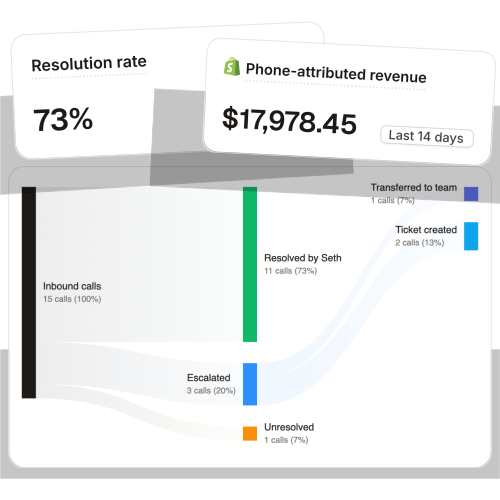
The AI answers your phone 24/7. It finds orders in your Shopify store, processes returns and exchanges, answers product questions from your knowledge base, and cancels orders when a caller asks. It resolves up to 90% of calls on its own for $1.99 a call after the first 50, versus the $7 to $16 a human-handled call costs at a BPO. Calls that genuinely need a person escalate cleanly to Gorgias, Richpanel, Reamaze, or whatever helpdesk you already run, so you keep your stack. WashCo, a Shopify brand we launched, recovered $22,664 in its first 7 days on the phone.
"My customers also feel like it's a normal person. They feel like they can communicate if they have questions."
Claudia Droge, TechCraft Studio
That quote is the answer to the objection everyone has, which is whether an AI on the phone will embarrass the brand. The single most repeated thing customers say after a call is that it doesn't sound like AI. If you want to weigh it against a night-shift hire, 24/7 ecommerce phone support walks through the trade. A tool like Dialpad gives your human reps a better phone, but it still needs the humans. The purpose-built phone agent for Shopify doesn't.
What it costs to run Shopify customer service (and where the money leaks)
Before you add anything, look at where the spend actually goes. Labor is 60 to 80% of total support cost, which means the lever that matters is how many human-minutes the repetitive volume consumes, not the per-seat price of your helpdesk. Burnout makes it worse: 56% of service agents report it under traditional models, and replacing one rep costs $10,000 to $35,000, per scaling research.
So the question isn't "what's the cheapest helpdesk." It's "how much of my payroll is doing work that doesn't need a human." Here's the math on a typical $50M brand running a six-rep team:
| Line item | Today | With routine calls handled by AI |
|---|---|---|
| 6 reps × $4K loaded per rep | $24,000/mo | n/a |
| AI phone support (~$5K/mo) | n/a | $5,000/mo |
| Net monthly CS spend | $24,000/mo | $5,000/mo |
| Monthly savings | n/a | $19,000/mo |
| Annual savings | n/a | $228,000/yr |
That's roughly 70% of repeatable calls (order status, returns, the same five product questions) routed off your team. The other 30%, the genuinely hard calls, still go to your reps, who now have the time to actually solve them. If you want this run against your real volume instead of a model, book a 30-min call and we'll do the math live.
For the channels you keep human, the usual cost levers still apply: more self-service to shrink the queue, tighter routing, and the response-time SLAs above. Our Shopify support cost reduction guide goes deeper, and you can sanity-check any plan against current Ringly pricing. Brands on Shopify Plus tend to feel the phone leak first, because their volume and AOV are both higher.
Frequently asked questions
What is the Shopify customer service phone number? Shopify's general support line is (888) 746-7439. On most plans, the fastest path to a Support Advisor is the AI Search bar in the Shopify Help Center. That line is for store owners with Shopify account issues, not for your customers.
Does Shopify handle customer service for my store's buyers? No. Shopify supports you as the merchant. When your customers call or email about an order, that goes to your team, not to Shopify. You build and run the support experience your buyers get.
What's the best customer service app for a Shopify store? For a paid helpdesk, Gorgias is the ecommerce-native default; Zendesk and Freshdesk are common alternatives. For phone specifically, a general helpdesk treats voice as an add-on, so brands with real call volume usually pair it with a phone-focused tool. We rank the options in our Shopify customer service apps guide.
How fast should a Shopify store respond to customers? Shopify's benchmarks put live chat under a minute, email under four hours, and everything under 24 hours. The numbers matter most during launch and peak-season spikes, when slow responses turn into negative reviews fast.
Is Shopify Inbox enough for a growing brand? Shopify Inbox is free and fine for chat on a new store. Once you're past a few hundred tickets a month, you'll want a paid helpdesk that writes back to Shopify, and Inbox doesn't cover phone at all.
How do I add phone support without hiring a night shift? Hand the routine calls to an AI phone agent that answers 24/7, finds orders in Shopify, and escalates the hard calls to your team. That's how brands keep a live phone line after-hours without staffing one. Ringly resolves up to 90% of calls on its own.
How much does it cost to run Shopify customer service? Labor is 60 to 80% of the total, so the real cost is human-minutes spent on repetitive calls, not your software seat price. A six-rep team runs around $24,000 a month loaded; routing the routine 70% to AI typically nets about $19,000 a month back.
Talk to us

If you run a $10M-$100M Shopify brand and the phone is the channel quietly costing you, a 30-min call is the fastest way to see the number. We'll pull your last week of missed and after-hours calls and show you what's leaking.
Our 3 promises.
- Live in under 1 hour. Setup and test calls are free.
- 30-day money back on the $99 plan fee.
- 65% resolution guarantee: if Seth resolves under 65% of your support calls in a month, that month comes back as credit (after 90 days on Pay per call).
Ruben (Ringly co-founder) takes these calls personally.