
This post in 30 seconds.
- A returns management service has two layers: the logistics of getting product back (portal, label, restock) and the phone line that answers everyone asking where their refund went. Almost everything written about returns covers only the first.
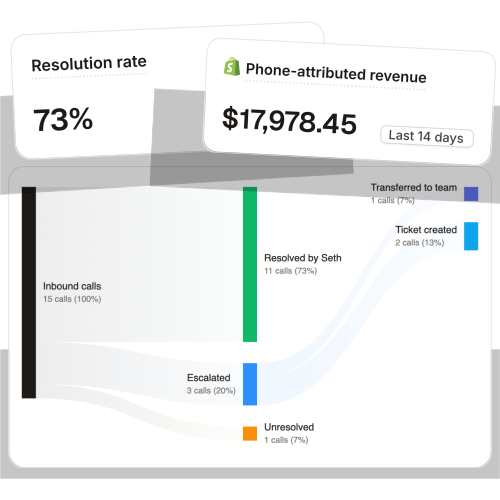
- Return-status and refund-timing calls are some of the most repeatable calls a brand gets. Across 50+ Shopify brands we work with, the AI resolves 73% of inbound calls on its own.
- Built for $10M-$100M Shopify brands with a real CS team and a visible phone number, the kind where returns season quietly turns the phone into a refund hotline.
Search "returns management service" and you get two kinds of articles. Listicles of return-portal software, and definitions of reverse logistics. Both are about getting the product back into the warehouse. Neither one mentions the phone.
If you run customer experience at a $10M-$100M Shopify brand, you already know the part those articles skip. A return isn't done when the label is printed. It's done three weeks later, after the customer has called twice to ask whether you got the box and when the money lands. That second half, the calls, is the part a returns management service is supposed to cover too, and it's the part that quietly eats your CS team's week.
We run AI phone support for 50+ Shopify brands, and return-status calls show up in almost every one. If your phone turns into a refund-status hotline every time returns spike, book a 30-min call and we'll show you how much of that queue can run itself.
What a returns management service actually is
A returns management service is the whole system that handles a product coming back: the policy, the return portal, the prepaid label, the inspection, the restock or write-off, and the refund or exchange. Tools like Loop, AfterShip, Narvar, and ReturnGO own most of that flow. They give the customer a self-serve portal, generate the label, and push the refund once the box is scanned. If you've shopped for returns management software, that's the layer you were looking at.
Here's where it splits. That portal-and-label layer is the logistics half. There's a second half that no software portal closes: the human asking a question the portal didn't answer. A returns management service isn't finished at the return portal. It's finished when someone answers the customer who calls anyway.
And a lot of customers call anyway. US shoppers returned about 16.9% of online purchases in 2024, according to the National Retail Federation. On a brand doing real volume, that's thousands of returns a quarter, and a predictable share of those turn into a phone call. Not because your portal is bad. Because a refund is money, money makes people anxious, and anxious people pick up the phone.
So when you evaluate a returns management service, you're really evaluating two things. The reverse-logistics stack, which the returns app you already run probably handles fine. And the call layer, which usually has no owner at all except your CS reps and a clear return policy nobody reads before dialing.
The half nobody writes about: the return-call queue
Listen to a week of a brand's return calls and the same four questions cover most of them. Did you get my return. Where's my refund and when does it post. How do I start one. Can I just exchange it instead. That's it, over and over, all day, especially in the two weeks after any big sale.
These are the most repeatable calls you get, which is exactly why they're so expensive to staff with humans. A US rep loaded costs around $4,000 a month, and a chunk of that pay goes to reading a Shopify order screen out loud and saying "your refund posts in 3 to 5 business days." It's the same answer every time. It doesn't need a person. But it absolutely needs an answer, because the alternative is worse.
The return call you miss is the one that turns into a chargeback or a one-star review about a refund the customer swears never came. When a caller can't reach anyone, 85% never call back and 62% switch to a competitor, per PCN's missed-call study. Most brands answer only about 37.8% of inbound calls in the first place, according to Ambs Call Center. On a refund question, an unanswered call isn't a lost lead. It's a customer who already gave you their money back and now thinks you stole it.
Return-status calls are close cousins of WISMO calls, the "where's my order" wave that makes up 30-40% of support tickets in normal periods and 50%+ at peak, per Salesforce. Same shape, same volume, same drain on the team. The only difference is the customer is asking about money going out instead of a box coming in.
This is the part of returns where AI phone support actually earns its keep. WashCo, a Shopify brand we launched, recovered $22,664 in its first 7 days on the phone, much of it from calls a human team would have let roll to voicemail after hours. The point isn't the headline number. The point is that the calls hitting your support line about refunds and exchanges are mostly answerable from data you already have in Shopify.
How brands staff the return-call layer
Once you accept that returns generate a call wave, the real question is who answers it. There are four common setups, and they're not equal.
| Option | What it handles | Cost shape | After-hours |
|---|---|---|---|
| In-house CS team | Everything, but slowly during spikes | ~$4,000/rep/mo loaded | Only if you staff a night shift |
| BPO / answering service | Scripted status calls | $1.50-$3.50/call plus monthly minimums | Sometimes, at extra cost |
| Self-serve return portal only | The form, not the call | Flat SaaS fee | Portal yes, the call no |
| AI phone agent | The repeatable status, refund, and how-to calls, 24/7 | ~$0.42 per resolved call | Yes |
In-house is the default and the most expensive way to answer "where's my refund" five hundred times a month. Your reps are good. That's why it's a waste to spend their hours on the one call that never changes. The next hire you make to cover returns season is a hire you're carrying year-round.
A BPO or outsourced answering service can take scripted status calls off your plate, but you trade control and CSAT for it. The script is rigid, the rep doesn't know your brand, and you're paying per call plus a minimum whether the volume shows up or not.
A return portal on its own is great and you should keep it. But a portal is a form. It answers the customers who self-serve and silently fails the ones who'd rather call, who skew older and higher-AOV, which is to say your best customers.
An AI phone agent sits in front of your existing helpdesk, whether that's Gorgias, Zendesk, or Gladly, and answers the repeatable return calls around the clock. It reads the order, gives the refund timing, walks the customer through starting a return, and hands the messy ones to your team with full context. The most common thing customers say after one of these calls is that it didn't feel like AI.
"My customers also feel like it's a normal person. They feel like they can communicate if they have questions."
Claudia Droge, TechCraft Studio
You're not picking one of these forever. Most brands keep their reps and their portal and add the phone layer to absorb the after-hours and seasonal spike, so the team stops drowning every time a sale ends.
What this costs vs what it saves
Run the math on the call layer specifically, not the whole returns stack. Take a $50M Shopify brand running a 6-rep CS team.
| Line item | Today | With Ringly |
|---|---|---|
| 6 reps × $4K loaded per rep | $24,000/mo | n/a |
| Ringly (illustrative) | n/a | ~$5,000/mo |
| Net monthly CS spend | $24,000/mo | $5,000/mo |
| Monthly savings | n/a | $19,000/mo |
| Annual savings | n/a | $228,000/yr |
That's roughly 70% of repeatable calls, the return-status, refund-timing, and how-to-return questions, routed to the AI. The other 30%, the genuinely hard calls, still go to your team, who now have time to actually solve them.
The per-call gap is the part that compounds. The AI resolves calls at about $0.42 each versus $7-$16 for human BPO handling. And it dodges the cost nobody budgets for: replacing a burnt-out rep runs $14,113, per Gartner data via Insignia, and refund-status repetition is exactly the kind of work that burns reps out.
If you want the real numbers for your own call volume, book a 30-min call and we'll do the math live against your returns season.
Setting up the return-call layer in a week
You don't rip anything out. Keep your returns portal, keep your helpdesk, keep your phone number. The phone agent goes in front of what you already run.
Setup is mostly pointing the AI at your data. Connect your Shopify store so it can read orders and refund status, give it your return policy and best practices, and set the rules for what it handles versus what it escalates. It's live in under an hour, and the full build runs on a 14-day Launch Sprint that's on us, not on your team.
The split that matters is what the AI owns and what it hands off. It handles the repeatable layer on its own: did you get my return, when does my refund post, how do I start one, can I exchange instead, what's your window. It escalates the cases that need judgment, a damaged item, the wrong product, a return lost in transit, an out-of-policy exception, and passes your rep the full call context so they're not starting cold.
Done right, the phone stops being the thing that breaks every returns season. Your team handles fewer, better calls, your subscription and refund edge cases get human attention, and the routine "where's my refund" wave never hits voicemail. If your bigger goal is fewer returns in the first place, that's a separate project, and we've written about how to reduce product returns and DTC returns best practices separately.
Frequently asked questions
What is a returns management service? It's the full system for handling product coming back: the policy, the return portal, the label, the inspection, the restock, and the refund or exchange. Most people use the term for the logistics software. The part that often has no owner is the call layer, the customers who phone in to ask about their return or refund.
Does a returns management service handle phone calls or just the return portal? Most returns software is portal-only. It handles the customers who self-serve and leaves the calls to your CS team. To cover the call layer you need either staffed phone support, a BPO, or an AI phone agent that answers return-status and refund questions directly.
How many of our return calls can actually be automated? The repeatable ones, which are usually the majority: return status, refund timing, how to start a return, and exchange questions. Across 50+ Shopify brands on Ringly, the AI resolves 73% of inbound calls autonomously. Complex cases like damaged or lost items escalate to your team.
Should we outsource return-status calls to a BPO? You can, and it'll take scripted calls off your plate, but you give up control and brand voice and pay per call plus minimums. An AI phone agent handles the same scripted calls at about $0.42 per resolved call, 24/7, while keeping your data and your tone.
Does Ringly replace our returns portal like Loop or AfterShip? No. Keep your portal. Ringly is the phone layer that answers the customers who call instead of using the portal, and it reads the same Shopify order data the portal does.
How much does handling return calls cost? With a human team, you're paying around $4,000 a month per loaded rep, and a lot of that goes to repeatable status calls. Ringly plans start at $349/mo (Grow) and $799/mo (Pro), with Enterprise priced by call for higher volume. The AI resolves calls at roughly $0.42 each versus $7-$16 for human BPO handling.
Can the AI actually process a refund, or just check status? It checks order and refund status, gives accurate timing, and walks customers through starting a return or exchange. For the actual money movement and any non-standard case, it hands off to your team with full context so nothing falls through.
Talk to us

If returns turn your phone line into a refund-status hotline every week, a 30-min call is the fastest way to see how much of that queue runs itself. We'll look at your real return-call volume and show you what your store is leaving on the table after-hours.
The 3-layer guarantee.
- Live in 14 days or it's free until launched.
- 65% resolution in 90 days or we refund the last 3 months of subscription fees.
- We keep working free until we hit 65%.
Ruben (Ringly co-founder) takes these calls personally.