
This post in 30 seconds.
- The formula: retention rate = ((customers at end − new customers) ÷ customers at start) × 100. One line, worked example below.
- The number nobody else shows you: a chunk of the customers in your churn figure didn't leave because of price or product. They called, nobody picked up, and they bought somewhere else. 62% of people switch to a competitor after one unanswered call.
- Who this is for: founders, COOs, and Heads of CX at $10M-$100M Shopify brands with a phone line and a 3-12 rep support team. We pulled the support angle from 150,000 real calls.
You came here for a number, so let's get you the number first. The retention rate formula is one line, and you'll have your own figure in about 30 seconds. Then there's a second part most calculators skip, and it's the part that actually moves the number: a lot of what lands in your churn column is customers you never spoke to. If you run customer experience or ops at a Shopify brand doing somewhere between $10M and $100M, that gap is probably bigger than you think.
We build AI phone support for Shopify brands, which means we read a lot of call logs. Across 50+ brands we've handled 150,000 calls, and the pattern that shows up over and over is the after-hours order question that went to voicemail and then went quiet. If your retention number looks fine but you're not sure why some customers don't come back, book a 30-min call and we'll talk through your case.
The retention rate formula
Here's the whole thing:
Retention rate (%) = ((E − N) ÷ S) × 100
- S = customers at the start of the period
- E = customers at the end of the period
- N = new customers you acquired during the period
That's it. The one part people get wrong is N. You subtract the new customers out of the ending count on purpose, because retention is a question about the customers you already had, not the ones you just bought with ad spend. Leave the new customers in and you're measuring growth, which hides whether your existing base is actually sticking around.
Retention rate tells you what percentage of the customers you started with were still buying by the end of the period. It's the cleanest read you have on loyalty, and it's why roughly 65% of revenue at most brands comes from existing customers (HubSpot). The customers you keep are the ones paying the bills.
If you'd rather track repeat orders than logo count, that's a related but different metric, and we'll untangle the three of them in a second.
A worked example, step by step
Say you're running the math on a quarter.
| Input | Value |
|---|---|
| Customers at start (S) | 1,000 |
| New customers during period (N) | 200 |
| Customers at end (E) | 1,050 |
Plug it in:
- Subtract new from ending: 1,050 − 200 = 850
- Divide by the starting count: 850 ÷ 1,000 = 0.85
- Multiply by 100: 85% retention rate
So even though you grew from 1,000 to 1,050 customers, your real retention is 85%. You kept 850 of the original 1,000 and bought the rest of the growth. The 150 you lost are your churn, which makes your churn rate 15% (it's always just 100 minus retention).
One thing the generic calculators gloss over: in ecommerce, the period you pick matters more than the math. A coffee subscription brand and a mattress brand have completely different natural repurchase rhythms, so a 12-month window flatters one and punishes the other. Pick a window that matches how often a happy customer would actually reorder, and hold it steady so you can compare quarter to quarter.
Retention rate vs churn vs repeat purchase rate
These three get mixed up constantly, usually on the same call where someone asks "wait, which number are we using?"
| Metric | What it measures | How to get it |
|---|---|---|
| Retention rate | % of existing customers you kept | ((E − N) ÷ S) × 100 |
| Churn / attrition rate | % of existing customers you lost | 100 − retention rate |
| Repeat purchase rate | % of customers who bought more than once | orders ≥ 2 ÷ total customers |
Retention rate and repeat purchase rate answer different questions, and treating them as the same number is the most common reporting mistake we see. Retention asks "did the people I had stay?" Repeat purchase asks "how many of all my customers came back at least once?" Most DTC operators live in repeat-purchase rate and lifetime value because that's what Triple Whale and the Shopify reports surface. The board usually asks for the clean retention figure, which is when people start googling the formula.
Churn is the easy one. It's whatever's left over after retention. If you kept 85%, you lost 15%.
What's a good retention rate? DTC benchmarks
Short version: the average DTC ecommerce brand sits around 31% in 2026, and the top tier runs 45-55% (Finsi). Repeat customer rate for online retailers averages about 28% (MobiLoud). Here's where the lines fall:
| Retention / repeat rate | Where you stand |
|---|---|
| Under 20% | Losing customers faster than you should |
| 20-30% | In line with most DTC brands |
| 30-40% | Beating the average |
| 40%+ | Strong, usually subscription or consumables |
It swings hard by vertical, so judge yourself against your own category, not a universal "good" number:
| Vertical | Typical retention / repeat range |
|---|---|
| Pet | 30-35% |
| Beauty / skincare | 22-28% |
| Specialty food | 18-25% |
| Supplements / health | 15-22% (40%+ with subscription) |
| Subscription models | ~67% average |
One behavioral fact worth keeping in your head: a first-time buyer has about a 27% chance of a second purchase, but once they make that second purchase the odds of a third jump past 54% (MobiLoud). The whole game is getting people to order twice. Which brings us to the part the formula can't see.
The churn your calculator can't see
The formula tells you what your retention is. It says nothing about why a customer didn't come back. And when we read through real call logs, a big slice of the "didn't come back" pile turns out to be customers who tried to reach you and couldn't.
The numbers here are ugly. 32% of people will walk away from a brand they love after a single bad experience (Salesmate). 79% of online complaints never get a response. And 62% of callers who can't reach a person switch to a competitor, while 85% never call back at all (PCN Answers). None of that shows up in your retention math. It just shows up later as a smaller number with no obvious cause.
The good news buried in that data: 67% of churn is preventable if you actually resolve the problem on first contact (Salesmate). Most of the calls driving it aren't hard. They're "where's my order," return questions, and the same product questions over and over. The kind of thing a customer wants answered at 9 p.m. when your team has gone home.
A missed call after hours is a churned customer who hasn't shown up in your numbers yet. We see it constantly: at a $250+ AOV, somewhere between 12% and 18% of orders generate a phone call, and the ones that hit voicemail are the ones most likely to quietly disappear. WashCo, a Shopify brand we launched, recovered $22,664 in its first 7 days on the phone.
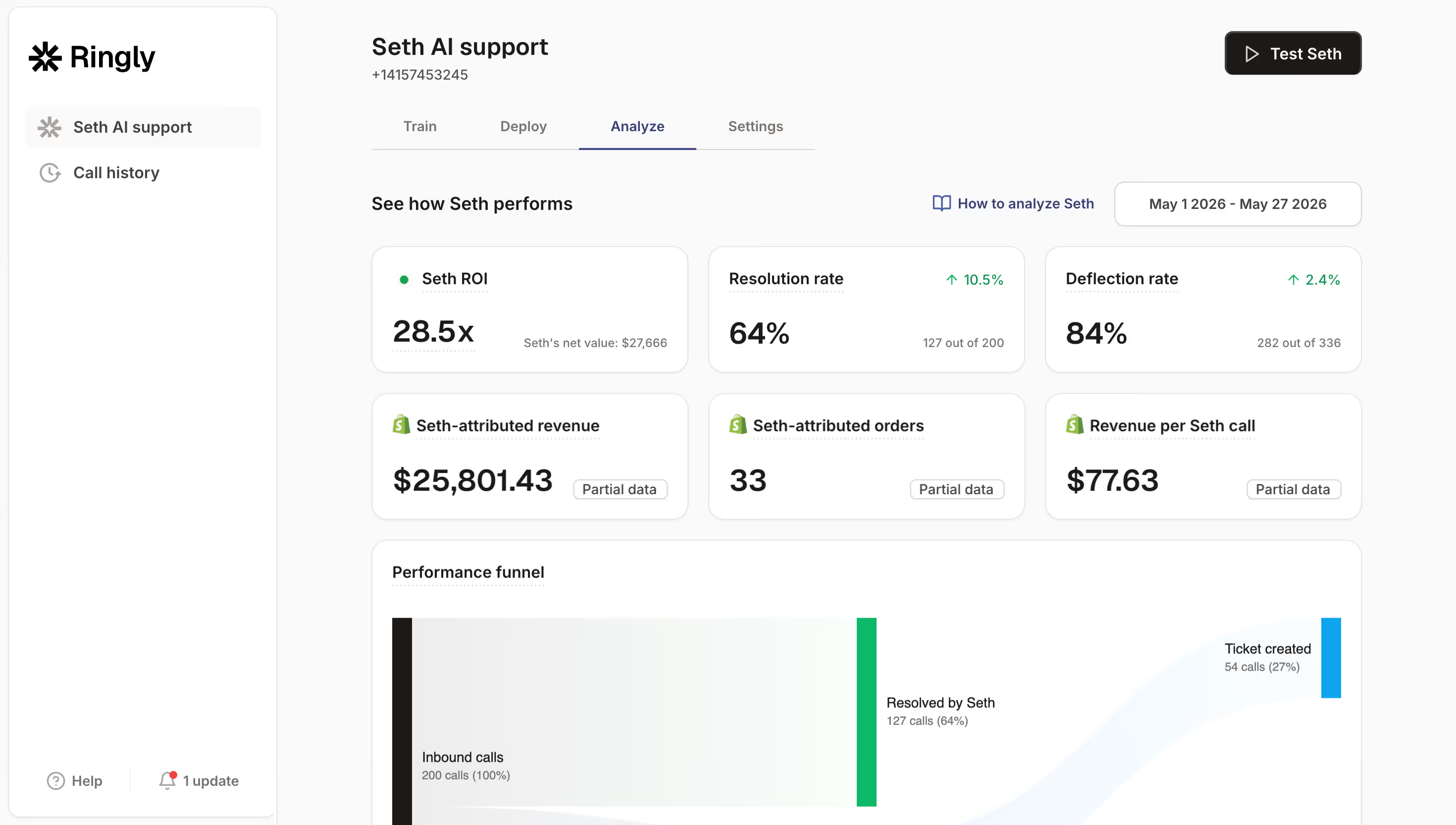
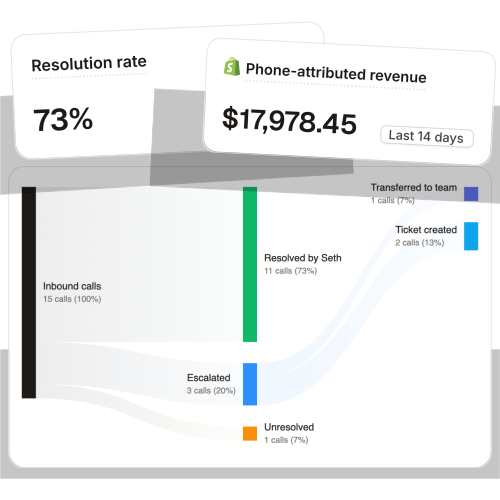
This is the whole reason we build AI phone support for Shopify brands. The AI answers inbound calls 24/7, finds the order in Shopify, handles returns, and answers product questions from your knowledge base, and across 50+ brands it resolves 73% of calls on its own. The hard 27% still go to your team.
"My customers also feel like it's a normal person. They feel like they can communicate if they have questions."
Claudia Droge, TechCraft Studio
What a retention point is worth, and what it costs to get it
Retention compounds in a way that makes the math lopsided. The widely-cited Bain & Company figure (originally from Reichheld and Sasser's "Zero Defections" work) is that a 5% increase in retention lifts profits by at least 25%. Even taking the conservative end of that, a few points of retention is one of the highest-return numbers on your P&L, because you're keeping margin you already paid to acquire.
So what does it cost to defend those points? Most of the defense is just answering the calls that drive repeat purchases. Here's the typical trade for a $50M brand running a 6-person support team:
| Line item | Today | With Ringly |
|---|---|---|
| 6 reps × $4K loaded per rep | $24,000/mo | n/a |
| Ringly (~$5K/mo) | n/a | $5,000/mo |
| Net monthly support spend | $24,000/mo | $5,000/mo |
| Monthly savings | n/a | $19,000/mo |
| Annual savings | n/a | $228,000/yr |
That's roughly 70% of the repeatable calls (order status, returns, the same five product questions) handled for less than the cost of one rep, while your team keeps the genuinely complex 30%. You defend the retention number AND cut the support line at the same time.
If you want to see what that trade looks like against your actual call volume, book a 30-min call and we'll do the math live.
How to actually move the number
Once you have the retention rate, the work is moving it. The levers that matter most for a DTC brand:
- Answer the phone, especially after hours. The single biggest hidden leak. Calls that roll to voicemail at night are repeat buyers you're handing to competitors. Coverage outside business hours is where most of the recoverable revenue sits (24/7 phone support).
- Resolve on first contact. 67% of churn is preventable when the problem gets solved the first time. Bouncing a customer between channels is how you lose them. See first-call resolution.
- Kill the WISMO friction. "Where's my order" is 30-40% of support volume and it's the question most tied to whether someone trusts you enough to reorder. Handle it fast and proactively (WISMO calls).
- Save the subscription before it cancels. For consumables, every pause-or-skip call you catch is 12 months of LTV defended. Don't let those calls die in a queue.
- Measure with clean data. Most brands can't compute a trustworthy retention rate because the data is split across Shopify, the helpdesk, and a spreadsheet. Fix the measurement before you trust the trend (ecommerce customer retention).
For more of the underlying data, the customer retention statistics and DTC ecommerce statistics breakdowns go deeper, and the ecommerce customer service guide covers the service side. If AOV is part of your retention story, the ecommerce AOV and Shopify Plus customer service pieces help. And if you want to see the order-lookup mechanics, that's check order status and the broader loyalty program play.
Frequently asked questions
Why do I subtract new customers from the retention formula? Because retention measures whether your existing customers stayed, not how fast you grew. If you leave new customers in the ending count, a big ad month would make your retention look great even while your original base walks out the door. Subtracting them isolates the customers you actually kept.
What's a good customer retention rate for an ecommerce brand? The DTC average sits around 31% in 2026, with top performers at 45-55%. Under 20% means you're leaking customers; 30-40% beats the average. It varies a lot by category, so compare yourself to your own vertical, not a universal benchmark.
What's the difference between retention rate and repeat purchase rate? Retention rate is the percentage of your existing customers who kept buying over a period. Repeat purchase rate is the percentage of all customers who bought more than once. They're related but not interchangeable, and reporting one as the other is the most common mistake we see.
Can retention rate be negative? No. The lowest it goes is 0% (you lost everyone you started with). If your math produces a negative number, you've usually counted new customers in the wrong bucket. Double-check that N only includes customers acquired during the period.
What time period should I use to calculate retention rate? Match the window to how often a happy customer would naturally reorder. Monthly works for consumables and subscriptions; quarterly or annual fits higher-consideration products. The key is to keep the window consistent so you can compare periods cleanly.
How does customer service affect retention rate? Heavily, and it's the part the formula can't show you. 32% of customers leave after one bad experience, and 62% switch to a competitor after a call that goes unanswered. Resolving issues on first contact prevents an estimated 67% of churn, which is why answering the phone (especially after hours) is one of the most direct retention levers you have.
Does Ringly help with retention? Indirectly, by making sure the calls that drive repeat purchases actually get answered. Ringly is AI phone support for Shopify brands: it handles inbound calls 24/7, resolves 73% of them autonomously, and escalates the rest to your team. The calls it catches are often the ones that would otherwise have quietly become churn.
Talk to us

If you run a $10M-$100M Shopify brand and your retention number has a leak you can't see in the math, a 30-min call is the fastest way to find it. We'll look at your last 7 days of calls and show you what's quietly turning into churn.
The 3-layer guarantee.
- Live in 14 days or it's free until launched.
- 65% resolution in 90 days or we refund the last 3 months of subscription fees.
- We keep working free until we hit 65%.
Ruben (Ringly co-founder) takes these calls personally.