
This post in 30 seconds.
- The fastest way to reduce customer service ticket volume isn't a bigger team. It's killing the same 8-10 repeatable questions at their source, across every channel, including the phone line most guides pretend doesn't exist.
- WISMO alone is 30-50%+ of your volume, and the phone is both the priciest channel ($15-$25 a call) and the one quietly leaking revenue when it rolls to voicemail.
- Written for founders, COOs, and Heads of CX at $10M-$100M Shopify brands with a visible phone number and a paid helpdesk like Gorgias or Zendesk.
Every Monday the queue is back to where it was Friday. You hired rep #4, you bought the helpdesk, you turned on a chatbot, and the inbox still fills with the same questions over and over. Where's my order. How do I return this. Does this ship to Canada. If you run customer experience at a $10M-$100M Shopify brand, you already know the feeling: you're not short on effort, you're short on a way to stop the volume at the source.
Here's what most advice gets wrong. It treats ticket volume as a chat-and-email problem and quietly ignores the phone line ringing in the corner. We run AI phone support for 50+ Shopify brands, and when I read through their real call logs, the repeatable split is the same everywhere: the same handful of questions make up 70-80% of every channel. Reduce that 70-80% at the root and the queue stops rebuilding itself.
If you're drowning in repeatable tickets and the phone keeps going to voicemail after 6 p.m., that's exactly the gap we close for $10M-$100M Shopify brands. Book a 30-min call and we'll read your last week of missed calls with you and show you where the volume actually goes.
Where your ticket volume actually comes from
You can't cut what you haven't counted. Before you touch a single tactic, look at where the tickets are born, by channel and by reason.
For most DTC brands the reason breakdown is lopsided. WISMO, the "where's my order" question, runs 30-40% of tickets in a normal week and climbs past 50% during a launch or BFCM peak, per Salesforce. Returns and exchanges are next. Product and shipping questions fill out most of the rest. The genuinely novel, one-off problem your reps were hired to solve is a thin slice on top.
The channel you forget is usually the one bleeding the most money: the phone. A self-service resolution costs $1-$4, chat runs $8-$14, email $9-$16, and a phone resolution runs $15-$25 once you count re-contact, per 2026 cost-per-ticket benchmarks. A typical retail ticket sits around $2.70-$5.60 (Lorikeet). Phone is where each contact costs the most, and it's the channel almost every "reduce your tickets" guide skips, because it's expensive and hard to staff, so brands drop it to voicemail and pretend the volume went away.
It didn't go away. It turned into voicemails you never return and customers who bought from someone else. We cover the full money side of this in our breakdown of how to reduce customer service costs in ecommerce.
Find your repeatable 80% before you fix anything
The single highest-impact move is unglamorous: pull your tickets, tag them by reason, and find the 8-10 questions that make up most of the volume.
Pull 30 days of tickets from Gorgias, Zendesk, or whatever you run, and tag each by reason. Then do the same for the phone, which most teams never log. When I read real call logs across the 50+ Shopify brands we run, the same pattern shows up every time: order status, returns, a few product questions, and shipping. Roughly 70-80% of your contacts are the same short list, which means a small number of fixes covers most of your volume. Industry analysis lands in the same place, with about 80% of requests being redundant, and 81% of customers trying self-service first before they ever open a ticket (HBR).
So the work isn't "answer faster." It's "make the top 8-10 reasons stop generating contacts." Everything below is ordered by how much repeatable volume it removes. For the chat-and-email side of this, we've got a deeper tactical list in how to reduce support tickets in ecommerce.
The 7 levers that actually cut ticket volume
Not all of these move the needle equally. The first three remove whole categories of contact. The last one closes the channel nobody else does.
1. Send proactive order updates so they never have to ask
WISMO is a communication problem, not a support problem. If the customer has to ask where their order is, your notifications already failed.
Send updates at every real milestone: confirmed, processing, shipped, out for delivery, delivered. Brands that do this see WISMO drop about 40% in the first 30 days, climbing to 60-70% once the timing and copy are dialed in, per LateShipment. That's the biggest single category of volume, gone before anyone contacts you. More on the mechanics in our WISMO automation guide for Shopify and the full WISMO ticket teardown.
2. Build a help center that's actually maintained
A good self-service help center deflects 40-60% of routine questions. A stale one creates more tickets than it prevents, because customers read the wrong answer and contact you anyway.
The fix is boring and it works: own the top 10 questions as clean articles, link them in your order emails and order-status page, and review them monthly. Tie each article to a real ticket reason from your tagging, so the help center maps to actual demand. See Ringly's knowledge base for how we feed the same source-of-truth into the phone agent so the answers match across channels.
3. Add self-serve returns and order editing
One return can spin off three or four tickets: where do I send it, did you get it, where's my refund. A self-serve returns portal removes the first one entirely by letting the customer start the return, pick a reason, and get a label without you.
Order editing does the same on the front end. Let customers fix an address or swap an item after checkout and you kill a whole class of "can you change my order" contacts before they ship the wrong thing. Our Shopify self-serve returns guide walks the setup.
4. Tag and route so the right ticket lands in the right place
Tagging isn't just for analysis. It's how you stop a simple WISMO from sitting in the same queue as a genuine complaint.
Route by reason. Send the repeatable stuff to self-service or automation, and reserve your reps for the calls and tickets that actually need judgment. Intelligent routing cuts average resolution time by up to 74%, per edesk, mostly by not making a person triage the obvious.
It also gives you a clean number for the next quarter. Once tickets are tagged and routed, you can see at a glance how much of each rep's day is repeatable versus genuinely complex. That's the report your CFO actually wants when they ask about the headcount line, and it's the one most teams can't produce because the data lives in four different tools.
5. Fix the product and policy friction generating the tickets
Some of your volume isn't a support problem at all. It's a sizing chart nobody can read, a shipping policy that's vague on international, a checkout that won't let people apply a code.
Pull your top ticket reasons back to the page that caused them. Every contact you trace to a fixable bit of copy or UX is a contact you delete permanently. This is the slowest lever and the most durable one.
A quick way to find these: read the verbatim text of your 50 most recent WISMO and "how do I" tickets and ask what the customer was looking at when they gave up. Half the time it's a tracking link buried below the fold, a returns window that isn't stated on the product page, or a coupon field that silently rejects codes. Fixing one of those removes the contact for every future customer, not just the one who wrote in.
6. Put AI on chat for the repeatable text questions
For the questions that survive your help center, AI on chat handles the high-volume text stuff. Median AI ticket deflection in ecommerce hit 41.2% in 2026, with top-quartile brands at 58.7%.
The trap is using it as a wall. Deflection without resolution just makes people angry and pushes them to the phone. If your chatbot can't actually finish the job, all you've done is move the ticket to your most expensive channel. We compare the two directly in chatbot vs phone support for ecommerce.
7. Put an AI phone agent on the line nobody answers
Here's the lever every other guide skips. You fixed chat and email, and the phone is still ringing into voicemail after 6 p.m. For a DTC brand with a visible number, the phone is a real ticket source, the most expensive one, and the one leaking revenue when no one picks up.
Ringly.io is AI phone support for Shopify brands. The phone shouldn't be a tax on your support team. Instead of hiring a phone rep every time call volume goes up, the AI takes the routine inbound calls so your team can focus on the work that actually moves revenue.
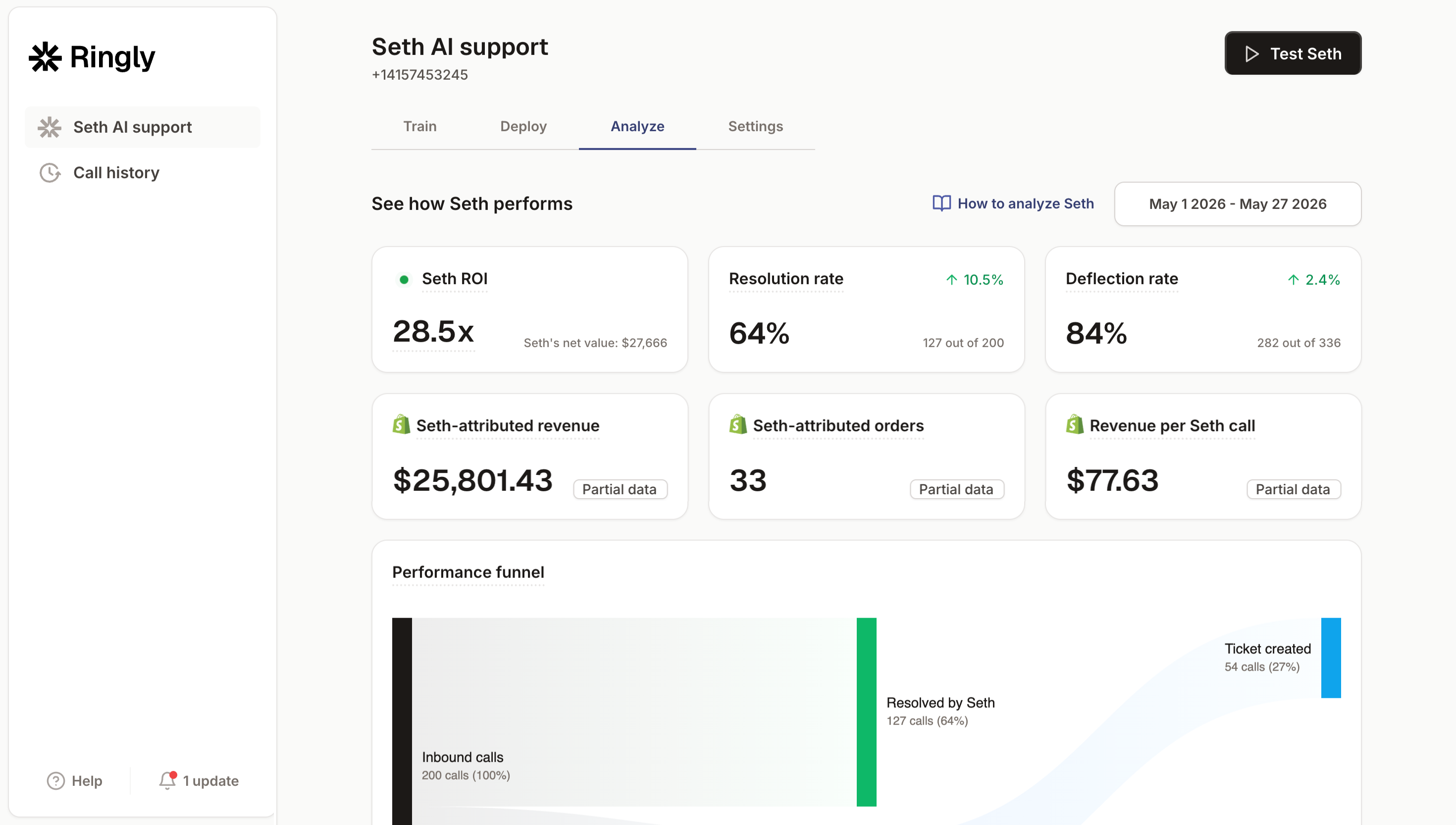
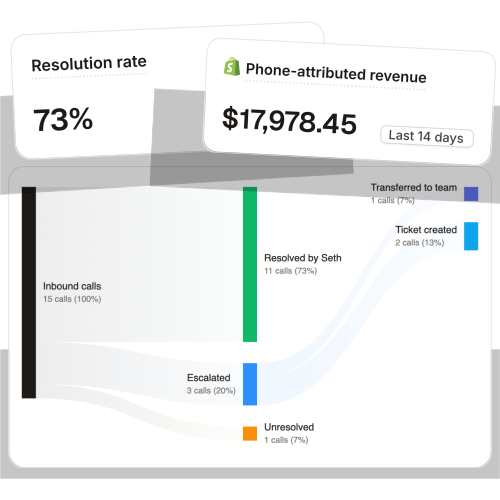
The AI answers inbound calls 24/7. It finds orders in your Shopify store, processes returns and exchanges, answers product questions from your knowledge base, and rescues abandoned carts via outbound follow-up. Across 50+ brands, it resolves 73% of calls autonomously at roughly $0.42 per resolved call, versus $7-$16 a call for a human BPO. Calls that need a person escalate cleanly to Gorgias, Zendesk, Richpanel, or whatever helpdesk you already run, with a smart call transfer that hands off context.
WashCo, a Shopify brand we launched, recovered $22,664 in its first 7 days on the phone. BioLongevity Labs, a supplement brand on Ringly, resolves 79% of its calls end to end without a human. The point isn't the logo. It's that the phone-channel volume you wrote off as unstaffable is both reducible and revenue-positive when you stop sending it to voicemail.
"My customers also feel like it's a normal person. They feel like they can communicate if they have questions."
Claudia Droge, TechCraft Studio
Plans: Grow $349/mo (1,000 minutes), Pro $799/mo (2,500 minutes), Enterprise by call only. Live in under an hour. There's a 65% resolution guarantee: if the AI resolves under 65% of your calls in 90 days, you get the last 3 months refunded.
What the phone line costs you vs an AI phone agent
Run the math on the channel everyone ignores. The savings hide in what you're paying people to do work that doesn't need a person.
Take a $50M Shopify brand running a 6-rep CS team:
| Line item | Today | With Ringly |
|---|---|---|
| 6 reps × $4K loaded per rep | $24,000/mo | n/a |
| Ringly (approx) | n/a | $5,000/mo |
| Net monthly CS spend | $24,000/mo | $5,000/mo |
| Monthly savings | n/a | $19,000/mo |
| Annual savings | n/a | $228,000/yr |
That's roughly 70% of repeatable calls (order status, returns, product questions, the same five things over and over) routed to the AI. The other 30%, the genuinely complex calls, still go to your team, who now have time to actually solve them.
And there's a hidden line item the spreadsheet misses: revenue. 78% of buyers abandon a brand after one unanswered call, per PCN. Every voicemail isn't just a deferred ticket, it's a customer halfway to a competitor. For the headcount side of this, see how to scale customer service without hiring.
If you want to see your own numbers, book a 30-min call and we'll do the math live against your real call volume.
Mistakes that quietly grow your ticket volume
The brands that stay stuck usually make the same handful of errors. Each one looks like progress and quietly adds contacts.
- Treating deflection as a wall. A chatbot that blocks but doesn't resolve just routes the ticket to your phone, your most expensive channel. Resolution is the goal, not deflection.
- Letting the help center go stale. A wrong answer in your KB generates the contact it was supposed to prevent. Review monthly against your real ticket tags.
- Sending the phone to voicemail. It feels like you removed a channel. You removed the answer, not the demand, and the revenue walks.
- Hiring before fixing the source. Adding rep #5 to answer WISMO is paying a person to do work a notification should have done. Fix the source first, then size the team to what's left.
- Never tagging by reason. If you don't know your top 10 question types, every lever above is a guess. Tag first.
Most of these come from a general ecommerce customer service setup that grew by adding people instead of removing causes, and from never extending the same thinking to 24/7 phone coverage.
Frequently asked questions
What counts as a "good" customer service ticket volume?
There's no universal number, because volume scales with orders. The metric that matters is your repeatable share: if 70-80% of tickets are the same 8-10 questions, that's your reduction target. Track tickets per 1,000 orders over time, not the raw count.
What causes high support ticket volume in ecommerce?
Mostly WISMO (30-50%+ of tickets), returns and exchanges, and product or shipping questions. Almost all of it is repeatable. The real driver is a communication or self-service gap, not customer behavior, which is why the fix is to answer before they ask, not to staff up.
How much can I realistically reduce ticket volume?
Proactive order notifications alone cut WISMO 40% in the first month and 60-70% once optimized. Stack a maintained help center (40-60% deflection on routine questions) and a self-serve returns portal, and a meaningful majority of your repeatable volume disappears. The phone channel is the most under-addressed and often the biggest remaining slice.
Does reducing ticket volume hurt customer satisfaction?
Only if you confuse deflection with resolution. A wall that blocks customers without solving their problem hurts CSAT. Answering the question before it's asked, or resolving it instantly, raises satisfaction. The goal is fewer contacts because fewer problems, not because you got harder to reach.
What about phone calls, not just chat and email tickets?
This is the channel most guides skip. For a DTC brand with a visible number, phone is a real ticket source, the most expensive one ($15-$25 a call), and the one that leaks revenue when it goes to voicemail. An AI phone agent handles the repeatable calls 24/7 so the phone stops being volume you ignore.
How do I find which tickets are repeatable?
Pull 30 days from your helpdesk, tag each ticket by reason, and log your phone calls too. The top 8-10 reasons will be 70-80% of volume. That list is your roadmap. Without it, every reduction tactic is a guess.
Can AI reduce ticket volume without annoying customers?
Yes, when it resolves rather than blocks. Across 50+ Shopify brands, Ringly's AI resolves 73% of calls autonomously, and the most repeated thing customers say is that it doesn't sound like AI. The annoying version is a bot that deflects; the useful version actually finishes the job and escalates cleanly when it can't.
Talk to us

If you run a $10M-$100M Shopify brand, you've already deflected what chat and email can deflect, and the phone is still the channel adding the priciest, most ignored volume. A 30-min call is the fastest way to see what that line is costing you and how much of it routes to an AI agent.
The 3-layer guarantee.
- Live in 14 days or it's free until launched.
- 65% resolution in 90 days or we refund the last 3 months of subscription fees.
- We keep working free until we hit 65%.
Ruben (Ringly co-founder) takes these calls personally.