
This post in 30 seconds.
- The product-launch spike is the one phone surge you can put on a calendar, and most brands still drop calls in the four-hour window right after the drop.
- Roughly 70% of launch calls are the same handful of questions (is it back in stock, where's my order, did my order even go through). Route those to AI and keep your team on the 30% that's actually hard.
- Written for founders, COOs, and Heads of CX at $10M-$100M Shopify brands with a visible phone number and a paid helpdesk already in place.
You send the launch email to your whole list. You turn the ad spend up. The drop goes live at 10am, and by 10:20 the phone line that one person usually covers is ringing four times faster than they can pick up. By noon you've got a voicemail backlog nobody will get to before tomorrow, and the customers who couldn't get through are already refreshing a competitor's product page.
Here's the part that stings. The better your launch did, the worse your phone queue got. The surge showed up at the exact moment you'd spent the most money driving people to call. If you run support at a $10M-$100M Shopify brand, you've lived some version of this, and you probably treated it as something to survive rather than something to plan. It doesn't have to be. Book a 30-min call and we'll walk through your next drop.
Most teams at $10M-$100M Shopify brands run a small phone team and a launch calendar they don't share with support until the week before. We've launched AI phone support for 50+ Shopify brands trying to fix exactly that gap. Book a 30-min call and we'll map what your phones will do on launch day before it happens.
What a launch surge actually does to your phone line
A launch doesn't raise call volume by 20%. Across the launches we've watched on Ringly, the phone spikes 3 to 10x normal in a four-to-six-hour window, then tails off. Your email goes out, the ads fire, and everyone who has a question wants it answered in the next hour, not next week.
The phone is the channel that breaks first. Chat and email queue up quietly. The phone either gets answered or it doesn't, and when it doesn't, the caller hears voicemail or hold music and leaves. Roughly 80% of callers who hit voicemail hang up without leaving a message (Eden), and most callers put on hold are gone within the first minute (Brightmetrics). On a normal Tuesday that's a slow leak. On launch day it's a flood. And the customers you drop don't wait around: 78% abandon a brand after a single unanswered call (PCN).
That's why a launch is the worst possible day for the phone line to fall over. It's the one day you can least afford a dropped call, because the caller is mid-purchase, not mid-complaint. If you don't already run 24/7 phone support, the launch is the moment that gap becomes visible to your highest-intent customers all at once.
The brands that feel this worst are the higher-AOV ones, because the phone matters more the more an order is worth. At a $250-AOV store, 12-18% of orders generate a phone call, versus around 3% at a $40-AOV store (Ringly data). So a successful drop at a $60M skincare or supplement brand doesn't just sell more units. It rings the phone harder than the same drop would at a low-ticket store, and it does it all at once.
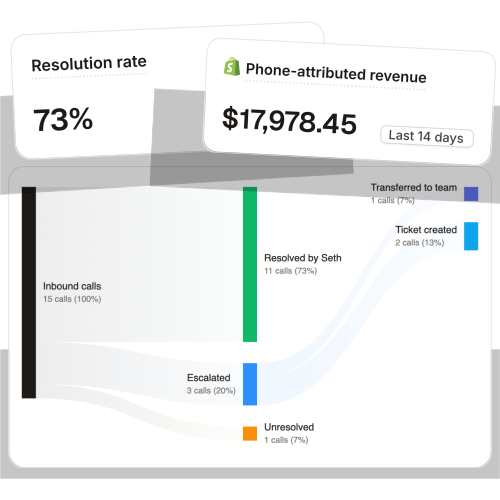
I've sat and watched the call log during a launch window for a brand we'd just turned on. The shape is always the same: a near-vertical wall of calls in the first hour, then a long tail. A human team can't flex to that shape. You either overstaff for a wall that lasts ninety minutes, or you understaff and drop the calls. It's the same shape you fight at Black Friday peak, but the launch version has one thing going for it that a random spike doesn't.
Why a launch surge is different from a random spike
You knew the date. You picked it. You wrote the email, scheduled the send, and bought the ads. The launch surge is the only phone surge in your year that shows up on a calendar weeks in advance, and that changes everything about how you can prepare for it.
A random spike (a viral post, a shipping delay, a press hit) catches you flat because you find out when the phone starts ringing. A launch doesn't. The industry guidance is to lock your support plan 8 to 10 weeks before a major campaign, and most brands have that runway sitting unused. They plan the creative, the email flow, and the inventory down to the unit, then leave the phone line on the same single-rep setup it runs the other 360 days.
WashCo, a Shopify brand we launched, recovered $22,664 in its first 7 days on the phone. Not by adding people. By having the phone actually answered during the window when callers were ready to buy. The calendar advantage is real, and almost nobody spends it.
Map your launch calls before you staff for them
Before you decide how to cover a launch, look at what people actually call about. Launch calls are not exotic. They cluster into three buckets, and the split decides your whole plan. (If you've ever priced out an ecommerce call center for peak coverage, you already know how lopsided the volume is.)
The repeatable 70%, the questions that have one correct answer and don't need a person:
- Is it back in stock / when does it ship: the single biggest launch-day question. The answer lives in your store, not in a rep's head.
- Where's my order: WISMO is 30-40% of support volume normally and over 50% at peak (Salesforce). It spikes the second the confirmation emails land. We break this category down in WISMO calls.
- Did my order go through: launch-day checkout anxiety. The customer hit pay twice and wants to know if they were charged twice.
- Basic product and sizing questions: anything answerable from your knowledge base or product page.
- Simple returns and exchanges: the early "wrong size" calls that start two days after delivery.
The escalate 20%, calls that start routine and need a handoff partway through: a duplicate charge that needs a refund, a payment that failed, an order that shipped to the wrong address. The first-call resolution lives in your order status lookup; the fix lives with a human.
The human-always 10%: the angry customer, the press inquiry, the VIP, the genuinely weird edge case. This is the work your team was actually hired to do, and it's the work they never get to on launch day because they're buried under "is it back in stock."
Once you see the split, the staffing question answers itself. You don't need ten more people on launch day. You need the 70% handled so your existing team can get to the 30%.
Staff for it or automate it: the launch-day math
The instinct is to throw people at the window: hire seasonal reps, pull people off other queues, call the BPO. The math doesn't hold up.
A seasonal rep takes weeks to ramp before they're useful, and your launch window is hours. Replacing a single CS rep already runs about $14,113 when you count hiring and training (Gartner via Insignia), and a temp you onboard for one drop is idle or gone the other eleven months. You're paying for a wall of capacity to cover a spike that lasts an afternoon.
Run the steady-state numbers and the gap is obvious. A typical $50M Shopify brand carries a 6-rep CS team:
| Line item | Today | With AI handling the repeatable 70% |
|---|---|---|
| 6 reps × $4K loaded per rep | $24,000/mo | n/a |
| AI phone support (~$5K/mo) | n/a | $5,000/mo |
| Net monthly CS spend | $24,000/mo | $5,000/mo |
| Monthly savings | n/a | $19,000/mo |
Per call, the contrast is sharper. An AI-resolved call runs roughly $0.42, versus $7-$16 per call through a human BPO. The point isn't to fire anyone. It's that the routine launch calls (the 70% above) don't need a person, and paying a person to answer them, especially a temp you're paying to learn on launch day, is the expensive way to do it. Self-serve plans start at $349/mo, and you can see the full breakdown on the pricing page.
If your next drop is already on the calendar, book a 30-min call and we'll do this math against your real call volume. There's more on the staffing side in how to scale customer service without hiring.
The pre-launch prep checklist
Here's where the calendar advantage turns into a real plan. If you've got two months of runway, spend it on these. None of it is heavy lifting, and all of it has to happen before the drop, not during it.
- Load the knowledge base with launch-specific answers: the new product's specs, the restock date, the launch promo code, the shipping cutoff. The AI can only answer what it knows, so feed it the launch FAQ your marketing team already wrote. Set this up via the knowledge base.
- Set your escalation rules for the 30%: decide upfront which calls go straight to a human and how they hand off. A good call transfer keeps the context so the customer doesn't repeat themselves.
- Test the phone agent on your real launch questions: call it yourself. Ask "is the new drop back in stock", ask "where's my order". If it answers cleanly, your launch line is ready.
- Brief your team on the 30%, not the 70%: your people should walk into launch day knowing they only catch the hard calls. That's the whole point.
- Watch the dashboard live during the window: keep call analysis open so you can see the spike hit and confirm calls are resolving instead of stacking.
This is the same prep discipline that pays off at holiday peak, just compressed into a single afternoon. The brands that handle launches well aren't the ones with the biggest teams. They're the ones who treated launch day as a known event instead of a surprise.
After the drop: don't pay for capacity you stopped needing
The launch ends. The phone settles back to normal by the end of the week. And now you've got a problem the staffing approach created: the four temps you hired are still on payroll, or the BPO contract you signed has a minimum, and the spike that justified them is over.
This is the quiet cost of staffing for a spike. You scale up for an afternoon and you can't scale back down cleanly. The AI doesn't have that shape. It absorbs the launch wall, then costs you nothing extra once the volume drops, because it scales to zero between drops. That's the difference between a fixed cost you're stuck with and a variable one that follows your real volume. For most brands that's the whole case for AI phone support over a human-only setup: the volume isn't steady, so the team shouldn't be fixed.
And it holds up at peak. The most repeated thing customers say after talking to our AI is that it doesn't sound like AI, even during the busiest window of the year.
"My customers also feel like it's a normal person. They feel like they can communicate if they have questions."
Claudia Droge, TechCraft Studio
TechCraft handles 88% of its calls without a human, launch days included. If you want the full phone-side playbook beyond launches, we wrote it up for DTC brands, and the same model runs across Shopify Plus customer service generally.
Frequently asked questions
How much does call volume actually spike during a product launch? In the launches we've handled, the phone runs 3 to 10x normal volume in a four-to-six-hour window after the drop. Higher-AOV stores spike hardest, because 12-18% of orders at a $250-AOV store generate a phone call versus around 3% at a $40-AOV store.
Should I hire seasonal reps for a launch or automate the surge? A temp takes weeks to ramp and your launch window is hours, so they're rarely productive in time, and you're paying for them the other eleven months. Automating the repeatable 70% of launch calls (back-in-stock, WISMO, order confirmation) lets your existing team handle the hard 30% without new headcount.
What customer service questions spike most during a product launch? "Is it back in stock," "where's my order," and "did my order go through" dominate. These are answerable from your store data and knowledge base, which is exactly why they're the ones to route to an AI phone agent before launch day.
Will customers mind talking to AI on launch day? The most common feedback we hear is that it doesn't sound like AI. You stay in control of what escalates, so the launch-day calls that genuinely need a person still reach your team, and the routine ones get answered instantly instead of hitting voicemail.
How far in advance should I prepare support for a launch? The industry guidance is 8 to 10 weeks for a major campaign, but the real work (loading the launch FAQ into the knowledge base, setting escalation rules, testing the phone agent) takes an afternoon. The advantage is simply that you know the date, so do it before the drop, not during it.
Does Ringly work with my current helpdesk during a spike? Yes. Calls that need a human escalate cleanly to Gorgias, Richpanel, Reamaze, or whatever helpdesk you already run, and you control what escalates. The AI sits in front of your existing stack rather than replacing it.
Talk to us

If your next drop is on the calendar and your phone line still goes to voicemail after the first hundred callers, a 30-minute call is the fastest way to see what you're leaving on the table. We'll look at your real call volume and map what the phones will do on launch day.
The 3-layer guarantee.
- Live in 14 days or it's free until launched.
- 65% resolution in 90 days or we refund the last 3 months of subscription fees.
- We keep working free until we hit it.
Ruben (Ringly co-founder) takes these calls personally.