
This post in 30 seconds.
- The January returns wave grows faster than holiday sales do, and most of the operational cost lands on your support queue, not your warehouse.
- The calls are 70% repeatable: return status, "where's my refund," gift returns, exchanges, return-window questions.
- Built for founders, COOs, and Heads of CX at $10M-$100M Shopify brands running a paid helpdesk and a visible phone number.
Holiday sales crossed $1 trillion for the first time in 2025, and the returns bill came right behind it. The National Retail Federation forecast nearly $849.9 billion in merchandise returns for the year, with roughly 17% of holiday sales coming back. If you run a $10M-$100M Shopify brand with a real phone line, you already know where most of that pain shows up. Not the warehouse. The phone.
I went through the January call logs across the Shopify brands we run phone support for. The post-holiday queue is mostly the same five questions, and roughly 70% of it is repeatable. That number matters, because the part everyone under-staffs for is the January phone spike, not the December order rush. If your weekend line goes to voicemail in the first two weeks of January, you're losing returning customers at exactly the moment they're deciding whether to shop with you again. We've launched AI phone agents for 50+ Shopify brands trying to fix that. Book a 30-min call and we'll go through your last week of missed calls with you.
How big the post-holiday returns spike actually gets
Returns don't trail off after Christmas. They accelerate. Salesforce data reported by DigitalCommerce360 found that 12.2% of online orders globally were returned in just the first two weeks of January 2026, up 3% year over year, on top of $181 billion in returned online purchases across November and December.
The post-holiday window is its own peak season, and it runs for weeks, not days. Adobe expects returns to stay elevated by 8% to 15% through the first two weeks of January. Cahoot puts roughly 18% of all holiday purchases coming back between December 26 and January 31. Extended holiday return windows stretch the whole thing out: a gift bought November 1 is often still returnable on January 31, which keeps your queue hot long after the tree comes down.
The first Monday after New Year's even has a name. Retailers call it National Returns Day, and the press calls the whole month "Returnuary." Whatever you call it, it's the day the refund calls start, and they don't stop for a month. For a deeper stat breakdown, our ecommerce returns facts post has 32 of them.
One number worth holding onto: returns grew almost twice as fast as orders this season. Holiday order volume rose around 6% year over year, while post-holiday return volume climbed about 11%. So even if your December went great, your January is structurally harder than it was last year, and it scales with the success you just had. The brands that grew the most over Black Friday and Cyber Monday are the ones staring down the biggest refund queue right now.
Why January is a phone problem, not just a logistics problem
Search "post-holiday returns" and almost everything that ranks is about labels, carriers, and restocking. That's the warehouse view. It's real, but it's not where your team drowns.
The January spike is where your support queue gets buried under "where's my refund" calls. Most ecommerce brands see ticket volume run 2 to 3 times normal in early January, with the second surge bigger than Black Friday for support specifically. Aircall reports holiday call volume climbing 60% to 80%, peaking at up to 10x a normal day. Then come the disputes and the chargebacks from customers who returned an item three weeks ago and haven't seen the money. Your reps are already worn down from December. Now they're fielding the angriest calls of the year.
Here's the part that actually costs you. According to PCN's missed-call study, 85% of callers who can't reach a person never call back, and 62% switch to a competitor. A missed return call in January isn't a missed ticket. It's a customer you spent Q4 acquisition dollars on, walking. And if you're the founder, you already know how this ends: a few loyal customers found your cell years ago, and January is when that habit gets expensive. For the routine refund-status side of this, see how we handle WISMO calls.
The five calls that flood your queue in January
Read enough post-holiday call logs and the pattern is boring, which is exactly why it's automatable. Five questions make up most of the volume:
- "Where's my refund?" The item's back, the money isn't, and the customer wants a date. Pure status lookup.
- "How do I return this?" Often from a gift recipient who isn't the buyer and has no order number. Needs the policy and a return label, not a human.
- "How long until I get my money back?" Refund-timing anxiety. One clear answer ends the call.
- "Can I exchange it instead?" Wrong size, wrong color, wrong scent. A swap, not a refund.
- "Am I still in time to return this?" Return-window question, made worse by extended holiday windows nobody remembers the date on.
Roughly 70% of your January phone volume is these five questions, and none of them need your most experienced rep. WashCo, a Shopify brand we launched, handles calls like these at $0.91 each instead of the $2.70 a human-handled call costs. The 30% that's left, the genuinely emotional gift return or the messy multi-item exchange, is exactly where you want a human with time to actually help. The trouble is your team can't get to the 30% when they're buried under the 70%. Our guides on Shopify refunds and Shopify exchanges break down the routing.
You can't hire your way out of it
The obvious move is to staff up for January. It doesn't work, and the math is the reason.
Recruiting, onboarding, and training a seasonal rep takes 45 to 60 days. The January spike lasts about four weeks. By the time a new hire is productive, the wave is gone and you're paying for idle headcount, or you let them go and eat the $14,113 it costs to replace a rep when you need them again next year. You can't react your way through a surge that's shorter than your hiring cycle.
Now run the steady-state numbers on the team you already keep year-round to absorb this.
| Line item | Today | With Ringly |
|---|---|---|
| 6 reps x $4K loaded per rep | $24,000/mo | n/a |
| Ringly (~$5K/mo) | n/a | $5,000/mo |
| Net monthly CS spend | $24,000/mo | $5,000/mo |
| Monthly savings | n/a | $19,000/mo |
| Annual savings | n/a | $228,000/yr |
That's roughly 70% of repeatable calls (return status, refund timing, exchanges, return-window questions, the same five things over and over) routed to the AI. The other 30%, the genuinely complex calls, still go to your CS team, who now have time to actually solve them. If you'd rather see this run against your real call volume, book a 30-min call and we'll do the math live. More on the staffing side in how to scale customer service without hiring.
The survive-the-peak playbook
You can't fix the January queue in January. But you can build the infrastructure in October and November so the spike never hits full force. Here's what the brands that come through it calm actually do.
- Set up a real self-service returns portal before the window opens. Forrester found 72% of customers prefer self-service when it exists. A portal that prints the label and shows refund status kills a big chunk of the calls before they happen.
- Send proactive refund-status updates. Most "where's my refund" calls are anxiety, not a real problem. An SMS or email at each step ("we got it," "refund issued," "expect it in 3-5 days") stops the call from ever being placed.
- Refresh your return-policy FAQ in November. Extended windows and gift returns create edge cases your page didn't cover last year. Update it before the recipients who didn't buy the gift start calling.
- Route the repeatable calls to an AI phone agent. The five questions above are the floor of your volume. Hand them to something that answers in seconds, 24/7, including the after-hours and weekend calls your team can't cover.
- Reserve your humans for the 30%. Emotional gift returns, multi-item exchanges, the genuinely upset customer. That's where a real person changes the outcome, and it's where your team should be spending January.
The whole game is deflecting the predictable so your team has room for the calls that actually need them. Do this work before December and January stops being a fire. For the pre-season version of this, see our holiday customer service preparation guide, and for the year-round picture, ecommerce returns: cost, causes, and how to handle them.
A quick word on timing, because it's the part most teams get wrong. The instinct is to treat January as the problem and solve it in January. By then it's too late: your self-service portal is whatever it was, your FAQ is last year's, and your phone agent (if you have one) hasn't been tuned on your actual return policy. The brands that come through calm built the deflection layer in October and tuned it in November against real call recordings. When the wave hit, the routine 70% was already being absorbed and the team only saw the calls a human should see. The work is cheap if you do it early and expensive if you do it during the fire.
It's also worth being honest about what "deflection" means here. It isn't burying the customer in a phone tree until they give up. A caller who can't get an answer doesn't disappear, they call back angrier or they leave. Good deflection means the customer gets a real answer faster than a human queue could give it, on the channel they chose, including the phone. That's the difference between an IVR maze and an agent that actually resolves the call. Done right, your ecommerce customer service numbers go up in January, not down.
Where an AI phone agent fits
Ringly.io is AI phone support for Shopify brands. Instead of hiring and training a phone team for a four-week spike, the AI handles inbound calls 24/7: it checks order status, explains your return policy, processes returns and exchanges, and answers the refund-timing questions that make up the bulk of your January queue.
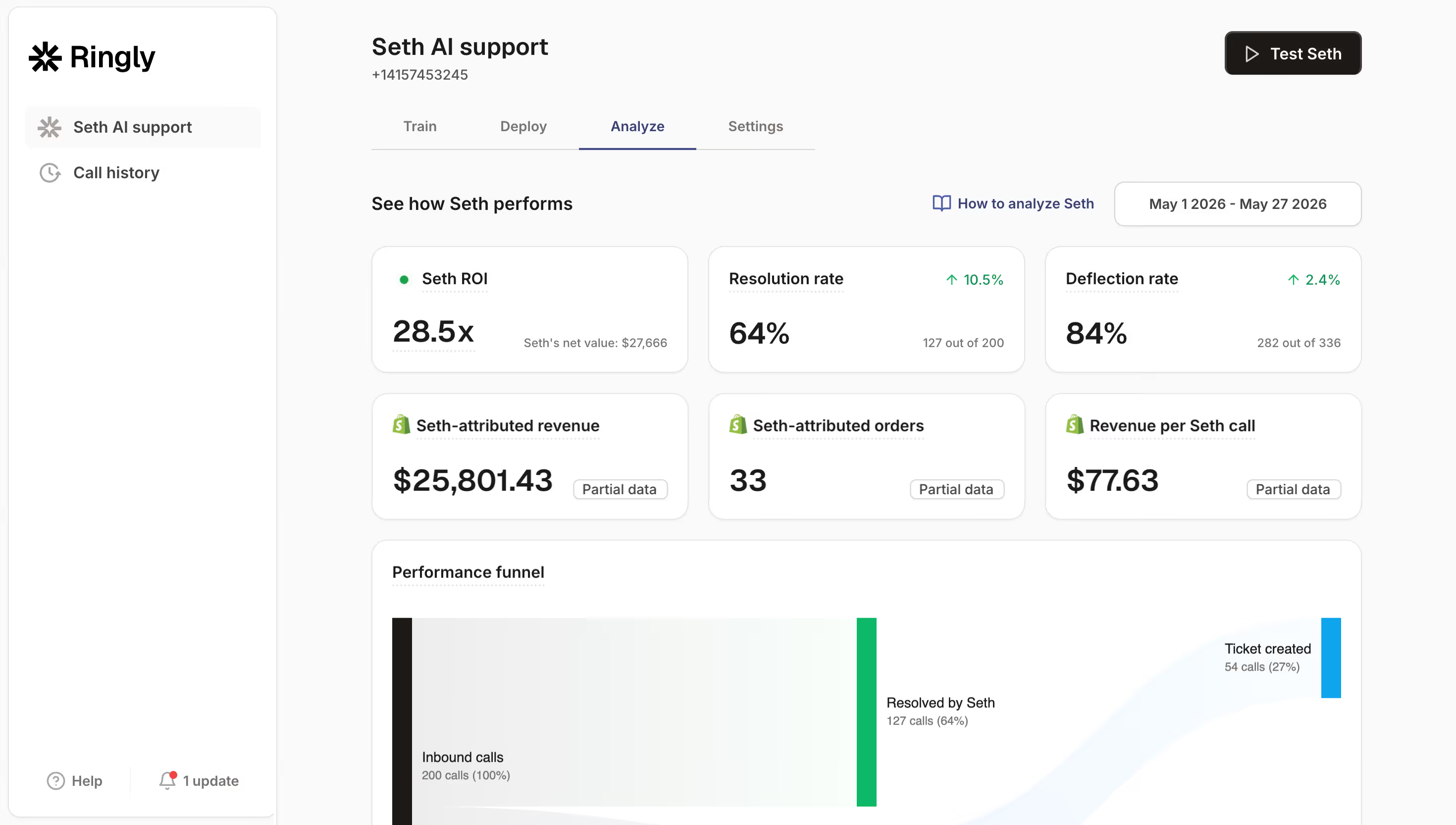
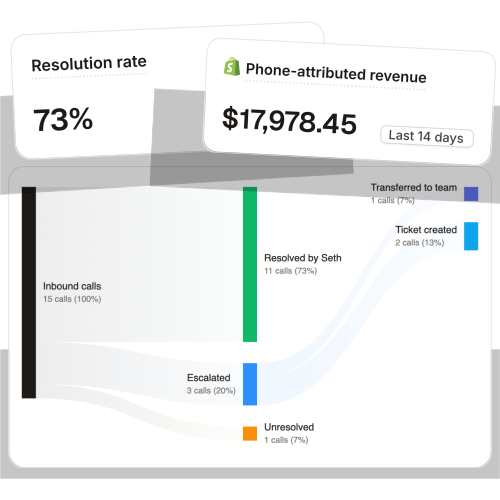
Across 50+ brands, the AI resolves 73% of calls autonomously at roughly $0.42 per resolved call. Calls that need a human escalate cleanly to Gorgias, Richpanel, Reamaze, or whatever helpdesk you already run, so you keep your stack and your phone number. The thing most operators worry about is whether customers can tell it's AI on an already-tense return call.
"My customers also feel like it's a normal person. They feel like they can communicate if they have questions."
Claudia Droge, TechCraft Studio
That's the bar. A return call in January is the worst possible moment to sound like a robot, and the single most repeated thing customers say after a call is that it didn't. For the always-on side, see 24/7 ecommerce phone support and our breakdown for Shopify Plus customer service teams.
Frequently asked questions
When does the post-holiday returns spike peak? It starts the first Monday after New Year's (National Returns Day) and stays elevated through late January. Adobe data shows returns running 8% to 15% above baseline in the first two weeks of January, and extended return windows keep volume high until the end of the month.
How much does customer service call volume go up after the holidays? Most ecommerce brands see ticket volume run 2 to 3 times normal in early January, and phone-specific volume can climb 60% to 80% with peak days hitting up to 10x. The second surge, driven by returns and exchanges, is often bigger for support than Black Friday itself.
Can I just hire seasonal reps for January? Usually not in time. Recruiting and training a rep takes 45 to 60 days, and the January spike lasts about four weeks, so reactive hiring misses the window. Self-service, proactive notifications, and AI call handling set up before the season are what actually carry the load.
What is National Returns Day, or "Returnuary"? National Returns Day is the first Monday after New Year's, when gift returns peak. "Returnuary" is the industry nickname for the whole month, because returns stay elevated through late January rather than clearing in a few days.
Does an AI phone agent actually handle refund and return calls? Yes. The bulk of January calls are return status, refund timing, gift returns, exchanges, and return-window questions, which are exactly the repeatable calls an AI resolves well. Emotional or complex cases escalate to your team. Across Ringly's 50+ brands the AI resolves 73% of calls on its own.
How fast can we get phone coverage live before the spike? Ringly is live in under an hour for the basics, and the full build runs on a 14-day Launch Sprint. To be ready for January, the practical deadline is starting in November so it's tuned before the window opens.
Talk to us

If you run a $10M-$100M Shopify brand and the January refund queue eats your team every year, a 30-min call is the fastest way to see what the spike is actually costing you and what an AI phone agent would absorb.
The 3-layer guarantee.
- Live in 14 days or it's free until launched.
- 65% resolution in 90 days or we refund the last 3 months of subscription fees.
- We keep working free until we hit 65%.
Ruben (Ringly co-founder) takes these calls personally.