
The short version.
- Good phone etiquette doesn't fail your ecommerce brand. The fifth where's-my-order call of the hour does, when a tired rep clips the greeting and skips the recap.
- The etiquette that matters is the kind you can hold consistent on every call, including the ones at 11 p.m. you currently send to voicemail.
- Written for founders and Heads of CX at $10M-$100M Shopify brands running 3-12 reps and a visible phone line.
Most phone etiquette advice reads like it was written for a call center that has all the time in the world. Answer warmly, listen actively, never interrupt, close with next steps. All true. None of it survives a Monday with 217 tickets stacked since Friday and two reps out sick.
If you run a $10M-$100M Shopify brand with a phone number on the site, you already know etiquette isn't really your problem. Your reps know how to be polite. They just can't be polite the same way on the 50th identical call, and they can't be polite at all on the calls that roll to voicemail after 6 p.m. This is the playbook for the etiquette that actually holds up in an ecommerce queue: by call type, at volume, and after hours.
We've launched AI phone agents for 50+ Shopify brands trying to fix exactly this, the gap between the etiquette they train and the etiquette the customer actually gets when the team is drowning. If your phone goes quiet after hours or your reps are burnt out on the same questions over and over, book a 30-min call and we'll walk through your queue with you.
Why phone etiquette is different for an ecommerce brand
A phone call to a DTC brand isn't a support ticket with a voice attached. It's usually a customer who already spent money, is now anxious about it, and decided the website wasn't fast enough. The stakes are higher and the patience is lower.
One bad phone call doesn't just cost you a ticket, it costs you the order and often the customer. Around 1 in 6 shoppers will back out of a purchase after a poor phone experience, according to Fullview's customer service research. And the leak starts before anyone is rude: 85% of callers who can't reach a person never call back, and 62% switch to a competitor, per a 2026 PCN study. Etiquette is moot if nobody picks up.
So the real etiquette question for an ecommerce brand isn't "are my reps polite." It's "is the experience consistent." Rep #1 who's been there two years sounds warm and capable. Rep #5, three weeks in and overwhelmed, sounds curt. The weekend caller gets a voicemail nobody returns. Same brand, three completely different experiences, and the customer doesn't know or care which rep they got. They just remember how the brand made them feel.
That consistency problem is what the generic etiquette guides miss. They treat it like a training issue. At a growing Shopify brand, it's an operations issue.
The etiquette rules that matter, by call type
Generic phone etiquette is a flat list of 20 tips. An ecommerce queue isn't flat. The same four or five call types come back over and over, and each one has its own etiquette trap. Here's how to handle the ones that actually fill your queue.
The WISMO ("where's my order") call
WISMO is 30-40% of ecommerce tickets in a normal week and 50%+ at peak, per Salesforce. It's the call your reps have answered a thousand times, which is exactly why the etiquette slips.
The trap: a rep who's bored of the question rushes it. They skip the warm greeting, pull up the tracking, read the date, and hang up. The customer feels processed, not helped.
What good looks like: greet by name, acknowledge the worry before the facts ("I get it, you ordered six days ago and it's gone quiet"), give the tracking detail, then close with a recap text so they don't have to call again. The recap text is the etiquette move most brands skip, and it's the one that actually cuts repeat calls. For the full operational version of this, our guide to handling WISMO calls goes deeper.
The return or exchange call
Returns are where tone matters most, because the customer is already half-disappointed. Curt efficiency reads as "we want your money back as fast as possible so we don't have to talk to you."
What good looks like: never make them justify the return out loud, confirm the action plainly ("done, I've started the exchange"), and tell them exactly when they'll see the refund or the replacement. Vague timelines ("a few days") generate the next call. Specific ones ("3 to 5 business days, and I'm texting you the confirmation now") end it.
The after-hours or weekend caller
This is the etiquette failure nobody trains for, because there's no rep on the line to be polite. The call rings out, rolls to voicemail, and 80% of voicemail-routed callers hang up without leaving a message, per Eden's research. The best phone manners in the world don't help a customer who never reaches a human.
Good after-hours etiquette is structural, not verbal: pick up the call, answer the routine question on the spot, and only take a message for the calls that actually need a person. We'll come back to how you do that without a night shift.
The angry-about-shipping caller
The one call where reps either shine or end up on Trustpilot. The instinct is to defend the carrier or the policy. That's the wrong move.
What good looks like: let them finish (don't interrupt, even when you know the answer at word three), reflect it back ("that's a real hassle, especially since you needed it for the weekend"), own the brand's part even if the carrier is at fault, and offer one concrete fix. Patience here is the whole game. Interrupting an upset customer is the fastest way to turn a recoverable call into a public review.
The 7 core etiquette habits every ecommerce rep should keep
Underneath the call-type tactics, a handful of habits carry every call. None of them are new. The hard part isn't knowing them, it's holding them on call 50 of the day.
- Answer fast. Aim to pick up inside three rings. Speed is the first etiquette signal a customer reads, before a single word is spoken.
- Open warm and named. "Thanks for calling [Brand], this is [Name], how can I help?" beats a cold "Support, hold please" every time.
- Ask before you hold or transfer. "Mind if I put you on hold about a minute while I pull up your order?" A silent hold feels like being hung up on.
- Listen all the way through. Don't interrupt, even when you know the answer. Take notes so they never repeat themselves.
- Use plain language. Say "we'll fix it," not "I'll escalate this to tier-two fulfillment." Jargon makes a customer feel small.
- Be honest when you don't know. "I don't have that in front of me, let me find the person who does and call you back within the hour" builds more trust than a confident guess.
- Close with next steps and a recap. Tell them what happens next, when, and text the confirmation. The recap is what stops the second call.
The single most valuable etiquette habit in ecommerce is the closing recap, because it converts a polite call into a call that doesn't repeat. Most brands train the greeting and forget the close.
If your reps know all seven and still deliver them unevenly, the problem isn't the training. It's that there's too much volume for any human to stay consistent across. Book a 30-min call and we'll look at where your queue is breaking the etiquette you already trained.
Etiquette breaks at volume, and after 6 p.m.
Here's the part the tip listicles skip. Your reps don't lose their manners on the hard calls. They lose them on the easy ones.
Reading through 50+ Ringly customer call logs, the etiquette failures almost never show up on the genuinely tricky calls. Reps stay sharp on those, because the hard calls feel like the job. The clipped greetings and skipped recaps show up on the fifth identical WISMO of the hour, when the rep is running on autopilot and just wants to clear the queue. Most operators tell us 70-80% of their calls are the same handful of questions. That repeatable 70-80% is exactly where the brand voice quietly erodes.
And it's expensive to keep throwing humans at it. Replacing one CS rep runs about $14,113, and the industry sits at 31.2% annual turnover, per Gartner data via Insignia. The same research puts 74% of agents in ongoing burnout. Burnt-out reps don't quit being polite on purpose. The volume just grinds it out of them.
A rep on their fortieth repeat call of the day isn't a rude rep, they're a tired one, and the customer can't tell the difference. WashCo, a Shopify brand we launched, recovered $22,664 in attributed revenue in its first 7 days on the phone, much of it from calls that used to roll to voicemail.
Then there's the after-hours gap. Businesses answer only 37.8% of inbound calls and send another 37.8% to voicemail, per AmbsCallCenter. For a DTC brand, a big chunk of that missed volume is evenings and weekends, when there's no rep on the clock and no etiquette to speak of, just a voicemail box filling up with calls you'll never return. You can't train your way out of an empty chair.
How to keep etiquette consistent with an AI phone agent
So how do you hold one warm, on-brand standard across every rep, every shift, and every after-hours call without hiring people you can't afford to keep busy?
You stop asking humans to carry the repeatable 70%. Route the WISMO, returns, and product questions to an AI phone agent that answers the same way every time, 24/7, and let your team spend their patience on the calls that actually need a person.
The instant objection is the right one: won't an AI agent sound robotic and off-brand, the opposite of good etiquette? It's the fear every operator raises, and it's fair. They've all seen a chat bot fail in public. The thing is, the most repeated compliment we hear from customers calling brands on Ringly is "you don't sound like AI." Good etiquette on a phone call is mostly consistency, patience, and a warm close, and those are exactly the things a well-built agent never gets tired of.
"My customers also feel like it's a normal person. They feel like they can communicate if they have questions."
Claudia Droge, TechCraft Studio
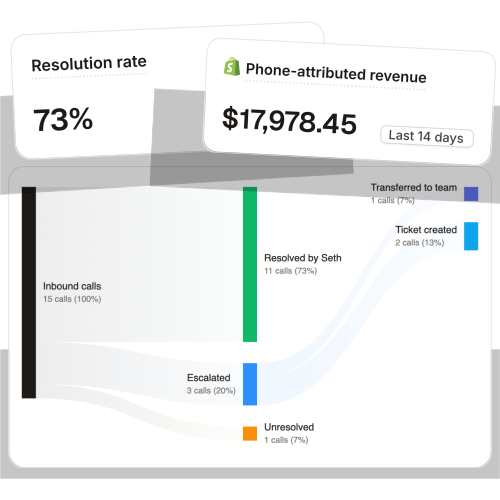
Ringly.io is AI phone support for Shopify brands. Instead of growing your support headcount every time call volume goes up, the AI takes the routine inbound calls so your team can focus on the work that actually moves revenue. It answers 24/7 in 40 languages, finds orders in your Shopify store, processes returns and exchanges, answers product questions from your knowledge base, and recovers abandoned carts. Across 50+ brands it resolves 73% of calls autonomously at roughly $0.42 per resolved call. TechCraft Studio handles 88% of its calls without a human, and BioLongevity Labs hits 79% end-to-end resolution.
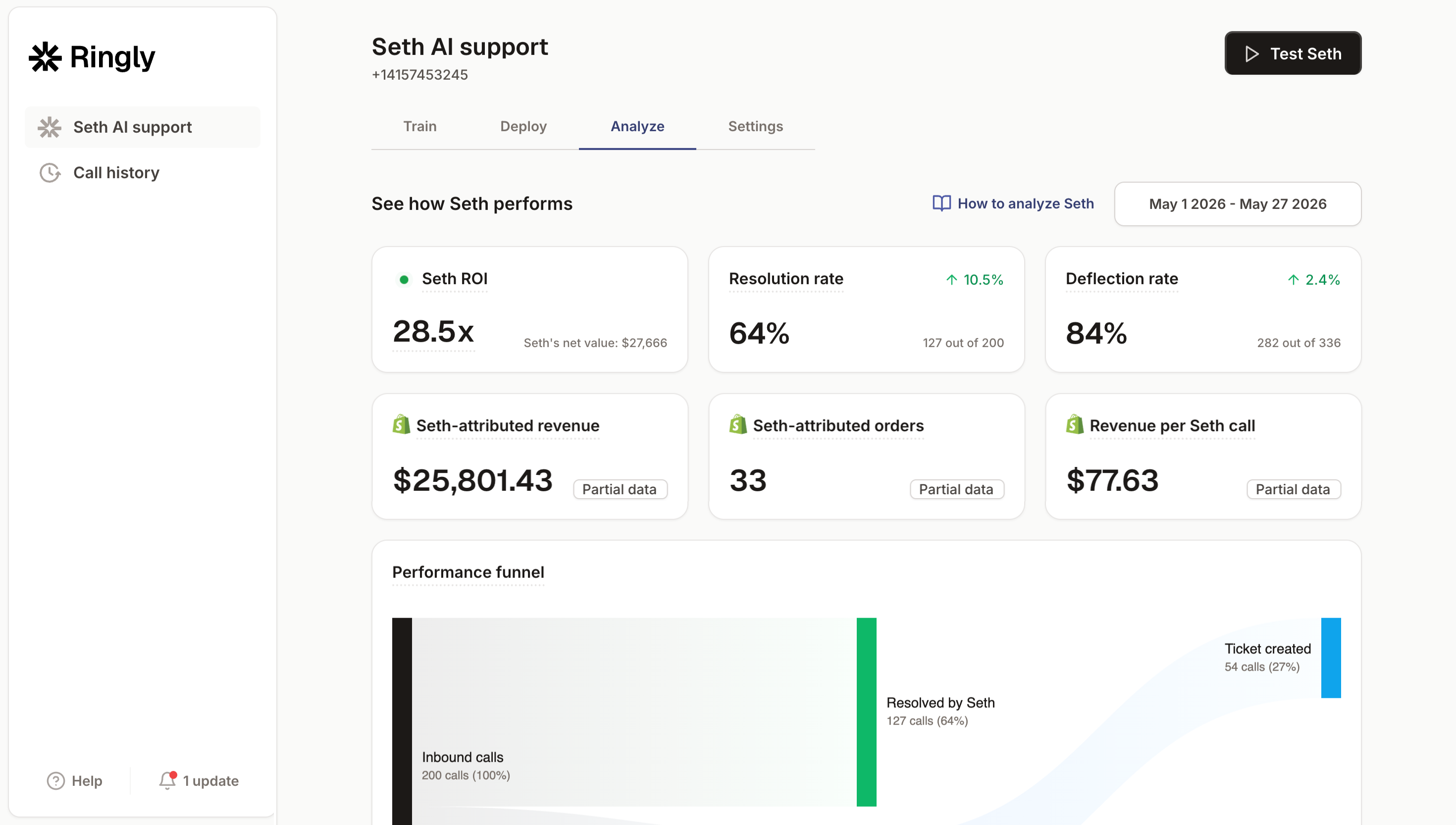
Escalation etiquette matters here too. The calls that need a human shouldn't dead-end with the AI. A clean handoff means the agent passes full context to your team and escalates into Gorgias, Richpanel, or whatever helpdesk you already run, so the customer never starts over. You keep your number, your helpdesk, and your workflows. For the longer comparison of AI voice support versus a human team, we wrote a full breakdown, and our take on scaling customer service without hiring covers the operating model.
What good etiquette costs you, and what it saves
Consistent etiquette at volume has a price, and most brands pay it in headcount. Here's what that looks like for a typical $50M Shopify brand running a 6-rep CS team.
| Line item | Today | With Ringly |
|---|---|---|
| 6 reps × $4K loaded per rep | $24,000/mo | n/a |
| Ringly Enterprise (~$5K/mo) | n/a | $5,000/mo |
| Net monthly CS spend | $24,000/mo | $5,000/mo |
| Monthly savings | n/a | $19,000/mo |
| Annual savings | n/a | $228,000/yr |
That's roughly the 70% of repeatable calls (order status, returns, product questions, the same things over and over) routed to the AI with the same warm etiquette every time. The other 30%, the genuinely complex calls, still go to your reps, who now have the bandwidth to actually be patient on them. The math isn't really about the price of the tool. It's about what you stop spending to keep a leaking phone line staffed. For a brand operating at scale, our Shopify Plus customer service guide runs the same numbers at higher volume, and the full pricing sits on the pricing page.
Good etiquette and lower cost usually feel like a trade-off. The reason they aren't here is that the repeatable calls were never the ones that needed a human touch. They needed a consistent one. Worth pairing with the basics in our ecommerce phone support best practices and the broader ecommerce customer service playbook, which ties phone manners back to customer retention.
Frequently asked questions
What is good phone etiquette for an ecommerce business? It's a warm named greeting, real listening, plain language, and a clear close with a recap text, applied consistently to every call. For DTC specifically, it also means handling the high-frequency calls (order status, returns) without sounding rushed, since those are most of your volume.
How fast should an ecommerce brand answer support calls? Aim to pick up within three rings. Speed is the first etiquette signal a customer reads, and answer rate matters even more than ring time. Most businesses answer fewer than 38% of their calls, so just reliably picking up already puts you ahead.
How do you keep phone etiquette consistent across a team? Document the greeting, the hold language, and the closing recap, then audit real call recordings, not scripts. The honest answer is that perfect human consistency at volume is very hard, which is why brands route the repeatable calls to an AI agent that delivers the same standard every time.
Should ecommerce brands use a script for phone support? Use a loose framework, not a rigid script. Reading a script word for word sounds robotic, which is itself bad etiquette. Give reps the structure (greeting, listen, plain language, recap close) and let them sound human inside it.
How do you handle angry customers on the phone? Let them finish without interrupting, reflect the frustration back, own the brand's part even if a carrier caused it, and offer one concrete fix. Patience is the whole game. Interrupting an upset customer is the fastest way to turn a recoverable call into a public review.
Can an AI phone agent have good etiquette? Yes, when it's built for it. Etiquette on the phone is mostly consistency, patience, and a warm close, things a well-built agent never tires of. The most common compliment we hear about Ringly is "you don't sound like AI."
How do you handle after-hours calls without hiring a night shift? Route after-hours calls to an AI phone agent that answers the routine questions on the spot and only takes a message for the complex ones. That keeps the phone answered 24/7 without staffing evenings and weekends you can't keep busy.
Talk to us

If you run a $10M-$100M Shopify brand and your phone goes quiet after 6 p.m., a 30-minute call is the fastest way to see what the queue is actually costing you. We'll look at the calls you're dropping and where the brand voice is breaking, then map what good etiquette at full volume would take.
The 3-layer guarantee.
- Live in 14 days or it's free until launched.
- 65% resolution in 90 days or we refund the last 3 months of subscription fees.
- We keep working free until we hit 65%.
Ruben (Ringly co-founder) takes these calls personally.