
This post in 30 seconds.
- Eleven phone customer service tips that hold up when your team is buried, not just when it's quiet, each one paired with a real number.
- The tip that unlocks the other ten: stop sending the repeatable 70% of calls to a human. Across 50+ Shopify brands we run, that 70% is the same five questions.
- Built for founders, COOs, and Heads of CX at $10M-$100M Shopify brands with a visible phone line and a paid helpdesk.
Most phone customer service tips assume your team has time to use them. Slow down, listen, personalize, never read a script. Good advice, all of it. None of it survives a Monday where 217 tickets stacked up over the weekend and two reps called out sick.
If you run support at a $10M-$100M Shopify brand, you already know the gap. The etiquette is fine. The problem is volume. We run AI phone support for 50+ Shopify brands, and when I read through their real call logs, the same thing shows up every time: roughly 70% of the phone volume is five questions repeated all day. That number is the reason most of these tips fail in practice, and it's the reason the list below is ordered the way it is.
This is a phone customer service guide written for a team that's drowning, not a team with a quiet queue. For the broader channel picture, our DTC customer service playbook covers email and chat too, but the phone is where most brands lose the most, so that's what this one is about. If your phone is the channel you answer worst right now, book a 30-min call and we'll pull your missed-call data and show you where the time is going.
First, look at what's actually on the phone
Before any tip lands, you need to see the call mix honestly. Most of your phone volume is not the call you're worried about. It's five questions you've heard ten thousand times.
Across DTC support, the recurring five are: where's my order, can I return or exchange this, does this fit, can you pause or cancel my subscription, and is this in stock. The first one alone, WISMO ("where is my order"), runs 30-40% of all tickets in normal periods and over 50% at peak, and each one costs $5 to $22 to handle manually according to Salesforce. On the phone, those calls are pure data retrieval. A rep opens the order, reads the tracking number out loud, ends the call.
Imagine answering "where's my package?" forty times a day, every day. That's the work that crushes rep morale and drives the turnover that keeps you hiring. So the tips below split into two jobs: handle the repeatable volume so it stops eating your team, and make the calls that DO need a human as good as they can be. Most lists only cover the second job. That's why they don't move the needle.
11 phone customer service tips that hold up under real call volume
These come from watching how 50+ Shopify brands actually run their phone lines, not from a list of etiquette rules. The order matters: the first few free up the capacity that makes the rest possible.
1. Answer fast, or you never get to use any other tip
A perfect call you never pick up is worth nothing. The classic benchmark is the 80/20 rule: answer 80% of calls within 20 seconds. A lot of teams now stretch for 90/15, 90% within 15 seconds.
Here's why the clock is brutal. About 60% of callers hang up within the first 60 seconds of waiting, and the average busy contact center loses roughly 27% of inbound calls to abandonment per Brightmetrics. Worse, most businesses only answer about 37.8% of the calls that come in, with the rest going to voicemail or nothing at all according to AmbsCallCenter. Speed isn't a nicety. It's the entire game. If your queue regularly sits past a minute, no amount of empathy training fixes it, because the customer already hung up.
The trap is that answer speed is the one metric you can't fix with better people. You fix it with more capacity at the moments volume spikes: the Monday-morning backlog, the hour after a paid creative pops, the week of a product drop. A team sized for the average will always blow the SLA at the peak, and the peak is when the most revenue is on the line. So before you train anyone on tone, look at when your hold times spike and ask whether the calls stacking up in that window even need a person.
2. Take the repeatable 70% off your humans first
This is the tip that makes the other ten work. If ~70% of your phone volume is the same five questions, your reps spend most of their shift on calls that don't need a person. Pull that volume off them and two things happen at once: hold times drop, and the calls that reach a human are the ones worth a human.
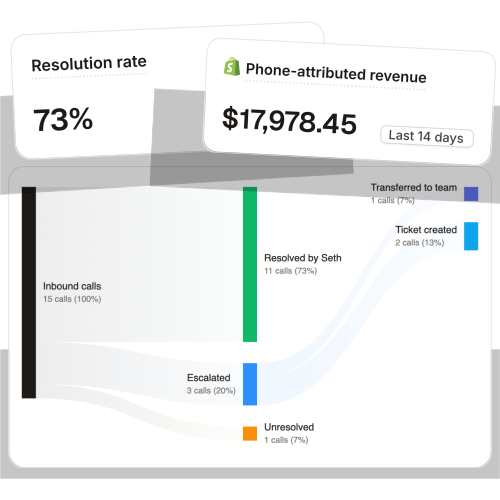
This is what we built Ringly to do. It's AI phone support for Shopify brands: it answers inbound calls 24/7, finds the order in your store, handles returns and exchanges, answers product questions from your knowledge base, and escalates the rest to your team. Across 50+ brands it resolves 73% of calls on its own. TechCraft Studio handles 88% of its calls without a human. The reps still take the complicated ones. They just stop reading tracking numbers out loud all day.
"My customers also feel like it's a normal person. They feel like they can communicate if they have questions."
Claudia Droge, TechCraft Studio
3. Use scripts for structure, not for the words
Scripts should shape the call, not write the sentences. A good script is a checklist: confirm who you're talking to, restate the problem, name the next step, set an expectation. A bad script is a wall of text the rep reads in a flat voice, and customers hear it instantly.
Give your team the steps and the boundaries (what they can refund, when to escalate, what to never promise) and let them say it in their own words. The brands with the best phone reputations don't have the most polished scripts. They have reps who know the four beats of a call and sound like humans hitting them.
The four beats that work on almost any call: confirm who you're talking to and what they ordered, restate the problem so they know you heard it, state exactly what you're going to do, and set a timeline they can hold you to. Drop a flat opener like "thank you for calling, how may I direct your call" and you've already told the customer they're in a queue. The same goes for anything you put on an AI front line: write the policy and the escalation rules as instructions, not as a paragraph to be recited. The structure makes the call consistent. The delivery is what makes it feel human.
4. Pull up the order before you say hello
Preparedness is one of the five P's of phone etiquette for a reason. If your rep is searching for the order while the customer is talking, the call is already slower and colder than it needs to be. Wire your phone system to your Shopify order data so the customer's name, last order, and tracking are on screen the second the call connects.
This is also what makes personalization real instead of a tip you nod at. "Hi Sarah, I see your order shipped Tuesday and it's in Columbus right now" lands completely differently than "can I get your order number?"
5. Mirror their words back, then confirm
Active listening sounds soft until you watch a call go sideways without it. The move is simple: let the customer finish, then repeat the core of what they said in their words before you respond. "So the box arrived but the second item was missing, is that right?"
It does two jobs. It tells the customer they were heard, and it catches the misread before you solve the wrong problem. On an angry call it also buys a beat of calm, which matters more on the phone than on email because tone travels.
There's a version of this that scales past your best rep, too. The reason "you don't sound like AI" is the most common thing customers say after a Ringly call is that the agent confirms before it acts. It reads the situation back, then resolves it, instead of barreling into a canned answer. Mirroring isn't a personality trait you have to hire for. It's a step in the call you can make non-optional, whether a human or an agent is on the line.
6. Have exactly one clean escalation path
When a call needs a manager or a specialist, the handoff is where trust gets won or lost. Nothing erodes a customer faster than being transferred, dropped, and asked to re-explain from scratch.
A clean escalation has three parts: a clear trigger (whoever's on the call knows exactly which types they should not try to solve), the full context attached (order, history, what's already been said), and a warm handoff where the next person opens already knowing the story. Get any one of those wrong and the customer feels the seam.
If you run AI on the front line, the same rule applies to the bot-to-human jump, and it's the part most AI phone tools botch. The call should transfer with the full context so your rep picks up mid-story, not at the beginning. The whole point of putting AI on the routine calls is to protect the human moments. A bad handoff throws that away.
7. Don't let after-hours roll to voicemail
A huge share of DTC calls land outside 9-to-5, especially for brands with older customers who prefer the phone. And voicemail is where revenue quietly dies: most callers routed to voicemail hang up without leaving a message, and most voicemails that do get left never get a call back.
You have three options for after-hours: pay reps to sit a thin overnight shift (expensive and idle), let it roll to voicemail (you already know how that goes), or cover the after-hours queue with AI and escalate anything real to the morning. The first two leak money. The third keeps the line live without a night shift.
A practical detail most teams miss: after-hours volume is bursty, not steady. A late-evening reorder, a weekend gifting question, a Sunday-night "did my subscription charge twice." There's never enough of it to justify a human on the clock, but there's always enough to lose a sale or earn a one-star review about nobody picking up. That mismatch (real revenue, not enough volume to staff) is exactly the shape AI handles best. It costs nothing to sit idle and answers instantly when a call comes in at 11 p.m.
8. Keep one record of every conversation
Your phone calls, emails, chats, and DMs should land in one place. When a customer who emailed yesterday calls today, the rep needs to see that thread, not start cold. A scattered record is how a customer ends up re-explaining the same issue three times across three channels, which is the single fastest way to turn a small problem into a churn risk.
Most DTC brands already run a helpdesk like Gorgias or Gladly for this. The phone just needs to write into the same record instead of living in a separate silo. The mistake is treating the phone as its own island: a separate number, a separate tool, a separate log that nobody reconciles. Whatever picks up the call, human or AI, should escalate and write back into the helpdesk you already run, so the next person to touch that customer sees the whole history.
9. Measure resolution, not just calls answered
"Calls answered" tells you the phone rang. "Resolved on the first call" tells you the customer actually got helped. Answer rate is the vanity number. First-call resolution is the one that predicts whether they call back angry or never call back at all.
Track resolution rate per call type. You'll usually find the repeatable five resolve at a high rate (they're simple) and the complex calls drag the average down (they should, they're hard). That split tells you exactly which calls to take off your humans and which to invest training in. For reference, the brands we run hold a 73% autonomous resolution rate on the routine volume, which frees the team to push first-call resolution up on the hard calls.
Two more numbers worth watching alongside resolution: average handle time and what share of calls land after hours. If handle time on WISMO is creeping up, your reps are hunting for order data instead of reading it off a screen, which is a tooling problem, not a people problem. If a big slice of volume is after-hours, you're either paying for coverage you barely use or losing those calls entirely. Both point back to the same move: take the predictable volume off the humans so the metric that actually matters, did the customer get helped, can climb.
10. Protect your reps from the volume that burns them out
A support rep realistically handles 20-50 calls a day depending on complexity. Fill those slots with WISMO and you get a burned-out team in a few months and a new hire to train in a few more. Every rep who quits is a $4,000-a-month loaded seat to refill plus weeks of ramp where they're slow and the queue grows.
The fix is not "hire more empathetic people." It's "stop feeding your people the calls that turn them into a search engine." Move the routine volume off them and the same reps you have today get to do the work they were actually hired for. That's the cheapest customer retention move in support, and almost nobody frames it as one.
11. Keep your number, your helpdesk, and your tone. Add capacity, not a new stack.
The last tip is a warning. The temptation when the phone is a mess is to rip everything out and start over. Don't. Your phone number, your helpdesk, your escalation rules, and the way your brand talks are assets. Whatever you add should sit in front of them, not replace them. The goal is more capacity on the routine calls, not a six-week migration that breaks the workflows your team already knows.
This matters because the all-in-one pitch is seductive when you're buried: one tool, one login, one vendor to fix everything. In practice, the brands that tear out a working setup to chase it usually spend a quarter rebuilding what they already had, and the phone stays bad the whole time. The faster path is to keep what works and add capacity exactly where you're losing calls. Point the new layer at the routine 70%, keep your number and your reps and your helpdesk, and you can be answering more calls this month instead of next quarter.
What the routine 70% is actually costing you
Tips are free. The volume isn't. Here's the math for a typical $50M Shopify brand running a 6-rep phone team.
| Line item | Today | With Ringly |
|---|---|---|
| 6 reps × $4K loaded per rep | $24,000/mo | n/a |
| Ringly Enterprise (~$5K/mo) | n/a | $5,000/mo |
| Net monthly CS spend | $24,000/mo | $5,000/mo |
| Monthly savings | n/a | $19,000/mo |
| Annual savings | n/a | $228,000/yr |
That assumes roughly 70% of repeatable calls (order status, returns, product questions, the same five things over and over) route to the AI. The other 30%, the genuinely complex calls, still go to your team, who now have time to actually solve them. WashCo, a Shopify brand we launched, recovered $22,664 in its first 7 days on the phone with this setup. Resolved calls run about $0.42 each on the AI versus $7 to $16 per call at a human BPO.
Want to see this against your own call volume instead of a sample brand? Book a 30-min call and we'll do the math live.
Common mistakes that quietly kill phone CX
A few patterns show up over and over at brands with a struggling phone line.
- Staffing an overnight shift you can't afford. A US rep costs about $4,000/mo loaded and sits idle most of an after-hours shift because the volume isn't steady. The economics never pencil out.
- Scripting the personality out. Over-tight scripts make reps sound like a recording, which is the exact thing customers complain about when they say a brand "felt robotic."
- Measuring calls answered and stopping there. You can answer every call and still resolve none of them. Resolution is the number that matters.
- Ignoring the repeatable 70%. Every tip about empathy and personalization assumes your team has the bandwidth to use it. If they're buried in WISMO, they don't. Free the capacity first.
Frequently asked questions
What is the most important phone customer service tip?
Answer speed, then call routing. About 60% of callers hang up within 60 seconds, so a call you never pick up is a customer you've already lost. Once you're answering fast, the next lever is routing the repeatable 70% of calls off your humans so they can focus on the calls that actually need them.
How fast should we answer customer calls?
The standard benchmark is the 80/20 rule: 80% of calls answered within 20 seconds. Many teams now aim for 90% within 15 seconds. If your average wait creeps past a minute, expect heavy abandonment.
Should phone reps use scripts?
Use scripts for structure, not for the exact words. A script should give reps the beats of a good call (confirm, restate, set the next step) and the boundaries on refunds and escalation. Reading a script word-for-word in a flat voice is what makes customers feel like they're talking to a machine.
How do you handle after-hours phone calls without hiring a night shift?
Cover the after-hours queue with AI and escalate anything real to the morning. Paying reps to sit a thin overnight shift is expensive and mostly idle, and letting calls roll to voicemail loses most of them, since most voicemail-routed callers hang up without leaving a message.
Can AI handle phone customer service without annoying customers?
Yes, when it only takes the routine calls and hands the rest to a human. The most common thing customers say after talking to our AI is that it doesn't sound like AI. The repeatable questions (order status, returns, stock) get resolved fast, and the complex or emotional calls go straight to your team.
How much can a Shopify brand save by automating routine phone calls?
A 6-rep phone team runs about $24,000/mo loaded. Routing the repeatable ~70% of calls to AI typically cuts that to around $5,000/mo, a net saving near $19,000/mo or $228,000/yr, while the team keeps the complex calls. Resolved calls run about $0.42 each on AI versus $7 to $16 at a human BPO.
Will this replace my support team?
No. It removes the repeatable volume that burns reps out, so the team you have handles the calls worth handling. Brands on Ringly keep their reps for the hard, high-value calls and let the AI take the order-status and returns volume.
Talk to us

If you run a $10M-$100M Shopify brand and the phone is the channel you answer worst, a 30-minute call is the fastest way to see what the routine 70% is costing you. We'll pull your missed calls, run the math against your real volume, and show you which calls to take off your team first.
The 3-layer guarantee.
- Live in 14 days or it's free until launched.
- 65% resolution in 90 days or we refund the last 3 months of subscription fees.
- We keep working free until we hit it.
Ruben (Ringly co-founder) takes these calls personally.