
This post in 30 seconds.
- Omnichannel support software is supposed to unify every channel into one shared context, but most platforms quietly under-deliver on one channel: the phone.
- We compare 7 platforms (Gorgias, Richpanel, Re:amaze, Front, Zendesk, Kustomer, Gladly) on the criteria that actually matter for a Shopify brand, with the voice channel front and center.
- Built for $10M-$100M Shopify brands running a paid helpdesk and a visible phone line that someone still has to answer.
Picture the stack most $30M Shopify brands actually run. Email lives in Gorgias. Chat is in a second tool. Instagram and Facebook DMs are in a third. And the phone? It rings four times, then drops to a voicemail box nobody on the team has checked since the last launch.
That is the problem omnichannel support software is supposed to solve. One inbox, one customer history, every channel talking to every other channel. Most of these platforms do a genuinely good job of it for email, chat, and social. The catch is the channel they all treat as an afterthought, and for a high-AOV ecommerce brand it is often the most expensive one to get wrong.
If you run customer experience at a Shopify brand doing $10M-$100M, you already know which channel I mean. The phone is where your highest-intent customers go, and it is the channel almost every omnichannel tool leaves half-built. We work with Shopify brands on exactly this gap, so before you pick a platform, book a 30-min call and we'll show you what the after-hours queue is actually costing you.
Omnichannel support software at a glance
Here is the short version before the deep dives. For ecommerce, the column that separates the contenders is "native voice," and almost nobody scores well on it without charging enterprise rates.
| Platform | Best for | Native voice? | Starting price | G2 |
|---|---|---|---|---|
| Gorgias | Shopify-native written channels | No (partner add-on) | $60/mo | 4.6 |
| Richpanel | All-in-one written + self-service | Limited | $49/seat/mo | 4.5 |
| Re:amaze | Affordable broad channels | Light | ~$29/agent/mo | 4.6 |
| Front | Collaborative shared inbox | No | ~$19/seat/mo | 4.7 |
| Zendesk | Enterprise omnichannel depth | Yes (Talk add-on) | $55/agent/mo | 4.3 |
| Kustomer | Unified CRM timeline | Yes | $89/user/mo | 4.4 |
| Gladly | True native voice, premium CX | Yes (native) | ~$180/agent/mo | 4.6 |
Notice the pattern. The tools priced for a growing DTC brand (Gorgias, Richpanel, Re:amaze, Front) either skip native voice or treat it as a bolt-on. The tools that take voice seriously (Zendesk Talk, Kustomer, Gladly) charge for it, and Gladly's seat minimums put it out of reach for most brands your size. We'll come back to how to fix the voice leg without re-platforming everything.
What omnichannel support software actually means (and where it breaks)
Omnichannel does not mean "we offer more channels." It means every channel shares the same customer context, so a person can start in chat, switch to email, and call you on Tuesday, and your agent sees one continuous history instead of three disconnected fragments.
That distinction matters more than the marketing makes it sound. According to DevRev, 74% of customers hate repeating themselves across channels, and roughly 56% say they have been forced to because the systems were disconnected. Every time a customer crosses a channel boundary and has to start over, you have a multichannel setup wearing an omnichannel label.
True omnichannel is shared context across channels, not a longer list of inboxes. When context carries across, the payoff is real: Capital One Shopping's research found brands with strong omnichannel engagement retain 89% of customers, versus 33% for the ones with weak, stitched-together setups.
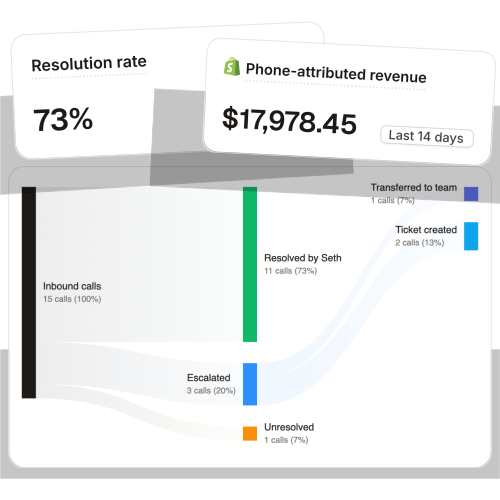
So where does it break? Almost always on voice. Email, chat, and social are text. They slot neatly into a shared inbox. The phone is live, it is synchronous, and it needs an actual agent or an AI that can hold a real conversation. That is harder to build, so most platforms either skip it or sell it as a separate product with per-minute fees. The result is an "omnichannel" deployment where the highest-intent channel is the least connected one.
What to look for in omnichannel support software
When you evaluate platforms, score them on what actually changes your support economics, not the feature checklist. Here is the list I'd hand a Shopify operator.
- Shared customer context across every channel: one timeline, so a caller who emailed yesterday isn't a stranger today. This is the whole point of omnichannel; if it's missing, you have multichannel.
- Shopify-native order actions: can an agent see the order, issue the refund, and start the return inside the conversation, or do they tab out to the admin?
- A real voice channel, not a bolt-on: does the phone share the same context as the rest of the stack, or is it a separate tool duct-taped on? This is the criterion the SERP forgets.
- AI that resolves, not just routes: routing a call to a human queue is not resolution. Look for AI that can actually close "where's my order" and return questions end to end.
- Clean escalation: when a call or chat needs a person, does it hand off with the full history attached?
- Predictable pricing: per-ticket, per-seat, per-conversation, and per-minute fees stack fast. Model your real volume before you sign.
That voice criterion is not me grinding an axe. It is the single most common gap I see. A platform that nails email and chat but strands the phone in voicemail isn't omnichannel, it's multichannel with a good inbox. And the cost of getting it wrong is steep: omnichannel retailers report 179% faster revenue growth than siloed ones, and a missed call from a $200 order is a churn event, not a ticket.
How I evaluated these omnichannel platforms
I'm Ruben, co-founder of Ringly. Over the last few weeks I ran a real Shopify store's support across these platforms and scored each one the way a $10M-$100M DTC operator would, not the way a feature page wants you to.
Here are the five criteria I scored against:
- Shared customer context. I sent the same customer through email, chat, and phone on each platform and checked whether the agent saw one history or three fragments.
- Shopify-native order actions. I pushed a test order through and tried to issue a refund and start a return from inside the conversation, without leaving for the Shopify admin.
- The voice channel, for real. I checked whether the phone was a first-class native channel, a paid add-on, or missing, and after hours I called each platform's own support line to see who even picks up a phone.
- AI that resolves. I ran a "where's my order" and a return request through each tool's automation and measured whether it closed the call or just punted it to a human.
- Pricing predictability. I modeled a realistic mid-volume month with AI, overage, and voice fees included, not the headline price.
The voice test was the one that separated the field, and it is the angle the top-ranking roundups skip entirely. I don't take affiliate commissions on any tool below. Ringly appears here too, scored against the same criteria, and I'm honest about what it is and is not (it is not an omnichannel inbox).
The 7 best omnichannel support platforms for ecommerce (2026)
1. Gorgias
Best for: Shopify brands that live in written channels and want order actions inside every conversation. Gorgias is the most ecommerce-native helpdesk in the list, and for email, chat, social, and SMS it is hard to beat.
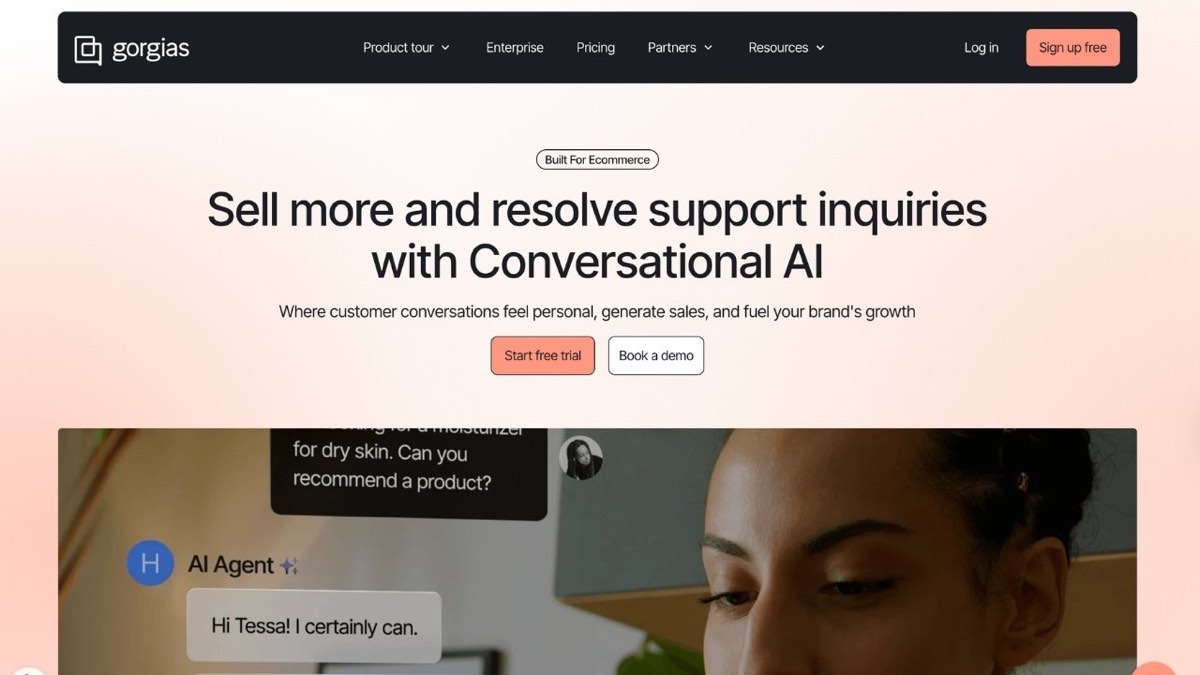
Gorgias pulls Shopify order data straight into the ticket, so an agent can refund, cancel, or start a return without leaving the thread. Its rule-based automation and macros are genuinely good. If your support is 90% text, this is a strong pick.
Pricing
| Plan | Price | Included |
|---|---|---|
| Starter | $10/mo | 50 tickets |
| Basic | $60/mo | 300 tickets |
| Pro | $360/mo | 2,000 tickets |
| Advanced | $900/mo | 5,000 tickets |
AI Agent conversations are billed on top of tickets (roughly $0.90-$1.00 each), and overage runs $0.36-$0.40 per ticket, per Gorgias pricing breakdowns.
What works
- Best in the category Shopify integration: order context and actions live inside the conversation
- Strong rule-based automation: macros and triggers handle repetitive written tickets well
- Ecommerce-native from the ground up: built for Shopify, not retrofitted
What doesn't
- No native phone channel: voice requires a partner integration, which adds cost and another point of failure
- AI double-billing: you pay the ticket and the automation fee on AI conversations
- Costs climb at volume: ticket-based pricing plus overage adds up fast
Why it ranks 1st. For written-channel omnichannel on Shopify, Gorgias is the strongest tool here. It ranks first on what it does, with the honest caveat that the phone is the one channel it doesn't natively own. If you want the full picture, see how it stacks up in our Gorgias vs Richpanel comparison.
2. Richpanel
Best for: Cost-conscious Shopify brands that want an all-in-one written-channel helpdesk plus a strong self-service portal to deflect WISMO before it becomes a ticket.
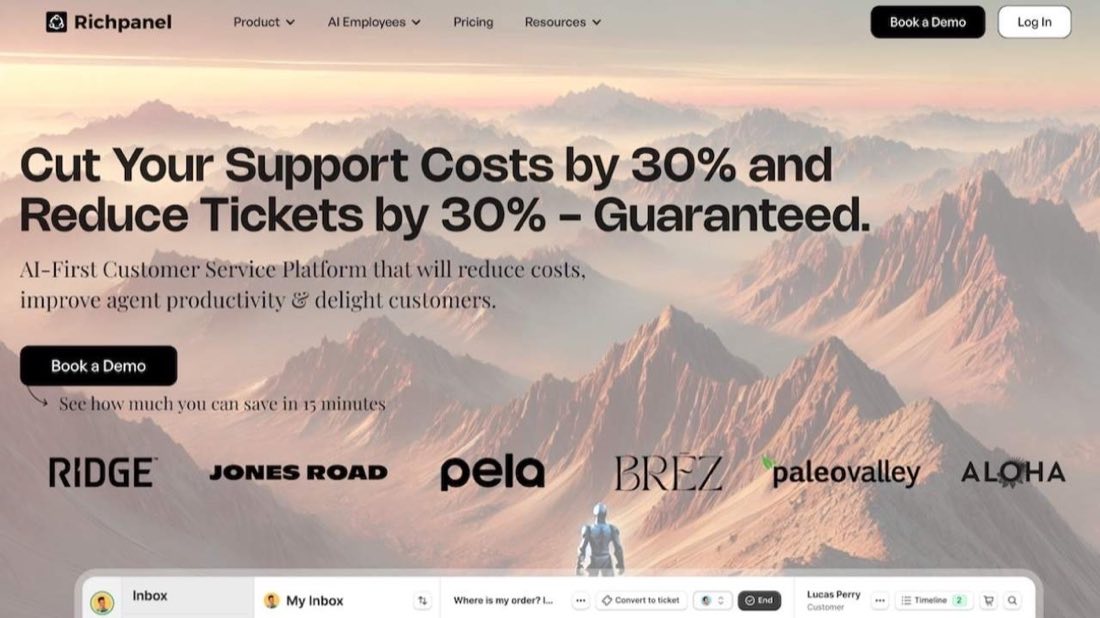
Richpanel handles email, chat, and social with a customer-facing self-service portal that lets shoppers track orders and start returns themselves. Its Sidekick AI is an add-on. For brands trying to cut written ticket volume without a big spend, it earns its spot.
Pricing
| Plan | Price | Notes |
|---|---|---|
| Starter | from $29/agent/mo | per seat |
| Regular | $49/seat/mo | common starting plan |
| Self-service portal | $9-$99/mo | separate, by order volume |
| Sidekick AI | +$10/seat/mo | add-on |
Note the two-part bill: a per-seat platform fee plus a separate order-based portal fee, per Richpanel's pricing.
What works
- Low entry price: one of the cheaper ways into an all-in-one ecommerce helpdesk
- Strong self-service portal: deflects order-status questions before they hit your team
- Multi-store support: handy if you run more than one Shopify store
What doesn't
- Voice is underdeveloped: the phone channel feels less mature than the written ones
- Two-part pricing: the seat-plus-portal model is easy to underestimate
- AI costs extra: Sidekick is an add-on, not included
Why it ranks 2nd. A solid written-channel all-in-one for budget-minded Shopify brands. It is not a voice answer, but for email, chat, and self-service it competes well with Gorgias. We break down both in the Gorgias vs Richpanel comparison.
3. Re:amaze
Best for: SMB-to-mid ecommerce brands that want broad channel coverage (email, chat, social, SMS, FAQ, push) at the lowest realistic price.
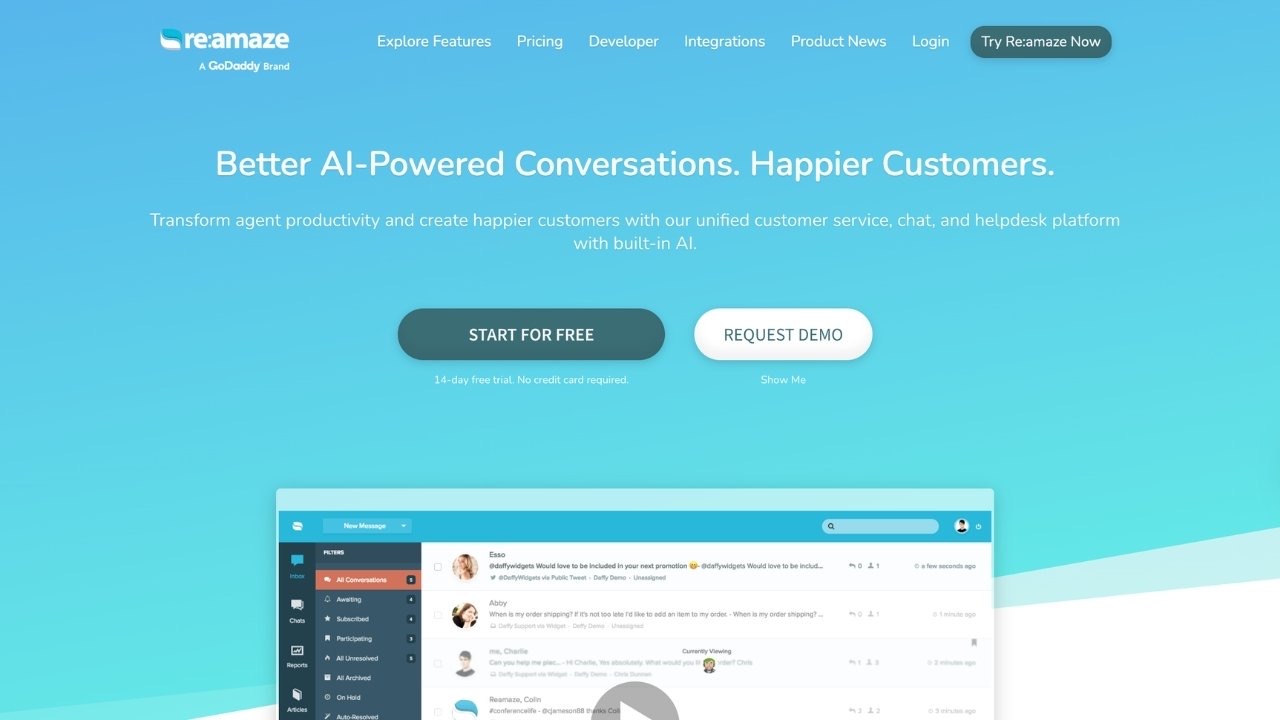
Re:amaze is the budget pick that still covers most written channels. Setup is quick, it has chatbots and an FAQ builder, and it carries a 4.6/5 on G2. For a smaller team that needs one inbox without an enterprise contract, it is a reasonable starting point.
Pricing
| Plan | Price | Notes |
|---|---|---|
| Basic | ~$29/agent/mo | core channels |
| Pro | ~$49/agent/mo | + chatbots, reporting |
| Plus | ~$69/agent/mo | + advanced features |
What works
- Affordable per-agent pricing: among the cheapest omnichannel options
- Broad written channels: email, chat, social, SMS, and FAQ in one place
- Easy setup: fast to get a team live
What doesn't
- Thin on voice: phone is not a core native channel
- Less Shopify-deep than Gorgias: order actions are lighter
- Enterprise features are limited: routing and analytics are basic
Why it ranks 3rd. The best budget omnichannel for written channels. Voice is not its strength, so if the phone matters to you (it should), you'll be solving that separately.
4. Front
Best for: Teams that want the best shared-inbox collaboration experience, especially email-heavy support and ops teams that comment, assign, and draft together.
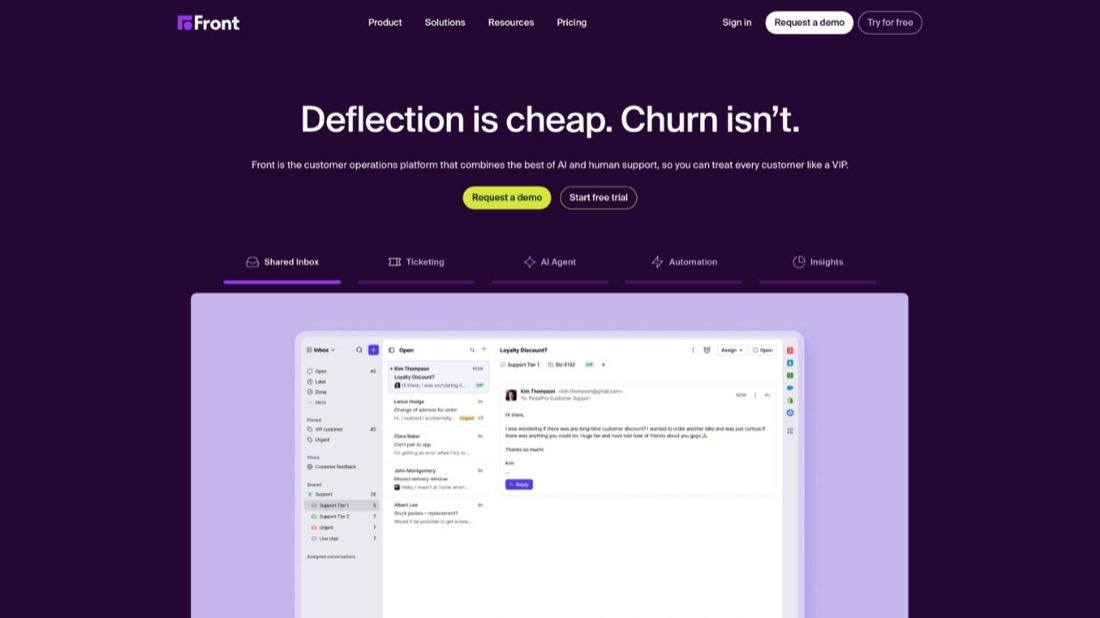
Front is less an ecommerce helpdesk and more a collaborative inbox done extremely well. It outscores Zendesk on ease of use (9.1 vs 8.6 on G2) and is loved for its clean UX and email workflows. For commerce specifically, it is lighter on order actions and has no native voice.
Pricing
| Plan | Price | Notes |
|---|---|---|
| Starter | ~$19/seat/mo | core shared inbox |
| Growth | ~$59/seat/mo | + automation, analytics |
| Scale/Enterprise | $99+/seat/mo | advanced |
What works
- Best shared-inbox collaboration: comments, assignments, and drafts feel natural
- Clean, fast UX: teams adopt it quickly
- Strong email workflows and rules: great for high email volume
What doesn't
- Not ecommerce-native: lighter Shopify order actions than Gorgias or Richpanel
- No native voice: phone runs through integrations only
- Commerce features are an add-on mindset: built for inboxes first, stores second
Why it ranks 4th. If your support is email-heavy and collaborative, Front is excellent. For a Shopify brand that needs deep order actions and a real phone channel, it leaves two of the most important boxes unchecked. See alternatives in our Front alternatives guide.
5. Zendesk
Best for: Larger brands and contact centers that need deep omnichannel customization and can absorb the cost and configuration overhead.
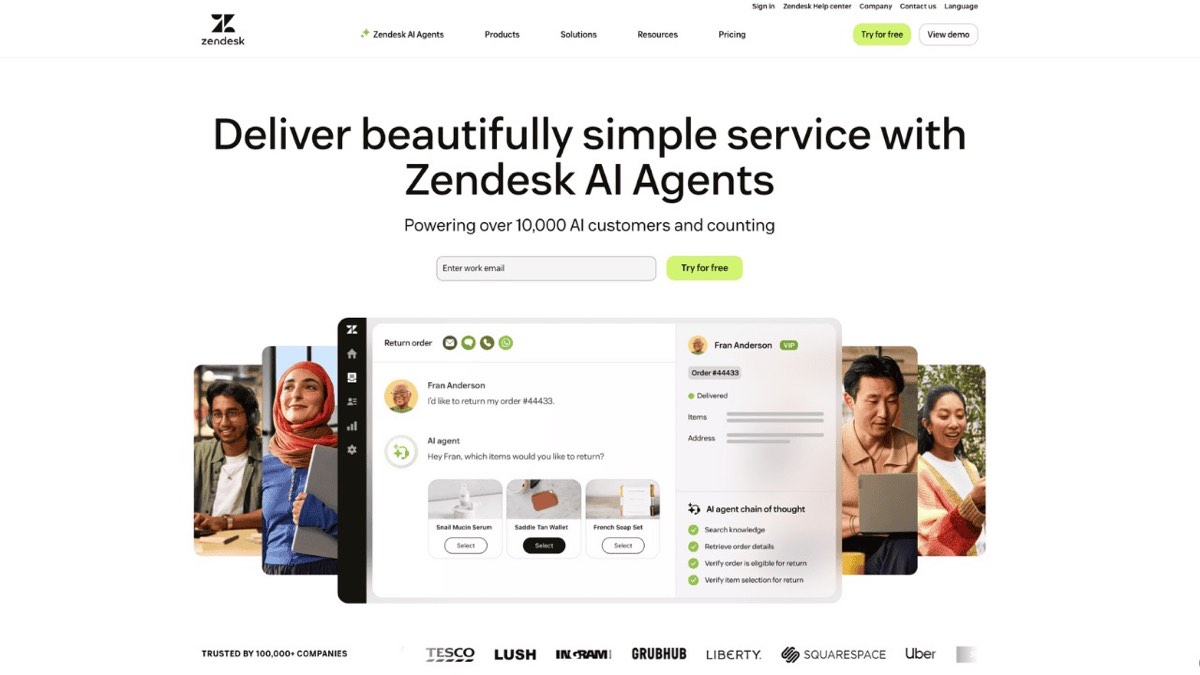
Zendesk is the most complete omnichannel suite on the list. Email, chat, messaging, social, and voice (via Zendesk Talk) all live in a unified agent workspace, and the customization depth is unmatched. The trade-off is complexity and price.
Pricing
| Plan | Price | Notes |
|---|---|---|
| Suite Team | $55/agent/mo | entry suite |
| Suite Growth | $89/agent/mo | + automation |
| Suite Professional | $115/agent/mo | + advanced |
| Talk (voice) | add-on + per-minute | separate |
Most teams pay 2-3x the headline once add-ons, AI, and Talk are included, per pricing breakdowns. It carries a 4.3/5 across 7,000+ G2 reviews.
What works
- Scales to enterprise: handles huge volume and complex routing
- Voice is available: Zendesk Talk brings phone into the workspace
- Massive integration marketplace: connects to almost anything
What doesn't
- Complex, layered pricing: 4 suite plans, 2 AI models, 6 add-ons, annual-only
- Voice costs extra: Talk is an add-on with per-minute fees
- Heavy to configure: you'll want an admin or a partner
Why it ranks 5th. The most complete omnichannel suite if you can afford it and staff it. For a $10M-$100M DTC brand, the configuration and cost are often more than the use case needs. Lighter options are in our Zendesk alternatives guide.
6. Kustomer
Best for: High-volume mid-market and enterprise brands that want a unified customer timeline instead of a ticket-by-ticket model.
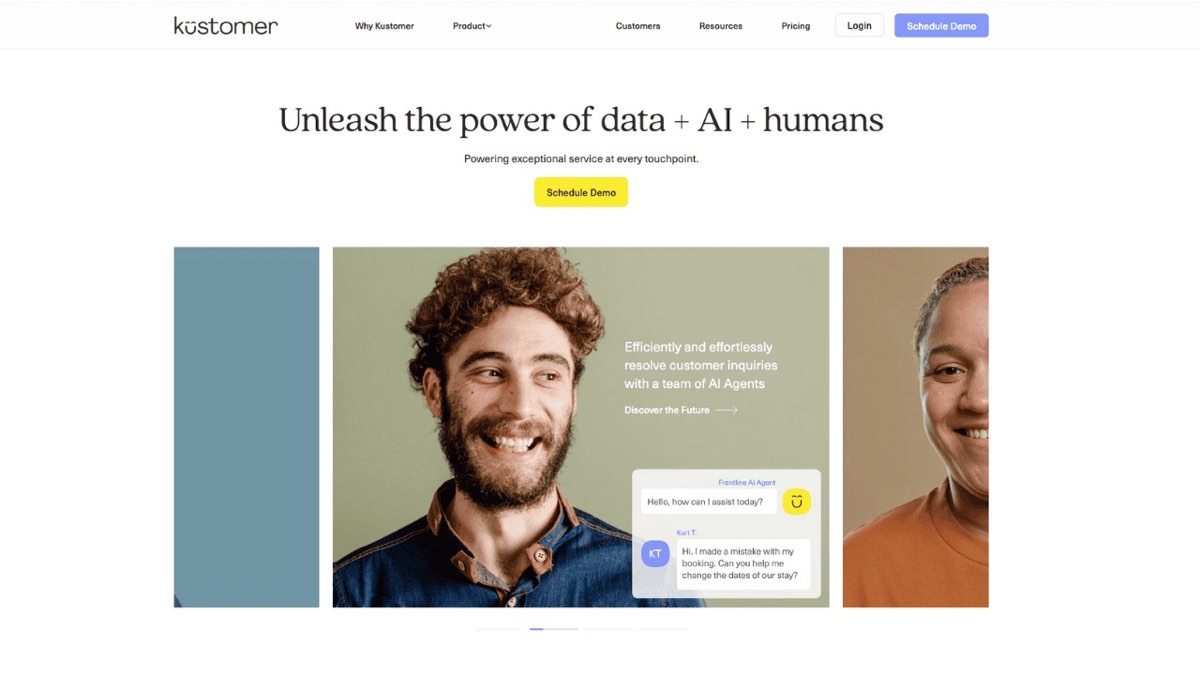
Kustomer's pitch is a single customer timeline that pulls every interaction into one view, more like a CRM than a ticketing tool. For brands drowning in written volume, that unified context is valuable. The base price and per-conversation AI fees push it toward larger teams.
Pricing
| Plan | Price | Notes |
|---|---|---|
| Enterprise | $89/user/mo | min 8 seats, annual |
| Ultimate | $139/user/mo | advanced |
| AI | $0.60/engaged conversation | usage-based |
| Copilot | +$40/user/mo | add-on |
Details per Kustomer's pricing; it holds 4.4/5 on G2.
What works
- Unified customer timeline: every channel in one continuous view
- Built for high written volume: routing and automation scale
- Strong AI and reporting: good for data-heavy teams
What doesn't
- High base price: 8-seat minimum plus per-conversation AI fees
- Overkill for smaller brands: more platform than most $10M-$30M brands need
- Setup is heavy: expect a real implementation
Why it ranks 6th. A strong unified-context model for high-volume mid-market and up. Voice is secondary to the written-channel timeline, and the price tags it for bigger teams. More options in our Kustomer alternatives guide.
7. Gladly
Best for: Enterprise CX teams that want true native voice as a first-class channel and will pay a premium for a people-centered, channel-less model.
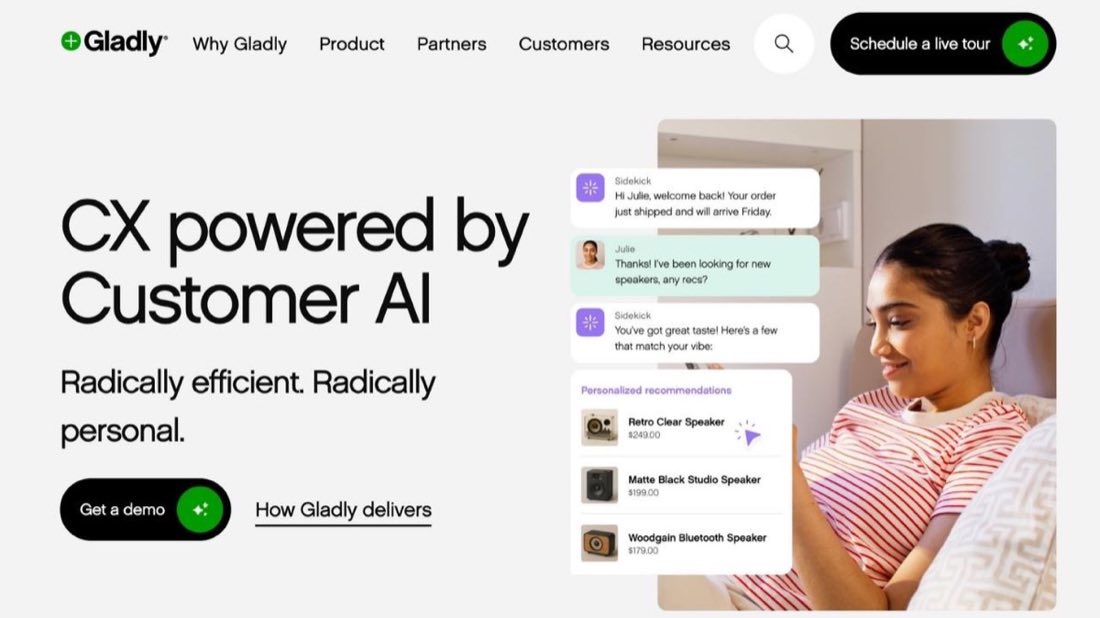
Gladly is the one platform here that does not strand voice. Telephony is native and first-class, sitting alongside chat, SMS, social, and email in a single person-centered timeline. It is genuinely premium CX. It is also priced like it.
Pricing
| Package | Price | Minimum |
|---|---|---|
| Hero | ~$180/agent/mo | 10 users ($1,800/mo min) |
| Superhero | ~$210/agent/mo | 45 users ($9,450/mo min) |
Quote-based and annual, per Gladly pricing analysis.
What works
- True native voice: the phone is a first-class channel, not an add-on
- Person-centered timeline: one continuous customer view across channels
- Premium CX: polished experience for high-touch brands
What doesn't
- Enterprise price and seat minimums: the 10-to-45-user floors price out most DTC brands
- Overkill for $10M-$100M brands: more platform than the use case usually needs
- Long setup: this is a contact-center commitment
Why it ranks 7th. The truest native-voice omnichannel on the list, and the proof that doing voice right is expensive when it is bundled into a full enterprise suite. For most brands your size, the seat minimums alone are a dealbreaker. Lighter options are in our Gladly alternatives guide.
Where Ringly fits: the voice layer for your omnichannel stack
Here is the honest part. Ringly is not an omnichannel inbox, and I'm not going to pretend it is. It does not manage your email, chat, or social. What it does is fix the one channel almost every platform above leaves half-built: the phone.
Ringly.io is AI phone support for Shopify brands. Your team wasn't hired to answer the same call 50 times a day. Instead of bolting telephony onto your helpdesk or paying enterprise rates for native voice, Ringly handles the inbound phone channel and plugs into the omnichannel stack you already run.
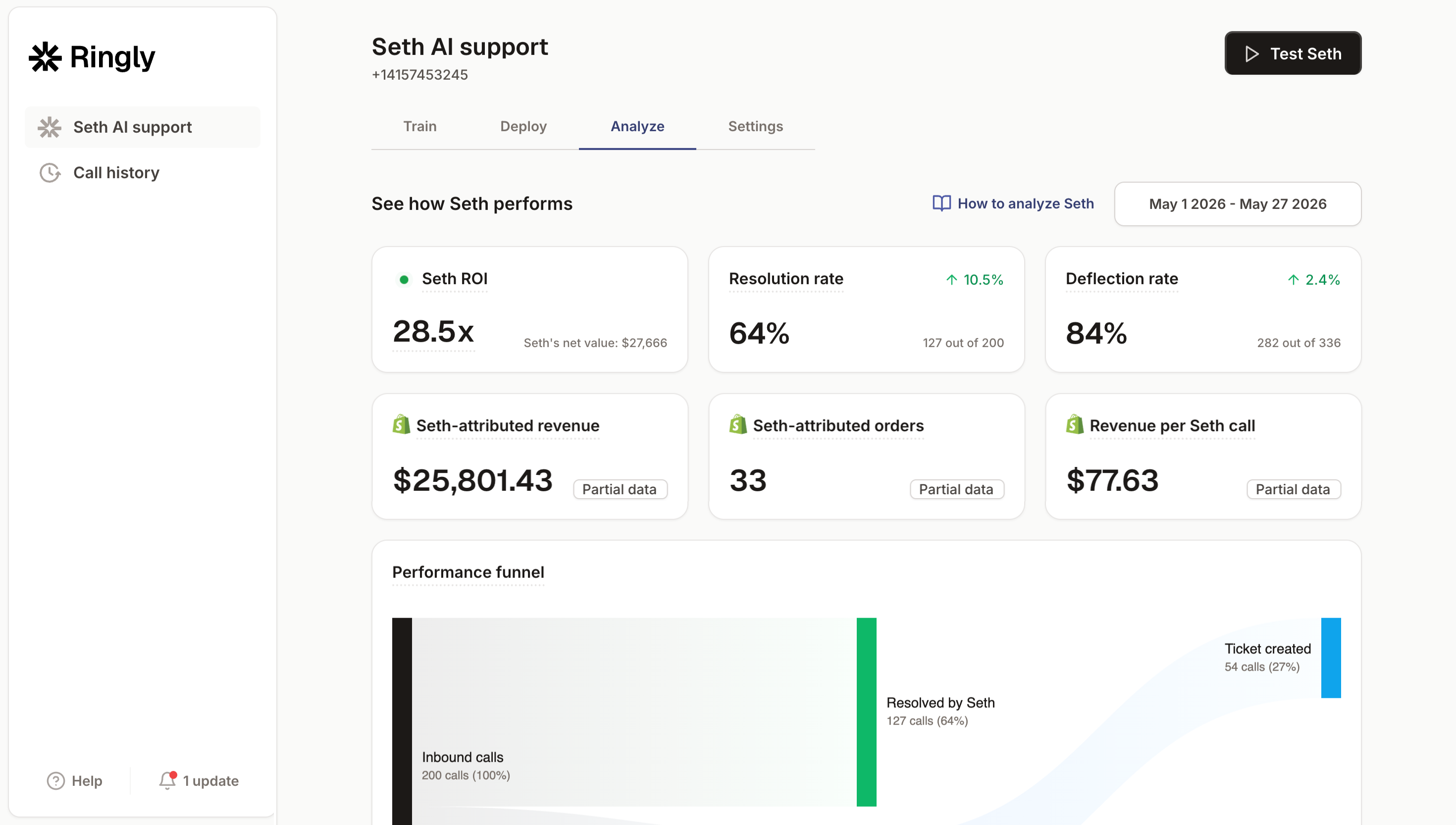
The AI answers inbound calls 24/7. It finds orders in your Shopify store, processes returns and exchanges, answers product questions from your knowledge base, and cancels orders when a caller asks. When a call needs a person, it escalates cleanly to Gorgias, Richpanel, Re:amaze, or whatever helpdesk runs your other channels. It resolves up to 90% of calls autonomously.
WashCo, a Shopify brand we launched, recovered $22,664 in its first 7 days on the phone. That is the revenue the voicemail box was eating.
The objection I hear most is whether the AI sounds like a person. Here is one of our customers on that exact question:
"My customers also feel like it's a normal person. They feel like they can communicate if they have questions."
Claudia Droge, TechCraft Studio
So the math. Take a typical $50M Shopify brand running a 6-rep CS team where the phone is the bottleneck:
| Line item | Today | With Ringly on voice |
|---|---|---|
| 6 reps × $4K loaded per rep | $24,000/mo | partly reallocated |
| Ringly (~$5K/mo) on the phone channel | n/a | $5,000/mo |
| Routine phone calls handled | by people | ~70% by AI |
| Net effect | reps buried in WISMO | reps freed for complex work |
The routine phone calls (order status, returns, the same five questions over and over) route to the AI. Your team handles the genuinely complex ones, and your written channels stay exactly where they are. If your phone goes to voicemail after 6 p.m., book a 30-min call and we'll do the math on your real call volume.
Pricing: $99 a month for the first 50 conversations, then $1.99 each. Live in under an hour, with a 65% resolution guarantee. It is not the whole omnichannel platform. It is the channel the omnichannel platform forgot.
How to choose the right omnichannel support software
The honest read is that no single tool here perfectly serves a $10M-$100M Shopify brand on every channel. Only 29% of businesses deliver the connected cross-channel experience that 90% of consumers say they want, and the voice gap is a big reason why. So choose by what your support actually looks like.
- Choose Gorgias if your support is mostly written and you want the deepest Shopify order actions. Pair it with a real voice layer for the phone.
- Choose Richpanel if you want an affordable all-in-one for written channels plus a self-service portal to deflect WISMO.
- Choose Re:amaze if you need broad channel coverage at the lowest price and voice is not a priority.
- Choose Front if your team is email-heavy and collaborative and ecommerce order actions are secondary.
- Choose Zendesk if you are large enough to absorb the cost and configuration and want voice in the same suite.
- Choose Kustomer if you run high written volume and want a unified CRM-style timeline over a ticket model.
- Choose Gladly if you are an enterprise CX team that wants true native voice and can clear the seat minimums.
- Add Ringly if any of the above leaves your phone channel stranded, which for most of them, it does. It plugs into your existing helpdesk and fixes voice without a re-platform.
The most common winning setup I see for a brand your size is not one platform that does everything. It is a strong written-channel helpdesk you already like, plus a voice layer that actually resolves calls. For more on that, see our guide to Shopify voice agents and ecommerce phone support.
Frequently asked questions
What's the difference between omnichannel and multichannel support software?
Multichannel means you offer several channels that run on separate systems. Omnichannel means those channels share one customer context, so a person can move from chat to email to phone and your agent sees one continuous history. The test is simple: if customers have to repeat themselves when they switch channels, it's multichannel.
Does omnichannel support software include phone and voice?
Sometimes, but it's the weakest channel for most platforms. Gorgias, Richpanel, Re:amaze, and Front have no real native voice. Zendesk and Kustomer offer it at added cost, and Gladly is the only one here with true native voice, at an enterprise price. Many brands add a dedicated voice layer instead.
What's the best omnichannel support software for Shopify?
For written channels, Gorgias is the most Shopify-native. For the phone channel specifically, you usually need a separate voice layer because the helpdesks treat it as an afterthought. The strongest setup for a $10M-$100M Shopify brand is often a written-channel helpdesk plus an AI phone layer like Ringly.
Do I have to replace my current helpdesk to go omnichannel?
No, and you usually shouldn't. Ripping out a helpdesk your team already knows is a big migration project with real risk. If the gap is voice, you can add a phone layer that plugs into your existing inbox and escalates into it, without touching your written channels.
How much does omnichannel support software cost?
It ranges widely. Budget written-channel tools start around $29-$60/mo, mid-market platforms run $55-$139/agent/mo, and enterprise voice-native suites like Gladly start near $180/agent with seat minimums. Watch for per-ticket, per-conversation, and per-minute fees that stack on top of the headline price.
Can I add a real phone channel without an enterprise contract?
Yes. You don't need Gladly's seat minimums or Zendesk Talk's per-minute fees to get a working voice channel. Ringly starts at $99 a month, goes live in under an hour, and resolves up to 90% of calls autonomously, while escalating the rest into your existing helpdesk.
Does Ringly replace Gorgias or Zendesk?
No. Ringly is not an omnichannel inbox. It handles the inbound phone channel and plugs into Gorgias, Zendesk, Richpanel, or whatever helpdesk runs your written channels. Think of it as the voice layer that completes the stack, not a replacement for it.
Will the AI on the phone sound like a bot?
The most common compliment our customers report is "you don't sound like AI." The AI answers in 40 languages, holds a real conversation, and hands off to a human when a call needs one. Customers can ask follow-up questions the way they would with any agent.
Talk to us

If you run a $10M-$100M Shopify brand and your omnichannel stack has every channel covered except the phone, a 30-min call is the fastest way to see what that gap is costing you after-hours.
Our 3 promises.
- Live in under 1 hour. Setup and test calls are free.
- 30-day money back on the $99 plan fee.
- 65% resolution guarantee: if Seth resolves under 65% of your support calls in a month, that month comes back as credit (after 90 days on Pay per call).
Ruben (Ringly co-founder) takes these calls personally.