
This post in 30 seconds.
- A return is the moment your NPS gets decided, not the moment the relationship ends. Handle it well and the returner becomes a promoter more often than a customer who never returned at all.
- Easy returns lift NPS by 15 to 25 points, and 96% of shoppers buy again after an easy one. A voicemail-routed return does the opposite.
- Built for founders, COOs, and Heads of CX at $10M-$100M Shopify brands with a visible phone line and a returns queue that spikes after every drop.
A return is not the end of the relationship. It is the test of it.
Most operators treat returns as a cost to shrink. Fair, they are expensive. But there is a second number moving every time someone calls to send something back, and it decides whether that customer comes back to buy again or quietly tells ten friends not to. That number is your NPS, and the returns experience moves it more than almost anything else you do.
If you run a $20M apparel brand on Shopify, you already feel this. Apparel return rates sit around 25% (some lines hit 40%), and every one of those returns is a fork in the road. The return either confirms the customer made a safe bet with you, or it confirms their worst fear about buying online. Here is the part most operators miss: the policy page is not where that gets decided. The call is.
We have launched AI phone agents for 50+ Shopify brands trying to keep that call answered, and I have read a lot of return-call transcripts to write this. If your returns line goes to voicemail after 6 p.m., book a 30-min call and we will show you what those calls are actually costing you in repeat customers.
Why a return is the moment your NPS gets decided
Start with the counterintuitive part, because it reframes everything.
Customers who go through a smooth return become promoters more often than customers who never returned anything at all. The return is a trust moment. You said you would make it easy, the customer tested whether you meant it, and you passed. That is a stronger loyalty signal than a purchase that never got stress-tested.
A smooth return is not damage control, it is the single best chance you get to convert a nervous buyer into a promoter.
The data backs this up hard. Easy returns lift NPS by 15 to 25 points, according to returns research from Happy Returns. On the loyalty side, Narvar found that 96% of customers buy again from a brand that offers an easy or very easy return. Flip it and the cost is just as real: 71% of shoppers say a bad return experience would stop them from buying again, up from 67% two years ago.
So returns belong on your NPS dashboard, not just your P&L. And to use them there, you have to separate two things operators constantly blur together:
- Return rate is how many orders come back. You lower it with better sizing, better product photos, better PDP copy.
- Return experience is what happens once an order is already coming back. You improve it with a clean policy, fast refunds, and a human (or human-sounding) answer when the customer calls.
You can have a low return rate and a terrible return experience, and your NPS will still bleed. The rate is a merchandising problem. The experience is a support problem. This post is about the second one, because that is the lever that moves NPS.
Worth saying plainly: the ecommerce average NPS sits around 45, with the top quartile at 72 and up, per ProofPost's 2026 benchmarks. The gap between average and top-quartile is mostly made of the moments brands handle badly. Returns are the biggest one.
The returns call is where promoters and detractors are made
Here is what nobody puts on the returns-experience slide: most of the make-or-break happens on a phone call, not on the returns portal.
A customer who can self-serve a return on your site never had a problem. The ones who call are the ones with a wrinkle. The order number starts with a letter and the portal rejected it. The window closed two days ago. The item arrived damaged and they want to know if they eat the shipping. These are the WISMO-adjacent calls, the same questions over and over, and they are exactly the moments where you either save the relationship or lose it.
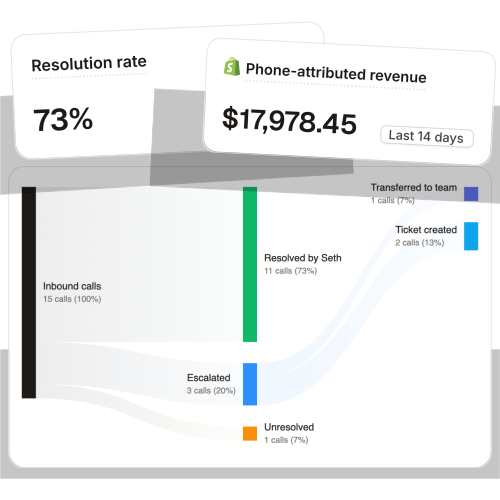
When I read real return-call transcripts across the brands we run, the routine returns questions are the same five, over and over. And the AI resolves 73% of those inbound calls on its own, which means the customer got an answer in the moment instead of a callback that never comes.
Now picture the version where nobody picks up. It is 8 p.m., the customer is annoyed, they call, and they hit voicemail. They leave a message you will not return until tomorrow afternoon, if at all. That customer is no longer a passive. That customer is a detractor, and they were a detractor before a single rep ever spoke to them. The missed call did the damage.
A returns call that goes to voicemail after hours is not a deferred conversation, it is a detractor you created on purpose.
This is the part that stings for founder-led brands: the customer who calls about a return is usually one of your most loyal. They bought, they had an issue, and instead of charging back or ranting on Trustpilot, they picked up the phone to give you a chance to fix it. WashCo, a Shopify brand we launched, recovered $22,664 in its first 7 days on the phone precisely because those calls got answered instead of dropped. Miss that call and you have taught your best customer not to bother next time.
How to measure returns-driven NPS
If returns move NPS, you should be measuring NPS at the returns touchpoint specifically. Most brands only run a relationship survey twice a year and wonder why it never tells them anything actionable.
There are two flavors, and you want both:
| Transactional NPS (returns) | Relationship NPS | |
|---|---|---|
| When it fires | Right after a return resolves | Quarterly or twice a year |
| What it measures | This specific returns experience | Overall feeling about the brand |
| Best for | Diagnosing the returns process | Tracking long-term loyalty trend |
| Sample question | "After your return, how likely are you to recommend us?" | "How likely are you to recommend us to a friend?" |
The transactional version is the sharp instrument here. Fire it 24 to 48 hours after the return is resolved, while the experience is fresh. Ask the standard 0-to-10 question, then add one open follow-up: "What is the main reason for your score?" The free-text answer is where the gold is. Detractors will tell you, in their own words, exactly which step broke.
Transactional NPS fired right after a return resolves will tell you more about your support in one week than a relationship survey tells you all year.
Then close the loop. Reach back out to detractors, fix the specific thing, and tell them you fixed it. CustomerGauge found that closing the loop with customers lifts retention by about 8.5%, and the same research traces a clean line from NPS to revenue: the London School of Economics put a 7-point NPS gain at roughly a 1% revenue gain, and Bain has NPS leaders growing at more than twice the rate of their competitors.
A few practical notes on getting this right:
- Tie the survey to the resolution, not the request. Survey after the refund clears, not when the return is filed. You are measuring how it ended, not how it started.
- Segment by channel. Score returns that were handled on the phone separately from portal-only returns. That split tells you whether your call coverage is helping or hurting.
- Watch the after-hours cohort. If returns that came in after 6 p.m. score lower, you have a coverage problem, not a policy problem.
For the mechanics of resolving the underlying tickets, our guides on returns management, first-call resolution, and the broader NPS measurement playbook go deeper than we can here.
What a bad returns call actually costs
Let's do the math operators usually skip, because the obvious cost hides the expensive one.
The obvious cost is processing. Each return runs $10 to $65 to handle, and only about 48% of returned items resell at full price, per Eightx's 2026 benchmarks. That is real money, and it is the number that gets all the attention.
The expensive cost is the customer you lose when the returns call goes badly. Repeat customers spend 31% more per transaction than new ones, and you are roughly 40% more likely to sell to them again (Narvar again). A detractor you created with a missed 8 p.m. call is not a $40 processing line item. They are the next two years of orders you will never see, plus the friends they talk out of buying.
Now look at what it costs to actually answer those calls with humans. Take a $50M Shopify brand running a 6-rep support team:
| Line item | Today | With Ringly |
|---|---|---|
| 6 reps x $4K loaded per rep | $24,000/mo | n/a |
| Ringly (~$5K/mo) | n/a | $5,000/mo |
| Net monthly support spend | $24,000/mo | $5,000/mo |
| Monthly savings | n/a | $19,000/mo |
| Annual savings | n/a | $228,000/yr |
The returns call is cheap to answer and brutally expensive to miss, which is the exact inversion most support budgets are built on.
That 6-rep team is paying for daytime coverage of the same five returns questions over and over, and the after-hours calls still hit voicemail. You are spending the most on the calls that matter least and nothing on the ones that decide your NPS. If you want to see your own version of this math against your real call volume, book a 30-min call and we will run it live.
How to protect the returns moment without a night shift
You do not fix this by hiring a weekend rep to sit by the phone. The volume is too bursty to staff and the routine questions do not need a human anyway. You fix it by making sure every returns call gets answered, the routine ones get resolved on the spot, and the genuinely hard ones reach a person who can actually help.
That is what Ringly does. Ringly.io is AI phone support for Shopify brands. Instead of growing your support headcount every time return volume spikes, the AI takes the routine inbound calls so your team can focus on the work that moves revenue.
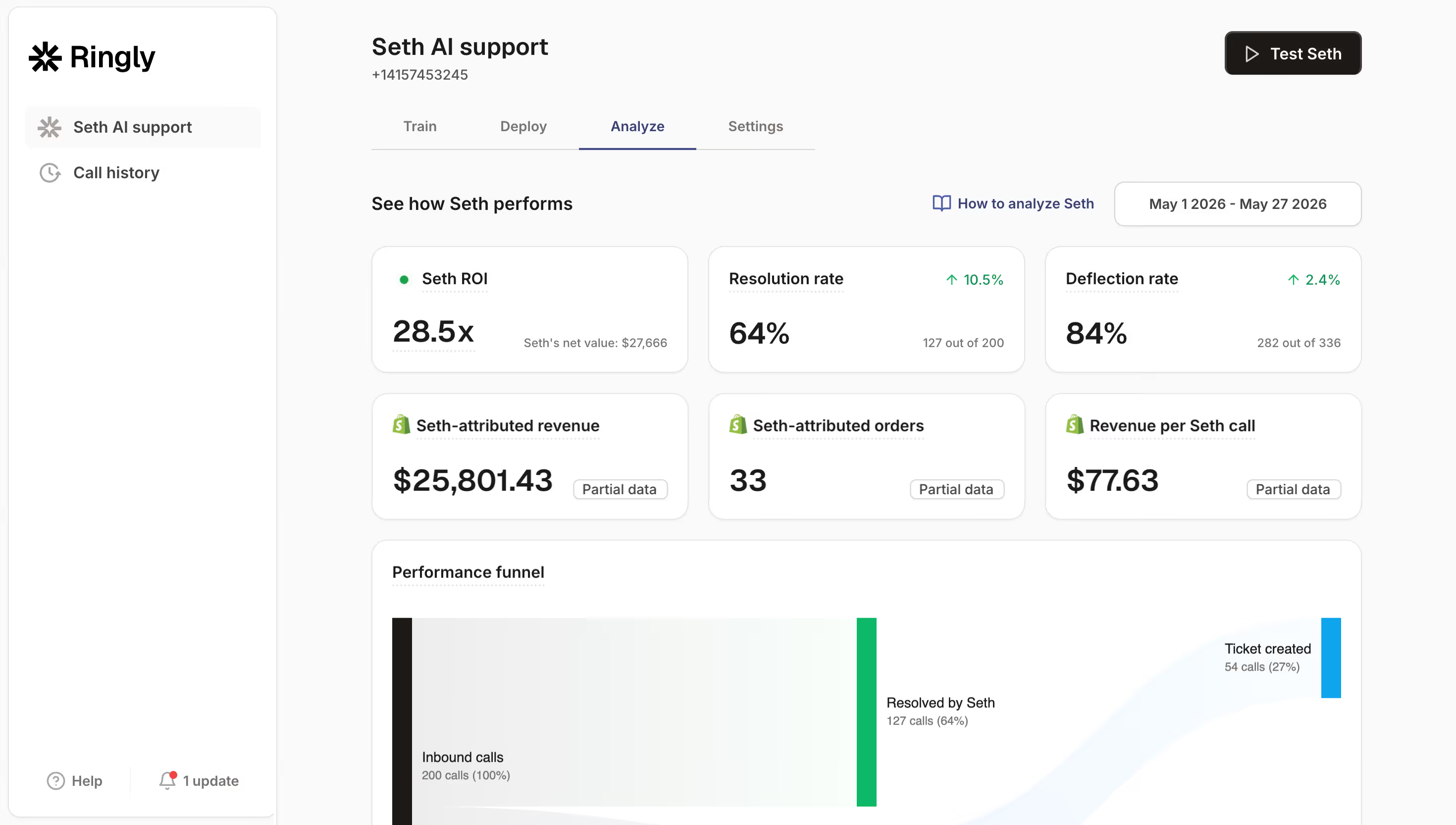
The AI answers inbound calls 24/7. It finds the order in your Shopify store, walks the customer through the return or exchange, checks order status, and answers product questions from your knowledge base. Across 50+ brands, the AI resolves 73% of calls autonomously at roughly $0.42 per resolved call. The calls that genuinely need a human escalate cleanly to Gorgias, Richpanel, Reamaze, or whatever helpdesk you already run. You keep your number, your stack, and your control.
The voice quality is the part that matters most for NPS. A returns call only protects loyalty if it does not feel like shouting into a robot.
"My customers also feel like it's a normal person. They feel like they can communicate if they have questions."
Claudia Droge, TechCraft Studio
That is the whole game on a returns call. If the customer feels heard and gets a real answer, the return becomes the trust moment that makes a promoter. If they feel processed, it becomes the moment that makes a detractor. The difference is whether anyone picks up, and whether the thing that picks up can actually resolve the call. For the after-hours window specifically, our take on 24/7 phone support and after-hours coverage is worth a read.
Frequently asked questions
Does a return actually lower your NPS, or can it raise it?
It can do either, and that is the point. A clean, fast return raises NPS, often above customers who never returned at all, because it proves you keep your promises. A return that ends in a voicemail or a slow refund tanks it.
What is a good NPS for an ecommerce brand?
The ecommerce average sits around 45, and the top quartile is 72 or higher, per ProofPost's 2026 benchmarks. If you are below 45, the fastest gains usually come from fixing the moments you currently handle badly, and returns are the biggest one. Our full NPS playbook for ecommerce breaks down benchmarks by category.
Should I send a transactional NPS survey after every return?
Yes, fire a transactional NPS survey 24 to 48 hours after each return resolves, while the experience is fresh. Add one open-text follow-up asking for the main reason behind the score. That free-text answer is where you learn which step of the return broke.
How is returns-driven NPS different from overall NPS?
Overall (relationship) NPS measures how customers feel about your brand in general, surveyed quarterly. Returns-driven (transactional) NPS measures one specific experience, fired right after the return resolves. The transactional version is far more useful for diagnosing what is actually wrong with your returns process.
Does answering returns calls 24/7 really move NPS?
Yes, because most returns calls that hurt NPS are the ones nobody answered. An after-hours return that hits voicemail creates a detractor before a rep ever speaks. Answering the call in the moment, even with AI for the routine questions, is one of the highest-impact NPS fixes available. See how brands scale support without hiring for it.
How much does a bad returns experience cost in repeat revenue?
The processing cost is $10 to $65 per return, but the bigger number is the lost repeat customer. Repeat buyers spend 31% more per order and are about 40% more likely to buy again, so a detractor created by a missed return call is worth far more than the return itself. For more, see our customer retention guide and the 2026 retention statistics.
Talk to us

If your returns calls roll to voicemail after 6 p.m., that is where promoters quietly turn into detractors. A 30-min call is the fastest way to see what your returns line is leaving on the table after hours, and what answering it would do to your NPS.
The 3-layer guarantee.
- Live in 14 days or it's free until launched.
- 65% resolution in 90 days or we refund the last 3 months of subscription fees.
- We keep working free until we hit it.
Ruben (Ringly co-founder) takes these calls personally.