
Missed call text back, in 30 seconds.
- It auto-texts a caller the second no one picks up, usually within 30 to 60 seconds, so they don't just hit voicemail and vanish.
- For an ecommerce store the twist matters: most of your missed calls aren't new leads, they're existing customers asking where's my order. Text-back recovers the contact. It doesn't answer the question.
- Written for founders, COOs, and heads of CX at $10M-$100M Shopify brands with a visible phone line and a support team, not the solo contractors every other guide is aimed at.
Search "missed call text back" and every result is built for a plumber. Recover the lead, beat the other contractor to the callback, win the job. Useful if you sell roof repairs. Less useful if you run a Shopify brand doing $30M a year, because the person calling your store at 9 p.m. usually isn't a new lead deciding between you and a competitor. They already bought. They want to know where their package is.
I called the demo lines of three missed-call-text-back tools as a fake customer, hung up, and waited. Every one texted me back a polite "sorry we missed you, we'll get back to you soon." None of them could tell me where my order was, which is the only thing I'd actually called about. That gap is the whole reason this guide exists.
If your phone rolls to voicemail after 6 p.m. and nobody returns those voicemails, you're losing customers you already paid to acquire. We've built AI phone support for 50+ Shopify brands trying to plug exactly that leak. Book a 30-min call and we'll show you what your store is dropping after-hours.
What missed call text back actually is (and how it works)
Missed call text back (MCTB) is a simple piece of automation. A customer calls your store number, nobody answers, and the system fires an automatic SMS to that caller within about 30 to 60 seconds. Instead of dead air and a voicemail nobody checks, the caller gets a text in their pocket while they're still thinking about you.
The whole point is speed: the caller hears nothing on the phone but feels a buzz in their pocket before they've dialed the next business. That's the pitch, and for a lot of businesses it's a real upgrade over a voicemail box.
The mechanics are boring, which is good:
- Detect the miss. The tool watches your line and registers any call that goes unanswered, whether it's after-hours, a weekend, or all your reps are already on calls.
- Fire the text. A pre-written SMS goes out automatically, usually inside a minute.
- Let them reply. The caller can text back, and now you've got a thread instead of a missed call.
- Throttle it. Good tools cap how often they auto-text the same number, so a customer who calls three times in an hour doesn't get spammed.
The reason it works at all comes down to one ugly number. According to CallRail's benchmark data, around 85% of people who reach a business and don't get through never call back. And 80% of callers who land in voicemail hang up without leaving a message at all. The call just evaporates. A text catches the person before they move on, and SMS gets opened: around 98% of texts are read versus roughly 20% of emails, so the message you send actually lands.
Speed is the other half of why it works. The data on response time is brutal. Reply within five minutes and you're up to eight times more likely to convert the contact, and an old MIT study found that responding within an hour made you seven times more likely to qualify a lead than waiting even a little longer. A text that goes out in 60 seconds beats a callback you get to on Monday, every time.
One catch worth knowing up front: your number has to be able to send texts. A plain landline can't. You'll need a textable number, which most modern ecommerce phone support setups already use. And once you're sending automated texts at any volume, you're in compliance territory, which we'll get to in the setup section.
Why ecommerce missed calls are a different problem
Here's where the generic advice falls apart. Every missed-call-text-back guide assumes the caller is a stranger shopping around. For a contractor, that's true. For a Shopify store, it usually isn't.
When someone calls your store and you don't pick up, run the odds on what they wanted. The Salesforce data puts where's-my-order (WISMO) at 30 to 40% of support tickets in a normal week and over 50% at peak. Add returns and product questions and you're looking at a caller who is, far more often than not, an existing customer with a specific problem. They're not deciding whether to buy. They already did.
That changes everything about what "recovering" the call means. A new-lead caller wants a callback. A WISMO caller wants the answer. When your text-back tool replies "thanks for calling, we'll get back to you soon," the contractor's lead feels reassured. Your customer feels brushed off, because they didn't want to be called back, they wanted to know if their order shipped. The real cost of a missed ecommerce call isn't a lost lead, it's a customer you already paid for who now writes a one-star review about how nobody picks up the phone.
This is the same revenue leak we broke down in our piece on missed calls in ecommerce, and it compounds. A missed WISMO call that turns into a cancellation doesn't just cost you that order. It costs you the repeat purchases that customer would've made over the next two years.
WashCo, a Shopify brand we launched, recovered $22,664 in its first 7 days on the phone, mostly by catching exactly these calls instead of dropping them. The point isn't the tool. It's that the calls a store misses are usually worth real money because the person on the line is already a customer. For the texture of why these calls pile up, our breakdown of WISMO calls goes deeper.
What missed calls actually cost an ecommerce store
Let's put a number on it, because "you're losing money" is easy to nod along to and ignore.
Say your average order value is $100 and you miss three calls a day where the caller would have bought or stayed. That's $300 a day, which is $109,500 a year out the side of the bucket, and that's before you count lifetime value. If each of those customers would've made three or four more purchases, you're not losing $300, you're losing closer to $1,000 a day in future orders.
Now stack it against the thing nobody mentions: phone calls convert. Research that traces back to BIA/Kelsey, cited by Conversion Sciences and others, puts phone-lead conversion at 10 to 15 times higher than web form leads. The person who picks up the phone is high-intent. They're closer to buying, or closer to churning, than almost anyone else who touches your brand that day. Dropping that call is the most expensive thing your support setup does.
A missed call from an existing customer is the most expensive call you'll drop all week, because you already paid the acquisition cost and you're about to refund it as goodwill or lose it to a chargeback. That's the math that should keep a CFO up, and it's the same logic we lay out in detail in ecommerce phone support ROI.
There's a payroll side too. The usual fix is to throw reps at it: hire a weekend person, staff later hours, eat the loaded cost of a US rep at roughly $4,000 a month who sits idle most of the after-hours shift because the volume is bursty, not steady. A 6-rep team at $4K loaded is $24,000 a month, and a big chunk of those calls are the same five questions over and over.
If you want to see your own version of that number against what an AI phone agent would cost, book a 30-min call and we'll do the math live on your real call volume.
How to set up missed call text back for your store
If you decide a text-back net is the right first move, here's the actual setup. It's not hard, but two of these steps trip stores up.
- Pick the tool or number. You've got three flavors: a standalone MCTB app, a business phone system that includes the feature like Aircall or Dialpad, or an SMS bolt-on inside the helpdesk you already run. If you're tiny, the standalone app is fine. If you have a team, keep it where your reps already work.
- Connect your store phone line. Point your existing number at the tool, or port it in. The goal is to keep the number customers already have, not to make them learn a new one.
- Set the trigger rules. Decide when the auto-text fires: every missed call, or after-hours only. Most stores want after-hours and overflow, because during business hours you'd rather the call actually get answered. Pair this with your call routing so reps still get first crack.
- Write the message, and put a tracking link in it. This is the ecommerce-specific bit nobody tells you. A contractor's text says "we'll call you right back." Your text should say something like "Sorry we missed you. Track your order here: [link]. Reply ORDER and we'll pull it up." Give the WISMO caller the thing they actually wanted instead of a promise to call. Keep it under 160 characters.
- Register for 10DLC and handle consent. This is the step that quietly kills campaigns. Since February 2025, US carriers block 100% of unregistered automated SMS, so if you skip A2P 10DLC registration your texts simply don't deliver. The FCC's one-to-one consent rule starts enforcement in January 2026, with global opt-out handling expected by April, so build a clean opt-out into your flow now. Nextiva's guide walks the registration.
The single best thing you can do with a store's text-back message is drop the order-tracking link straight into it, because that's the question 30 to 40% of your callers actually had. A "we'll get back to you" text wastes the one chance you have to answer them in the moment. You can wire the same automation into your Shopify customer service app so the thread lands in the same inbox as everything else.
Text-back vs answering the call (the honest comparison)
Here's the part I'd want a vendor to be straight with me about. Text-back is a recovery net. It catches the contact so the caller doesn't fully disappear. What it does not do is resolve the reason they called. For a where's-my-order or return-this-item call, "we'll get back to you" just moves the same unanswered question from voice to SMS.
So the real choice isn't which text-back tool. It's whether text-back is enough for your volume, or whether the better move is to answer the call in the first place so there's nothing to text back.
| Approach | What it does | Best for | Rough cost |
|---|---|---|---|
| Standalone text-back app | Auto-SMS on a missed call only | Solo or sub-$2M stores, no support team | $4 to $99/mo |
| Phone system with text-back | Phone line plus auto-text on miss | Small teams already buying a phone system | $14 to $25/user/mo |
| Helpdesk SMS bolt-on | Logs the miss as a ticket, can text from the inbox | Stores keeping it inside Gorgias or Zendesk | Varies |
| AI phone agent that answers | Picks up live, resolves WISMO, returns, and product questions, escalates the rest | $10M-$100M stores with real inbound and a CS team | $349 to $799/mo, custom above that |
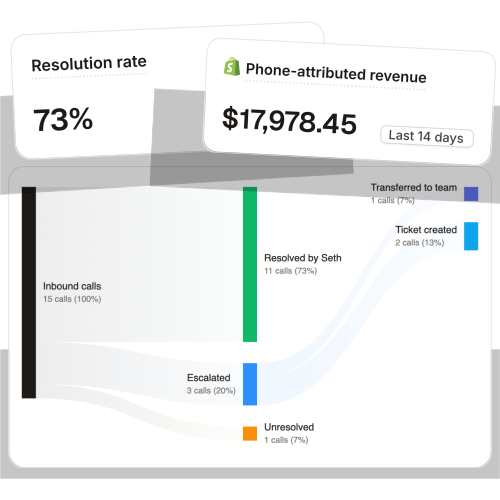
Ringly.io is the bottom row, and to be clear, it isn't a missed-call-text-back tool. It's the opposite approach. Instead of texting a caller after you miss them, the AI answers the phone 24/7 so the call gets resolved on the spot. It finds the order in your Shopify store, processes returns and exchanges, answers product questions from your knowledge base, and rescues abandoned carts. Across 50+ brands the AI resolves 73% of calls on its own at roughly $0.42 per resolved call, and anything it can't handle escalates cleanly to Gorgias, Richpanel, Reamaze, or whatever helpdesk you already run.
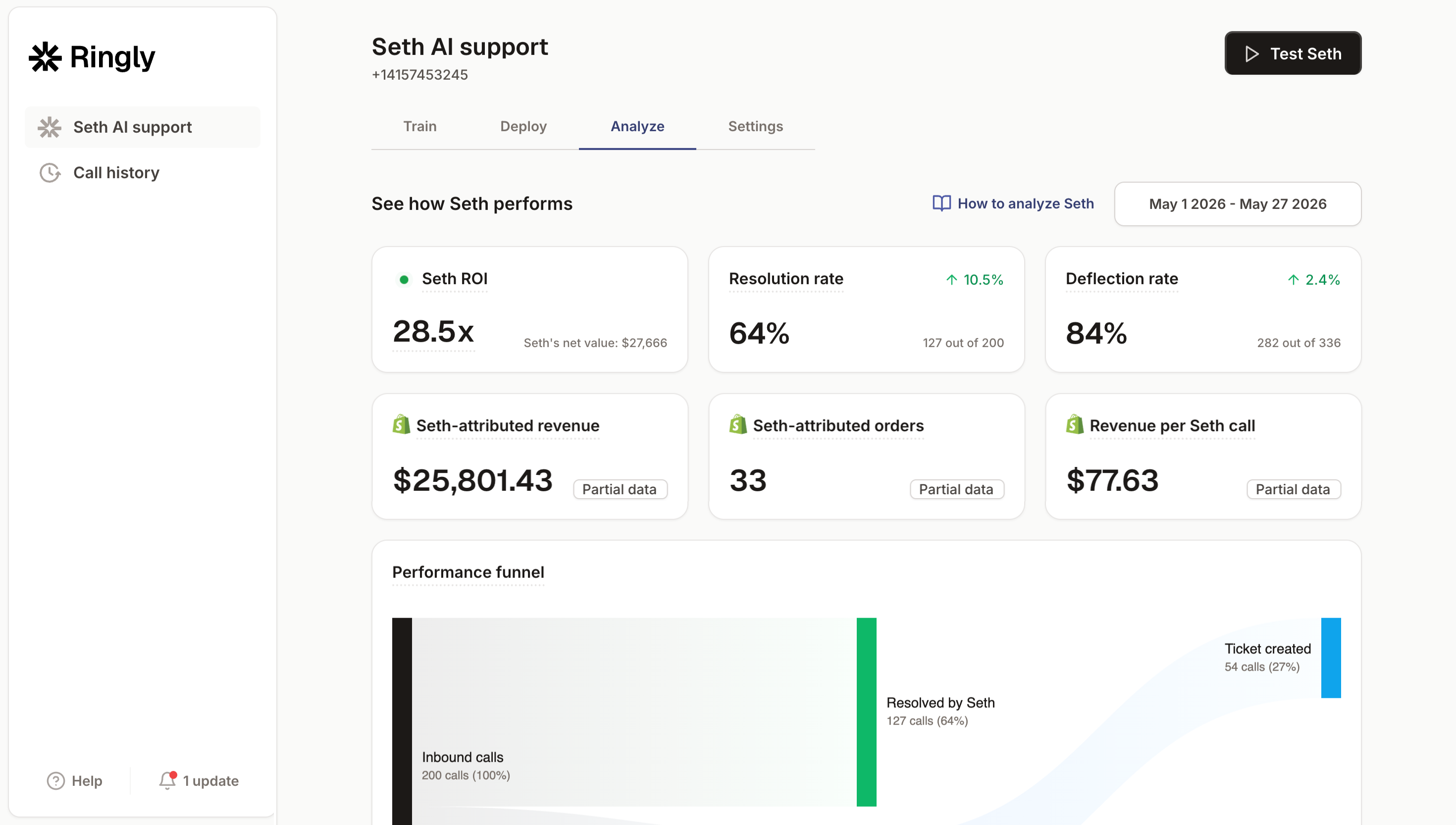
If 30 to 40% of your missed calls are the same WISMO question, answering it once beats texting it back and starting the conversation over. That's the difference between a recovery net and a resolution, and at the volume a $10M+ store runs, the resolution is what protects the customer relationship.
"My customers also feel like it's a normal person. They feel like they can communicate if they have questions."
Claudia Droge, TechCraft Studio
There's a softer reason answering wins too. A text-back thread asks the customer to do the work: read the text, type a reply, wait, type again. An angry WISMO caller at 9 p.m. doesn't want a pen-pal, they want their tracking number. Every extra step is another chance for them to give up and open a chargeback or a one-star review instead. Answering the call collapses all of that into a single 90-second conversation that ends with the problem solved.
When is plain text-back genuinely enough? If you're doing low volume, have no support team, and your calls are mostly new sales inquiries rather than order issues, a $20-a-month text-back tool is a perfectly good first net. Don't overbuy. But if you're past $10M, running a paid helpdesk, and your reps are already drowning in calls, text-back is a band-aid on a leak that an AI receptionist for ecommerce or a full AI voice agent is built to actually close. The right answer depends on where the bulk of your calls come from, and your ecommerce customer service reporting will tell you in about five minutes.
Frequently asked questions
Does missed call text back work for ecommerce? It works as a recovery net, but with a catch. Most ecommerce missed calls are existing customers asking where's my order, not new leads, so a generic "we'll get back to you" text often falls flat. It works far better when you put the order-tracking link directly in the message.
Will an auto-text annoy a customer who's already upset their order is late? It can, if the text is a brush-off. A "sorry we missed you, we'll call back" message to someone who just wanted a tracking number reads as a non-answer. The fix is to make the text useful: include the tracking link and a way to reply, so it answers instead of stalls.
Do I need 10DLC registration for missed call text back? Yes. Since February 2025, US carriers block all unregistered automated SMS, so without A2P 10DLC registration your text-back messages won't deliver. Plan for the FCC's one-to-one consent rule too, which starts enforcement in January 2026.
What should the text-back message say for a store? Lead with the answer, not a promise. Something like: "Sorry we missed you. Track your order here: [link]. Reply ORDER for help." Keep it under 160 characters and always include a clear opt-out.
Is text-back better than an AI phone agent that answers the call? For low-volume stores with no support team, text-back is a fine, cheap net. For a $10M+ store where most calls are WISMO, returns, or product questions, answering the call resolves the issue in one touch instead of restarting it over SMS. Our AI voice agents for customer support breakdown covers the tradeoff.
How much does missed call text back cost? Standalone apps run from about $4 a month to $99 a month plus setup. Phone systems with the feature built in run $14 to $25 per user per month. An AI phone agent that answers live starts at $349 a month; you can see Ringly's full pricing here.
Can missed call text back work with Gorgias or Zendesk? Yes. Most helpdesks can log the missed call as a ticket and send an SMS from the same inbox, which keeps the thread where your reps already work. If you'd rather the call get answered live and only escalate the hard ones, an AI phone agent sits in front of your helpdesk and hands off cleanly.
Talk to us

If your store's phone rolls to voicemail after 6 p.m. and those voicemails never get returned, a 30-minute call is the fastest way to see what you're actually losing. We'll pull the shape of your call volume and show you what answering it, not just texting it back, would change.
The 3-layer guarantee.
- Live in 14 days or it's free until launched.
- 65% resolution in 90 days or we refund the last 3 months of subscription fees.
- We keep working free until we hit it.
Ruben (Ringly co-founder) takes these calls personally.