
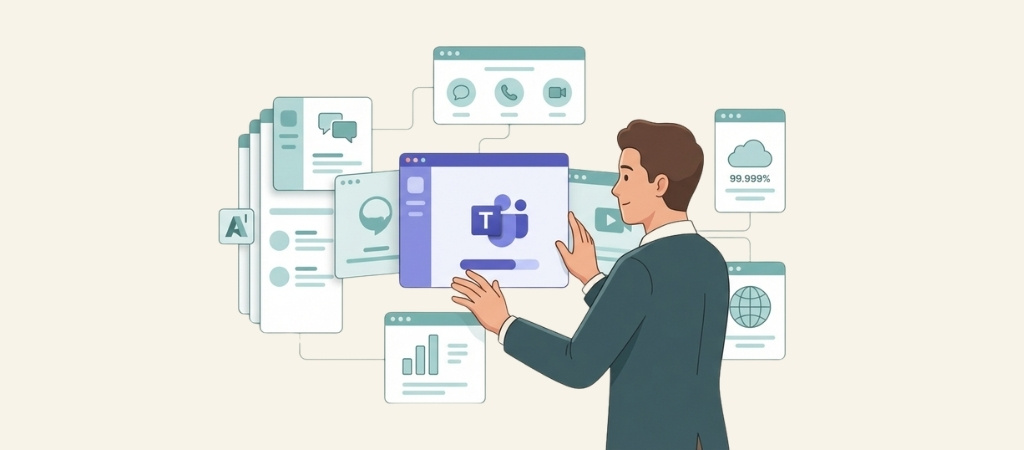
Microsoft Teams Phone seemed like a natural choice when you were already paying for Microsoft 365.
But then the add-ons started stacking up. $10 per user for the base Phone Standard license. Another $7 for domestic calling.
Up to $34 more if you need international. Before you know it, you're spending $50+ per user just to make phone calls.
Teams Phone also has its limitations. The contact center tools are basic. Support can be slow when you need help.
And if you're not all-in on the Microsoft ecosystem, integrations get frustrating fast.
This guide covers seven alternatives that might fit your business better.
We've looked at everything from AI phone agents that handle calls automatically to enterprise VoIP platforms with 99.999% uptime.
Whether you want to cut costs, get better features, or just explore your options, there's something here for you.
Editor’s note: Want to hear some sample AI support calls made for your Shopify store?
- Just paste your store URL
- Hear sample calls for your store (no email required)
- Listen to demo calls for my store

The real cost of Teams Phone (and why teams leave)
Let's look at the math. Teams Phone requires a Microsoft 365 subscription first ($6-22 per user depending on your plan) microsoft.com. Then you add:
- Teams Phone Standard: $10/user/month
- Domestic Calling Plan: $7/user/month
- International Calling Plan: up to $34/user/month
That's $23-51 per user before you even get to features. And those features? Pretty limited. The IVR is basic. Call queues are functional but not sophisticated. If you need real contact center capabilities, you're looking at third-party add-ons or upgrading to expensive enterprise tiers.
Support is another pain point. When your phone system goes down, you want help immediately. Microsoft's support tiers can mean waiting hours or days for a response on lower-tier plans.
A Frost & Sullivan study found that 48% of employees now use mobile as their primary business device, projected to hit 53% by 2027. Teams Phone's mobile experience works, but it's not exactly seamless. You're still fundamentally tied to the Teams app.
So what should you look for in an alternative? It depends on your priorities: cost savings, better features, easier management, or specific capabilities like AI automation or advanced analytics.
Microsoft Teams Phone alternatives at a glance
| Product | Starting Price | Best For | Key Differentiator | Free Trial |
|---|---|---|---|---|
| Ringly.io | $99/mo for the first 50 conversations, then $1.99 per conversation | E-commerce, automation | AI phone agent, 70%+ resolution rate | Try it for free |
| RingCentral | $20/user/mo | Enterprise reliability | 99.999% uptime SLA | 14 days |
| Google Voice | $10/user/mo | Google Workspace users | Simple, integrated with Google ecosystem | 14 days |
| Nextiva | $19/user/mo | Sales & support teams | Built-in CRM + phone in one | Yes |
| 3CX | Free or $175/yr | IT-controlled deployments | Flat annual fee, not per-user | Yes |
| Dialpad | $15/user/mo | AI-powered insights | Real-time transcription & sentiment | 14 days |
| CloudTalk | $25/user/mo | High-volume sales | Power dialer, 160+ countries | 14 days |
Top Microsoft Teams Phone alternatives for 2026
1. Ringly.io

Ringly.io takes a different approach from traditional VoIP. Instead of just routing calls to humans, their AI phone agent the AI actually handles them.
the AI answers calls 24/7, looks up orders, processes returns and exchanges, and only escalates to your team when necessary. For e-commerce stores, this means customers can call anytime and get immediate help with "where is my order" questions or return requests. The system integrates directly with Shopify to pull real-time order data.
Pricing works differently than per-user models. Ringly charges per phone conversation (see Ringly's pricing). For 1,000+ calls a month, talk to us about a custom plan. You're paying for resolution capacity, not seats.
The setup is fast. Ringly.io claims under 1 hour to deploy, and while that might be optimistic for complex configurations, the no-code onboarding is genuinely quick. You connect your store, upload your policies, pick a phone number, and the AI starts learning your business.
Pros:
- No per-user fees
- Handles 70%+ of calls without human intervention
- Deep Shopify integration
- quick setup
Cons:
- Focused on inbound support, not outbound sales dialing
- Best suited for e-commerce and support use cases
2. RingCentral

RingCentral has been in the cloud phone business since 1999 ringcentral.com. They've had time to build a mature, reliable platform with features for almost every use case.
The Core plan starts at $20 per user per month when billed annually ($30 monthly). That gets you unlimited domestic calling, 100 toll-free minutes, HD video meetings for up to 200 participants, and on-demand call recording. Advanced ($25/user annual) adds CRM integrations and automatic recording. Ultra ($35/user annual) includes 10,000 toll-free minutes and unlimited storage.
The standout feature is the 99.999% uptime SLA. That's about 5 minutes of downtime per year. For businesses where phone availability is critical, that matters. They also offer 330+ integrations, including a Microsoft Teams integration that lets you keep Teams for collaboration while using RingCentral for telephony.
Pros:
- Mature platform with extensive features
- 99.999% uptime SLA
- 330+ integrations
- Strong mobile apps
Cons:
- Can be complex to configure
- Add-ons like AI Receptionist ($39/mo) push costs up
- Interface feels dated compared to newer competitors
3. Google Voice
If your team already lives in Google Workspace, Voice is the path of least resistance. It adds business phone capabilities to the tools you're already using workspace.google.com.
Voice Starter costs $10 per user per month, but you need a Google Workspace subscription first ($7-22 per user). So realistically, you're looking at $17-32 per user total. Starter is limited to 10 users. Standard ($20/user) removes that cap and adds ring groups and multi-level auto attendants. Premier ($30/user) adds advanced reporting and data regions.
Features include voicemail transcription, call forwarding, SMS, and integration with Google Calendar. The mobile apps work well because, well, it's Google. Most stores go live within an hour if you already have Workspace configured.
Pros:
- Seamless Google Workspace integration
- Simple, clean interface
- Reliable mobile apps
- Affordable for small teams
Cons:
- Requires Google Workspace subscription
- Limited advanced features compared to competitors
- US-focused with limited international capabilities
- 10-user cap on Starter plan
4. Nextiva

Nextiva positions itself as a unified customer experience platform, not just a phone system. The idea is to combine VoIP, CRM, and customer journey tools in one place nextiva.com.
Pricing starts around $19 per user per month for Essential, which covers the basics. Professional (~$23/user) adds CRM integration and call pop (customer info appears when they call). Enterprise (~$33/user) includes advanced analytics and API access.
The CRM integration is the selling point. When a customer calls, you see their full history, pipeline stage, and previous interactions. For sales teams, this context is valuable. For support teams, it means not asking customers to repeat themselves.
Pros:
- Strong CRM integration
- Call pop shows customer context instantly
- Good value for the feature set
- Easy to use
Cons:
- Advanced features require higher tiers
- Not as established as RingCentral for pure telephony
- Some users report occasional call quality issues
5. 3CX
3CX takes a fundamentally different pricing approach. Instead of charging per user, they charge based on simultaneous calls (SC) 3cx.com. For teams with many users but low call volume, this can mean significant savings.
The free plan supports small teams up to 10 users. Pro runs about $175 per year for 8 simultaneous calls. Enterprise is roughly $425 per year for 16 SC. With 16 simultaneous calls, you could theoretically support 50+ users if they're not all on the phone at once.
Features include call queues, IVR, web conferencing, live chat, WhatsApp integration, and AI transcription. The Enterprise plan adds Microsoft Teams integration, which lets you use 3CX as the phone backend while keeping Teams for messaging and meetings.
The catch? You'll need some technical knowledge to set it up. 3CX offers hosted options, but the platform is really designed for IT teams who want control.
Pros:
- Flat annual fee, not per-user pricing
- Highly customizable
- Teams integration available (Enterprise)
- Can support many users with few simultaneous calls
Cons:
- Requires technical setup
- Teams integration requires Enterprise tier
- Support can be hit-or-miss
6. Dialpad

Dialpad puts AI at the center of everything. Real-time transcription, sentiment analysis, and automated coaching aren't add-ons. They're core features dialpad.com.
Standard costs $15 per user per month when billed annually ($23 monthly) dialpad.com/pricing. You get HD calls and meetings, real-time transcripts, instant call summaries via AI Recaps, and voicemail transcription. Pro ($25/user annual) adds CRM integrations and 24/7 support. Enterprise is custom pricing with SSO and 99.9% uptime SLA.
The AI Recaps feature generates automatic summaries after each call, highlighting key points and action items. For managers, sentiment analysis shows which calls are going well and which need attention. The platform supports international numbers in 50+ countries dialpad.com/pricing.
Pros:
- Best-in-class AI features
- Clean, modern interface
- Real-time transcription
- Good mobile experience
Cons:
- Limited international numbers (50+ vs 160+ for CloudTalk)
- 99.9% SLA is good but not RingCentral-level
- AI features require good audio quality to work well
7. CloudTalk
CloudTalk is built for sales teams that make a lot of calls. The platform includes power dialers, call tagging, and analytics designed specifically for outbound sales workflows cloudtalk.io.
Lite starts at $19 per user per month annually ($27 monthly) with unlimited US/Canada calls and basic IVR. Starter ($25/user annual) adds 500 EU minutes and call queues. Essential ($29/user annual) includes unlimited US/CA/EU calls and 95+ integrations. Expert ($49/user annual) adds unlimited global calls and includes the power dialer.
The power dialer automates sequential dialing, skipping voicemails and only connecting when a human answers. Parallel dialer (add-on, $39/user) dials up to 10 numbers simultaneously.
With 160+ countries supported for local numbers cloudtalk.io/pricing, CloudTalk works well for international sales operations.
Pros:
- Excellent for high-volume outbound calling
- Power dialer and parallel dialer options
- 160+ international numbers
- Strong analytics for sales teams
Cons:
- Pricier than some alternatives
- Learning curve for advanced features
- Minimum 3 users for Expert plan
- Overkill for teams not doing outbound sales
Finding the best fit for your team
Choosing the right alternative depends on your specific situation. Here's how to think about it.
By team size:
- Solopreneurs and tiny teams: Google Voice or Ringly.io
- Small to mid-size teams: 3CX, Nextiva, or Dialpad
- Enterprise: RingCentral
By use case:
- Sales teams doing outbound: CloudTalk or Nextiva
- Support teams wanting automation: Ringly.io or Dialpad
- General business phone: Google Voice or RingCentral
- IT teams wanting control: 3CX
By budget:
- Under $15/user: Google Voice, Dialpad, or 3CX (free tier)
- Mid-range ($20-35/user): RingCentral, Nextiva
- Premium ($50+/user): CloudTalk Expert
Migration tips:
- Start with number porting. Most providers handle this, but it takes 1-2 weeks
- Use trial periods to test call quality with your actual internet connection
- Consider a gradual rollout. Port a few numbers first, not everything at once
- Train your team before the switch. New interfaces mean new workflows
Try an AI phone agent for your business
Traditional VoIP systems route calls to humans. AI phone agents actually handle them. For businesses drowning in repetitive support calls, this is a fundamentally different approach.
Instead of hiring more agents or paying per user for seats that sit empty half the time, you pay for resolution capacity. the AI, Ringly.io's AI phone agent, resolves over 70% of calls without human intervention. Order lookups, returns, exchanges, FAQs. The routine stuff that eats up your team's day.
The setup is fast. Three minutes to connect your Shopify store, upload your policies, and deploy. the AI learns your business, speaks 30 languages, and escalates to your team only when needed.
If you're running an e-commerce store or any business with predictable, repetitive phone inquiries, an AI phone agent might save you more than just money. It might save your team from burnout.
Try it for free at Ringly.io and see how many calls the AI can handle for you.
Frequently Asked Questions
What are the best Microsoft Teams Phone alternatives for small businesses?
For small businesses, Google Voice offers the simplest setup if you already use Google Workspace. 3CX has a free tier for up to 10 users. Dialpad starts at $15 per user and includes AI features that larger competitors charge extra for.
How much can I save by switching from Microsoft Teams Phone to an alternative?
Teams Phone typically costs $23-51 per user depending on calling plans. Alternatives like Dialpad ($15/user) or 3CX (flat annual fee) can cut costs by 30-50%. For a 20-person team, that is $200-700 per month in savings.
Which Microsoft Teams Phone alternative has the best AI features?
Dialpad leads on AI with real-time transcription, sentiment analysis, and automatic call summaries included in all plans. Ringly.io takes a different approach with the AI, an AI phone agent that actually handles calls rather than just analyzing them.
Can I keep Microsoft Teams for messaging and use a different phone system?
Yes. RingCentral and 3CX both offer Microsoft Teams integrations that let you use Teams for chat and meetings while routing calls through their platforms. This gives you the best of both worlds.
What is the most reliable alternative to Microsoft Teams Phone?
RingCentral offers a 99.999% uptime SLA, which translates to about 5 minutes of downtime per year. They have been in business since 1999 and have the infrastructure to back up their reliability claims.
Which alternative works best for sales teams?
CloudTalk is built specifically for sales with power dialers, parallel dialing, and analytics designed for outbound calling. Nextiva is also strong for sales with its built-in CRM integration and call pop features.
Do any Microsoft Teams Phone alternatives offer AI phone agents?
Ringly.io offers an AI phone agent that handles inbound calls 24/7. CloudTalk also has AI voice agents starting at $350 per month. These go beyond traditional VoIP by actually resolving calls, not just routing them.